
Most of the cryptocurrency economy rests on a technical premise that few users ever examine: that the signature schemes securing transactions will remain computationally infeasible to break for the foreseeable future. Bitcoin relies on elliptic curve cryptography. Ethereum does as well. The same is true for most high-value public blockchains. Under classical computational limits, these systems remain secure.
Cryptographic security does not depend on belief or market confidence; it depends on the computational hardness of specific mathematical problems. When those hardness assumptions change, the security model changes with them.
Quantum computing is no longer a theoretical exercise discussed only in physics departments. It is an engineering race funded by governments and major technology companies. While practical, large-scale, fault-tolerant quantum computers are not yet operational, their trajectory is visible. For blockchain security, projected capability growth matters more than current deployment status.
The central issue is simple: the cryptographic primitives protecting most blockchains were never designed to withstand quantum algorithms. Shor’s algorithm, introduced in 1994, can efficiently break RSA and elliptic curve cryptography once a sufficiently powerful quantum computer exists. That includes the ECDSA signatures protecting Bitcoin wallets and Ethereum accounts. If those signatures become forgeable, ownership itself becomes forgeable. [1]
The concern is not immediate collapse but structural fragility. Cryptographic systems typically appear stable for long periods and then fail abruptly once a breakthrough invalidates their underlying hardness assumption. When a breakthrough arrives, it does not politely degrade security. It renders certain assumptions obsolete.
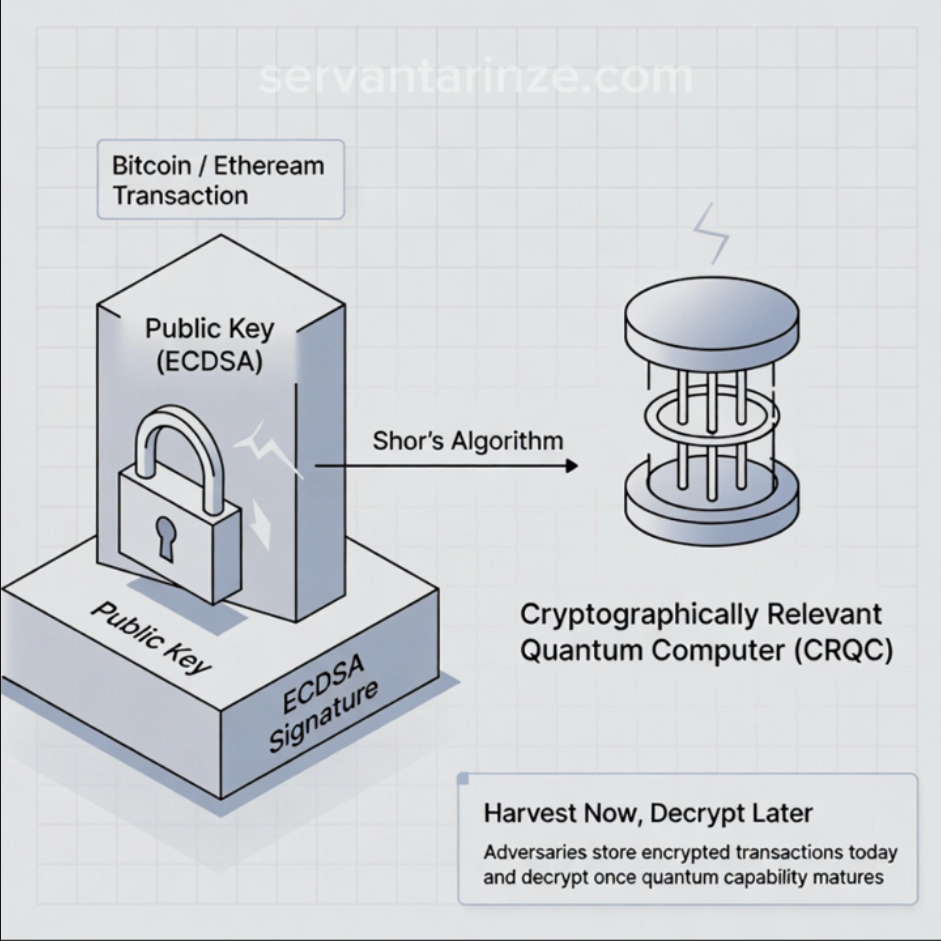
There is also a second dimension that many investors underestimate: “Harvest Now, Decrypt Later.” Because blockchains are public ledgers, exposed public keys and transaction data can be recorded indefinitely. An adversary does not need quantum capability today. They only need storage and patience. Once cryptographically relevant quantum computers emerge, previously captured data becomes a target.
In research discussions around post-quantum cryptography blockchain resilience, the question is no longer whether quantum computers will improve. The question is whether blockchain architecture will evolve before improvement reaches a critical threshold.
The long-term viability of decentralized systems ultimately rests on mathematical assumptions. The cryptography securing today’s ledgers was developed under classical computational models.
The Quantum Threat Is Not Speculative — It Is Mathematical
When people speak casually about quantum computers “breaking Bitcoin,” the phrase often sounds exaggerated. It shouldn’t. The vulnerability is not philosophical. It is algorithmic.
Most modern blockchains rely on elliptic curve cryptography (ECC) for digital signatures. In Bitcoin’s case, the Elliptic Curve Digital Signature Algorithm (ECDSA) secures ownership of funds. The private key proves control; the public key verifies it. Under classical computing assumptions, deriving a private key from a public key is computationally infeasible. That infeasibility is the backbone of cryptocurrency security.
Shor’s algorithm changes the landscape entirely. Once a sufficiently powerful cryptographically relevant quantum computer (CRQC) exists, Shor’s algorithm can solve the discrete logarithm problem efficiently — the very problem ECC depends on for security. This is not theoretical speculation. It is a proven quantum algorithm waiting for sufficient hardware.
In practical terms, if a quantum computer can derive private keys from exposed public keys, it can forge valid signatures. And if signatures can be forged, ownership becomes vulnerable.
Bitcoin introduces a subtle nuance that many overlook. Public keys are not always exposed immediately. Standard Bitcoin addresses are hashed versions of public keys. The public key is revealed only when funds are spent. That design was prudent. However, once an address is reused, or once funds are moved, the public key becomes visible on-chain permanently.
Research from multiple independent analysts suggests that millions of BTC sit in addresses where public keys have already been exposed. Some belong to early miners. Some to long-term holders. If quantum capability matures, these coins represent low-hanging fruit for adversaries.
Ethereum presents similar concerns. Account-based models expose public keys once transactions are made. While Ethereum’s ecosystem may adapt through hard forks or migration strategies, the challenge remains structural: signature systems are deeply embedded in consensus rules and wallet infrastructure.
Grover’s algorithm introduces a different, though less catastrophic, risk. It provides quadratic speedup for brute-force search problems. For hashing algorithms such as SHA-256, this effectively halves the bit security. A 256-bit hash becomes comparable to 128-bit security under quantum attack. That does not immediately break Bitcoin’s proof-of-work, but it reduces safety margins and long-term assumptions. [2]
Critically, no credible researcher claims that large-scale CRQCs will appear overnight. Estimates vary widely. Some suggest 10–20 years. Others remain cautious. Hardware scaling, error correction, and qubit coherence remain formidable engineering challenges. But cryptographic migration is not instantaneous either. Global financial infrastructure cannot pivot in a single software update.
This is why the conversation around quantum resistant ledger design has intensified. The urgency is not about tomorrow’s collapse. It is about the lifespan of digital assets. If a wallet is intended to hold value for decades, it must survive decades of computational advancement.
Blockchain was designed to eliminate reliance on trusted intermediaries. Yet without quantum-resistant signatures, long-term security implicitly depends on assumptions about the pace of quantum hardware development. That dependency introduces avoidable uncertainty into the security model.
Post-Quantum Cryptography Is Not Optional — It Is Structural
Once you accept that Shor’s algorithm is mathematically real, the conversation stops being about whether quantum computers will matter and becomes about what replaces today’s cryptography. Elliptic curves and RSA were elegant solutions for a classical world. In a quantum world, they become liabilities.
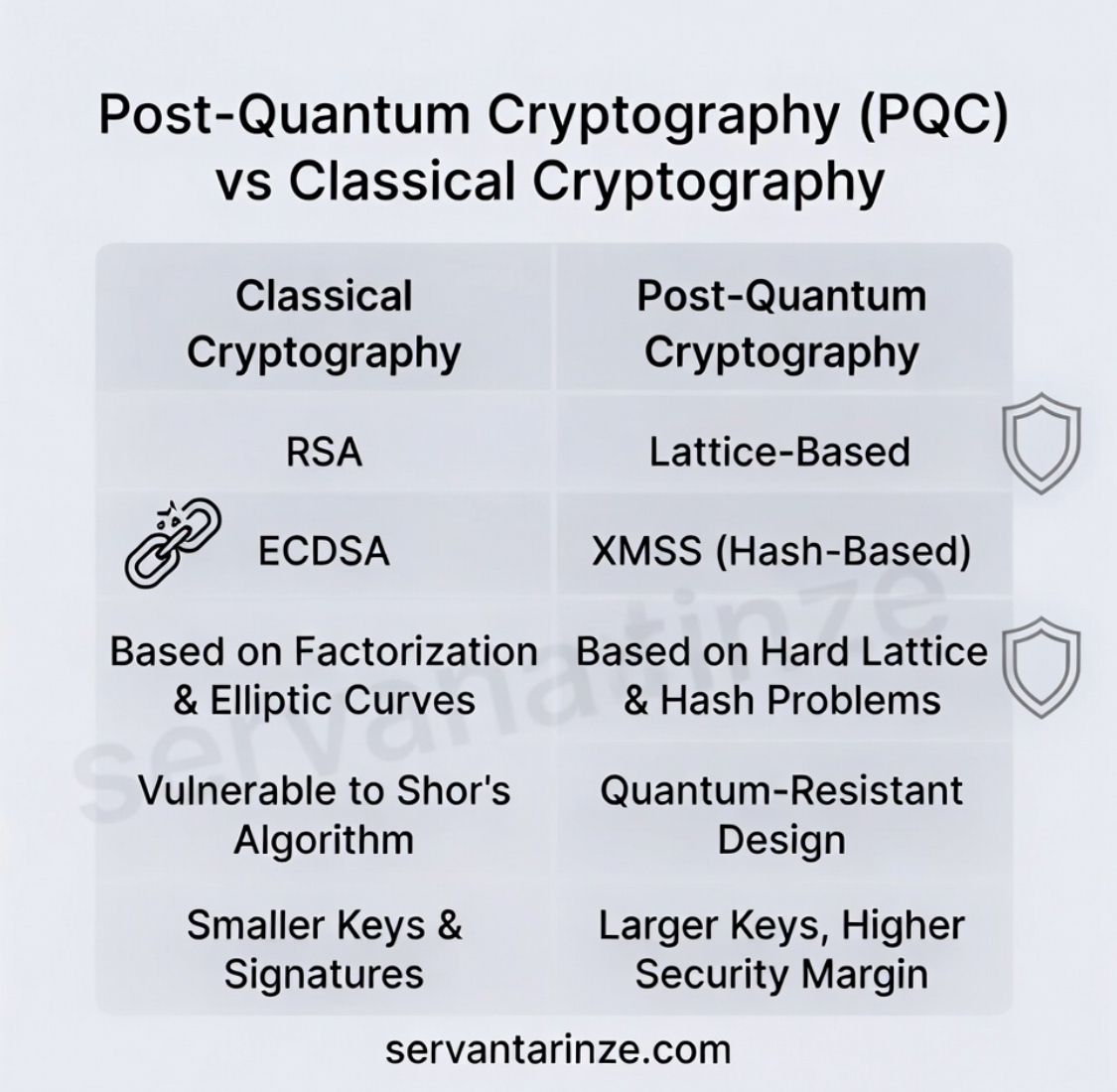
Post-quantum cryptography (PQC) does not rely on number factorization or discrete logarithms. Instead, it is built on mathematical problems that, as far as current knowledge goes, resist efficient quantum attack. These include lattice-based constructions, hash-based signatures, code-based systems, and multivariate polynomial schemes. None are speculative toys. They have been studied for decades, some since the 1970s.
The most important institutional development in this space has come from the U.S. National Institute of Standards and Technology (NIST). After years of open competition and peer review, NIST published its first finalized post-quantum standards, including ML-KEM for key establishment and standardized signature families (ML-DSA and SLH-DSA). [3][4][5] NIST also summarized the significance of this transition publicly as part of its PQC rollout. [6]
This was not a symbolic decision. It signaled that the global cryptographic community has accepted the inevitability of quantum disruption and is actively engineering around it.
For blockchain systems, digital signatures are the pressure point. Signatures secure transactions, validate consensus, and enforce smart contract execution. Replacing them is not like upgrading a website certificate. It touches wallet design, transaction size, network bandwidth, block limits, and consensus rules.
Lattice-based schemes such as Dilithium offer strong security proofs and relatively efficient verification, but they introduce significantly larger key and signature sizes compared to ECDSA. Hash-based signatures like XMSS carry different trade-offs: smaller assumptions and conservative security foundations, but constraints around state management and signature reuse.
This is where architectural foresight matters. Retrofitting PQC into an existing blockchain requires hard forks, wallet migrations, and careful coordination across miners, validators, exchanges, and users. It is possible. But it is delicate.
And delicate upgrades do not always succeed smoothly in decentralized ecosystems. History has shown that even modest consensus changes can fracture communities.
The deeper issue is philosophical. A blockchain is not merely software. It is a socio-technical system. Every cryptographic primitive embedded in it becomes part of its long-term trust contract. If that primitive fails, trust degrades. If trust degrades, value evaporates.
This is why the phrase post-quantum cryptography blockchain is not marketing jargon. It represents a necessary evolutionary stage. The ledger of the future cannot rely on mathematical problems already known to collapse under quantum computation.
The trade-offs are real. Larger signatures increase storage overhead. Verification costs may rise. Performance tuning becomes more complex. But the alternative — maintaining classical cryptography under quantum exposure — is not a stable equilibrium.
The engineering trade-offs are inconvenient, but long-term durability must take precedence over short-term efficiency.
The Quantum-Resistant Ledger: Built for the Threat, Not Retrofitted Against It
Most blockchain conversations about post-quantum cryptography revolve around upgrades. Patches. Migration plans. Hard forks scheduled “someday.” What makes the Quantum-Resistant Ledger (QRL) different is that it was never built on elliptic curves to begin with.
When QRL launched its mainnet in 2018, it did something most projects considered premature: it abandoned ECDSA entirely and adopted XMSS — eXtended Merkle Signature Scheme — as its core digital signature algorithm. [8]
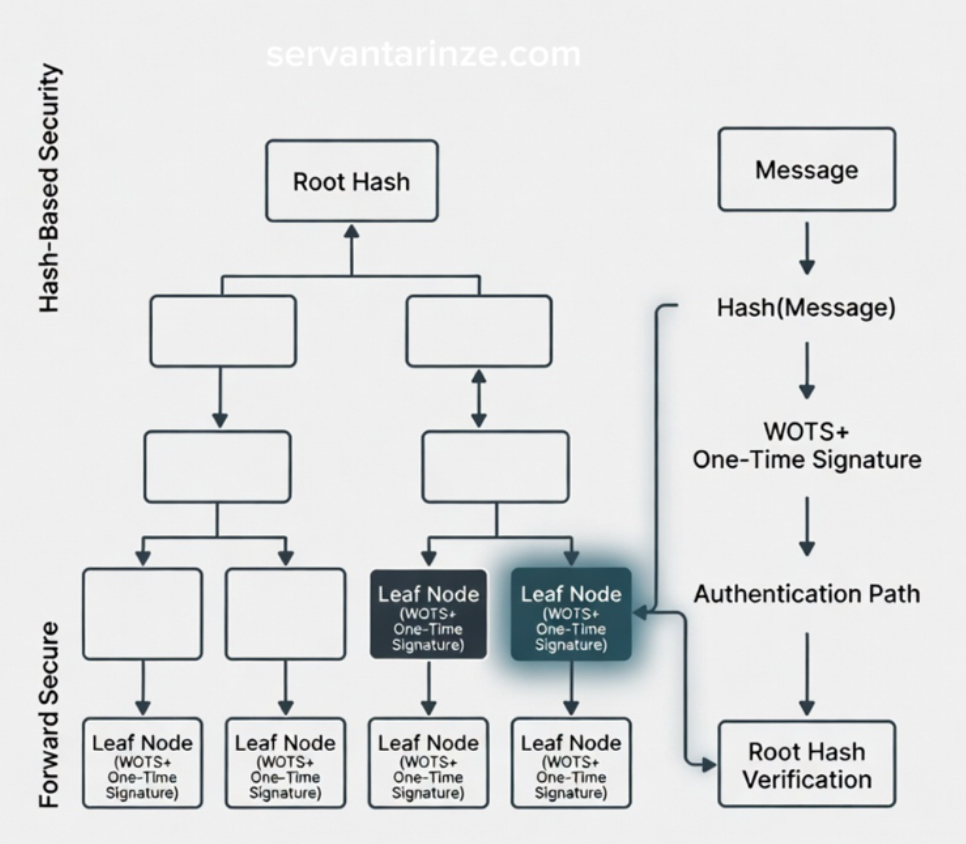
XMSS is not experimental in the academic sense; it is a hash-based signature scheme whose security is grounded in standard hash-function assumptions rather than discrete logarithms or factorization. [7] No elliptic curves. No algebraic shortcuts waiting for Shor’s algorithm to exploit.
Hash-based signatures are conservative by design. Their security depends on collision resistance and preimage resistance of hash functions — properties that remain intact even in a quantum context, though with reduced margins. Grover’s algorithm weakens brute-force search quadratically, but doubling hash length compensates cleanly. That is a manageable trade-off.
There is another property of XMSS that often gets overlooked in casual discussions: forward security. Each signature consumes a one-time key derived from a Merkle tree structure. Even if part of the system is later compromised, previous signatures remain secure. This structure imposes discipline. It requires careful state management. But it eliminates entire classes of cryptographic exposure common in reused elliptic-curve keys.
Critics initially focused on XMSS’s statefulness — the need to track used signatures carefully to avoid reuse vulnerabilities. In practice, QRL engineered wallet-level safeguards to handle this constraint. What seemed inconvenient in theory became manageable in implementation.
That design decision now looks less radical and more prescient.
Retrofitting post-quantum cryptography into Bitcoin or Ethereum involves replacing signature verification logic deeply embedded in consensus code. It requires coordination across billions in assets and infrastructure that was never designed for larger key sizes or different cryptographic assumptions.
QRL does not face that migration risk. Its foundation is already quantum-safe by construction.
Architecturally, QRL operates under Proof-of-Work, but with crypto-agility as a core principle. Crypto-agility means the ability to upgrade cryptographic primitives without rewriting the entire ledger or fragmenting consensus. In a field where cryptographic research evolves rapidly, this property is not cosmetic. It is survival-oriented.
The upcoming QRL 2.0 initiative pushes this further. By introducing a quantum-safe virtual machine layer compatible with Ethereum-style smart contracts, QRL positions itself as a bridge — not merely a niche chain, but a migration pathway for assets that require post-quantum durability.
This is where the phrase Quantum-Resistant Ledger stops being a project name and becomes a structural argument. If blockchains are meant to secure value for decades, not election cycles, their cryptography must anticipate adversaries that do not yet exist at scale.
Designing with post-quantum assumptions from inception fundamentally alters both implementation complexity and long-term migration risk.
The Industry Is Talking. Very Few Are Rebuilding.
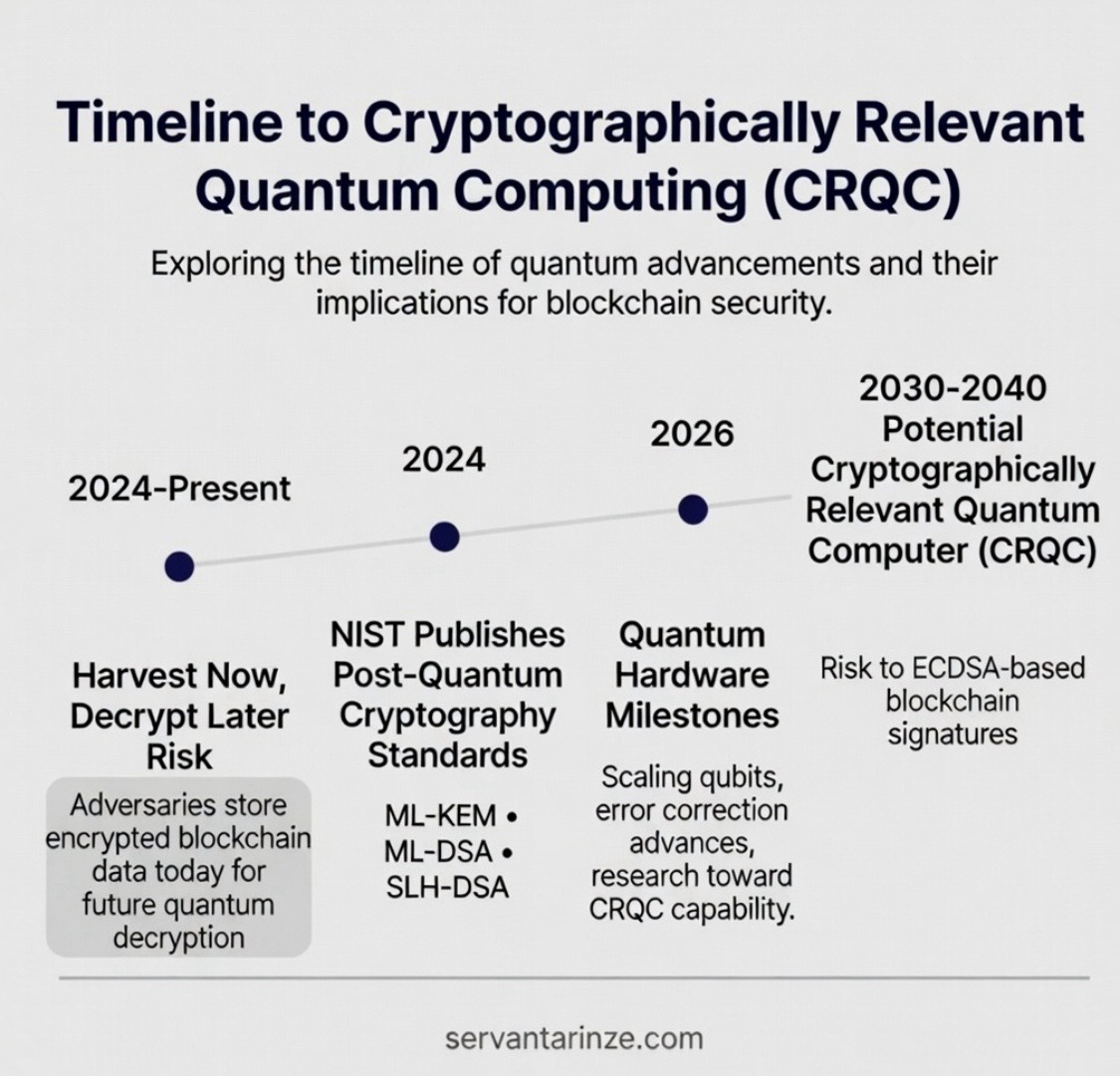
Once the conversation around quantum threats reached venture circles and protocol research teams, the tone shifted from dismissal to contingency planning. Whitepapers began mentioning “post-quantum readiness.” Research forums debated migration paths. Yet very few live networks have executed structural changes.
Bitcoin remains secured by ECDSA. Ethereum continues relying on elliptic-curve signatures. Both ecosystems are aware of the threat. Both have research discussions exploring signature abstraction layers or optional quantum-safe addresses. But awareness and implementation are different things.
Retrofitting post-quantum cryptography into a legacy blockchain is not like updating a library dependency. Digital signatures are embedded in transaction validation logic, wallet design, hardware security modules, multisig scripts, and layer-two systems. Every exchange, custodian, and cold storage provider would need coordinated upgrades.
There is also a political dimension. Hard forks are contentious. Signature changes alter transaction size, bandwidth consumption, and verification time. Larger keys mean larger blocks or fewer transactions per block. Performance trade-offs introduce debates about decentralization and node accessibility.
Some projects have chosen experimentation rather than replacement.
IOTA has explored Winternitz-based signatures. Abelian has implemented lattice-based cryptography. Hyperledger research groups have run pilot tests integrating post-quantum algorithms into enterprise frameworks. These experiments matter. They signal recognition. But they remain peripheral to dominant public chains.
Meanwhile, the National Institute of Standards and Technology finalized selections for post-quantum standards in 2024 and 2025 — including CRYSTALS-Dilithium, Falcon, and SPHINCS+. The message from standards bodies is unambiguous: transition planning must begin before quantum hardware reaches maturity.
The hesitation in public blockchains is understandable. Migration is expensive, risky, and socially disruptive. But delay carries asymmetric risk.
Blockchains are transparent by design. Public keys are permanently visible once funds are spent from an address. That visibility becomes an attack surface the moment a cryptographically relevant quantum computer exists.
There is a misconception that unspent Bitcoin remains safe indefinitely because only hashes of public keys are exposed. In reality, millions of coins have already revealed their public keys through address reuse. Those keys are archived forever.
This is not theoretical vulnerability. It is deferred vulnerability.
The longer networks wait, the larger the pool of exposed assets becomes.
The practical question is not whether quantum computing is progressing, but how much exposed value networks are willing to tolerate during prolonged transition planning.
If Post-Quantum Cryptography Fails, Blockchain Fails With It
I want to be precise here.
Blockchain is not magic. It is a cryptographic coordination system. Remove the integrity of its cryptography, and what remains is just a distributed database with weak authentication.
The immutability people celebrate does not come from “blocks.” It comes from digital signatures that cannot be forged and hash functions that cannot be reversed. That assumption is the foundation of every valuation model, every DeFi protocol, every institutional custody framework.
If Shor’s algorithm becomes practical at scale, elliptic curve signatures collapse. That does not mean the entire Bitcoin chain instantly disappears. It means transaction authenticity becomes forgeable. If an attacker can derive private keys from exposed public keys, they can sign transactions on behalf of original owners.
This would constitute a structural compromise rather than an isolated implementation flaw.
The market implications would not unfold calmly. Exchanges would freeze withdrawals. Custodians would scramble to migrate keys. On-chain governance systems would face signature chaos. Panic would not require full chain takeover — only a few credible demonstrations of quantum-enabled key recovery.
The deeper risk is reputational. Blockchains derive legitimacy from mathematical certainty. If that certainty weakens, trust migrates elsewhere.
This is why post-quantum cryptography is not a feature upgrade. It is survival architecture.
PQC does not promise invincibility. It promises resistance against known quantum attack models. Lattice-based, hash-based, and code-based schemes rely on mathematical problems that currently lack efficient quantum solutions. They are not perfect. But they shift the battlefield.
There are trade-offs. Larger signatures increase bandwidth. Verification costs rise. Storage requirements expand. These are engineering inconveniences. They are not existential threats.
The primary systemic risk is failing to update cryptographic primitives while computational capabilities advance.
Blockchains that do not incorporate cryptoagility — the ability to upgrade primitives without catastrophic disruption — will eventually face binary choices: hard fork under pressure, or bleed confidence gradually.
I have watched enough protocol debates to know that migration under crisis never produces elegant outcomes. Transition during stability is always cheaper than transition during panic.
That is why networks like the Quantum-Resistant Ledger are not merely alternative chains. They are demonstrations that a different cryptographic baseline is already possible.
The future of blockchain depends on post-quantum cryptography because blockchain depends on unforgeable signatures. If signatures become forgeable, decentralization becomes theater.
The Future of Blockchain Will Be Quantum-Resistant — Or It Will Be Fragile
There is a pattern in technological history that repeats more often than we admit. Systems collapse not because they were foolishly built, but because they were built on assumptions that stopped being true.
Elliptic curve cryptography has served blockchain well. It enabled Bitcoin’s rise. It secured Ethereum’s smart contract revolution. It anchored an industry worth trillions at peak cycles. But it was never designed with large-scale quantum computation in mind.
That is not a criticism. It is a chronological fact.
We are now entering an era where quantum hardware milestones are no longer theoretical milestones. Every year, coherence improves. Error rates decline. Logical qubit demonstrations advance. The conversation has shifted from “if” to “when.”
And long-lived assets cannot afford to wait for certainty.
Post-quantum cryptography in blockchain is not about panic. It is about foresight. It is about acknowledging that digital assets intended to last decades must be secured against threats that may emerge within decades.
The Quantum-Resistant Ledger demonstrates that a blockchain can operate without elliptic curves. It proves that hash-based signatures like XMSS can function in a live network. It shows that cryptoagility can be embedded at the protocol level rather than bolted on during crisis.
Other networks will adapt. Some will migrate carefully. Some will debate for years. Some will resist until pressure forces action. That is how ecosystems evolve.
The transition toward quantum-resistant primitives follows logically from established computational threat models.
The future of blockchain depends on post-quantum cryptography because the credibility of decentralization depends on unbreakable authentication. Without secure signatures, there is no ownership. Without ownership, there is no blockchain economy.
The implications are architectural rather than speculative; they follow directly from the mathematics underlying digital signature security.
Developers, infrastructure architects, and long-horizon asset holders should evaluate quantum-safe primitives and cryptoagile designs within their respective threat models.
Waiting for public demonstrations of large-scale key recovery would represent a reactive rather than preventive posture.
The responsible time to build quantum-resistant ledgers is before Q-Day — not after.
The networks that endure will likely be those that integrate quantum-resistant primitives before such integration becomes urgent.
References
- Shor, P. W. (1995). Algorithms for quantum computation: Discrete logarithms and factoring. arXiv.
View Source
↩ - Grover, L. K. (1996). A fast quantum mechanical algorithm for database search. arXiv.
View Source
↩ - National Institute of Standards and Technology. (2024). FIPS 203: Module-Lattice-Based Key-Encapsulation Mechanism Standard (ML-KEM).
View Source
↩ - National Institute of Standards and Technology. (2024). FIPS 204: Module-Lattice-Based Digital Signature Standard (ML-DSA).
View Source
↩ - National Institute of Standards and Technology. (2024). FIPS 205: Stateless Hash-Based Digital Signature Standard (SLH-DSA).
View Source
↩ - National Institute of Standards and Technology. (2024). NIST releases first 3 finalized post-quantum encryption standards.
View Source
↩ - Hülsing, A., Butin, D., Gazdag, S., Rijneveld, J., & Mohaisen, D. (2018). XMSS: eXtended Merkle Signature Scheme (RFC 8391). RFC Editor.
View Source
↩ - The Quantum Resistant Ledger (QRL). (2018). XMSS and NIST—Launch context and quantum-safe signature choice.
View Source
↩
Frequently Asked Questions About Quantum-Resistant Ledger & Post-Quantum Cryptography (FAQ)
What is a quantum-resistant ledger?
A quantum-resistant ledger is a blockchain designed with post-quantum cryptography instead of classical elliptic-curve signatures. It uses cryptographic algorithms that remain secure even if large-scale quantum computers become capable of running Shor’s algorithm to break RSA or ECDSA.
Can quantum computers really break Bitcoin and Ethereum?
In theory, yes. A sufficiently powerful cryptographically relevant quantum computer (CRQC) running Shor’s algorithm could derive private keys from exposed public keys used in Bitcoin and Ethereum. While such machines do not yet exist at required scale, long-term assets remain exposed to future quantum advances.
What is “Harvest Now, Decrypt Later” in blockchain security?
Harvest Now, Decrypt Later (HNDL) refers to adversaries storing encrypted blockchain data or exposed public keys today with the intention of breaking them once quantum computers become powerful enough. This creates long-term risk for assets intended to remain secure for decades.
What makes XMSS important for post-quantum blockchain security?
XMSS (eXtended Merkle Signature Scheme) is a hash-based digital signature approved by NIST as quantum-safe. Unlike elliptic curve cryptography, its security relies only on the strength of cryptographic hash functions, making it resistant to known quantum attacks.
When should blockchains migrate to post-quantum cryptography?
Migration planning should begin before quantum computers become capable of breaking current cryptography. Because blockchain upgrades require coordination, governance, and infrastructure changes, waiting until a quantum breakthrough occurs could create instability and asset vulnerability.