
Reinforcement learning has always looked stronger in retrospect than it feels in practice. People usually point to AlphaGo, robot control, and game-playing agents as evidence that the framework scales cleanly. That reading is too generous. Anyone who has actually worked with large state spaces, unstable value estimates, sparse rewards, or continuous control knows where the optimism starts to thin out. Classical reinforcement learning succeeds, but it succeeds while carrying a permanent burden: the cost of exploring and evaluating huge decision spaces grows faster than our methods become elegant. Function approximation helps, better optimizers help, and larger hardware helps. The bottleneck remains. Once the environment becomes genuinely high-dimensional, the agent spends an extraordinary amount of time learning what not to do[1].
That pressure is one reason quantum reinforcement learning keeps returning to serious discussion rather than fading into the category of speculative crossover ideas. The phrase has been used loosely for quite a while. Sometimes it refers to reinforcement learning for controlling quantum systems. Sometimes it means classical agents using quantum subroutines. The more interesting version is narrower and more radical. It asks what changes when states, actions, policies, and value approximators are represented in Hilbert space rather than in an ordinary classical feature space. The point is not decorative quantumness. The point is representation. A handful of qubits already span a state space that a classical table or network would treat very differently[2]. Superposition changes how information is encoded. Entanglement changes how correlations are expressed. Once those two ingredients enter reinforcement learning, the structure of the agent itself stops looking classical.
That is where it is worth slowing down. In ordinary reinforcement learning, an agent samples one transition at a time, updates one estimate at a time, and gradually shapes a policy through repeated interaction with the environment. In a quantum formulation, the agent can instead prepare and manipulate states that live in an exponentially growing vector space. That does not magically solve exploration, and it certainly does not mean one quantum circuit replaces years of algorithmic work. What it does mean is that policies, state encodings, and value landscapes can be expressed in a form that has no clean classical analogue. The intuition people usually reach for is parallelism, but even that word is too coarse. The real shift is that the agent is no longer learning only over a catalog of explicit states. It is learning over amplitudes, interference patterns, and measurement statistics inside a Hilbert space whose geometry matters to the training process.
Recent work has made that discussion harder to dismiss. Surveys of the field now separate fault-tolerant theoretical proposals from hybrid NISQ-era methods using variational quantum circuits as policy or value approximators. At the same time, newer results in hybrid deep quantum models have pushed the conversation closer to practical machine learning, including continuous-control settings where sample efficiency and generalization are not abstract concerns but daily engineering problems. The field is still early, and any claim of clear advantage should be treated carefully. Even so, the current literature is no longer limited to vague promises about quantum speedup. It is beginning to ask sharper questions: what does it mean to train a policy as a unitary map, how should rewards be extracted from observables, where do variational circuits help, and where do they merely repackage classical difficulty in more expensive language?
That last question matters because quantum reinforcement learning has reached the stage where imprecise enthusiasm becomes a liability. If the subject is framed carelessly, it turns into one more story about quantum computing eventually accelerating everything. That is not what makes this area interesting. The genuinely important idea is that Hilbert space offers a different arena for policy representation and decision dynamics. An agent encoded there does not merely store more information. It can organize information differently, explore differently, and sometimes approximate structures that classical architectures reach only indirectly. Whether that leads to broad practical advantage is still unsettled. Whether it changes the conceptual vocabulary of reinforcement learning is no longer in doubt.
I want to stay close to that distinction. The aim here is not to reframe reinforcement learning in quantum terms just for effect. The goal is to examine what actually changes once agent learning is pushed into Hilbert space: how states are encoded, how actions emerge from measurements, how policies become parameterized quantum circuits, how value functions can be written as expectation values, why some researchers see genuine promise in quantum-enhanced exploration, and why others remain appropriately skeptical. The technical details matter, but so does the tone of the conversation around them. Quantum reinforcement learning is neither science fiction nor finished method. It is a live research frontier sitting between quantum information theory, control, optimization, and machine learning.
Before getting to Hilbert space itself, it helps to clear a small amount of ground. Reinforcement learning already has its own vocabulary of instability, approximation, and policy search. Quantum computing brings in another vocabulary entirely. The overlap between the two only becomes meaningful once both are stripped down to the parts that actually matter for agent training.
Why Reinforcement Learning Changes Meaning in a Quantum Setting
Classical reinforcement learning begins with a familiar structure: an agent, an environment, a state, an action, a reward, and some rule for updating behavior from experience. That framework is general enough to include tabular Q-learning, policy gradients, actor-critic systems, deep value networks, and most of the methods that dominate modern benchmarks. The differences among those methods are substantial, but they share a common assumption about representation. The agent may use a table, a neural network, or some engineered feature map, yet the underlying objects are still classical. States are labels or vectors. Actions are discrete choices or real-valued controls. Policies are ordinary functions or distributions. Even when the system becomes large, the mathematics remains anchored to a classical space of representations.
Quantum reinforcement learning disrupts that assumption at the level of representation before it changes anything at the level of performance. A quantum state is not merely a longer vector. It lives in a complex Hilbert space with inner-product structure, phase relationships, and tensor-product growth that quickly outpaces classical intuition. A single qubit can be written as a superposition of basis states. Several qubits produce a joint state whose dimension scales exponentially with qubit count. Once an RL agent uses that space as its representational substrate, the question is no longer how to store one state-action estimate more efficiently. The question becomes how decision-making itself should be written when the policy is implemented by unitary evolution and the final action emerges through measurement.
That shift can be overstated, but it is still worth taking seriously. Suppose a classical agent must evaluate a large family of possible actions under uncertain future returns. In practice it samples trajectories, builds estimates, and gradually adjusts its policy network or value function. A quantum agent does not escape the need for sampling altogether, because measurement still converts amplitudes into classical outcomes. But before measurement, the agent can prepare states that encode many alternatives coherently. Interference then matters. Relative phase matters. The geometry of the parameterized circuit matters. Training is not just search over weights. It is search over a family of quantum transformations acting on encoded information.
That is why the Hilbert-space viewpoint is not a stylistic flourish. It changes what counts as a policy, what counts as a value estimate, and what it even means to explore an environment. In the strongest formulations, actions correspond to measurements on a quantum policy state or to operations generated by parameterized unitaries. In more practical near-term formulations, variational circuits play the role of compact nonlinear function approximators embedded inside otherwise classical RL loops. Both approaches matter, but they should not be confused. One is a deeper reimagining of agent learning. The other is a hybrid engineering strategy that may prove useful sooner.
The distinction becomes clearer once the classical ingredients are placed beside the quantum ones directly. Reinforcement learning still cares about states, actions, rewards, returns, policies, and value functions. Quantum theory still cares about state vectors, operators, observables, measurements, and unitary evolution. The interesting work begins at the boundary where those two vocabularies are mapped onto one another.
Hilbert Space, Without the Usual Shortcuts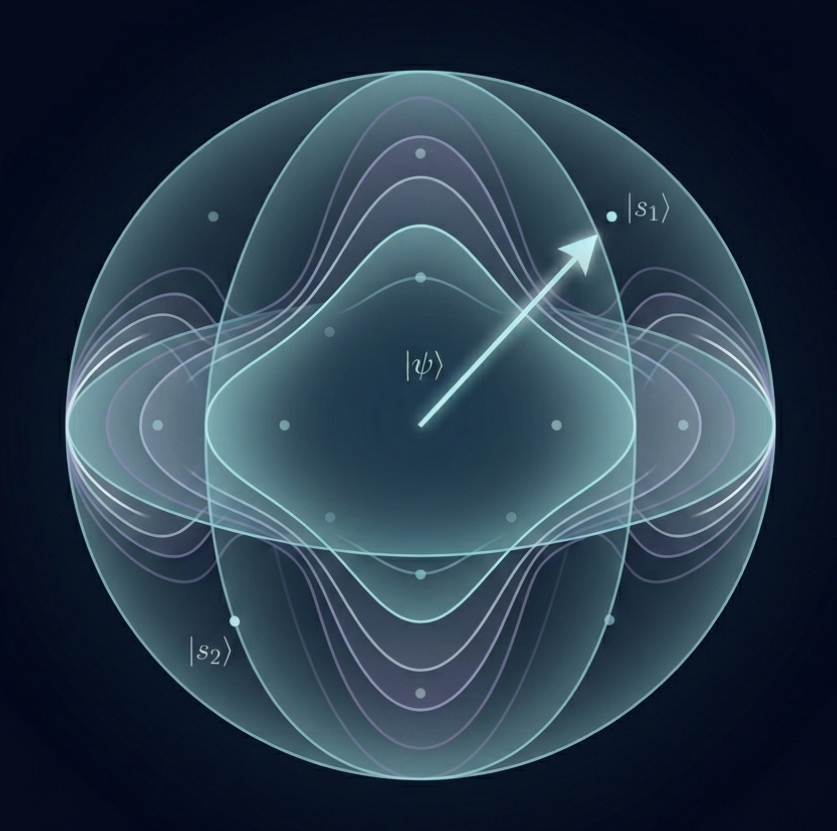
The phrase ‘Hilbert space’ is often introduced quickly and then left behind as if it were only formal. In practice it carries most of the weight in any quantum formulation of learning. A Hilbert space is not just a vector space with complex numbers. It is a space where inner products define geometry, where normalization constrains what counts as a valid state, and where evolution is restricted to transformations that preserve that structure. Those constraints sound abstract, but they become concrete the moment an agent’s internal representation is built from them.
A classical reinforcement learning agent represents its world using arrays, tensors, or neural embeddings. Those objects may be large, but they are still manipulated through ordinary arithmetic. A quantum agent instead encodes information in state vectors whose amplitudes carry both magnitude and phase. A normalized quantum state |ψ⟩ can be written as a weighted sum over basis states, with complex coefficients that interfere when transformed. The important point is not the notation. It is that information is distributed across amplitudes in a way that cannot be read directly without measurement.
Once multiple qubits are involved, the representational capacity expands rapidly. A system of n qubits spans a space of dimension 2ⁿ. That number appears often, but the real issue is not the size alone. It is how correlations are expressed. Entanglement allows relationships between components of the system that do not factor into independent parts. From the perspective of reinforcement learning, that opens a different way of encoding dependencies between states, actions, and latent features. Instead of approximating those dependencies through layered nonlinear networks, one can embed them into the structure of the quantum state itself.
That does not automatically grant usable advantage. Encoding classical data into quantum states can itself be expensive. Extracting useful information requires measurement, which collapses the state into a classical outcome. The promise lies in what happens between those two steps. Unitary transformations act on the state without destroying coherence, reshaping amplitude distributions in ways that depend on circuit structure and parameters. In variational approaches, those parameters become the learnable components of the agent. Training then amounts to adjusting a parameterized quantum circuit so that the measurement statistics align with higher expected return [3].
At a more intuitive level, one can think of Hilbert space as an environment in which the agent’s internal representation is not a point but a structured distribution over possibilities. That distribution is not classical probability alone. It includes phase information that influences how amplitudes combine when the system evolves. Reinforcement learning in that setting becomes a question of shaping interference patterns so that desirable outcomes become more likely when the state is measured. The language sounds different, but the objective remains recognizable: maximize expected reward under uncertainty.
The mapping between classical RL elements and quantum objects follows from that perspective. A classical state can be associated with a basis vector. A collection of states can be encoded into a superposition. Actions can be linked to transformations applied to the quantum state, often parameterized by continuous variables that the agent learns. Rewards are not stored directly but inferred through expectation values of observables or through classical feedback after measurement. Policies cease to be simple functions and become parameterized families of unitaries that shape how the agent’s state evolves before each decision.
That mapping is rarely clean in practice. Many implementations rely on hybrid loops where a classical optimizer updates quantum circuit parameters based on measured outcomes. The reason is not conceptual weakness but hardware reality. Current devices operate in a noisy regime, and fully quantum training pipelines remain out of reach. Even so, the representational shift introduced by Hilbert space remains intact. The agent is no longer confined to classical embeddings. Its internal state is governed by quantum rules, and learning becomes the process of tuning those rules.
Agents as Quantum States Rather Than Parameter Vectors
In classical reinforcement learning, it is natural to think of an agent as a parameter vector inside a neural network. Training adjusts those parameters until the policy behaves as desired. The agent is identified with its weights. That viewpoint becomes less useful once the policy is implemented as a quantum circuit. The parameters still exist, but they no longer define the agent directly. What defines the agent is the quantum state produced by the circuit at a given stage of interaction with the environment.
It is a subtle distinction, but it matters. A parameterized circuit takes an input state, applies a sequence of unitary operations, and produces a new state. Measurement then converts that state into a classical outcome, which can be interpreted as an action or as information used to update a value estimate. The parameters influence the transformation, but they are not themselves the object that interacts with the environment. The interaction happens through the quantum state and its measurement statistics.
From this perspective, training a quantum reinforcement learning agent involves shaping a family of quantum states rather than directly shaping a function. The parameters define a manifold of possible states accessible through the circuit architecture. Optimization explores that manifold, searching for regions where measurement outcomes correspond to higher expected returns. The geometry of that search is not identical to the geometry of classical optimization. It depends on how the circuit maps parameters to states and how sensitive the resulting observables are to parameter changes.
That sensitivity is one of the central challenges. Variational quantum circuits can exhibit regions where gradients become extremely small, a phenomenon often described as barren plateaus. In those regions, training stalls because parameter updates produce negligible change in the objective. This is not an exotic edge case. It appears frequently as circuits grow deeper or as system size increases [4]. Understanding how to design circuits that remain trainable is therefore not a secondary concern. It is central to making quantum reinforcement learning viable.
Even with those challenges, the state-centric view offers something different from classical policy networks. Because the agent’s internal representation is a quantum state, it can encode relationships that would require complex architectures to approximate classically. Interference can enhance or suppress certain outcomes. Entanglement can capture correlations across components of the input. These features do not guarantee improved performance, but they expand the space of representations the agent can access.
One practical consequence appears when considering exploration. Classical agents rely on stochastic policies, entropy regularization, or explicit noise processes to ensure sufficient exploration. A quantum agent already operates with inherent probabilistic outcomes due to measurement. The distribution of those outcomes is shaped by the circuit, and adjusting parameters changes that distribution. Exploration becomes intertwined with how amplitudes are arranged before measurement. In some proposals, amplitude amplification techniques are used to bias the agent toward more rewarding regions of the state space, although implementing such ideas in realistic settings remains an open problem.
The conceptual shift is easier to see in small examples. Consider a simple environment where actions correspond to measuring different components of a quantum state prepared by a variational circuit. The agent’s policy is encoded in how the circuit maps inputs to that state. Training adjusts the circuit so that measurement outcomes align with actions that yield higher reward. The process resembles policy gradient methods, but the underlying object being optimized is not a probability distribution parameterized by a neural network. It is a quantum state evolving under a parameterized unitary.
That difference carries through to value estimation as well. Instead of storing Q-values in a table or approximating them with a network, one can represent value information through expectation values of observables measured on quantum states. The Bellman equation still provides a conceptual anchor, but its implementation can involve operators acting on states rather than explicit scalar updates. Translating those ideas into stable algorithms is still an active area of research, but the direction is clear. Reinforcement learning in Hilbert space is not just classical RL with a different backend. It is a rephrasing of the agent itself.
What Changes When the Policy Is Not a Function
In classical reinforcement learning, a policy is usually treated as a function. It maps states to actions, either deterministically or through a probability distribution. That framing is so familiar that it often goes unquestioned. Even when the policy is represented by a deep neural network, the underlying idea remains the same. The agent evaluates an input and produces an output according to a learned mapping.
That picture becomes less precise once the policy is implemented through a parameterized quantum circuit. The circuit does not simply evaluate an input and return an action. It transforms a quantum state, and the action emerges only after measurement. The policy is therefore not a function in the usual sense. It is a process that reshapes a distribution of amplitudes, where the final decision is inseparable from the act of observation.
This distinction affects how one interprets learning. In a classical setting, improving a policy means refining a mapping so that better actions are chosen more often. In a quantum setting, improvement corresponds to reshaping the geometry of the state space so that measurement outcomes align with higher reward. The object being optimized is not a direct input-output relation, but the structure of a transformation that governs how information evolves before it becomes observable.
One consequence is that the boundary between representation and decision becomes less rigid. The same transformation that encodes information also determines how actions are distributed. There is no clean separation between feature extraction and policy evaluation. Both are embedded in the same unitary process. This can be seen as an advantage, because it allows correlations and dependencies to be expressed more compactly. It can also be a source of difficulty, because it reduces modularity and makes the behavior of the agent harder to interpret.
Thinking of the policy as a transformation rather than a function helps clarify what is genuinely different about reinforcement learning in Hilbert space. The agent is not selecting actions from a fixed representation. It is continuously reshaping the space from which those actions are drawn. Learning, in that sense, is not just about better decisions. It is about altering the structure in which decisions are even defined.
Training Dynamics Inside Hilbert Space
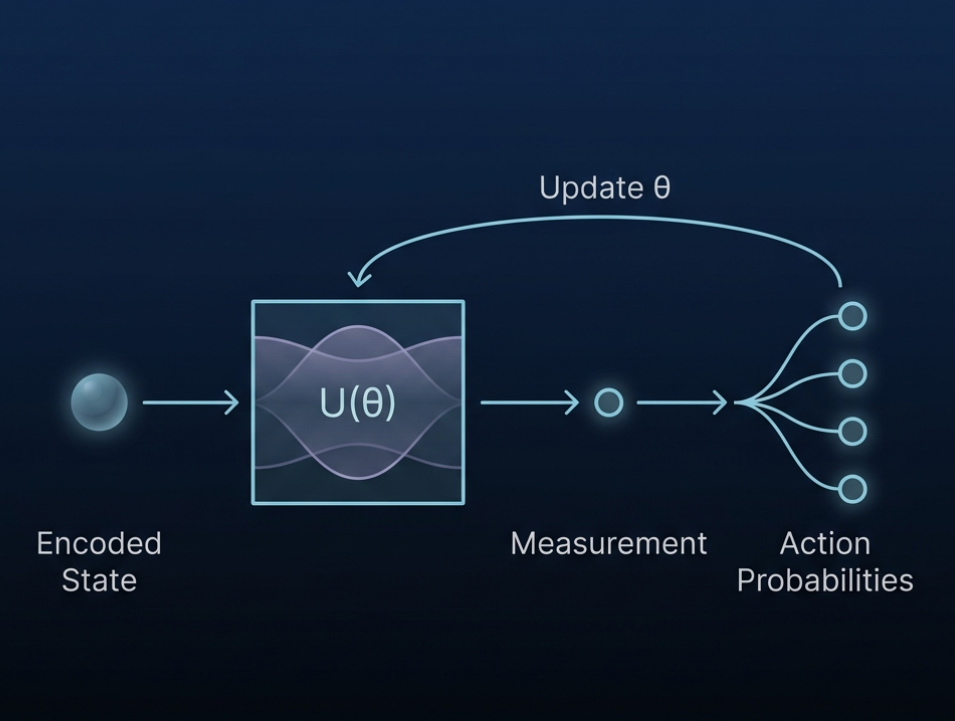
Once the agent is treated as a quantum state produced by a parameterized circuit, training no longer looks like adjusting weights in a conventional network. It becomes a process of steering a unitary transformation so that the resulting state, when measured, yields outcomes that correlate with higher return. That description sounds simple, but it hides a complicated interaction between parameter space, circuit structure, and measurement statistics.
A typical setup begins with an encoding step. Classical observations from the environment are mapped into a quantum state, often through angle encoding or amplitude encoding. That state is then passed through a sequence of parameterized gates forming a variational ansatz. The circuit produces an output state whose amplitudes depend on both the input and the current parameters. Measurement extracts classical information from that state, which is interpreted as an action or as part of a value estimate. The environment responds, and the loop continues.
The optimization step sits on top of that loop. Because the circuit is differentiable with respect to its parameters, gradients can be estimated using methods such as the parameter-shift rule or stochastic perturbation techniques. The objective is still defined in terms of expected return, although it is often written as an expectation value over measurement outcomes. Policy gradient methods adapt naturally to this setting. The gradient of the expected reward with respect to circuit parameters can be expressed in terms of shifted circuit evaluations, allowing classical optimizers to update the parameters.
What changes is not the existence of gradients but their behavior. The mapping from parameters to outcomes is mediated by a quantum state, and that introduces sensitivity patterns that differ from classical networks. Small parameter changes can produce global changes in the state due to interference. At the same time, certain regions of parameter space can become flat, producing the barren plateau problem mentioned earlier. Training therefore involves navigating a landscape whose geometry is shaped by both the ansatz and the underlying Hilbert space.
Quantum policy gradient methods treat the variational circuit as a stochastic policy. Measurement outcomes define a probability distribution over actions, and the policy is updated to increase the likelihood of actions that lead to higher rewards. The structure resembles classical policy gradient algorithms, but the distribution is not parameterized by a softmax over logits. It is determined by the squared amplitudes of the quantum state. Adjusting parameters changes those amplitudes, which in turn reshapes the action distribution.
An alternative line of work focuses on value-based methods. In these approaches, quantum circuits approximate value functions or Q-functions. Instead of outputting a single scalar, the circuit may encode value information into expectation values of observables. Training then minimizes a form of Bellman error, using measured values to update circuit parameters. Hybrid architectures often combine quantum circuits with classical networks, using the quantum component as a feature map or nonlinear transformation inside a larger model.
Continuous control introduces another layer of complexity. Classical methods such as deterministic policy gradients or actor-critic systems rely on smooth mappings from states to actions. Quantum versions attempt to represent these mappings through parameterized circuits whose measurement outcomes correspond to continuous values or to discretized approximations of them. Recent hybrid models have shown that such approaches can handle continuous environments with reasonable stability[5], although they still depend heavily on classical optimization and simulation.
One reason these methods attract attention is their potential impact on sample efficiency. Reinforcement learning often suffers from requiring large numbers of interactions with the environment. Some quantum proposals suggest that structured exploration within Hilbert space, combined with techniques inspired by amplitude amplification or natural gradient methods, could reduce the number of samples needed to reach a given performance level. Results in this direction remain preliminary, but they are among the few areas where a plausible advantage is discussed without excessive speculation.
The training loop, taken as a whole, therefore blends familiar and unfamiliar elements. The outer structure still resembles reinforcement learning: observe, act, receive reward, update. The inner mechanics, however, operate on quantum states transformed by parameterized unitaries. Measurement bridges the two worlds, converting quantum information into classical signals that can drive optimization. The success of the approach depends on how well those two layers are aligned, and on whether the representational richness of Hilbert space translates into practical improvements rather than additional complexity.
Superposition, Interference, and Exploration Behavior
It is often said that superposition allows an agent to consider many possibilities at once, but it becomes meaningful only when tied to how learning unfolds over time. A quantum state can encode a combination of many basis states simultaneously, yet the agent still receives a single outcome after measurement. The benefit, if it exists, comes from how amplitudes evolve before that measurement and how interference shapes the resulting distribution.
In classical reinforcement learning, exploration is enforced through randomness injected into the policy. The agent samples actions, observes outcomes, and gradually builds a picture of which actions are better. The process can be slow when the action space is large or when rewards are sparse. In a quantum setting, the distribution over actions emerges from the amplitudes of the state produced by the circuit. Those amplitudes are not independent. They interfere with one another under unitary transformations.
Constructive interference can increase the probability of certain outcomes, while destructive interference suppresses others. Training can therefore be viewed as shaping interference patterns so that desirable actions become more likely when the state is measured. This is not equivalent to evaluating all actions simultaneously and selecting the best. Measurement still produces a single sample. The advantage, if present, lies in how efficiently the circuit can reshape the distribution toward useful regions of the action space.
Some theoretical proposals connect this idea to amplitude amplification, where the probability of desired states is increased through repeated transformations. In a reinforcement learning context, one might imagine amplifying trajectories associated with higher rewards. Translating that intuition into stable algorithms remains difficult, particularly in noisy intermediate-scale devices. Even so, the connection highlights a difference in how exploration can be conceptualized. It is no longer only about sampling more broadly. It is about reshaping the distribution through coherent transformations.
Another aspect worth noting is that interference introduces dependencies that do not appear in classical probability distributions. Changing a parameter that affects one part of the state can influence outcomes associated with other parts due to the global nature of the quantum state. This can accelerate learning in some cases, but it can also make training less predictable. The same mechanism that allows richer representation can introduce instability if the circuit is not designed carefully.
These considerations suggest that quantum reinforcement learning should not be judged solely by whether it can reproduce classical results. Its value lies in whether it can express policies and exploration strategies that are difficult to capture classically. Demonstrating that convincingly requires more than isolated examples. It requires consistent behavior across tasks where classical methods struggle with representation or sample efficiency. That remains an open challenge, but the framework provides a different way of thinking about exploration itself.
Recent Directions and Hybrid Architectures
Much of the current momentum in quantum reinforcement learning comes from hybrid models rather than fully quantum pipelines. This is not a compromise in the negative sense. It reflects the reality of available hardware and the recognition that useful progress often happens at the boundary between classical optimization and quantum representation. Variational circuits are embedded into reinforcement learning loops as policy modules, value approximators, or feature maps, while classical optimizers handle parameter updates. The result is not a pure quantum agent, but a system where the representational layer operates in Hilbert space and the learning loop remains accessible.
One area that has received increased attention is continuous control. Classical reinforcement learning has developed a range of methods for handling continuous action spaces, including deterministic policy gradients and actor-critic frameworks. Translating those ideas into a quantum setting requires careful handling of how actions are encoded and extracted. In some implementations, measurement outcomes are mapped to continuous values through expectation values or through post-processing of measurement statistics. In others, the circuit produces parameters that are then interpreted classically. Hybrid deep quantum models have shown that such approaches can remain stable in environments that would traditionally be handled by algorithms like TD3 or PPO, although they do not yet demonstrate a consistent advantage.
Another line of work explores reinforcement learning as a tool for optimizing quantum systems themselves. In these cases, the agent interacts with a quantum environment, learning to control parameters that influence system behavior. Examples include tuning pulse sequences, discovering circuit structures, or navigating the space of quantum feature maps used in machine learning tasks. The feedback loop is similar to classical reinforcement learning, but the environment dynamics are governed by quantum evolution. This direction is often more immediately practical because it aligns with tasks already relevant to quantum computing.
Natural gradient methods have also been adapted to the quantum setting. In classical reinforcement learning, natural policy gradients adjust parameters using a geometry-aware update that accounts for the curvature of the policy space. Quantum analogues extend this idea by considering the geometry induced by the Hilbert space and the parameterized circuit. Early results suggest that such methods can improve convergence behavior in certain regimes, particularly when combined with structured ansätze. Claims about improved complexity should be interpreted carefully, but the conceptual link between geometry and optimization is becoming more prominent.
The broader pattern is that progress tends to occur where representation, optimization, and hardware constraints are considered together rather than in isolation. Circuits are designed with trainability in mind. Optimization methods are adapted to quantum-specific landscapes. Hybrid loops are structured to reduce the cost of measurement while maintaining useful gradient signals. The field has moved beyond simply asking whether reinforcement learning can be made quantum. It is now asking which parts of reinforcement learning benefit from quantum representation and which remain more efficient when handled classically.
Comparing Classical and Quantum Reinforcement Learning
Any serious comparison between classical and quantum reinforcement learning has to move past slogans about exponential speedup. The relevant differences appear in representation, training behavior, and hardware requirements. Classical methods rely on explicit or learned feature representations, often implemented through deep networks. Quantum methods encode information into amplitudes and phases, allowing for compact representations of certain structures but requiring careful encoding and measurement.
In terms of sample efficiency, the picture is not settled. Some theoretical results suggest that quantum-enhanced methods could reduce the number of samples needed to achieve a given level of performance, particularly in settings where amplitude amplification or structured exploration can be applied. Empirical results, however, remain limited and often depend on specific problem formulations. Hybrid models sometimes show improvements in small-scale environments, but scaling those results remains an open problem.
Scalability itself is tied directly to hardware. Classical reinforcement learning benefits from mature compute infrastructure and well-understood optimization pipelines. Quantum reinforcement learning must operate within the constraints of NISQ devices or rely on simulators, both of which introduce limitations. Noise, limited qubit counts, and the cost of repeated measurements all affect performance. These factors make it difficult to compare methods directly without accounting for the underlying implementation.
Despite these challenges, there are domains where quantum approaches appear naturally aligned. Tasks involving quantum systems, complex optimization landscapes, or structured high-dimensional spaces may benefit from representations that capture correlations more directly. In such cases, the question is not whether quantum methods outperform classical ones in general, but whether they offer a better match for the structure of the problem.
A useful way to think about the comparison is not as a competition between two fixed approaches, but as a spectrum of hybrid strategies. At one end are fully classical methods with quantum-inspired features. At the other are fully quantum agents operating within fault-tolerant systems that do not yet exist. Most current work sits in the middle, combining classical control with quantum representation. The balance between those components is likely to shift as hardware improves.
Where the Classical Intuition Breaks Down
A recurring difficulty in understanding quantum reinforcement learning is that classical intuition continues to be applied long after it stops being reliable. It is natural to think in terms of state enumeration, trajectory sampling, and explicit probability distributions, because those concepts have guided reinforcement learning for decades. In a Hilbert-space formulation, those ideas remain relevant but no longer describe the full picture.
One common misconception is to treat superposition as a form of parallel evaluation, as if the agent were simultaneously testing many actions and selecting the best. That interpretation overlooks the role of measurement and interference. The system does not produce multiple outcomes. It produces one outcome whose probability is shaped by the entire structure of the state before measurement. The advantage, if it exists, lies in how efficiently that structure can be adjusted, not in evaluating alternatives independently.
Another point of confusion arises when thinking about value functions. In classical reinforcement learning, values are associated directly with states or state-action pairs. In a quantum setting, value information is often embedded in expectation values of observables. This makes it harder to separate representation from evaluation, and it complicates the interpretation of what the agent has learned. The same observable may reflect multiple aspects of the underlying state, depending on how the circuit is constructed.
Even the notion of exploration becomes less straightforward. Classical methods inject randomness to ensure coverage of the action space. Quantum methods operate with intrinsic probabilistic outcomes, but those probabilities are not independent samples. They are the result of coherent transformations that can introduce global dependencies across the state. Exploration is therefore shaped by the structure of the circuit as much as by any explicit stochastic mechanism.
Recognizing where classical intuition breaks down is not a matter of abandoning it entirely. It is a matter of knowing when it no longer provides reliable guidance. Reinforcement learning in Hilbert space does not replace classical ideas. It extends them into a setting where familiar concepts must be reinterpreted rather than applied directly.
Case Studies and Experimental Settings
Small-scale environments have been used to test quantum reinforcement learning ideas in controlled settings. Tasks such as CartPole or simple grid-world problems provide a way to evaluate whether variational circuits can learn policies that stabilize systems or maximize reward over time. In these cases, quantum policies often achieve performance comparable to classical baselines, demonstrating that the framework is at least functional. Whether it offers consistent improvement is less clear, but the experiments provide a foundation for further work.
More specialized applications involve controlling quantum systems directly. Reinforcement learning agents have been used to discover pulse sequences that drive a system toward a desired state or to optimize parameters in quantum circuits. These tasks align more naturally with quantum representation because the environment itself is quantum mechanical. The agent’s actions influence a system already described by Hilbert space dynamics, reducing the need for complex encoding.
There are also early explorations of using quantum reinforcement learning in coordination problems, where multiple agents or components must act in a correlated way. The ability of quantum states to encode entangled relationships suggests a possible advantage in representing joint policies or shared information. These ideas remain largely theoretical, but they highlight directions where classical methods face increasing complexity.
Across these case studies, a consistent theme appears. Quantum reinforcement learning is most promising where the structure of the problem aligns with the structure of Hilbert space. When that alignment is weak, the overhead of encoding and measurement can outweigh any representational benefit. Identifying those boundaries is part of the ongoing research effort.
Limitations, Open Questions, and What Has Not Been Solved
It is easy to become overly optimistic here once Hilbert space enters the discussion, especially when exponential representation is involved. That language has been used before in quantum computing, often without the accompanying constraints. Reinforcement learning adds another layer of difficulty because performance depends not only on representation, but on stability, sample efficiency, and the behavior of the optimization process over time. Those factors do not disappear in a quantum setting. In several cases, they become harder to manage, and there is still a gap here that is hard to ignore in practice[6].
Noise remains the most immediate limitation. Current quantum devices operate in a regime where coherence times are limited and gate operations are imperfect. Variational circuits can tolerate a certain level of noise, but reinforcement learning requires repeated interaction, repeated measurement, and iterative updates. Errors accumulate across those steps. Even when simulations show promising behavior, transferring that performance to real hardware introduces degradation that is not always easy to correct.
Another issue appears in the training landscape. Variational quantum circuits are known to exhibit regions where gradients vanish or become extremely small. These barren plateaus do not merely slow training; they can make learning effectively impossible for certain circuit designs. The problem becomes more pronounced as the number of qubits increases or as the circuit depth grows. Reinforcement learning compounds this difficulty because the objective function is already noisy due to stochastic rewards and environment dynamics. Combining both sources of instability creates a landscape that is difficult to navigate.
The question of advantage is also unresolved. There are theoretical settings where quantum reinforcement learning can outperform classical methods, particularly in models that assume access to quantum oracles or idealized operations. Translating those results into realistic environments is far less straightforward. Most practical implementations today rely on hybrid systems and classical optimization. Improvements observed in small-scale experiments do not yet generalize in a way that would justify claims of broad superiority.
Encoding and readout introduce additional overhead. Preparing a quantum state that faithfully represents classical input can be expensive, especially for high-dimensional data. Measurement collapses the state, requiring repeated runs to estimate expectation values with sufficient accuracy. These steps can offset potential gains if not handled carefully. In reinforcement learning, where many iterations are required, the cumulative cost becomes significant.
There is also a structural limitation tied to the types of operations available. Not all quantum transformations are equally easy to implement, and not all contribute to learning in a meaningful way. Designing ansätze that are expressive enough to capture useful policies while remaining trainable is an active area of research. Poor choices lead to circuits that are either too rigid to learn or too complex to optimize.
Even at a conceptual level, there are open questions about how best to define value functions, policies, and credit assignment in a quantum framework. Classical reinforcement learning has developed a rich set of tools for dealing with delayed rewards, partial observability, and exploration trade-offs. Translating those tools into Hilbert space is not always straightforward. Some ideas carry over naturally, while others require reformulation.
The result is a field that sits in an intermediate state. The theoretical foundations are strong enough to justify continued investigation. The experimental results are sufficient to demonstrate feasibility in controlled settings. The gap between those two remains substantial. Closing that gap will depend on progress in hardware, algorithm design, and a clearer understanding of where quantum representation provides a meaningful advantage rather than additional complexity.
Where Practical Work Begins
For those interested in working with quantum reinforcement learning today, the entry point is almost always hybrid. Fully quantum pipelines are not accessible in a stable or scalable way, but simulators and software frameworks make it possible to experiment with variational circuits inside reinforcement learning loops. The goal is not to reproduce large-scale results immediately, but to understand how the pieces interact.
Frameworks such as Pennylane and Qiskit provide tools for building parameterized quantum circuits and integrating them with classical optimization routines. When combined with reinforcement learning environments, these tools allow the construction of simple agents whose policies are represented by quantum circuits. The workflow typically involves encoding observations into a quantum state, applying a variational circuit, measuring the result, and using the outcome to update parameters through a classical optimizer.
Small environments are useful starting points. Tasks like CartPole or basic control problems allow the behavior of quantum policies to be observed without overwhelming complexity. These experiments often reveal both the strengths and the limitations of the approach. Circuits can learn meaningful behavior, but training stability depends heavily on parameter initialization, circuit design, and the choice of optimizer.
Gradient estimation deserves particular attention. The parameter-shift rule provides a way to compute exact gradients for certain types of gates, but it requires multiple circuit evaluations per parameter. Stochastic methods such as simultaneous perturbation can reduce the number of evaluations but introduce additional variance. Choosing between these methods involves a trade-off between accuracy and computational cost.
Noise mitigation techniques can improve results when working with real devices or realistic simulations. Error mitigation, circuit simplification, and careful choice of ansatz all contribute to making training more stable. These considerations are not optional. They are part of the design process when working in a quantum setting.
The most productive way to approach the field at this stage is to treat it as exploratory rather than definitive. Build small systems, observe their behavior, and compare them with classical baselines. The differences that emerge are often more informative than any single performance metric. Over time, those observations contribute to a clearer picture of where quantum reinforcement learning is likely to be useful.
Conclusion
Reinforcement learning has always been shaped by the limits of representation. The difficulty has never been defining objectives or writing update rules. It has been the cost of exploring large spaces and the fragility of approximating value in environments where feedback is sparse, delayed, or noisy. Classical methods have pushed those limits steadily, but they have not removed them.
Working in Hilbert space changes the terms of that discussion. It introduces a representation in which information is distributed across amplitudes, where correlations can be embedded directly into the structure of the state, and where transformations act globally rather than component by component. That shift does not eliminate the challenges of reinforcement learning. It reframes them. Exploration becomes tied to interference. Policies become parameterized transformations rather than explicit functions. Value is inferred through expectation rather than stored directly.
Whether those differences translate into practical advantage remains unsettled. The current generation of methods operates within hybrid systems, constrained by noise, limited qubit counts, and the cost of repeated measurement. Theoretical results suggest directions where improvement is possible, particularly in structured environments or in settings aligned with quantum dynamics. Empirical evidence is still developing, and it does not yet support broad claims of superiority.
What is becoming clear is that reinforcement learning may not remain entirely classical. The introduction of Hilbert space as a representational substrate expands the range of questions that can be asked about how agents learn. Some of those questions will lead to methods that remain primarily classical. Others may open paths that depend on quantum structure in a more fundamental way.
At this stage, careful work matters more than strong claims. Building small systems, understanding how circuits behave under training, and identifying where representation changes outcomes are more valuable than searching for immediate breakthroughs. Progress will come from aligning theory, algorithms, and hardware rather than advancing any one of them in isolation.
There is a tendency to treat quantum reinforcement learning as a future capability waiting for better machines. That view is incomplete. The more interesting development is already underway. The language used to describe agents, policies, and learning dynamics is expanding. Hilbert space is part of that expansion. Whether it becomes central or remains specialized will depend on how convincingly it reshapes the problems that reinforcement learning has struggled with for decades.
References
- Sutton, R. S., & Barto, A. G. (2018). Reinforcement Learning: An Introduction (2nd ed.). MIT Press.
View Source
↩ - Nielsen, M. A., & Chuang, I. L. (2010). Quantum Computation and Quantum Information. Cambridge University Press.
View Source
↩ - Skolik, A., McClean, J., Mohseni, M., van der Smagt, P., & Leib, M. (2022). Quantum agents in the gym: A variational quantum algorithm for deep Q-learning.
View Source
↩ - McClean, J. R., et al. (2018). Barren plateaus in quantum neural network training landscapes.
View Source
↩ - Zhang, Y., et al. (2025). Training hybrid deep quantum neural networks for continuous control.
View Source
↩ - Meyer, J. J., et al. (2022). Quantum reinforcement learning: A survey.
View Source
↩
Frequently Asked Questions About Quantum Reinforcement Learning in Hilbert Space
What does it mean to train a reinforcement learning agent in Hilbert space?
It means the agent’s internal representation is no longer a classical vector or neural network embedding, but a quantum state evolving inside a Hilbert space. Policies are implemented as parameterized unitary transformations, and decisions emerge through measurement. Training adjusts circuit parameters so that the resulting measurement statistics align with higher expected rewards.
How is exploration different in quantum reinforcement learning?
Exploration is shaped by how amplitudes interfere rather than by adding randomness to a policy. The probability of selecting an action depends on the structure of the quantum state before measurement. Training modifies interference patterns so that desirable actions become more likely, which is fundamentally different from classical sampling strategies.
Does quantum reinforcement learning provide a proven advantage over classical methods?
Not yet in a general sense. There are theoretical results suggesting improved efficiency in specific settings, but practical implementations remain hybrid and constrained by current hardware. Most evidence so far demonstrates feasibility rather than consistent superiority.
What role do variational quantum circuits play in QRL?
Variational circuits act as parameterized models for policies or value functions. Their parameters are trained using classical optimization methods, while the circuit itself defines how information is represented and transformed within Hilbert space.
Is quantum reinforcement learning practical today?
It is practical at a small scale through simulators and hybrid systems. Fully quantum implementations are limited by current hardware, but experimental setups already allow researchers to study how quantum representations affect learning behavior.