
There is a tension at the center of the streaming business. The industry keeps moving toward sharper pictures, wider color, larger panels, and more immersive home viewing, yet every technical leap carries an environmental cost that is easier to overlook but harder to ignore over time. 8K sits at the sharpest edge of that contradiction. It promises extraordinary visual detail, but the environmental overhead attached to delivering that detail at scale is not small. InterDigital’s recent work on sustainable high-definition media put a useful number into circulation: 8K televisions can produce roughly 1.77 times the carbon emissions of comparable 4K sets when the wider system impact is considered, a result tied to the extra energy demanded by more pixels, more processing, and more data movement.[1] That number matters because it shifts the discussion away from screen glamour and back toward infrastructure reality.
The context is already heavy. Streaming, when treated as a global system rather than a consumer habit, carries an emissions footprint that researchers and industry analysts have compared to that of smaller countries when annualized across platforms, networks, devices, and data centers. Even baseline viewing figures are no longer trivial. Recent 2025 reporting from TRG Datacenters placed one hour of HD streaming at about 42 grams of CO₂ under typical assumptions.[2] Once the conversation moves from HD to 4K and then to 8K, the economics of compression stop being just an engineering concern and become part of a broader energy question. Resolution growth without bitrate discipline is simply a carbon escalation story written in nicer pictures.
That is why AI codecs have moved from experimental curiosity to serious operational interest. In practice, the most relevant systems in 2026 are not science-fiction replacements for every established standard. They are hybrid, commercially usable approaches that bring machine learning into HEVC, AV1, and related compression workflows to cut waste where conventional encoders are still too blunt. The real value is not abstract intelligence. It is better bitrate allocation, sharper perceptual decisions, and smaller files moving through networks and CDNs without equivalent losses in what viewers actually see. When those gains land in the range of 30 to 50 percent, the climate implications are not secondary. They are central.
I want to stay close to that practical reality here. The argument is not that 8K has suddenly become harmless. It has not. The argument is that AI-enhanced compression has become the fastest credible way to make 8K green streaming less wasteful, more defensible, and more technically sustainable than the old bitrate-heavy model ever allowed. The discussion that follows looks at the mechanics, the measured savings, the carbon math behind those savings, and the limits that still need to be stated plainly if the conversation is going to remain serious.
The 8K Streaming Footprint Problem Is Not Abstract
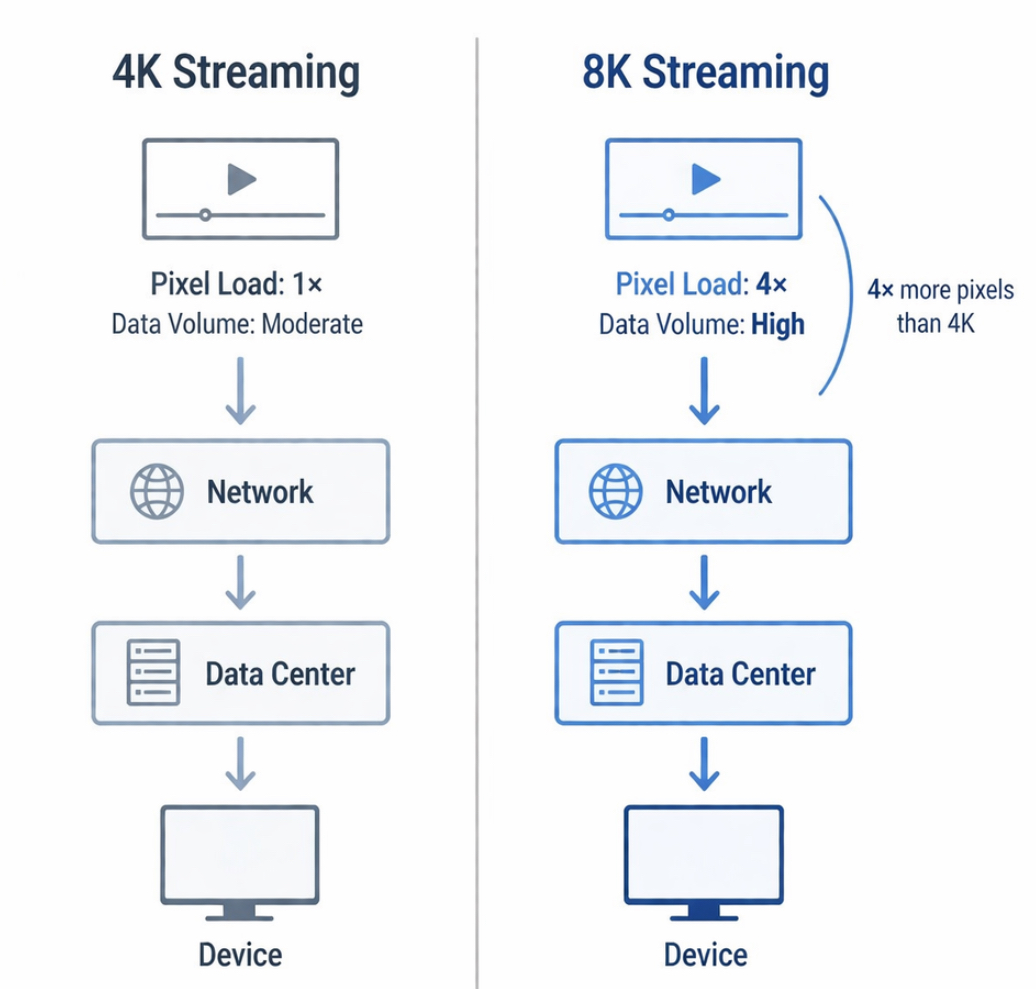
It helps to step back from marketing language and look at what 8K actually means in raw terms. Moving from 4K to 8K is not a marginal upgrade. It is a fourfold increase in pixel count. Every frame carries four times the visual information, and that multiplies the pressure across the entire delivery chain: encoding complexity rises, storage expands, and transmission requirements scale in ways that traditional compression strategies struggle to contain. Even with modern codecs, unoptimized 8K streams can push into bitrates that make large-scale distribution inefficient outside controlled environments.
The carbon footprint tied to that increase does not come from a single source. It is distributed across the system. End-user devices account for a large share, often estimated in the range of 70 to 80 percent depending on the study and usage pattern. But that does not make the rest negligible. Network transmission, CDN operations, and encoding workloads collectively form a second layer of energy demand that becomes more visible as data volumes rise. In many streaming pipelines, idle capacity and peak traffic handling introduce inefficiencies that sit quietly in the background but scale rapidly with higher bitrates. When the bitrate doubles or triples, those inefficiencies become measurable emissions.
One detail that is often overlooked in public conversations is how sensitive the system is to total data volume rather than just resolution. Fiber networks are relatively efficient per bit, but efficiency per bit does not offset exponential growth in the number of bits being transmitted. The dominant variable remains how much data is pushed through the system per hour of viewing. That is why bitrate, not just resolution, sits at the center of the environmental discussion. A poorly compressed 8K stream does not simply look sharper; it forces every layer of the infrastructure to work harder for longer.
There is also a structural issue tied to scale. Streaming platforms are not optimizing for a single user. They are optimizing for millions of concurrent sessions across regions with different network efficiencies and different energy mixes. A bitrate decision made at the encoding stage propagates outward into aggregate load across global infrastructure. That is where small percentage gains translate into large environmental differences. A reduction of 30 percent in bitrate, applied across millions of viewing hours, becomes a reduction in total transmitted data that is difficult to ignore.
The tension, then, is clear. The industry wants to move toward higher fidelity experiences, but the traditional approach to compression does not bend easily enough to make that transition sustainable. Static encoding strategies treat frames too uniformly. They allocate bits without sufficient awareness of what the viewer actually perceives as important. As resolution climbs, that inefficiency becomes more expensive, both technically and environmentally. This is the exact point where AI-assisted compression starts to matter, not as a theoretical improvement, but as a necessary adjustment to how video is prepared and delivered at scale.
Approximate Bitrate Pressure: Traditional vs. Target with AI Optimization
| Resolution | Traditional Bitrate Range | AI-Optimized Target Range | Relative Reduction |
|---|---|---|---|
| 4K UHD | 15–25 Mbps | 10–18 Mbps | ~25–35% |
| 8K UHD | 80–100 Mbps | 40–60 Mbps | ~40–50% |
The numbers above are not fixed targets. They vary with content type, motion complexity, and encoder configuration. But they reflect a pattern that has become consistent across multiple implementations. Once machine learning is introduced into the encoding decision process, bitrate allocation becomes more selective. Less data is spent on visually redundant areas, and more is reserved for regions that carry perceptual weight. The result is not just smaller files. It is a shift in how efficiently each transmitted bit contributes to perceived quality.
AI Codecs in Practice: What Has Actually Changed
The term “AI codec” has been used loosely over the past few years, sometimes to describe research systems that are not yet deployable and sometimes to describe real production pipelines that are already shaping how video is delivered. The distinction matters. What actually works today at scale is not a complete replacement of established standards like HEVC or AV1. It is a layer of machine learning wrapped around them, refining decisions that were previously made through fixed heuristics and hand-tuned rules.
Traditional encoders follow predictable logic. They divide frames into blocks, estimate motion, apply transforms, and assign bits based on relatively static models of rate-distortion tradeoffs. That approach has been refined over decades, but it still treats many visual decisions too uniformly. A complex scene and a simple scene can receive similar treatment in areas where a human viewer would not notice the difference. As long as bandwidth was relatively abundant, that inefficiency remained tolerable. At 8K, it becomes costly.
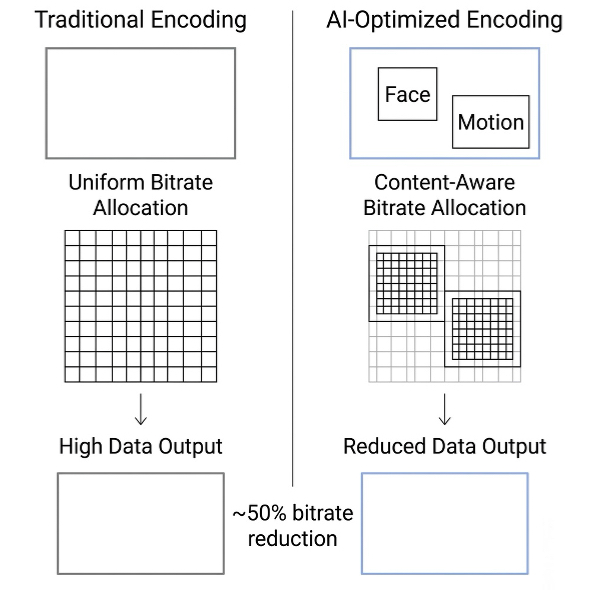
What has changed is the introduction of models that can interpret visual context before those encoding decisions are finalized. In practical terms, this means a pipeline that looks at the content first, not just the signal. Convolutional neural networks and related architectures are used to detect regions that matter more to perception: faces, edges, motion boundaries, areas with fine texture. The encoder is then guided to allocate bits in a way that aligns more closely with how people actually see the image, rather than how a generic mathematical model treats it.
This does not break compatibility. The output remains standards-compliant. A stream encoded with AI-assisted HEVC or AV1 can still be decoded by existing devices. The intelligence sits on the encoding side, shaping how the bitstream is constructed, not altering the decoding rules. That is why these systems have moved into production environments. They do not require a new ecosystem to function.
Several concrete techniques have emerged across vendors and research groups. One of the most widely adopted is content-aware pre-processing. Before encoding begins, the video is cleaned and stabilized in ways that make compression more efficient. Noise reduction is a common example. By removing visually irrelevant noise, the encoder avoids wasting bits trying to preserve randomness that viewers would not value. Super-resolution models can also be applied selectively, allowing lower-bitrate representations to be enhanced back toward higher perceptual quality after decoding.
Another layer involves adaptive bitrate control at a much finer granularity. Instead of assigning bits based on coarse scene categories, AI models generate dynamic rate-distortion curves that adjust continuously across frames. Regions of interest receive more precision, while background areas are compressed more aggressively. The result is a redistribution of bits rather than a simple reduction, and that redistribution is what allows overall bitrate to fall without an equivalent drop in perceived quality.
It is worth noting that this evolution is happening alongside formal standardization work, but not waiting for it. Efforts such as MPEG’s Neural Network Video Coding exploration and related initiatives signal where the field is heading, but current deployments are pragmatic. They rely on hybrid designs that can be integrated into existing encoding pipelines today. That is why companies working on AI-driven compression have been able to move from lab demonstrations to commercial deployments in sports streaming, social platforms, and large-scale video libraries.
The important point is not the terminology. It is the shift in how decisions are made. Encoding is no longer treated as a purely signal-processing problem. It is increasingly treated as a perceptual optimization problem, informed by models that learn from data rather than relying entirely on fixed assumptions. That shift is what opens the door to meaningful bitrate reductions at resolutions where traditional methods begin to plateau.
How AI Codecs Actually Reduce Bitrate in 8K Workflows
The shift from theory to measurable savings comes down to specific decisions made during encoding. What looks like a simple percentage drop in bitrate is usually the result of multiple small corrections applied consistently across frames. Once those corrections are applied at 8K scale, the cumulative effect becomes large enough to change how video is delivered.
One of the most consequential changes is how content complexity is evaluated before bits are assigned. Traditional encoders estimate complexity based on motion vectors, residuals, and block-level heuristics. AI-assisted systems take that further by analyzing semantic structure. They distinguish between areas that carry visual meaning and areas that do not. A crowd scene, for example, is not treated as a uniform mass of motion. Faces, edges, and focal regions receive different treatment from background blur or repetitive textures. This is where a meaningful portion of bitrate savings begins.
Region-of-interest allocation is closely tied to that shift. In practice, the encoder is guided to spend bits where the viewer is likely to look. Facial detail, fast-moving objects, and high-contrast edges are preserved with higher fidelity, while peripheral or low-importance regions are compressed more aggressively. This is not new in concept, but machine learning makes it far more precise. Instead of static rules, models adapt to each frame and each sequence. That adaptability is what allows the system to reduce total bitrate without introducing obvious artifacts.
Another layer comes from pre-encoding enhancement. Noise, compression artifacts from source material, and subtle distortions all increase the difficulty of efficient compression. AI-based filters can remove or reshape those elements before the encoder begins its work. When noise is reduced intelligently, the encoder avoids spending bits on randomness. When edges are clarified, motion estimation becomes more stable. These are not cosmetic adjustments. They directly influence how efficiently the signal can be represented.
Rate-distortion optimization itself has also evolved. Instead of relying solely on traditional cost functions, AI-assisted encoders incorporate learned models that better reflect perceptual quality. Metrics like VMAF have already influenced encoding decisions at scale, particularly in large streaming platforms. When combined with machine learning, those metrics become part of a feedback loop that continuously refines how bits are allocated. The encoder is no longer optimizing for a generic mathematical balance. It is optimizing for what viewers actually perceive as quality.
The results are not theoretical. Across multiple implementations, similar patterns appear. Visionular’s Aurora5 platform has reported bitrate reductions in the range of 40 to 50 percent under controlled conditions using AI-assisted HEVC.[3] Netflix’s dynamic optimization work, which blends machine learning with perceptual metrics, has demonstrated comparable reductions in certain content categories.[4] YouTube’s evolution from H.264 to VP9 and AV1, supported by machine learning-driven decisions, has delivered bandwidth savings in the range of 30 percent.[5] Even more targeted deployments, such as ARTE’s use of AI models in encoding workflows, have reported additional gains in the 10 to 25 percent range on top of existing optimizations.[6]
What matters for 8K is not any single number, but the consistency of the pattern. When a traditional 8K stream requires something on the order of 80 to 100 Mbps to maintain a given level of perceptual quality, a 40 to 50 percent reduction brings that requirement down to roughly 40 to 60 Mbps. That is not a marginal improvement. It is the difference between a format that strains distribution networks and one that begins to fit within more realistic delivery constraints.
Illustrative Comparison: 8K Bitrate Before and After AI Optimization
| Scenario | Typical Bitrate | Perceptual Quality |
|---|---|---|
| Traditional Encoding (HEVC / early AV1) | 80–100 Mbps | High, but inefficient allocation |
| AI-Enhanced Encoding | 40–60 Mbps | Comparable or improved perceptual quality |
There is an important detail behind these numbers. The reduction is not achieved by simply compressing more aggressively across the board. It is achieved by avoiding unnecessary precision where it does not contribute to perception. That distinction explains why quality does not degrade in proportion to bitrate. The system is not discarding value uniformly. It is redistributing it.
At 8K resolution, that redistribution becomes the central mechanism for making the format viable beyond controlled environments. Without it, scaling higher resolution simply multiplies inefficiency. With it, the relationship between resolution and data volume begins to loosen, and that is where the environmental implications start to follow.
The Carbon Payoff: When Bitrate Falls, Emissions Fall with It
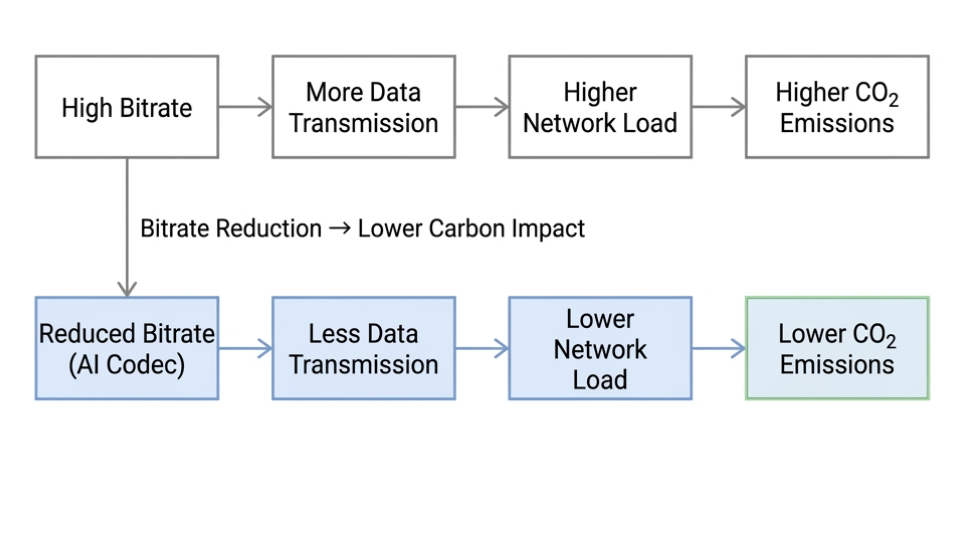
The environmental value of better compression is often described too loosely, as if lower bitrate were only a convenience metric for bandwidth planning. It is more than that. In streaming systems, bitrate is one of the clearest operational bridges between picture delivery and carbon output. Fewer bits sent across the network means less data moved through transit links, CDNs, caching layers, and edge infrastructure. It also means less storage pressure over time and, in many workflows, less compute waste during repeated packaging and distribution. The gains are not uniform across every region or device class, but the direction is consistent: when total data volume declines, the energy tied to distribution declines with it.[6] That relationship is the practical environmental case for AI-enhanced encoding.
Some of the strongest public evidence comes from optimization projects that were not framed as abstract sustainability campaigns at all, but as technical efficiency work with measurable side effects. RESET’s 2025 reporting on green streaming highlighted ARTE’s experience with optimized video encoding, noting a savings potential in the range of 10 to 25 percent depending on device age and content characteristics. That range is important because it shows the climate effect does not require a miraculous leap. Meaningful carbon reduction can begin with incremental compression improvements applied consistently across a large catalog and audience base.
InterDigital’s work points to a related but complementary layer of the problem. Its Pixel Value Reduction research focuses on display-side energy demand rather than network delivery alone, showing that intelligently reducing pixel value can lower display power consumption while preserving perceived quality. That matters because the sustainability burden of streaming is not confined to the transport chain. End-user screens remain a major part of the footprint, especially at higher resolutions where luminance and processing demands rise. In other words, greener 8K is not just about sending less data. It is also about making the pixels that finally appear on screen less energy-intensive to render.
There is also a workflow effect that tends to get less public attention than network savings. AI-assisted transcoding can reduce wasted compute by making encoding decisions more selective and, in some implementations, faster. Coconut’s 2025 analysis of AI and machine learning in transcoding argues that machine learning is increasingly being used to improve efficiency, speed, and resource allocation across video pipelines. That does not mean every AI-assisted workflow consumes less energy at every moment. Some models add overhead, especially during analysis and pre-processing. But once that overhead is balanced against lower output bitrates, reduced storage expansion, and more efficient throughput, the net effect can still be favorable. The question is not whether AI uses compute. It does. The question is whether it prevents more waste downstream than it introduces upstream. In many modern streaming workflows, the answer is yes.
The 8K case becomes clearer when those effects are scaled together. If an unoptimized 8K pipeline carries materially higher emissions than 4K because it moves more data and drives more display energy, then a 30 to 50 percent bitrate reduction changes the equation quickly. A stream that would otherwise demand around 100 Mbps but can be delivered closer to 50 Mbps does not merely save bandwidth on paper. It roughly halves the transmission load associated with that stream. Exact carbon impact still depends on geography, electricity mix, access network, and device efficiency, so no honest analysis should present a single universal number. Even so, proportional reductions remain meaningful. If transmission-related emissions track data volume closely, then cutting bitrate by half can produce a roughly similar reduction in that portion of the footprint.
8K Carbon Savings Framework
| Variable | Without AI Optimization | With AI Optimization | Effect |
|---|---|---|---|
| Average 8K bitrate | 80–100 Mbps | 40–60 Mbps | Lower transmitted data volume |
| Network/CDN load | Higher | Lower | Reduced delivery energy demand |
| Storage expansion over time | Higher | Lower | Less infrastructure overhead |
| Display-side energy pressure | High at 8K | Potentially moderated with pixel-level efficiency tools | Lower end-device power draw in some scenarios |
A simple working formula helps keep the issue grounded:
Estimated transmission carbon savings = baseline transmission emissions × bitrate reduction percentage
If a platform knows the estimated transmission-related emissions attached to one million hours of 8K viewing, and AI optimization reduces average bitrate by 40 percent, then the transmission portion of those emissions can be expected to fall by roughly 40 percent as well, assuming the network path and energy mix remain broadly similar. That is not a total-footprint calculation, because devices and regional power grids still matter. It is, however, a practical way to quantify the effect of codec improvements on one of the most controllable parts of the system.
That is why the environmental discussion around 8K needs to stay close to bitrate, not drift into vague talk about innovation. Compression efficiency is not a side story. It is the mechanism that determines whether 8K remains an energy-intensive luxury tier or begins to look operationally defensible in a world that is no longer willing to treat streaming growth as environmentally weightless.
Where the Efficiency Actually Comes From in the Streaming Stack
Bitrate reduction is often treated as a single improvement applied at the encoding stage, but the practical gains are distributed across several layers of the streaming stack. That distribution matters because it explains why relatively modest percentage reductions in bitrate can produce disproportionate effects on infrastructure load and energy consumption.
The first layer is encoding itself, where AI-assisted decisions prevent unnecessary precision from entering the bitstream in the first place. This is the most visible change, but it is not the only one. Once a smaller stream is produced, every downstream component processes less data. That includes packaging systems, origin servers, caching layers, and content delivery networks that replicate and serve the stream across regions. Each step benefits from reduced payload size, even if its internal logic has not changed.
Network transmission is where the effect becomes most measurable. Streaming systems are designed to handle peaks rather than averages, which means capacity is often provisioned with headroom that sits partially idle. When bitrate falls, that headroom stretches further. The same infrastructure can serve more users without scaling up at the same rate, and the energy associated with moving data across transit networks and edge nodes declines accordingly. The system does not become efficient in a single step. It becomes less wasteful across many small ones.
Storage is another layer where the effect accumulates over time. Large video catalogs are not static. They are replicated, re-encoded, and distributed in multiple formats and bitrate ladders. When each representation is smaller, the long-term growth of storage infrastructure slows. That has both cost and energy implications, particularly in systems where content is retained and redistributed over long periods.
There is also an indirect effect on playback stability. Lower bitrates reduce the likelihood of aggressive buffering, bitrate switching, and retransmission events, all of which introduce additional network activity. While these behaviors are often invisible to users, they contribute to the overall load of the system. Smoother delivery reduces that hidden overhead, tightening the relationship between delivered data and perceived quality.
Seen together, these layers explain why compression efficiency cannot be evaluated in isolation. The encoder is the entry point, but the impact propagates through the entire delivery chain. That propagation is what turns a percentage improvement in bitrate into a broader reduction in system-level energy demand.
Where This Is Already Working: Real Deployments, Not Theory
There is a tendency to treat compression improvements as something that belongs to white papers and internal engineering discussions. That view is outdated. A number of large platforms have already integrated machine learning into their encoding pipelines in ways that produce measurable operational impact. The details differ across companies, but the direction is consistent: less data moved, lower bandwidth pressure, and more predictable quality at scale.
Netflix’s work on dynamic optimization is often cited because it made the shift visible. Rather than encoding content with a fixed ladder of bitrates, the system evaluates each title and each scene, adjusting parameters to match perceptual complexity. Machine learning plays a role in refining how those decisions are made, particularly when paired with perceptual metrics like VMAF. The outcome is not simply smaller files. It is a redistribution of bitrate that aligns more closely with what viewers notice. In some categories, that has translated into reductions approaching 50 percent without degrading perceived quality.
YouTube’s transition toward VP9 and later AV1 provides another example of how machine learning quietly reshaped large-scale delivery. The platform did not present the shift as a sustainability initiative, but the bandwidth savings that followed were significant. Reports and engineering discussions have pointed to reductions in the range of 30 percent compared to earlier encoding approaches. Those savings, multiplied across billions of viewing hours, translate into a substantial reduction in total data movement, even if that outcome is rarely framed in environmental terms.
Outside of the largest platforms, specialized vendors have pushed similar ideas into commercial use cases where cost sensitivity is even more visible. Visionular’s deployments, including sports streaming platforms and video-heavy social applications, have shown that AI-assisted encoding can reduce operational expenditure by lowering bitrate and storage requirements simultaneously. In those environments, efficiency is not optional. It directly affects margins. That pressure tends to accelerate adoption faster than abstract sustainability goals.
Public broadcasting has also begun to experiment with these approaches in a more explicitly environmental context. ARTE’s collaboration with research groups, including work connected to Fraunhofer, has explored AI-assisted encoding models that reduce bitrate while maintaining quality across a diverse content catalog. Reported gains in the 10 to 25 percent range may appear modest compared to more aggressive scenarios, but they are grounded in real deployment constraints and reflect a conservative, reproducible path toward greener delivery.
What links these examples is not a shared implementation, but a shared outcome. Each system moves away from uniform encoding decisions and toward context-aware allocation of bits. Each system reduces total data volume without forcing viewers to accept visibly degraded images. And each system demonstrates that compression efficiency can be improved within existing standards, without waiting for a complete overhaul of decoding ecosystems.
The relevance to 8K is straightforward. None of these deployments depend on resolution-specific tricks. The same principles apply as pixel counts increase. If anything, higher resolutions amplify the value of each percentage point gained through optimization. A 30 percent reduction at 8K scale removes more absolute data than the same reduction at 4K. That scaling effect is what makes current deployments a meaningful indicator of what is possible as 8K distribution expands.
The Limits Still Matter
It would be easy to overstate the maturity of this space, especially now that “AI video compression” has become a useful marketing phrase. The more careful view is that the strongest gains in 2026 are coming from hybrid systems, not from fully neural codecs replacing the standards stack end to end. That distinction should remain explicit. HEVC, AV1, and related standards still anchor real-world deployment. Machine learning improves the decisions around them, but it has not made the rest of the pipeline irrelevant.
There is also a cost side that cannot be ignored. AI-assisted encoding often increases complexity at the front end of the workflow. Scene analysis, region detection, and pre-processing models consume compute. In some pipelines, that means a higher encoding burden at the start, particularly when content libraries are being prepared at scale. The reason this does not invalidate the model is that the added compute is often offset downstream by lower bitrate delivery, reduced CDN load, and smaller storage growth. Even so, the trade-off is real. A serious operator has to measure net gains across the entire workflow, not assume that “AI” automatically means lower energy in every step.
Compatibility has been another point of caution, though less than it was a few years ago. The practical reason hybrid systems have gained traction is that they preserve standards-compliant outputs. That avoids forcing users onto new decoders or waiting for a fresh hardware cycle. Still, the broader future many researchers discuss, especially around pure neural codecs, would require a different level of ecosystem readiness. Decoder support, silicon optimization, and standardization remain incomplete there. For consumer 8K streaming, that future is still further out than some headlines suggest.
Regional carbon intensity complicates the sustainability story as well. A bitrate reduction achieved in one market does not map to the exact same carbon savings in another if the electricity mix, network architecture, and device efficiency differ. This is why any universal emissions claim should be treated with suspicion. The most defensible language is proportional. Lower bitrate generally means lower transmission-related emissions, but the total reduction depends on where, how, and on what device the content is consumed.
There is also the simple reality that 8K remains a niche format in mass consumer terms. Public evidence for AI optimization is stronger in HD, 4K, and broader UHD pipelines than in openly documented 8K deployments. That does not weaken the argument, but it does shape how the argument should be made. The most reliable approach is to anchor the analysis in verified compression gains from current production systems and then scale those implications carefully to 8K, rather than pretending a huge body of 8K-specific field data already exists.
The practical conclusion is not pessimistic. It is measured. The hybrid approach is the workable path because it fits today’s infrastructure, today’s device base, and today’s business constraints. It improves efficiency where the system is currently wasteful without requiring the entire streaming stack to be reinvented first.
Where This Is Heading
The trajectory is already visible, even if the pace is uneven across regions and platforms. Compression is no longer treated as a finished problem. It is becoming an adaptive layer that evolves with content, hardware, and network conditions. The next few years will likely bring deeper integration between machine learning models and encoding logic, not as an add-on, but as a default expectation. Work around MPEG’s emerging codecs, including efforts that extend beyond VVC, suggests that gains in the range of 25 to 40 percent over current baselines are still being pursued with a combination of traditional tools and learned models. Those gains will not arrive overnight, but the direction is consistent.
Pure neural codecs will continue to attract attention, particularly in research environments. The idea of replacing block-based compression entirely with learned representations is not theoretical anymore, but it is not ready for broad consumer deployment either. Decoder efficiency, hardware acceleration, and standardization all need to converge before that approach becomes practical at scale. Until then, hybrid systems remain the working model, and they are already capable of delivering meaningful improvements without waiting for a generational shift in devices.
For platforms operating today, the decision point is less about whether to adopt AI-assisted encoding and more about how quickly to integrate it into existing workflows. The barrier is not conceptual. It is operational. Integrating new encoding strategies requires testing, validation, and sometimes rethinking how bitrate ladders are constructed and maintained. But the incentives are aligned. Lower delivery costs, more stable quality, and reduced infrastructure strain all point in the same direction. The environmental benefit follows from those same changes, rather than standing apart from them.
There is also a quieter shift happening at the user level, even if it is less visible. Device manufacturers are beginning to pay more attention to display efficiency, and playback systems are becoming more aware of network conditions and power usage. Those changes do not replace the need for better compression, but they reinforce it. When the entire chain becomes slightly more efficient at each stage, the cumulative effect becomes harder to ignore.
Conclusion
8K does not become sustainable simply because it exists. Left unoptimized, it extends the same pattern that has defined streaming growth for years: more data, more energy, more infrastructure strain. What changes the equation is not resolution by itself, but how efficiently that resolution is delivered. AI-assisted codecs address that problem at its source. By reducing bitrate through more selective, perception-aware encoding decisions, they limit the amount of data that needs to move through the system in the first place.
The gains are already visible in production environments. They are not uniform, and they are not without trade-offs, but they are large enough to matter. A 30 to 50 percent reduction in bitrate is not a minor optimization at 8K scale. It is a structural adjustment to how video is delivered. When that adjustment propagates across networks, CDNs, and storage systems, the environmental effect follows naturally from the technical one.
The question, then, is not whether the technology exists. It does. The more relevant question is how quickly it becomes standard practice. The answer will depend less on research milestones and more on adoption decisions made inside streaming platforms, infrastructure providers, and encoding pipelines that operate quietly behind every play button.
References
- InterDigital. “Sustainable High-Definition and Pixel Value Reduction.”
View Source
↩ - TRG Datacenters. “Streaming Carbon Footprint.”
View Source
↩ - Visionular. “AI Video Compression.”
View Source
↩ - Netflix Tech Blog. “Per-Title Encode Optimization.”
View Source
↩ - YouTube Engineering. “AV1 Codec.”
View Source
↩ - RESET. “Green Streaming.”
View Source
↩
Frequently Asked Questions About 8K Green Streaming and AI Codecs
Does 8K streaming consume significantly more energy than 4K?
8K streaming generally requires more energy because it involves four times the pixel data of 4K, which increases processing, transmission, and display demands. Without efficient compression, this leads to higher overall carbon emissions across networks, data centers, and end-user devices.
How do AI codecs reduce bitrate without lowering video quality?
AI codecs analyze visual content and prioritize areas that matter most to human perception, such as faces and motion. By allocating more bits to important regions and compressing less noticeable areas more aggressively, they reduce overall bitrate while maintaining perceived visual quality.
Are AI codecs already used by major streaming platforms?
Yes. Large platforms like Netflix and YouTube already use machine learning techniques within their encoding pipelines to optimize bitrate and improve efficiency. These implementations are hybrid systems that enhance existing codecs such as AV1 and HEVC rather than replacing them entirely.
Do AI codecs completely eliminate the carbon impact of 8K streaming?
No. AI codecs reduce a significant portion of the impact by lowering data transmission and processing requirements, but energy consumption from devices, networks, and electricity sources still contributes to the total footprint. They are a major improvement, not a complete solution.
Will fully neural video codecs replace current standards soon?
Fully neural codecs are still in development and are not widely deployed in consumer streaming as of 2026. Current progress is focused on hybrid systems that integrate machine learning into existing standards, which remain more practical for large-scale compatibility and deployment.