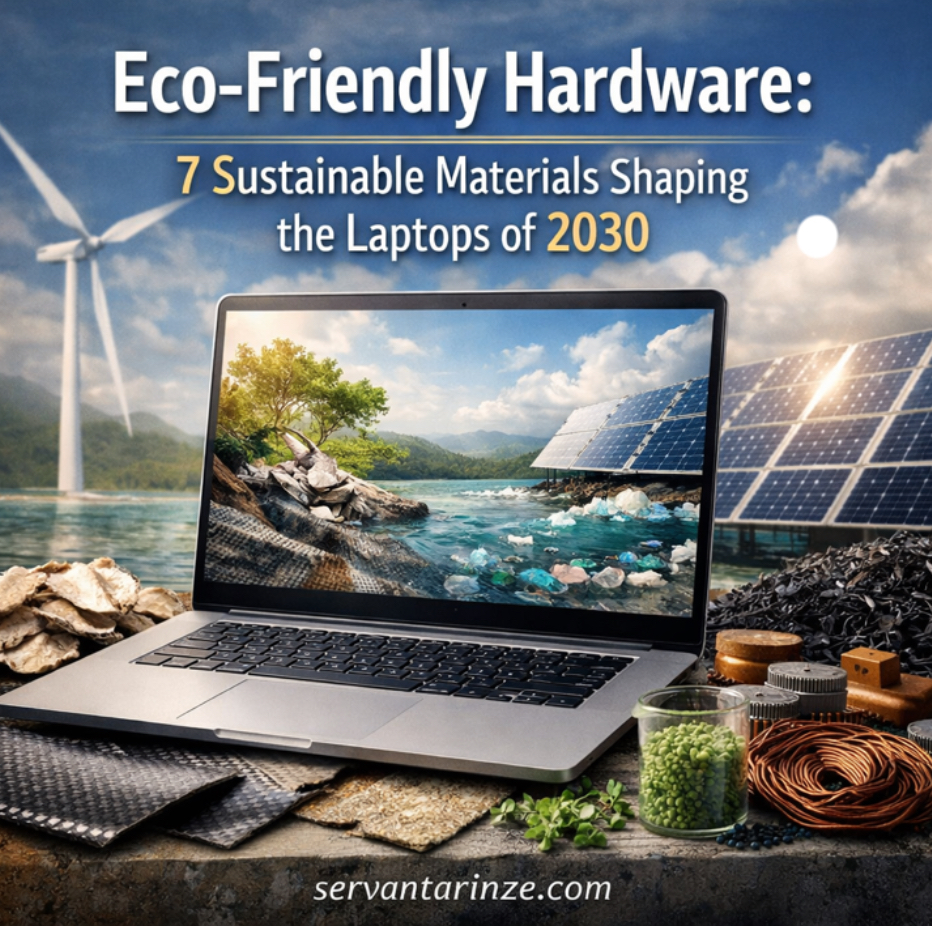

I keep seeing the same pattern in “green tech” conversations: we celebrate efficient chips and better battery life, then barely mention the part that carries most of the footprint—the materials and manufacturing that happen before the first boot.
A modern laptop is a condensed supply chain: mined metals, refined copper, engineered plastics, battery materials, coatings, glass, adhesives—then global shipping, machining, assembly, and packaging. Most of the environmental cost is embodied upfront, before the device ever becomes “your” device.
2030 matters because it’s the horizon most climate targets are tied to—and hardware supply chains move slowly. If you want lower embodied carbon, you don’t get there with small optimizations. You get there by changing inputs: alloys, polymers, battery chemistry, assembly methods, and what “end of life” means in practice.
People often treat sustainability as an accessory feature—something you add at the end. In hardware it’s the opposite: it has to be designed in. That means less virgin extraction, fewer petroleum plastics where alternatives work, and products that can be taken apart without turning valuable material into mixed waste.
The reality is that laptops aren’t “light” products in the way we mentally file them. A laptop feels like a sleek slab of productivity; in reality it’s metal, chemistry, polymers, glass, adhesives, coatings, and microelectronics—each with its own footprint and supply constraints. That’s why the sustainability debate keeps circling back to repairability, modularity, recycled content, and right-to-repair. It isn’t ideology. It’s resource math.
When I say “the laptops of 2030,” I’m talking about decisions you can already see in prototypes, supplier programs, and product lines—if you actually read the materials list. Acer’s Vero wasn’t perfect, but it signaled intent. Dell’s Concept Luna wasn’t a consumer product, but it showed something important: the old way of building hardware is getting expensive—financially, politically, and environmentally.
Why the Materials Conversation Suddenly Matters
The e-waste conversation keeps getting louder for a reason. The world produces tens of millions of tons of e-waste every year, and only a fraction is recovered at high quality. A lot of “recycling” is downcycling: mixed materials lose value, get contaminated, or become too costly to separate. Meanwhile manufacturing still wants predictable purity, predictable supply, and predictable price—exactly what virgin mining has always sold.
That predictability is getting harder to maintain. Critical materials don’t behave like infinite commodities. Energy prices and energy mix matter. Regulation is tightening. And once you track supply-chain emissions—Scope 3 in climate accounting—hardware becomes awkward in a useful way: it forces you to deal with origin, not just usage.
That’s where eco-friendly hardware stops being branding and becomes engineering plus procurement. Lower-impact laptops don’t come from a software setting. They come from redesigning the chassis to accept recycled feedstock, pushing suppliers toward low-emissions aluminum, treating plastics as a design choice rather than a default, and choosing fasteners/adhesives that don’t destroy recoverability. The real test is volume: “sustainable” has to work at scale, not as a boutique run.
The industry doesn’t need one mythical perfect green laptop. It needs a few material choices to become normal. Once large-scale recycled aluminum consistently meets finish and durability requirements, it becomes a default. Once reclaimed carbon fiber supply is stable, it becomes procurement rather than experiment. Once recycled cobalt is repeatable at scale, battery ethics shifts from debate to execution.
The question isn’t “will laptops be sustainable by 2030?”—that’s too vague to measure. The useful question is simpler: which materials are already proving they can replace the old defaults, and which ones still need manufacturing to catch up?
The framework here is straightforward: seven materials, seven real pathways, and one constraint that decides everything—whether it survives product design, cost pressure, and supply constraints.
The E-Waste Curve Is Not Slowing Down
Hardware ages faster now for reasons that have less to do with CPU performance and more to do with design choices. Glued batteries, disappearing ports, soldered RAM, top-case replacements for small failures—these aren’t accidents. They’re trade-offs for thinness, rigidity, and assembly efficiency. Every one of those trade-offs has a material consequence.
Global e-waste generation has climbed past fifty million metric tons annually, and laptops sit in the middle of that story—not as the heaviest devices, but as some of the most material-dense. Inside a few pounds of hardware are rare earth elements, precious metals, specialty polymers, and energy-intensive alloys. When those machines are discarded or poorly recycled, the embodied energy is lost. The extraction cycle starts again. [1]
The uncomfortable math is this: recycling rates for electronics remain uneven and often inefficient. High-value metals like gold and copper are recovered because economics demand it. Lower-value or composite materials are frequently shredded, mixed, or downcycled. The result is a system that still depends heavily on virgin mining to maintain quality standards for new devices.
This is why material innovation matters more than cosmetic sustainability claims. If manufacturers want meaningful carbon reduction, they must attack embodied emissions at the source: aluminum smelting, plastic polymerization, battery chemistry, and global logistics.
Why 2030 Is a Real Deadline, Not a Marketing Slogan
Corporate climate targets have a way of sounding abstract until you examine the timelines. Microsoft has committed to becoming carbon negative by 2030. Dell has outlined aggressive greenhouse gas reduction goals across its value chain. Intel has framed net-zero manufacturing emissions by 2040, with interim reductions this decade. These are not vague aspirations; they are measurable commitments tied to investor scrutiny and regulatory pressure. [2]
And here is the complication: for most hardware companies, Scope 3 emissions—those embedded in supply chains and material sourcing—often represent the majority of total footprint. That means the emissions tied to raw materials, component fabrication, and product assembly outweigh what happens during consumer usage.
No serious 2030 target is met by dimming screens or polishing standby power alone. The meaningful reductions come from what the laptop is physically made of—and how those inputs are produced.
That is where eco-friendly hardware becomes operational rather than aspirational. If a manufacturer can reduce the carbon intensity of aluminum production by switching to renewable-powered smelting, the emissions drop before the laptop even reaches a warehouse. If recycled plastics replace virgin polymers at scale, petroleum dependency falls. If cobalt can be sourced from recycled batteries instead of primary mining, ethical and environmental exposure shrinks simultaneously.
2030 functions as a forcing mechanism. It compresses experimentation cycles. It pushes pilot programs into production runs. It turns “concept devices” into procurement mandates.
The Circular Economy Is Not Theory Anymore
For years, the circular economy was discussed as an academic ideal: design products so materials can circulate instead of becoming waste. In practice, circularity demands brutal simplicity. Devices must be easier to disassemble. Materials must be easier to separate. Components must be standardized enough to be reused. Adhesives must give way to fasteners where possible. Modularity must compete with sealed minimalism.
Dell’s Concept Luna prototype was revealing not because it was perfect, but because it showed how dramatically a laptop’s internal architecture could change when disassembly becomes a design priority. Fewer screws. Simplified internal layout. Replaceable modules. Reduced adhesive reliance. These are not aesthetic changes—they are recovery strategies.
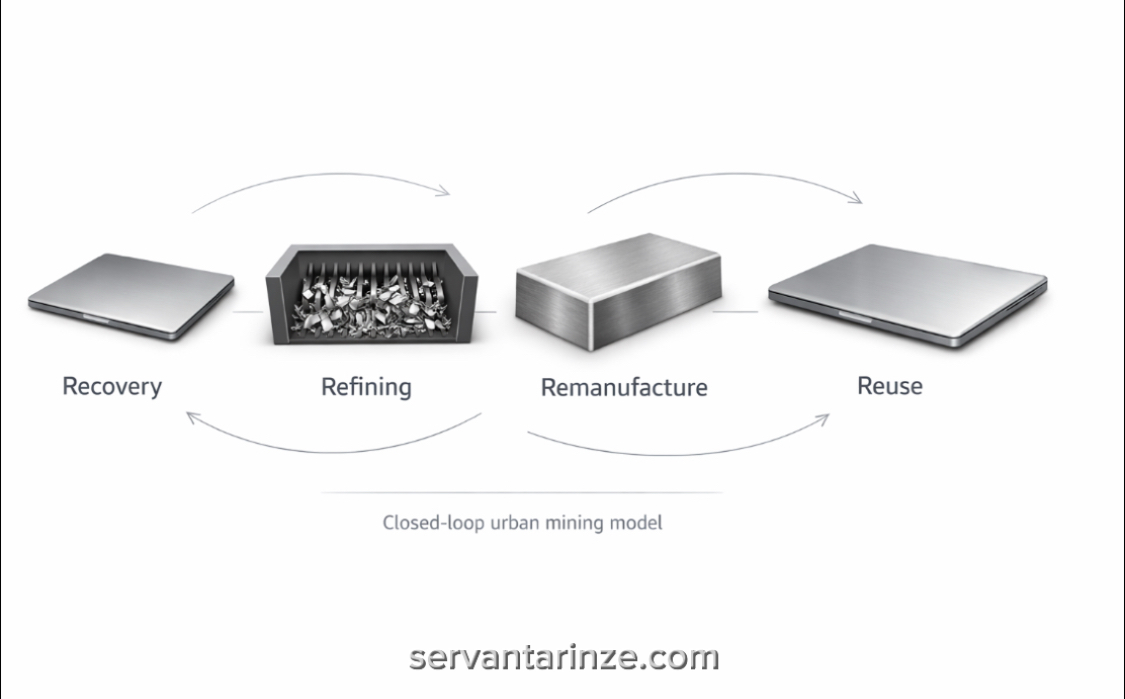
Urban mining—the recovery of metals from discarded electronics—is also gaining momentum. Instead of digging deeper into the earth, companies are increasingly looking at old devices as above-ground mines. Copper, gold, rare earth magnets, aluminum frames: all of them already exist in circulation. The challenge is designing current products so those materials are retrievable in high quality decades later.
The question has moved. It’s no longer whether recycled materials can appear in laptops—they already do. The real test is whether recycled and bio-based inputs can scale into dominant defaults without compromising durability, thermals, or industrial design.
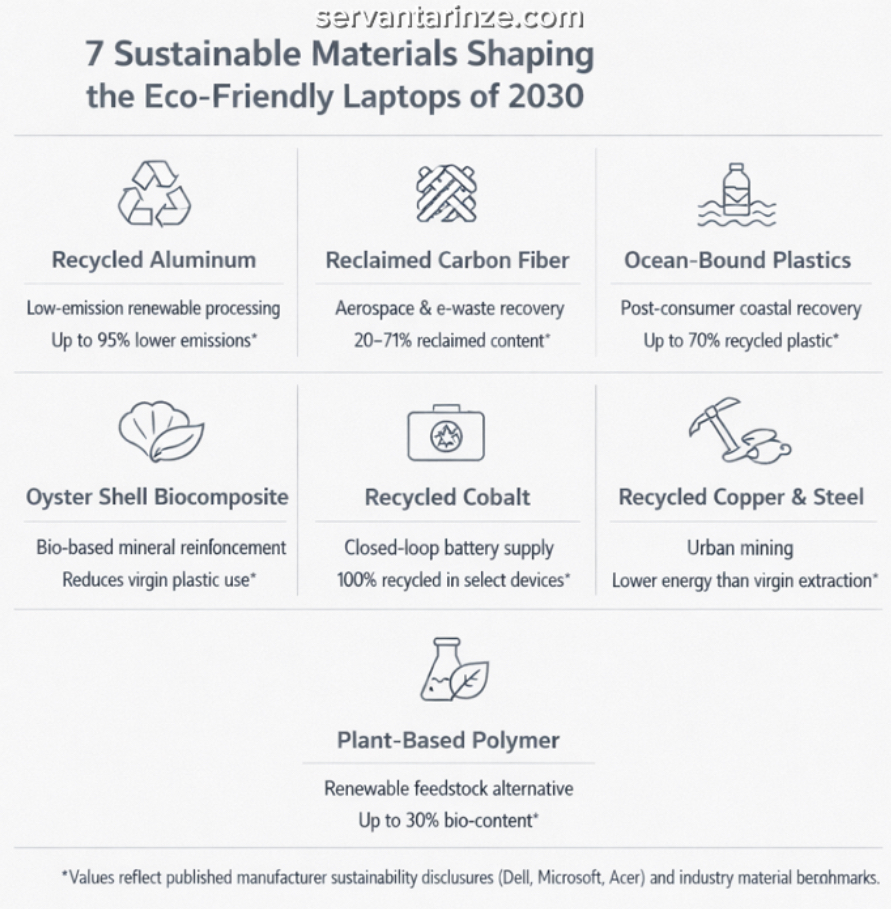
That brings us to the seven materials that are quietly redefining what sustainable laptop materials 2030 could realistically look like—not as a utopian vision, but as a set of engineering decisions that are already underway.
1. Recycled Aluminum & Low-Emissions Aluminum
Aluminum shows up in modern laptops for the same reasons it shows up in aircraft interiors: it’s stiff for its weight, it handles heat reasonably well, and it can be finished to look “premium” without adding complexity. The problem isn’t the metal. It’s the way primary aluminum is made. Smelting is brutally electricity-hungry, and the carbon story depends almost entirely on what powers the process.
What’s shifted in the last decade is the feedstock mix. Recycled aluminum (scrap that gets re-melted) takes a small fraction of the energy of primary production, which is why manufacturers keep chasing it for enclosures. The “up to ~95% lower energy” figure gets quoted a lot for a reason: at laptop volumes, the difference stops being academic and starts showing up in procurement decisions. [3]
Dell and Microsoft both talk about recycled aluminum, and that’s useful—but the more meaningful distinction is this: recycled content reduces demand for new extraction, while low-emissions smelting reduces the damage when virgin input is unavoidable. Those are two different levers, and the companies treating them as a real materials strategy tend to talk less about slogans and more about supply, purity, and process control.
There’s a reason this isn’t “just use scrap.” Enclosure alloys have tight tolerances, and finish consistency matters because cosmetic defects become returns. You also need predictable volume and predictable chemistry. The interesting part is that most of these problems aren’t theoretical anymore—they’re being solved by better sorting, better melt control, and more disciplined supplier qualification.
If the current trajectory holds, high-end enclosures will trend toward majority recycled aluminum simply because it aligns with cost, regulation, and corporate reporting pressure at the same time. Virgin input won’t disappear—it tends to come back in when you need a specific alloy behavior or consistent finishing. But the “brushed metal” look doesn’t have to carry the same embodied-carbon penalty it did a decade ago.
2. Recycled Plastics: From Post-Consumer Waste to Ocean-Bound Recovery
Plastic gets treated as the villain, but open a laptop and you’ll see why it persists: brackets, cable guides, keycaps, bezels, insulating layers—polymers solve a lot of small mechanical problems cheaply and reliably. The real issue isn’t that plastic “doesn’t work.” It’s that virgin polymer is tied to fossil feedstock, and end-of-life plastics in electronics are notoriously hard to recover cleanly.
Post-consumer recycled plastics are already showing up in real product lines, not just concept decks. Acer’s Vero is one of the clearer examples because it tells you, directly, that the casing is being used as a place to absorb recycled content. Ocean-bound plastics sit in a similar category: not magic, not a total solution, but a way of redirecting material that would otherwise become long-lived waste.
The constraint is consistency. Recycled polymers can swing in strength, brittleness, and flow behavior depending on feedstock and how it was processed. Laptop manufacturers hate variability because it turns into warping, cracking, tolerance drift, and cosmetic defects. The only way recycled plastic becomes normal is through better sorting, better purification, and compounding recipes that make the material behave predictably on an assembly line.
Packaging is changing too, mostly because it’s easier to fix than the product itself. Molded pulp, recycled cardboard, fewer plastic wraps—these aren’t the headline features people brag about, but they scale cleanly. Over millions of shipments, small packaging decisions become real material tonnage.
What will separate serious efforts from vague ones is sourcing clarity: how much recycled content is actually inside the device, and what stream it came from—post-consumer, ocean-bound, or industrial scrap. As soon as buyers start asking for documentation, “recycled” stops being a vibe and becomes a number with a paper trail.
Plastic isn’t disappearing from laptops. What can disappear is the assumption that it must start as virgin fossil feedstock every time.
3. Bio-Based Oyster Shell Composites
One of the more interesting materials stories in laptops doesn’t start in a mine. It starts in the waste stream of the food industry.

Oyster shells are mostly calcium carbonate. Ground and processed, they can act as a filler in polymer composites, changing stiffness and surface behavior while reducing the amount of virgin plastic needed. Acer’s Vero experiments are notable because they treat that “waste” as a legitimate input—diverting shell waste while cutting petroleum-derived content in parts of the enclosure. [4]
This isn’t just symbolism. Calcium carbonate fillers can change rigidity and surface stability in ways manufacturers actually care about. The environmental advantage is also concrete: less virgin polymer, and less shell waste headed toward disposal.
There are limits. These composites still have to survive drops, heat cycling, and years of handling without turning brittle or weirdly chalky. Early uses tend to show up in lower-stress parts or cosmetic panels for a reason. If the compounding recipes get better—and if suppliers can hold consistency—then you start seeing the material move into more structurally meaningful areas.
What feels “novel” now—oyster shell filler, agricultural residues, mineral-polymer hybrids—has a path to becoming boring composition detail inside enclosure plastics. That’s the real tell: when a material stops being a launch feature and starts being a line item in a spec sheet. Hardware has always borrowed from other industries; sustainability just makes that borrowing more deliberate.
4. Reclaimed Carbon Fiber
Carbon fiber is one of those materials people associate with aerospace for a reason: the stiffness-to-weight ratio is ridiculous when it’s done right. In laptops, that translates into rigid lids and frames without the “heavier than it looks” feeling. The catch is that virgin carbon fiber is expensive in energy terms, and the process generates scrap that used to be treated like unavoidable waste.
Reclaimed carbon fiber is the attempt to stop treating that scrap as a dead end.
Instead of spinning new fiber from precursor feedstock every time, you can recover carbon fiber from aerospace offcuts and industrial scrap, then reprocess it into usable composite parts. Dell’s Latitude work with reclaimed carbon fiber matters less as a marketing note and more as proof that you can hit real durability requirements without insisting on 100% virgin material.
The hard part is controlling performance. Reclaimed fibers aren’t identical to continuous virgin layups, so the resin system, fiber length, orientation, and molding process have to be tuned to keep stiffness and impact resistance where they need to be. And because laptops are “touch products,” surface quality matters too. When the processing is disciplined, you can get parts that behave close enough to virgin composites that the user never notices the difference.
From a sustainability standpoint, reclaimed carbon fiber does three practical things: it keeps high-value composite waste out of disposal streams, it reduces embodied carbon versus making new fiber, and it widens the definition of “recyclable” beyond metals. It’s also a preview of the bigger shift: materials that were once single-use inside industrial supply chains can be routed back into consumer hardware when the economics and quality control line up.
By the end of the decade, reclaimed composites could be quietly normal in premium laptops—especially in lids and structural panels—because the user experience stays the same: light, rigid, durable. The difference is upstream: lower carbon and less waste for the same industrial-design outcome.
5. Recycled Cobalt and Reduced-Cobalt Battery Architecture
If you want one material that exposes how messy modern electronics can be, it’s cobalt.
Cobalt sits inside lithium-ion cathodes because it helps stabilize performance and cycle life. But the supply chain has baggage: mining conditions, environmental damage, and real geopolitical risk. Even if you ignore the politics, the extraction and refining footprint is heavy. That’s why battery materials are now part of sustainability discussions whether manufacturers like it or not.
So the next decade isn’t just about “green casings.” It’s about what happens inside the battery pack—chemistry choices, sourcing, and whether critical materials can be recovered and reused with high purity.
Microsoft’s disclosure about using 100% recycled cobalt in certain Surface battery cells is the kind of signal that matters because it’s hard to do without real supplier coordination. Recycled cobalt typically comes from end-of-life batteries, manufacturing scrap, and production waste. Refining it back into battery-grade material isn’t trivial, but when it works it keeps a critical mineral in circulation and reduces exposure to new mining. [6]
In parallel, the industry is trying to use less cobalt per cell. Nickel-rich chemistries and alternative formulations aim to reduce cobalt intensity without wrecking longevity. The sustainability benefit is plain: you need less new cobalt, and the cobalt that remains becomes a higher-value target for recovery programs.
By 2030, a credible “premium” sustainability story will likely include batteries that either rely on recycled cobalt streams, use substantially less cobalt, or both. And that matters because the battery pack is one of the few places where a small materials decision can swing both carbon footprint and ethical exposure at the same time.
6. Recycled Copper and Recycled Steel
Two of the most important laptop materials are the least photogenic: copper and steel. Copper moves current through boards and power circuits. Steel shows up in hinges, frames, and reinforcements. They don’t get marketing love, but they carry real embodied energy because mining and refining are heavy processes.
Virgin copper and steel are carbon-intensive mainly because the upstream processes—mining, smelting, refining—burn a lot of energy. The upside is that both metals recycle well. Copper keeps its conductivity. Steel keeps its mechanical properties. If you can recover them cleanly, you don’t lose much performance.
Dell has talked publicly about bringing recycled copper and steel into its supply chain at meaningful scale, and that’s important because structural metals are the easiest place to go “circular” without compromising product performance. Recycled copper generally takes far less energy than mining new ore. Recycled steel can be dramatically lower-carbon when it’s produced in electric arc furnaces—especially when the electricity mix is clean.
This is where circular economy stops being a slogan. Old devices aren’t just “trash”—they’re metal inventory sitting in drawers and landfills. Urban mining is the industrial version of admitting that the richest ore body might be the one we already extracted and scattered across the planet as consumer electronics.
From an engineering perspective, recycled copper and steel don’t have to be a compromise if the material is processed properly. Conductivity, strength, machinability—those can remain in spec. The big difference is upstream: lower emissions and less pressure on virgin extraction.
By 2030, disclosure may flip from “nice to have” to expected: if you can tell me the processor and the screen size, you can probably tell me how much recycled copper and steel is inside the product. Silence will start to look like avoidance.
7. Plant-Based and Biodegradable Composites
Petroleum-derived plastics dominate electronics because they’re cheap, stable, and easy to mold at scale. The downside is obvious: they’re long-lived waste when recovery fails.
The more interesting frontier may be replacing part of that fossil-plastic baseline with bio-based polymers and composites that come from plant or agricultural waste streams.
We already see early adoption in small but meaningful places: castor-oil-derived polymers in certain components, tree-based or fiber-based packaging inserts, and composites like Acer’s oyster-shell mix that reduce fossil polymer content. The key point is that these materials still have to behave like electronics materials—stable under heat, stress, skin oils, cleaning agents, and years of use. If they can’t survive that reality, they won’t scale.
The carbon-accounting advantage is straightforward: bio-based feedstock starts as atmospheric carbon captured during growth, not fossil carbon pulled out of the ground. Manufacturing still uses energy, so it’s not automatically “clean,” but lifecycle emissions can improve when sourcing is responsible and the material actually replaces a meaningful fraction of virgin petroleum polymer.
“Biodegradable laptop” is mostly a misunderstanding. Electronics should not biodegrade while you’re using them. The real goal is reducing fossil-derived plastic where it makes sense and improving end-of-life recovery so fewer polymers end up as mixed, unrecyclable residue.
By 2030, it’s realistic to expect partially bio-based polymers in more structural “everyday” parts—keyboard decks, brackets, trackpad housings—assuming suppliers can prove stability and repeatability at scale. The winning materials won’t be the ones that sound best; they’ll be the ones that survive manufacturing and warranty reality.
Beyond Materials: The Manufacturing Shift That Makes Sustainability Real
Materials alone won’t save hardware. The bigger shift is design-for-disassembly: how devices are assembled, repaired, refurbished, and recovered when they’re done.
Dell’s Concept Luna prototype is useful because it treats disassembly time as a design metric: fewer adhesives, simpler internal layout, modules that can be removed without a fight. The principle is almost embarrassingly practical. If a laptop comes apart quickly, recovery improves. If the battery or ports can be replaced without destroying the chassis, lifespan stretches—and the emissions you avoided are the emissions of the next new device you didn’t have to build. [5]
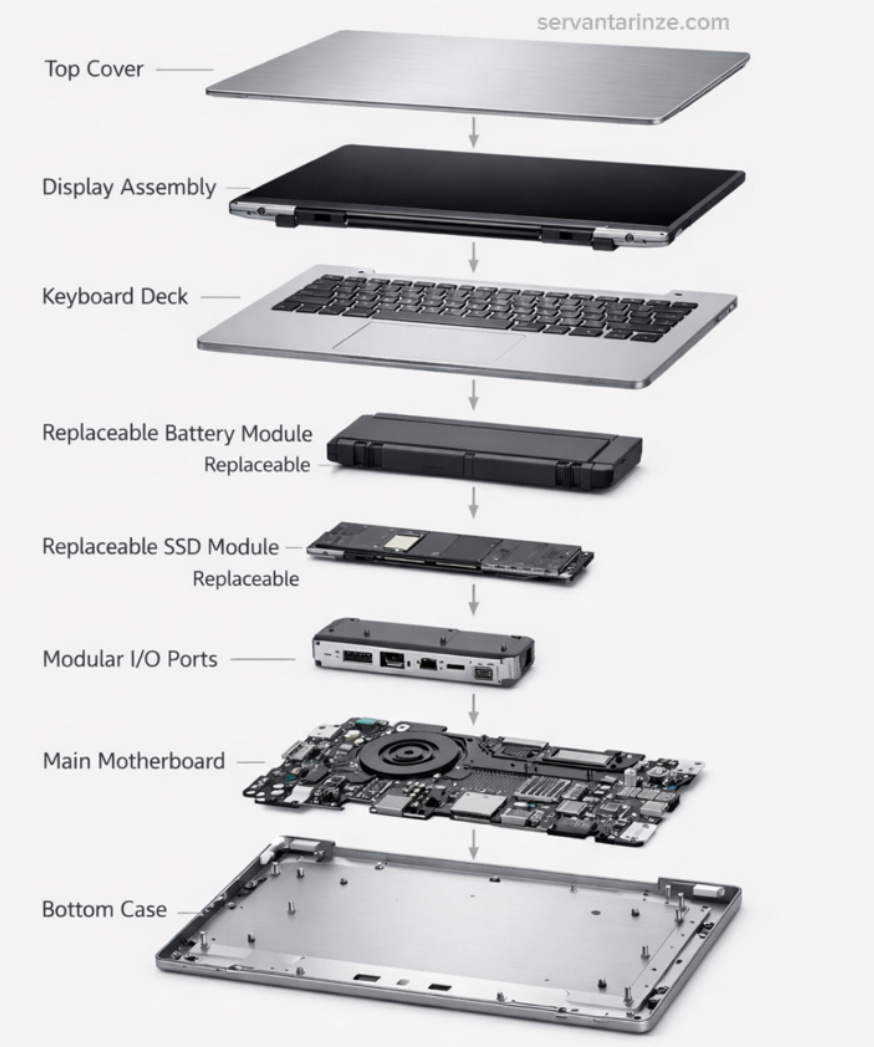
Repairability is environmental policy disguised as engineering. Extending device life by even one or two years can beat a lot of “green” messaging because you’re skipping the biggest footprint event: manufacturing a replacement. Modularity also makes reuse less hypothetical, especially in fleet environments where standardized parts can move between machines.
Remanufacturing is where the numbers get blunt. Refurbished enterprise laptops can carry dramatically lower emissions than new builds because you’re reusing the most carbon-intensive pieces of the product. This isn’t sentimental. It’s arithmetic: the cleanest laptop is often the one that didn’t need to be manufactured again.
Efficiency gains still matter, especially in power delivery. Better process nodes help, but the more visible shift is in adapters and charging circuits where wide-bandgap materials like GaN (and, in some contexts, SiC) reduce heat and improve efficiency. Heat is wasted energy, and it’s also a reliability tax. Lower heat can mean longer component life, fewer failures, and lower operational waste.
Even rare-earth recovery is moving from “nice idea” toward industrial reality in specific streams, like magnets and older drives. The more recovery improves, the less manufacturers have to pretend that the only supply is fresh mining.
When materials choices line up with repairability and recovery, sustainability stops being branding and becomes infrastructure.
The Strategic Outlook: What 2030 Will Actually Demand
Sustainability in hardware is sliding from “nice messaging” into procurement reality.
Scope 3 reporting pressure is tightening, and large buyers are starting to treat carbon disclosures as part of supplier competence, not PR. ESG metrics are moving off slides and into audits. In that environment, “eco-friendly hardware” isn’t a niche category—it’s a way to stay eligible for serious contracts.
By 2030, it wouldn’t surprise me if recycled-content and embodied-carbon disclosures sit next to processor and display specs. Some procurement teams already model lifecycle emissions across fleets. Once that becomes normal practice, product pages will follow.
The winners won’t be the loudest marketers. They’ll be the teams that can integrate recycled and low-emissions inputs into core engineering without sacrificing durability, thermals, or reliability—and can prove it with data and supply-chain consistency.
My expectation is that several of these choices will become boring defaults: recycled/low-emissions aluminum where enclosure aesthetics demand it, recycled plastics where polymer parts are unavoidable, reclaimed composites where they meet structural needs, and more circular battery-material sourcing as recovery improves. Not everywhere, not instantly—but enough that “virgin by default” starts to look outdated.
The laptops themselves won’t look alien. They’ll still be slabs with hinges and keyboards. The change is mostly invisible: alloy choices, composite sourcing, battery-material pathways, adhesives versus fasteners, and whether the device is designed to come apart without becoming junk.
That invisible shift matters because most of the footprint is locked in before first boot. If you care about real reduction, you have to attack embodied emissions: materials, energy mix, manufacturing, logistics, and end-of-life recovery.
So when people talk about sustainable laptop materials 2030, it shouldn’t read like futurism. It’s an industrial transition you can already see in supplier programs, prototypes, and manufacturing experiments.
The Deeper Implication: Performance and Responsibility Are No Longer Opposites
There was a period when “environmentally friendly” implied compromise—less durability, weaker materials, or higher cost. That assumption is eroding.
Reclaimed carbon fiber still delivers excellent strength-to-weight ratios. Recycled aluminum doesn’t suddenly become fragile because it was re-melted. More efficient semiconductors extend battery life while reducing operational energy draw. These aren’t symbolic swaps—they’re performance-aligned decisions.
In many cases, the engineering incentives and the sustainability incentives now point in the same direction.
The constraint is scale. Supply chains have to stabilize around recycled inputs. Verification systems have to confirm content claims. Recovery infrastructure has to mature. Without those pieces, good prototypes stay prototypes.
The direction, however, is visible.
By 2030, the premium conversation may expand beyond clock speed and display brightness to include how materials are sourced, reused, and reintegrated into manufacturing.
Silicon breakthroughs will still matter, but metallurgy, polymer chemistry, battery formulation, and lifecycle engineering will shape the footprint of the devices just as much.
Eco-friendly hardware isn’t about aesthetics. It’s about altering the material baseline—what goes in, how it’s processed, and what can be recovered later.
The laptops of 2030 are likely to incorporate recycled aluminum, reclaimed composites, more circular battery materials, and a higher share of recycled or bio-based polymers—not as a branding flourish, but because resource constraints and reporting pressure make those choices increasingly rational.
The shift isn’t driven by idealism alone. It’s driven by material constraints, emissions accounting, and cost structures that increasingly favor circular inputs.
And when those constraints accumulate, infrastructure adapts—slowly at first, then all at once.
References
- Forti, V., Baldé, C. P., Kuehr, R., & Bel, G. (2024). The Global E-waste Monitor 2024. UNITAR/ITU.
View Source
↩ - Microsoft. (2020, January 16). Microsoft will be carbon negative by 2030. Microsoft News.
View Source
↩ - Reuters. (2023). Factbox: How aluminium made from recycled metal helps cut emissions. Reuters.
View Source
↩ - Hunt, C. (2025, January 6). Acer used oyster shells in its new AI laptop to help reach carbon neutrality. Windows Central.
View Source
↩ - Dell Technologies. (2021, September 28). Dell Technologies Concept Luna: An Exploration of Sustainable Design. Dell Technologies.
View Source
↩ - Microsoft. (n.d.). Surface sustainability. Microsoft.
View Source
↩