
There’s a quiet mistake being made in the way quantum is discussed in policy rooms and boardrooms. The debate keeps orbiting breakthroughs—more qubits, lower error rates, better coherence—while the practical question that decides timelines is treated like an operational detail: can you actually get the machines built, moved, maintained, and trusted when every critical input is politically sensitive, technically fragile, and sourced through a thin layer of specialized suppliers?
Quantum systems don’t scale like ordinary IT. They scale like aerospace, like semiconductors, like defense electronics—industries where supply chains are shaped as much by export controls and “trusted vendor” lists as by physics. The moment quantum left the lab as a strategic technology, it inherited the same realities that govern critical infrastructure: chokepoints, single points of failure, and data that becomes a target long before a product ships.
In 2027, the risk isn’t that quantum “fails.” The risk is that quantum becomes uneven—accelerated in some blocs, delayed in others, and constantly negotiated across trade rules, licensing, and industrial capacity that was never built for a surge in demand. The people who will feel that first are not theorists. They’re procurement teams chasing lead times, logistics teams managing cold-chain constraints and delicate instrumentation, and security teams being asked to certify integrity in supply lines that now look like intelligence problems.
What tends to get overlooked is everything beneath the physics: the industrial inputs, specialized components, restrictive trade regimes, and the growing recognition that supply-chain data itself becomes a long-term liability in a post-quantum world.
Quantum hardware isn’t “high tech.” It’s high-dependency.
Across most serious quantum hardware programs the same pattern appears: an extraordinary concentration of dependency. Superconducting systems are the clearest example because they advertise their requirements in plain sight. You need dilution refrigeration at millikelvin temperatures; you need stable RF and microwave chains; you need materials that behave cleanly at cryogenic regimes; you need shielding, filtering, and manufacturing tolerances that don’t forgive improvisation. Even with heroic engineering, the machine still depends on a small set of industrial capabilities that cannot be spun up overnight.1
Trapped-ion platforms trade some cryogenic burden for a different kind of fragility: precision lasers, vacuum systems, optical components, and control electronics that must behave with discipline over long runs. Photonics leans on advanced fabrication ecosystems—specialty wafers, packaging, detectors, and manufacturing throughput that doesn’t materialize because a press release says it should. Each modality shifts the dependency map. None of them removes dependency.
That’s why “quantum supply chain” is not a metaphor. It’s a literal statement about where bottlenecks live: cryogenics capacity, photonics manufacturing, advanced electronics, specialty materials, and the small number of firms that can meet technical requirements without turning every shipment into a custom science project.
The chokepoints are not subtle. We just don’t like admitting them.
On paper, modern supply chains appear diversified. In practice, critical technologies concentrate. A handful of suppliers dominate certain cryogenic subsystems. Specialized lasers and photonics components are produced in limited volumes with long lead times. Semiconductor fabrication is capital-intensive and politically managed. Then there’s the raw-material layer: the quiet reality that processing capacity for certain inputs is highly concentrated, and that “availability” is not the same as “available to you under your rules.”
Policy now treats advanced hardware ecosystems as leverage. Export controls are not a side story anymore; they are the story. They shape which labs can buy what, which companies can sell where, which collaborations are considered acceptable, and which shipments become paperwork battles. The trend line is familiar from semiconductors: increasingly fine-grained restrictions, broader definitions of “dual use,” and a steady push toward domestic or allied capacity that sounds good in speeches and moves slowly in factories.
This is where quantum is different from many earlier technology cycles. The dependency is not just on software libraries or commodity compute. It’s on physical systems whose supply base is narrow and whose substitution options are limited. If a delivery slips by six months, the whole program doesn’t merely “wait.” It reallocates budgets, loses staff, renegotiates milestones, and reshapes who gets to claim momentum.
Global trade gets pulled into it because quantum is now a security problem by default.
Once a technology becomes strategically meaningful, supply chains stop being commercial in the ordinary sense. They become a site of contest. You see it in licensing regimes, in procurement language, in the rise of “trusted supplier” frameworks, and in the pressure to map not only tier-one vendors but sub-tier dependencies that used to be considered proprietary noise. The question shifts from “Who can deliver?” to “Who can deliver under constraint, with auditability, and without creating a downstream national-security headache?”
That shift is already visible in the way governments talk about advanced computing, sensing, and cryptography. Quantum sits at the intersection of all three. Even when the near-term applications are commercial—optimization, simulation, secure communications—the strategic framing follows it. That framing is already shaping industrial planning toward 2027 not because anyone loves bureaucracy, but because trade architecture is being rewritten around sensitive technologies.
If you’re building quantum hardware, you are operating inside that architecture whether you requested it or not. If you’re buying quantum capabilities, you inherit the architecture’s consequences: longer lead times, more certification, more paperwork, and a higher likelihood that the supply chain itself becomes a risk register item reviewed at the executive level.
The overlooked vulnerability: supply-chain data that ages badly.
There’s another layer of exposure that tends to be waved away until someone from security refuses to sign off. Supply chains generate sensitive data: contracts, bills of materials, vendor relationships, shipment details, calibration logs, design files, and troubleshooting notes. It is exactly the kind of information that gets copied, forwarded, archived, and stored “for later” across organizations that assume classical encryption will be enough forever.
The post-quantum concern isn’t theatrical. It’s mundane: data captured now can remain valuable later. Even if large-scale cryptanalysis is not on the immediate horizon for every actor, the logic of “collect now, exploit later” is already embedded in how intelligence and cyber operations behave. That turns supply-chain records into long-lived assets—especially when those records reveal dependencies, configuration details, and operational weaknesses that can be exploited without ever touching the quantum machine itself.
In other words, quantum supply chain security is not only about whether you can buy a cryogenic subsystem on time. It’s about whether the information that describes your system—what it uses, where it comes from, how it is assembled, and how it fails—remains protected as cryptographic assumptions evolve.
That is why trade and security converge here. The supply chain is the hardware story. The data trail is the security story. In 2027, the two won’t stay separate.
The material layer: where geopolitics becomes engineering constraint
Strip away the language of innovation and the quantum hardware stack begins to look like a materials problem wrapped in export paperwork. Superconducting platforms rely on metals and fabrication processes that demand purity, repeatability, and tight process control. Photonics leans on compound semiconductors and specialty wafers whose processing capacity is unevenly distributed. Even control electronics and advanced packaging tie back into semiconductor ecosystems that have already been politicized through licensing regimes and capital restrictions.
Rare earth elements and critical minerals rarely appear in glossy quantum announcements, yet they shape the underlying industrial base. Processing capacity for several of these materials is heavily concentrated. That does not mean every shipment is blocked or every contract endangered, but it does mean leverage exists. When trade policy tightens—whether through export licensing, quotas, or environmental enforcement—the downstream effect is not theoretical. It manifests as price volatility, delayed procurement cycles, and a sudden need to find alternate suppliers who may not meet the same quality threshold.3
Gallium, indium, germanium, niobium, molybdenum—these names sound distant from quantum headlines, yet they surface repeatedly in the supply chains of semiconductors, photonics components, and specialized alloys. When a single country dominates processing rather than mining, substitution becomes a multi-year exercise. Building new refining capacity is capital-intensive and politically sensitive. Scaling it to production-grade reliability is slower still. That is why diversification rhetoric often outruns industrial reality.
Helium adds a different kind of pressure. Cryogenic systems depend on stable supply, recovery, and management. While helium-4 is more common, helium-3 remains scarce and strategically significant for certain scientific and sensing applications. Even if not every quantum architecture depends on helium-3 directly, the broader cryogenics ecosystem does not operate in a vacuum. Shortages ripple. Allocation decisions get prioritized. Lead times stretch in ways that rarely make headlines but quietly alter program schedules.4
Component concentration: the uncomfortable math of limited suppliers
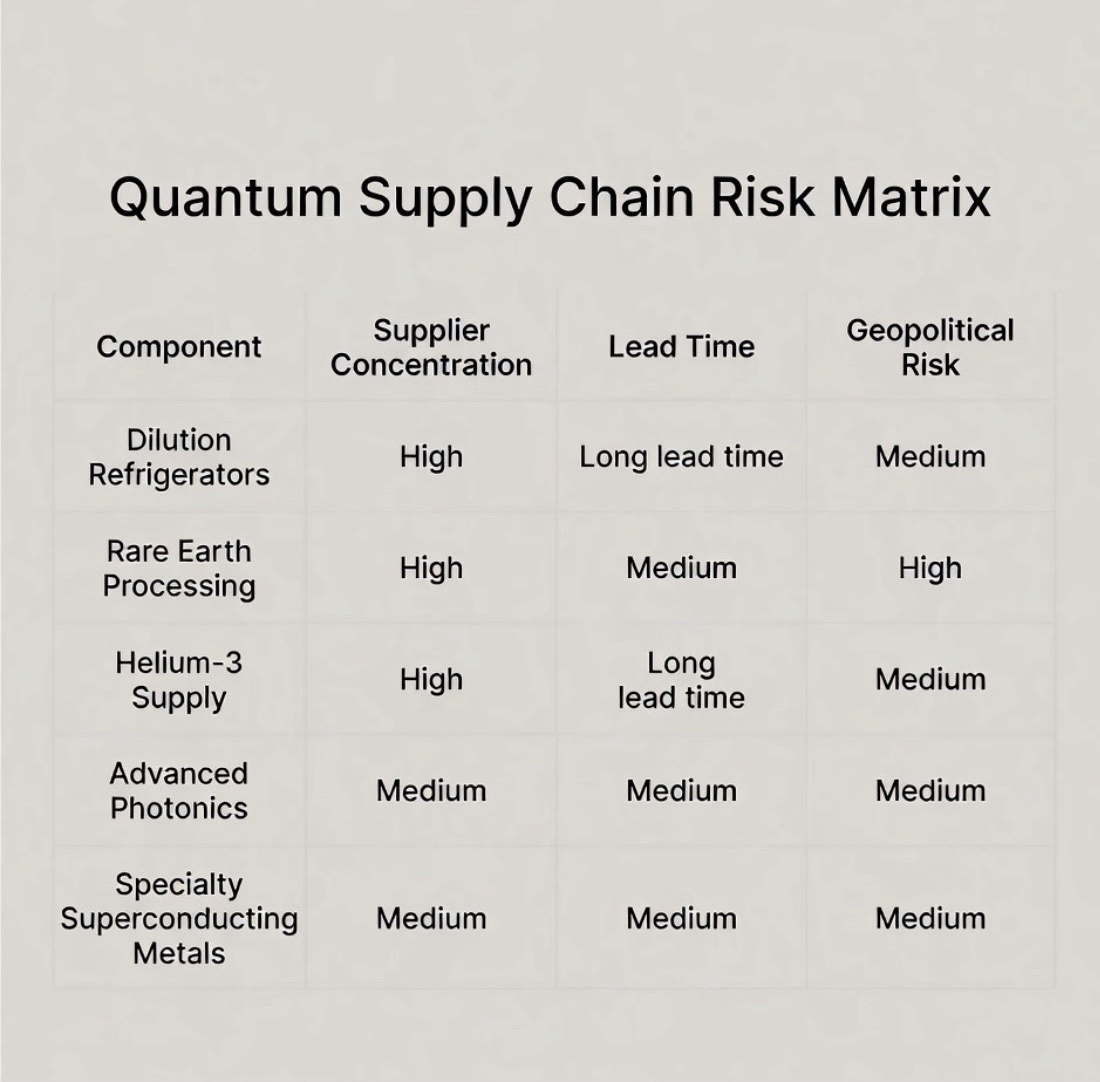
When engineers talk candidly, they will admit that certain subsystems effectively have a short list of viable providers. Dilution refrigeration, precision cryocoolers, advanced photodetectors, specialized vacuum systems—these are not commodity goods. They are manufactured by firms that spent decades refining niche expertise. That expertise is not easily replicated by simply allocating funds or announcing domestic capacity goals.
Lead times for high-end cryogenic equipment can stretch for months, sometimes longer depending on customization and integration demands. Production capacity is not infinite. Scaling it requires skilled labor, component sourcing, quality assurance frameworks, and supplier ecosystems that are themselves constrained. In a steady-state research environment, this tension is manageable. Under geopolitical fragmentation and export scrutiny, it becomes structural risk.
The same pattern appears in advanced lasers and photonics packaging. Precision components move through supply chains where small disruptions cascade quickly. If a supplier pauses shipments pending regulatory review, or if an export license requires additional documentation, the delay is not absorbed easily. Quantum programs are rarely modular enough to swap in off-the-shelf alternatives without redesign.
Semiconductor fabrication deepens the exposure. Even when quantum processors themselves are not fabricated in mainstream advanced nodes, they rely on electronic control systems and fabrication techniques tied to highly specialized equipment. The semiconductor industry has already been reshaped by strategic competition, with restrictions on advanced lithography tools and high-end chips. The spillover into adjacent ecosystems, including quantum-enabling hardware, is not hypothetical. It is a logical extension of existing policy patterns.
Export controls: not dramatic, but decisive
Export control frameworks have evolved quietly over the past few years. What began as targeted restrictions on advanced semiconductors and fabrication tools has expanded into broader scrutiny of enabling technologies. The language often centers on “dual use,” a term that sounds technical but carries strategic weight. When quantum sensing, encryption, and advanced computing intersect with defense and intelligence interests, the compliance environment tightens.2
Licensing processes are not inherently adversarial. They are administrative by design. Yet administration can slow momentum. Documentation requirements expand. Transaction reviews become more detailed. Cross-border research collaborations require additional diligence. Companies invest in compliance teams not because they seek bureaucracy, but because the alternative is operational uncertainty.
For firms operating across multiple jurisdictions, the complexity compounds. Different regulatory regimes define risk differently. A component considered routine in one market may trigger review in another. Navigating that terrain requires legal literacy alongside engineering competence. Smaller firms feel this pressure acutely; larger firms absorb it through scale but rarely eliminate it.
The net effect is subtle but real: the quantum hardware supply chain becomes segmented along political lines. Trusted partnerships deepen within blocs. Trade between blocs requires heavier paperwork and, occasionally, reconfigured product lines. None of this halts development outright. It does, however, shape who moves fastest and who spends disproportionate time clearing administrative hurdles.
2027 as an inflection point
The focus on 2027 is not arbitrary. It sits at the convergence of several timelines: corporate roadmaps for quantum deployment are moving from experimental access to structured service offerings, governments are aligning funding cycles with strategic technology objectives, post-quantum cryptography standards are transitioning from draft to implementation, and export-control regimes are becoming more refined and, in some cases, more expansive.6
That convergence means supply chains that once operated in a research rhythm will be asked to function at quasi-industrial scale under tighter oversight. The friction that was tolerable when systems were few becomes visible when systems multiply. A six-month delay on one refrigerator is inconvenient. A six-month delay across dozens of installations becomes a strategic setback.
Global trade does not collapse under this pressure. It reorganizes. Firms re-evaluate vendor lists. Governments expand incentives for domestic processing and fabrication. Allied sourcing becomes a phrase repeated often enough to become policy. The question is not whether this reorganization will happen. It is how orderly it will be—and how much of it will be reactive rather than planned.
At this stage, quantum supply chain security stops being a theoretical discussion about resilience. It becomes a measurable competitive factor. Those who mapped dependencies early and diversified with discipline will absorb shocks. Those who assumed continuity as a default condition will spend 2027 renegotiating reality.
The cyber layer: when the supply chain itself becomes a target
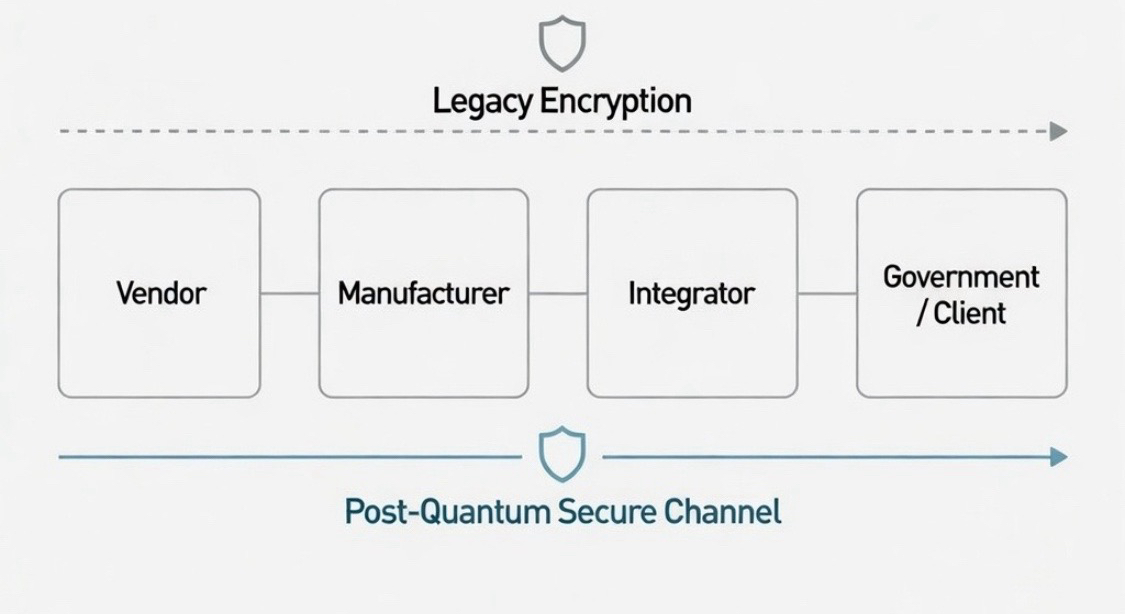
Physical chokepoints are visible. Data exposure is quieter. Every quantum hardware program generates a detailed record of its own dependencies: vendor contracts, technical drawings, firmware revisions, calibration logs, logistics schedules, and communications between engineering teams and suppliers. In ordinary times, this information is treated as commercially sensitive. In a period of strategic competition, it becomes operational intelligence.
The concern is not dramatic; it is procedural. Information intercepted or collected today can retain value years from now. Procurement archives reveal which subsystems are hardest to replace. Technical correspondence exposes integration challenges and known weaknesses. Shipment data outlines which facilities handle critical components. Even without breaking into a laboratory, an adversary who understands the supply chain understands pressure points.
Post-quantum cryptography enters here not as a theoretical safeguard but as a timeline issue. Classical encryption schemes that protect supply-chain communications were not designed with long-lived, high-value industrial secrets in mind under a quantum threat model. Even if large-scale quantum decryption capabilities are not immediately operational, the logic of collecting encrypted traffic now and attempting decryption later has already shaped cybersecurity strategy. That shifts the burden of proof onto organizations handling quantum-enabling hardware.
Supply-chain security, then, is not just about verifying physical components. It is about protecting the metadata that describes those components. Bills of materials, vendor risk assessments, and compliance documentation must be treated as durable assets. The longer a quantum program runs, the more sensitive its accumulated data becomes. Retention policies, encryption upgrades, and migration to post-quantum standards move from future planning to present necessity.
Vendor mapping as strategic discipline
In industries accustomed to layered subcontracting, it is easy to know the immediate supplier and remain vague about tiers beneath. Quantum hardware does not allow that comfort. If a cryogenic subsystem depends on a specialty alloy from a single processor, and that processor depends on a refining facility subject to export review, then the apparent diversity at the top of the chain masks a single point of failure.
Serious risk management requires mapping not just vendors but sub-tier dependencies, intellectual property linkages, and manufacturing geographies. That mapping is rarely glamorous. It is time-consuming, occasionally resisted by partners protective of proprietary relationships, and complicated by shifting ownership structures. Yet without it, diversification efforts remain cosmetic.
Governments have begun to demand more transparency in critical technology supply chains, not as a punitive measure but as a baseline requirement for public procurement and strategic funding. Companies that anticipate those expectations and build traceability into contracts position themselves differently from those who treat compliance as a last-minute scramble.
There is a tension here between openness and security. Revealing too much about a supply network can create exposure. Revealing too little can prevent informed mitigation. Navigating that balance requires structured information-sharing frameworks, clear classification policies, and disciplined access controls rather than blanket secrecy.
Resilience is not redundancy alone
Redundancy is often cited as the answer to supply risk: find a second supplier, stockpile critical inputs, diversify sourcing across allied markets. Those steps matter. They are also incomplete. Redundancy without quality equivalence simply shifts risk from scarcity to performance degradation. A backup component that introduces instability at cryogenic temperatures is not a solution. It is a deferred failure.
True resilience blends diversification with standardization. Where possible, designs must avoid locking into hyper-specific components that cannot be substituted without redesign. That requires foresight during the engineering phase, not after a disruption occurs. It also requires procurement teams to work alongside engineers rather than downstream from them.
Stockpiling, while politically attractive, introduces its own constraints. Certain materials degrade, certain components evolve quickly, and long storage cycles can create compatibility gaps when systems are upgraded. The challenge is not to warehouse indefinitely but to maintain a rolling buffer aligned with realistic deployment schedules.
Strategic reserves make sense when calibrated carefully. They make less sense when they become symbolic gestures disconnected from actual consumption patterns. The discipline lies in quantifying what is genuinely critical, what can be substituted, and what can be redesigned out of future iterations entirely.
Fragmentation versus cooperation
There is a temptation to frame the quantum supply chain in purely adversarial terms, as if the outcome must be rigid blocs and technological decoupling. Reality is more nuanced. Even in periods of tension, industrial ecosystems remain interdependent. Components cross borders. Research collaborations persist, though under scrutiny. Complete isolation is rarely feasible without sacrificing efficiency and innovation.
The more plausible near-term trajectory is selective fragmentation. Certain high-risk technologies become restricted, while less sensitive components continue to circulate. Trade becomes conditional rather than free-flowing. Companies adapt by building parallel product lines for different regulatory environments, increasing cost but preserving market access.
For quantum hardware, that could mean differentiated configurations depending on export classifications, with some features limited in certain jurisdictions. It could mean deeper alliances among countries that share regulatory standards and security frameworks. It could also mean increased pressure on smaller firms caught between competing regimes.
The stability of global trade in 2027 will depend less on whether fragmentation exists and more on whether it is predictable. Businesses can adapt to constraints when those constraints are clear. Sudden policy shifts and opaque licensing decisions create volatility that undermines long-term planning.
Quantum supply chain security, then, sits at the intersection of engineering discipline, cybersecurity foresight, and geopolitical literacy. Treating any one of those domains in isolation leaves exposure elsewhere. Integrating them is uncomfortable, resource-intensive, and unavoidable.
Economic stakes: when delay becomes competitive loss
Quantum markets are still measured in billions rather than trillions, but that understates their strategic gravity. The economic value is not only in selling machines. It sits in who gains early access to simulation capacity, optimization capabilities, and secure communications infrastructure. If a national program or private consortium secures reliable hardware deployment ahead of competitors, the advantage compounds across defense modeling, pharmaceutical research, advanced materials discovery, and financial risk analysis. Supply-chain friction translates directly into lost iteration cycles.
Deployment timelines are sensitive to hardware availability in ways that software industries rarely experience. When superconducting systems require precise cryogenic environments and complex integration, each installation becomes a coordinated project. If a key component is delayed by months, downstream milestones slide. Investors recalibrate expectations. Governments adjust funding narratives. Talent mobility follows perceived momentum.
In 2027, those compounding effects will matter more than marketing language. A firm that can deliver stable systems on schedule while competitors renegotiate supplier agreements gains reputational capital that is difficult to dislodge. A national program that demonstrates reliable scaling signals industrial maturity beyond laboratory success. Conversely, a program that stumbles repeatedly due to procurement bottlenecks sends a different signal, regardless of theoretical breakthroughs.
Global trade amplifies these signals. Countries positioning themselves as hubs for advanced computing and quantum services must reassure partners that supply chains are stable, secure, and legally predictable. Firms negotiating cross-border deployments must answer questions not only about performance metrics but about vendor traceability, export compliance, and post-quantum data security practices.
Industrial policy and the race for trusted capacity
Industrial policy has re-entered mainstream economic discourse with force. Incentive programs aimed at semiconductor fabrication, advanced manufacturing, and strategic materials processing are no longer politically marginal. Quantum hardware is small compared to mainstream chip production, yet it draws from the same foundational infrastructure: precision machining, advanced materials, fabrication facilities, and specialized engineering labor.
Governments are not simply funding research laboratories. They are funding ecosystems: foundries, supplier networks, workforce development programs, and domestic processing capabilities for critical inputs. The objective is not autarky but leverage. When supply chains are partially anchored within allied or domestic frameworks, exposure to abrupt external restriction decreases.
The lag, however, is structural. Building trusted capacity is a multi-year effort. Facilities must be constructed, certified, staffed, and integrated into global vendor networks. During that build-out, existing dependencies remain. That creates a transitional period where strategic intent outpaces industrial reality. The friction of that transition will be felt acutely around 2027, when early industrial policy investments are expected to produce tangible output.
Private firms navigating this environment face dual incentives. They must comply with evolving export and compliance frameworks while maintaining enough global engagement to remain commercially viable. Over-rotation toward isolation reduces market reach. Under-rotation risks regulatory exposure. Strategic equilibrium requires continuous reassessment of vendor portfolios, jurisdictional risk, and long-term alignment with policy trends.
Why supply bottlenecks reshape alliances
When advanced technologies hinge on scarce inputs, alliances deepen around shared access. Joint research initiatives expand to include joint procurement and shared infrastructure. Countries pool funding for facilities that would be inefficient to replicate individually. Standards bodies coordinate on interoperability and compliance to reduce friction within trusted networks.
At the same time, fragmentation pressures remain. Competing blocs invest in parallel capabilities, sometimes duplicating effort to avoid strategic dependency. This duplication increases cost but reduces vulnerability. In quantum hardware, where margins for error are thin, the trade-off between efficiency and sovereignty becomes explicit rather than abstract.
Global trade in 2027 will not be defined solely by tariffs or quotas. It will be shaped by confidence: confidence that components can move across borders without indefinite delay, that licensing decisions are predictable, and that cybersecurity standards protect sensitive industrial data. Where that confidence erodes, trade contracts. Where it stabilizes, trade persists—even under stricter rules.
The human layer: expertise as a scarce resource
Supply chains are not only physical and legal constructs; they are networks of people with specialized expertise. Cryogenic engineering, advanced photonics integration, quantum control electronics, and precision fabrication depend on skill sets that are not easily trained at scale. Visa regimes, academic exchange policies, and research collaboration rules therefore influence hardware timelines as much as material availability.
Restrictions on talent mobility can unintentionally create bottlenecks parallel to material shortages. A facility with funding and equipment but insufficient experienced engineers cannot accelerate output simply by increasing capital expenditure. Conversely, collaborative ecosystems that manage to balance security concerns with open scientific exchange often sustain momentum more effectively.
In the calculus of quantum supply chain security, workforce resilience becomes part of the equation. Training programs, cross-border research partnerships under clear compliance frameworks, and knowledge transfer within trusted networks mitigate risk that would otherwise concentrate in a handful of overextended teams.
By 2027, the narrative around quantum advantage will increasingly reflect not only scientific achievement but supply-chain maturity. Markets and policymakers will ask which ecosystems can build, secure, and sustain hardware deployment without chronic delay. The answer will determine not just who leads technically, but who shapes the rules of global trade in the quantum era.
Securing the chain: discipline before disruption
There is no single lever that “fixes” quantum supply chain exposure. What separates serious actors from reactive ones is discipline applied early. The first step is clarity: mapping dependencies at a level that includes sub-tier suppliers, fabrication partners, logistics hubs, and software integrations that touch hardware control systems. Many firms assume they understand their supply chain because they know their immediate vendors. That assumption breaks down under stress. True visibility requires contractual transparency, periodic audits, and technical literacy within procurement teams.
Governments have begun institutionalizing this approach. Vendor risk assessment frameworks, mandatory disclosure requirements for public contracts, and tighter export licensing processes are not random obstacles. They are attempts to impose structure on ecosystems that grew rapidly without geopolitical friction as a design parameter. Firms that treat these requirements as compliance burdens miss the strategic opportunity. The documentation demanded for public procurement often doubles as a resilience blueprint when disruptions occur.
Diversification is the most cited response, and it matters. Sourcing critical components from multiple jurisdictions reduces exposure to unilateral restriction. Yet diversification without coordination can multiply complexity. Suppliers must meet identical quality standards. Integration testing must accommodate variation. Contracts must anticipate regulatory divergence. The goal is not simply more suppliers, but interchangeable capability verified through rigorous qualification.
Stockpiling appears attractive during periods of uncertainty, particularly for materials with concentrated processing capacity. But hoarding is not strategy. Critical materials must be rotated, tracked, and aligned with realistic deployment schedules. Over-accumulation ties up capital and creates storage risk. Under-accumulation leaves programs exposed. Strategic reserves function best when tied to clear consumption models and periodic review rather than political optics.
Post-quantum cryptography inside the supply chain
Supply-chain hardening is incomplete if it stops at physical redundancy. Information flows must be upgraded in parallel. Contracts, engineering drawings, firmware updates, maintenance logs, and procurement records travel through digital channels that were architected under classical cryptographic assumptions. Transitioning to post-quantum cryptography standards for these records is not symbolic; it is preventive maintenance for industrial intelligence.5
Migration is complex. Legacy systems must interoperate with new cryptographic schemes. Partners across jurisdictions must align on standards to avoid fragmentation. Yet delaying migration risks accumulating encrypted archives that age poorly. Sensitive documentation describing hardware configurations and vulnerabilities should not depend indefinitely on cryptographic primitives whose long-term resilience is contested.
Forward-looking organizations treat cryptographic agility as part of vendor qualification. They assess whether partners can update security protocols without disrupting operations. They build internal capacity to implement new standards incrementally rather than through abrupt overhauls. By 2027, such agility will distinguish firms that anticipated change from those forced into hurried compliance.
Design choices as risk mitigation
Engineers hold more leverage over supply-chain resilience than they sometimes acknowledge. Architectural decisions can either lock systems into narrow component ecosystems or allow substitution without catastrophic redesign. Standardized interfaces, modular subsystems, and documented tolerance ranges expand future flexibility. Over-optimization around a single vendor’s component may deliver marginal performance gains while entrenching long-term dependency.
Resilience-oriented design requires early collaboration between engineering and procurement teams. It is not enough to verify that a component performs under laboratory conditions. Teams must ask whether equivalent alternatives exist, whether the supplier base is geographically concentrated, and how quickly production capacity could scale under surge demand. These questions feel commercial, yet they shape technical viability over multi-year horizons.
Lifecycle planning also plays a role. End-of-life strategies for critical components—recovery, refurbishment, or controlled recycling—reduce pressure on primary supply. In certain cases, urban mining of specialty materials may supplement new sourcing. Closed-loop systems for cryogenic gases and rare inputs improve not only environmental metrics but strategic independence.
Allied sourcing and trusted networks
As trade architectures adjust, alliances around trusted sourcing become more formalized. Shared compliance frameworks, mutual recognition of security standards, and coordinated export licensing reduce friction within blocs. For quantum hardware firms, alignment with such networks can provide stability even when global conditions remain volatile.
This alignment does not imply exclusionary isolation. It signals clarity. When regulatory expectations are predictable and certification pathways transparent, firms can plan procurement cycles with greater confidence. Investors respond to predictability; so do customers deploying sensitive infrastructure.
At the same time, companies operating across multiple markets must maintain fluency in divergent regulatory environments. Building internal legal and compliance expertise is no longer optional overhead. It is strategic infrastructure. Firms that underestimate this reality risk discovering too late that technical readiness is meaningless without authorization to ship.
Preparing for 2027 without overreaction
Framing quantum supply chain security as an imminent crisis can be counterproductive. Overreaction can freeze collaboration, inflate costs, and encourage inefficient duplication. The more constructive stance recognizes structural risk while preserving functional trade where feasible. The objective is not to sever global interdependence, but to manage it consciously.
Preparation therefore emphasizes calibration: measured diversification, transparent vendor mapping, cryptographic modernization, and continuous dialogue with regulators rather than adversarial standoffs. Governments and industry share incentives here. Abrupt disruption harms both sides. Structured resilience strengthens both.
By the time 2027 arrives, the firms and ecosystems that invested in disciplined preparation will not appear dramatic. They will appear steady. Deliveries will arrive within forecast windows. Compliance reviews will pass without emergency revisions. Cybersecurity teams will operate under updated standards rather than retrofitted patches. That steadiness, in a strategic technology race, is competitive advantage disguised as operational competence.
What 2027 will reveal about power
Power in advanced technology is often misread as laboratory achievement. In practice, it is logistical reliability. The country or consortium that can move sensitive components across borders without indefinite delay, certify vendors without paralyzing collaboration, and protect industrial data without strangling interoperability holds more influence than the one that merely announces a breakthrough.
Quantum hardware sharpens that reality. It compresses geopolitical tension, industrial capacity, and cybersecurity into a single system that either deploys on schedule or does not. By 2027, the measure of maturity will not be press releases about qubit counts. It will be installation density, uptime, cross-border deployment capability, and supply continuity under constraint.
Global trade architecture is already bending around sensitive technologies. Quantum does not create that shift; it accelerates it. Licensing frameworks will grow more specific. Vendor audits will become more common. Procurement language will increasingly reference security standards and post-quantum readiness alongside technical specifications. These changes will not feel revolutionary. They will feel procedural. Their cumulative effect will be structural.
The most resilient ecosystems will be those that avoided absolutism. Total dependency invites coercion. Total isolation invites stagnation. Between those poles lies disciplined interdependence—alliances grounded in shared standards, diversified sourcing calibrated to technical reality, and cryptographic modernization embedded quietly into everyday operations.
The race behind the race
Much attention focuses on the visible race for quantum advantage, measured in hardware performance and algorithmic capability. Running parallel to it is a quieter race: who can construct a supply chain that does not fracture under political stress, resource scarcity, or cryptographic transition. The second race determines whether the first translates into sustained influence.
Engineers often focus on coherence times and error correction. Procurement teams focus on delivery schedules. Security teams focus on encryption and data retention. In isolation, each group solves a fragment. Together, they define whether a quantum program survives contact with reality.
By 2027, that integration will separate aspirational strategies from durable ones. Organizations that treated quantum supply chain security as a peripheral compliance exercise will confront bottlenecks they cannot accelerate through funding alone. Those that treated it as core infrastructure—mapping vendors, modernizing cryptography, diversifying with discipline, and aligning with predictable trade frameworks—will operate with fewer surprises.
Securing global trade is securing capability
Quantum hardware will not overturn global trade. It will refine it. Sensitive technologies tend to carve out tighter corridors through which trust must flow. The width of those corridors depends on transparency, shared standards, and credible enforcement rather than rhetoric.
Securing global trade in 2027 therefore means securing the integrity of the systems that enable quantum hardware to move, operate, and scale. It means acknowledging material dependencies rather than obscuring them. It means upgrading information security before archives become liabilities. It means aligning industrial policy with engineering timelines rather than assuming political will can compress fabrication cycles.
The conversation around quantum advantage often gravitates toward who builds the most capable machine. The more enduring question is who builds the most resilient chain beneath it. In a landscape shaped by export controls, material chokepoints, and evolving cryptographic standards, resilience is not a slogan. It is leverage.
The race is not only for qubits. It is for continuity.
Frequently Asked Questions About The Quantum Supply Chain (FAQ)
What does “quantum supply chain” actually include?
It’s the full stack of inputs required to build and operate quantum systems: critical materials (specialty gases, rare inputs, superconducting metals), high-precision components (cryogenics, lasers, photonics), fabrication and packaging capacity, test/measurement equipment, and the cross-border logistics and compliance layers that move all of it. In practice, the risk is rarely “a missing chip” and more often a chokepoint in a niche industrial subsystem with long lead times.
Why is 2027 used as a strategic reference point?
Because procurement cycles and export-control regimes move on multi-year timelines, and the “slow parts” of quantum hardware (specialized cryogenics, optics, and qualified supply) don’t scale on demand. The point is less a calendar prediction and more a planning horizon: what looks “fine” in a lab prototype can become fragile at deployment scale once lead times, controls, and supplier concentration collide.
What is “Harvest Now, Decrypt Later” in a supply-chain context?
It’s the idea that an adversary can capture encrypted data today (contracts, BOMs, design files, vendor communications, shipping manifests) and decrypt it later when quantum-capable cryptanalysis becomes practical. Supply chains are rich in long-lived sensitive data: vendor maps and engineering documentation remain valuable even years after capture.
What’s the first practical step for companies that buy or build quantum hardware?
Build a “true dependencies” map: which components are single-sourced, which have the longest lead times, where export controls or licensing can interrupt delivery, and which suppliers sit behind your suppliers. Most organizations underestimate tier-2 and tier-3 fragility. Once the map exists, you can justify dual-sourcing, qualification budgets, buffer inventory, and data-security upgrades with real numbers.
Does “post-quantum cryptography” matter for logistics and procurement data already?
Yes—because the value of supply-chain intelligence isn’t short-lived. Even before full migration, prioritizing PQC for high-sensitivity flows (supplier agreements, design exchanges, firmware signing, and long-term archives) reduces the “store-now, crack-later” exposure. The sensible move is staged migration: protect the most durable and most exploitable data first.
References
- National Institute of Standards and Technology (NIST). (2024). FIPS 205: Stateless Hash-Based Digital Signature Standard (SLH-DSA). NIST Computer Security Resource Center.
https://csrc.nist.gov/pubs/fips/205/final
↩ - Bureau of Industry and Security (BIS), U.S. Department of Commerce. (2024, September 6). Commerce Control List Additions and Revisions; Implementation of Controls on Advanced Technologies. Federal Register.
https://www.federalregister.gov/documents/2024/09/06/2024-19633/commerce-control-list-additions-and-revisions-implementation-of-controls-on-advanced-technologies
↩ - International Energy Agency (IEA). (2024). Critical minerals (data and analysis; includes processing concentration and supply-chain risk context). IEA.
https://www.iea.org/topics/critical-minerals
↩ - U.S. Geological Survey (USGS). (2026). Mineral Commodity Summaries 2026: Helium. USGS.
https://pubs.usgs.gov/periodicals/mcs2026/mcs2026-helium.pdf
↩ - National Institute of Standards and Technology (NIST). (2024). FIPS 203: Module-Lattice-Based Key-Encapsulation Mechanism Standard (ML-KEM). NIST Computer Security Resource Center.
https://csrc.nist.gov/pubs/fips/203/final
↩ - National Institute of Standards and Technology (NIST). (2024). FIPS 204: Module-Lattice-Based Digital Signature Standard (ML-DSA). NIST Computer Security Resource Center.
https://csrc.nist.gov/pubs/fips/204/final
↩