
Quantum logic may sound like a concept built only for scientists, but its principles affect everyone living in a digital world. It is the foundation of quantum computing — a new model of processing information that challenges everything we know about classical computers. While traditional logic is built on fixed values, quantum logic is built on probability, superposition, and the idea that information can exist in multiple states at once.
If you have ever wondered why quantum computers behave differently, why qubits feel so mysterious, or how these ideas translate into real technology, this guide breaks it all down in simple language. You will learn how quantum systems process information, how quantum gates reshape computation, and why quantum logic is becoming one of the most important skills in modern tech.
The goal of this article is straightforward: to make quantum logic understandable, practical, and enjoyable — even if you have no background in physics or advanced mathematics. Let’s begin with the key difference between classical and quantum ways of thinking.
Understanding the Difference Between Classical and Quantum Logic
Classical logic is the framework behind all traditional computers. Every value is either a 0 or a 1, and every operation follows the rules of Boolean algebra. Your laptop, your phone, and even satellites rely on this strict binary system — a world of definite outcomes and predictable steps.
Quantum logic breaks away from that rigidity. Instead of storing information as fixed values, quantum systems represent information as probabilities. A qubit can be 0, 1, or both at the same time. This unusual property, known as superposition, allows quantum computers to process a wide range of possibilities simultaneously.
The difference is more than technical — it’s philosophical. Classical logic asks, “Is it true or false?” Quantum logic asks, “What is the probability of each truth being real at this moment?” This shift opens doors to new kinds of computation that classical machines cannot perform efficiently.
Before moving further, we first need to understand the basic building block of quantum logic: the qubit.
Check this: Quantum Hardware Explained: 7 Powerful Insights Every Beginner Must Know
What Exactly Is a Qubit?
To understand quantum logic, you must first understand the qubit — the core unit of quantum information. A qubit is similar to a classical bit but far more expressive. While a traditional bit can only hold one value at a time, a qubit uses the rules of quantum mechanics to exist in multiple states simultaneously.
The easiest way to imagine a qubit is to picture a coin. A classical bit is like a coin lying flat on the table: it is either heads or tails. A qubit, however, is like a coin spinning in the air — at that moment, it represents both heads and tails at once. This “multi-state” nature is what gives quantum computing its unusual power, allowing quantum machines to analyze many possibilities in parallel.
Physically, qubits can be implemented using trapped ions, superconducting circuits, photons, or electron spins. Companies like IBM, Google, and Intel use superconducting qubits cooled to temperatures colder than outer space. These extreme conditions help preserve the delicate quantum states that make quantum logic possible.
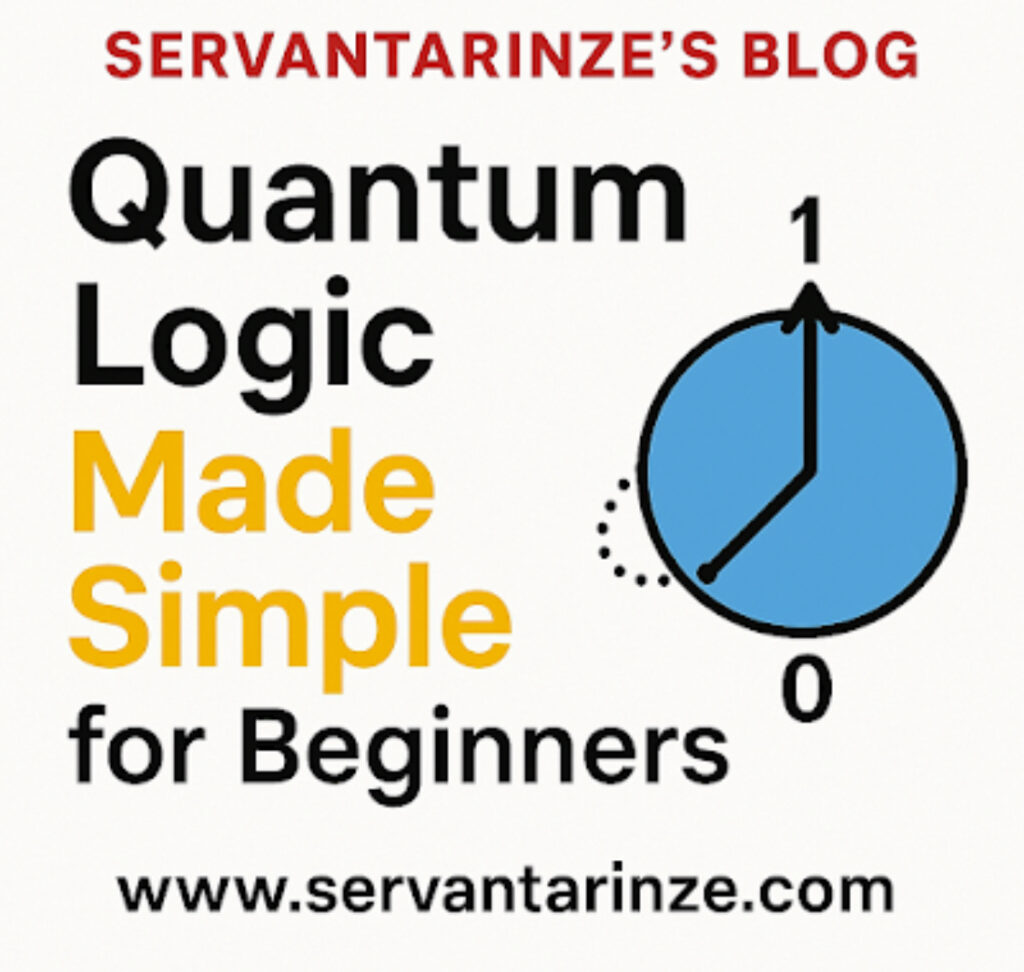
The orientation of a qubit can be represented on a sphere called the Bloch Sphere. Instead of flipping between 0 and 1 like a switch, a qubit smoothly rotates between all the possible combinations of those values. This continuous range of states enables more flexible and powerful computation than classical binary logic.
Once you understand the qubit, the next step is learning the two principles that make quantum logic unique: superposition and entanglement.
The Power of Superposition and Entanglement
Two concepts form the heart of quantum logic: superposition and entanglement. These are the rules that allow quantum systems to behave differently from anything in classical computing.
Superposition means a qubit can hold multiple values at once. Instead of choosing between 0 or 1, a qubit can represent both. This allows quantum computers to analyze countless possibilities in parallel, making them extremely powerful for tasks like optimization, simulation, and cryptography.
Entanglement, on the other hand, connects two or more qubits in a way that classical systems cannot match. When qubits become entangled, the state of one qubit instantly affects the state of the other — even if they are separated by long distances. Einstein famously referred to this as “spooky action at a distance,” yet it is a scientifically proven phenomenon and a key pillar of quantum logic.
Together, superposition and entanglement unlock the massive parallelism that gives quantum computers their advantage. These principles allow quantum systems to search vast problem spaces, process encrypted information, simulate molecules, and solve structures that classical algorithms struggle to handle.
To work with qubits in meaningful ways, quantum computers use specialized building blocks known as quantum gates. These gates manipulate qubit states through rotations, phase shifts, and interference — creating the foundation of every quantum algorithm.
How Quantum Gates Actually Work
In classical computing, logic gates like AND, OR, and NOT operate on bits that are either 0 or 1. But in quantum logic, gates work very differently. Instead of flipping fixed values, quantum gates gently rotate, shift, or phase-adjust a qubit on the Bloch Sphere. This means each gate changes the probability distribution of a qubit instead of simply switching it from one state to another.
The most common example is the Hadamard Gate (H). This single operation pushes a qubit into perfect superposition — a balanced state where it represents both 0 and 1 at the same time. For beginners learning quantum logic, this is often the first moment where quantum computing feels truly different from everything you know about classical systems.
Another essential gate is the Pauli-X Gate, which behaves like a quantum version of the classical NOT gate. Instead of flipping 0 to 1, it flips the state vector across the Bloch Sphere. Other Pauli gates (Y and Z) rotate qubits around different axes and play critical roles in phase manipulation, an important part of quantum algorithms.
When these gates are combined in sequence, they form a quantum circuit. This circuit defines how qubits change over time, how interference builds up, and how probabilities collapse into meaningful outcomes after measurement. Every quantum algorithm — from Shor’s factorization to Grover’s search — is ultimately built from these basic building blocks.
Reversible Computation and Quantum Truth Tables
One of the first surprises beginners encounter when studying quantum logic is that every quantum operation must be reversible. Unlike classical gates, which sometimes lose information, quantum gates preserve all the information encoded in the qubit’s state. This is a requirement of quantum mechanics: no information may be destroyed, only transformed.
This has major implications for energy efficiency. In classical systems, irreversible operations — like certain AND or OR outcomes — discard information, which is directly connected to heat generation at the hardware level. Quantum logic avoids this waste entirely. Because quantum gates are reversible, they offer a blueprint for future computers that operate with dramatically lower energy overhead.
Reversible computation leads to a different kind of truth table. Instead of mapping single inputs to single outputs, quantum truth tables describe transformations of the entire state space. The famous CNOT Gate (controlled-NOT) is a perfect example. It flips the state of a target qubit based on the condition of a control qubit, making it both reversible and essential for generating entanglement.
Understanding reversible gates is a key step in mastering quantum logic. They ensure that quantum algorithms maintain coherence, preserve interference patterns, and avoid information loss — all of which are crucial for building stable quantum circuits.”
Quantum Circuits Simplified
To visualize a quantum circuit, imagine a musical composition. Each “wire” represents a qubit, and each gate symbol represents an instruction that changes that qubit’s state. When read from left to right, the circuit diagram shows how qubits evolve from their initial configuration into a final result that can be measured.
For example, a circuit with three qubits can represent eight simultaneous states due to superposition (2³). Adding even a few gates creates complex interference patterns that amplify correct answers and suppress incorrect ones — the essence of how quantum logic produces useful outcomes from probabilistic states.
Modern tools such as IBM’s Qiskit Composer, Google’s Cirq Visualizer, and the Quirk simulator allow beginners to experiment with gates visually. By dragging and dropping gates into a circuit and seeing how they change qubit states, anyone can build intuition for how quantum computers “think.”
As circuits grow in complexity, interference becomes the key ingredient. Quantum algorithms work by carefully designing interference patterns so the right answers survive and the wrong answers cancel themselves out. This ability to manipulate probability through structured logic is one of the most elegant aspects of quantum computation.
Understanding Measurement and Collapse
One of the most misunderstood parts of quantum logic is the idea of measurement. Before a qubit is observed, it exists as a blend of probabilities — not just 0, not just 1, but a calculated mixture of both. This mixture is what gives quantum computing its power. But the moment you measure a qubit, that delicate blend collapses into a definite state.
The collapse is not random chaos. It follows precise mathematical rules. If a qubit leans more toward the “0” side of the Bloch Sphere, it is more likely to collapse into 0. If it leans more toward the “1” side, it is more likely to collapse into 1. The process is unpredictable for individual qubits, but predictable across many repeated measurements. This is why quantum computers run the same circuit many times — to extract useful statistical patterns.
This collapse phenomenon forces engineers to think differently. In classical computing, you can check a value anytime without changing it. But in quantum logic, measurement destroys the quantum state. Engineers must design circuits carefully, waiting until the exact final moment to measure. A measurement made too early wipes out the computational advantage offered by superposition and interference.
For beginners, this idea can feel strange. But it mirrors nature precisely. Measurement is not a flaw — it is a built-in rule of how information behaves at the quantum level. Understanding this rule is essential for mastering quantum logic and building algorithms that take advantage of quantum behavior rather than working against it.
Visualizing Quantum States
Because quantum states cannot be seen directly, visualization becomes an essential learning tool. One of the clearest ways to imagine a qubit is through the Bloch Sphere. This 3D model represents every possible qubit state on the surface of a sphere: the North Pole for 1, the South Pole for 0, and every point in between representing a unique quantum mixture.
With quantum logic, gates rotate the qubit around this sphere. A simple phase shift can move the qubit into a new orientation that produces completely different probabilities during measurement. Seeing these rotations helps beginners understand that quantum computing is not magic — it is geometry applied to probability.
Several visualization tools make this easier to grasp. Q-CTRL’s visualizers show how qubit states respond to noise, pulses, and gate operations. Quirk, a browser-based simulator, displays how interference patterns grow inside a circuit. IBM’s educational tools provide step-by-step visual animations of how qubits evolve through each gate in a sequence.
These tools turn abstract math into something intuitive. You can literally watch a qubit rotate, stretch, compress, or shift phase as it passes through different gates. For anyone just entering the world of quantum logic, these visuals transform confusion into clarity.
Common Misconceptions About Quantum Logic
Quantum computing has exploded in popularity, but with popularity comes confusion. One of the biggest misconceptions is that quantum computers are simply “faster versions” of classical computers. That’s not true. They don’t speed up everything — they accelerate specific tasks where superposition and interference matter.
Another common misunderstanding is the belief that quantum logic violates natural laws or represents some mystical force. In reality, it follows strict mathematical rules that have been validated through decades of experiments in physics, chemistry, and engineering. Everything quantum computers do is governed by precise equations — nothing mystical, nothing magical.
Some people also assume that quantum logic will instantly break all cybersecurity overnight. This exaggeration creates fear, but the truth is more nuanced. Quantum computers threaten specific algorithms, not the entire security ecosystem, and new quantum-safe standards are already in place to protect the future internet.
Finally, many believe quantum logic is too complicated for beginners to learn. The opposite is true. With good explanations, simple visuals, and structured examples, anyone can understand the core ideas. Quantum logic is not a secret reserved for experts — it is an evolving field where curious learners are always welcome.
Quantum Logic vs Classical Algorithms
To understand why quantum logic matters, you must see how it completely reshapes the way algorithms work. Classical algorithms follow a linear or branching structure — they evaluate one possibility, then the next, and so on, step by step. Even when you use parallel processing with GPUs or clusters, the system still breaks the task into many smaller classical steps.
Quantum logic introduces a different approach. Instead of evaluating one path at a time, a quantum algorithm uses superposition to explore many paths simultaneously. It then uses interference — constructive and destructive — to amplify correct answers and cancel out incorrect ones. This is not “speed” in the traditional sense; it is a new way of navigating information.
A clear example is Shor’s Algorithm, which factors large numbers exponentially faster than known classical methods. This is why it threatens RSA encryption. Another is Grover’s Algorithm, which reduces the time required to search unstructured data from n steps to roughly √n. These improvements emerge from logical operations that obey quantum rules rather than classical ones.
Researchers publishing on platforms like arXiv consistently show that hybrid systems — where classical and quantum logic work together — will dominate future computing. The classical processor provides reliability and scale, while the quantum processor provides exploration, optimization, and depth that classical algorithms cannot match.
This is why quantum logic is not simply an upgrade. It is a new paradigm. And engineers who learn to think in terms of quantum states, interference, and reversible operations will shape the next generation of algorithms.
Read also: Quantum vs Classical: 12 Powerful Differences Explained
Real-World Applications of Quantum Logic
Although quantum computing is still developing, quantum logic already influences real-world industries in measurable ways. In finance, major institutions like JPMorgan and Goldman Sachs collaborate with IBM and Google to test quantum optimization for portfolio modeling and risk analysis. These tasks involve enormous search spaces that benefit directly from quantum logical operations.
In healthcare, quantum simulations help researchers understand molecular structures and protein folding — something classical supercomputers struggle with due to the astronomical number of variables. Quantum logic makes such simulations more realistic by representing molecular states in superposition and handling interactions more naturally.
Cybersecurity experts also rely on quantum logic to plan for the post-quantum world. Understanding how quantum algorithms break classical cryptography helps organizations prepare next-generation encryption standards. This is why PQC (post-quantum cryptography) is becoming part of global cybersecurity policy.
In logistics and transportation, quantum logic improves optimization for route planning, supply chains, and resource allocation. Companies working with quantum annealers — like D-Wave — already report improvements in solving large constraint problems that classical solvers handle slowly.
Even creative industries are experimenting with quantum systems. Simulated quantum randomness produces richer textures in generative art and offers new pathways for music creation. The applications continue to expand as quantum hardware evolves.
How Researchers Use Quantum Logic in AI
The intersection of artificial intelligence and quantum logic is one of the most promising areas of modern research. AI models excel when they can explore high-dimensional data, optimize complex functions, and evaluate many possibilities. These tasks map naturally to quantum computing.
One of the most powerful tools is the Variational Quantum Circuit (VQC). This acts like a quantum neural layer. Instead of weights and activations, it uses gate parameters and quantum transformations. A classical optimizer updates these parameters, while the quantum circuit evaluates the results. This hybrid loop creates models that explore richer feature spaces than classical networks alone.
Another breakthrough is the Quantum Support Vector Machine (QSVM). Instead of using classical kernels, QSVMs embed data into enormous quantum Hilbert spaces. Two points that look inseparable in classical space may become linearly separable in a quantum-enhanced map. This enables better classification for small datasets, noisy patterns, and cybersecurity anomaly detection.
Researchers in IBM’s Quantum AI Initiative, Google Quantum AI, and MIT’s quantum labs report progress in quantum-enhanced clustering, pattern recognition, and reinforcement learning. These systems use quantum logic to evaluate many policy paths simultaneously — something classical RL agents cannot do efficiently.
In simple terms, quantum logic gives AI a new kind of intuition. Instead of scanning data step by step, the model can explore many configurations at once. This leads to faster convergence, deeper insights, and entirely new learning architectures that classical hardware cannot replicate.
Understanding Measurement and Collapse in Quantum Logic
One of the most confusing parts of quantum logic is the idea of measurement. When a qubit is left alone, it exists in a combination of possibilities. But once you measure it, the qubit “collapses” into a definite value — either 0 or 1. This collapse does not mean the quantum state was meaningless; it means you forced the probabilistic world of quantum logic to reveal a single outcome.
For beginners, the simplest way to imagine this is to think of a spinning coin. While spinning, it is neither heads nor tails; it is in motion with both possibilities present. The moment it lands, the uncertainty disappears. Quantum logic behaves the same way — except it uses mathematics, not motion, to hold multiple possibilities.
This collapse process is both powerful and limiting. It allows quantum computers to produce real answers, but it also means the timing of measurement must be carefully controlled. Measuring too early destroys useful quantum information. Measuring too late increases the risk of noise. Researchers design quantum algorithms to strike a perfect balance.
Visualizing Quantum States Without Math
Quantum logic becomes easier when you can “see” the states in your mind. The most common tool for beginners is the Bloch Sphere — a 3D sphere that shows every possible qubit state as a point on its surface. A qubit pointing upward represents 1. Downward represents 0. Any point between represents a mixture of both.
This simple visual helps people understand rotation, phase, interference, and the effects of quantum gates. Tools like Qiskit Visualizer, Quirk, and Q-CTRL animations convert abstract equations into smooth graphics that even beginners can understand. Once you see how quantum states evolve, the whole idea of quantum logic becomes far less mysterious.
Common Misconceptions About Quantum Logic
Because quantum logic feels new and unfamiliar, many myths surround it. One of the biggest misconceptions is that quantum computers are automatically “faster” at everything. They are not. Quantum logic gives exponential advantages only for specific tasks such as optimization, cryptography, and simulation.
Another common myth is that quantum logic is unscientific or violates physical laws. In reality, quantum mechanics is one of the most experimentally proven theories in science. Every major principle — superposition, entanglement, interference — has been verified through thousands of experiments worldwide.
Finally, some believe quantum logic is too complicated for beginners. But once you remove the heavy math and focus on concepts, the core ideas are surprisingly intuitive. You don’t need to understand equations to understand how qubits behave. You only need the right explanations.
How Quantum Logic Appears in Real-World Applications
Quantum logic already shapes industries even though large-scale quantum computers are still developing. In cybersecurity, it is guiding the global shift toward post-quantum cryptography. In finance, it supports risk modeling and portfolio optimization. In medicine, quantum logic helps simulate molecules for drug discovery — something classical computers struggle to do.
Even logistics companies use quantum-inspired methods to optimize routes, reduce travel time, and cut cost. Whenever a problem involves many variables interacting in complex ways, quantum logic offers new approaches that classical algorithms cannot match.
How Quantum Logic Influences AI Research
Artificial Intelligence is one of the fastest-growing areas influenced by quantum logic. Researchers are creating hybrid systems where a classical neural network handles large-scale patterns, while a quantum circuit handles tasks such as feature mapping and optimization.
Variational Quantum Circuits (VQCs) are one of the best examples. These circuits act like quantum “layers” that adapt during training. They explore high-dimensional spaces that classical neural networks cannot reach. The result is AI that can make stronger predictions with fewer parameters.
Quantum Support Vector Machines (QSVMs) are another powerful tool. They use quantum kernels to separate data that is impossible to classify using ordinary methods. For industries like finance and cybersecurity, this opens the door to stronger anomaly detection and fraud prediction.
In summary, quantum logic does not replace AI — it enhances it. The future will belong to systems that combine both classical and quantum models.
Challenges and Limitations of Quantum Logic
Quantum logic is powerful, but it has limits. Real quantum processors suffer from noise — tiny errors caused by heat, vibration, or environmental interference. Qubits also lose their state quickly, a problem called decoherence. These issues make it hard to run long quantum programs without errors.
To address this, researchers are developing quantum error correction and noise-resistant algorithms. IBM, Google, and MIT are making progress, but fully stable quantum systems are still a few years away. This does not reduce the importance of learning quantum logic now — it simply means we are in the early stages of a long technological evolution.
How Quantum Logic Connects to Blogging and Digital Innovation
If you are a blogger, educator, or content creator, learning quantum logic gives you a massive advantage. Millions of people want simple explanations about quantum computing, AI, and emerging technology — but very few writers can explain these topics clearly.
When you use quantum logic concepts to write helpful, accessible content, you position yourself as an authority. This builds trust, attracts traffic, and sets your blog apart in a world where everyone copies generic AI content. High-quality human explanations win, and that is exactly what quantum logic helps you deliver.
From tech education to digital entrepreneurship, understanding advanced topics early helps you create content that leads the industry, not follows it.
Update Tracker: Recent Quantum Logic Breakthroughs
- IBM reaches a major qubit milestone — improving stability and circuit depth.
- Google Quantum AI demonstrates advanced error correction using logical qubits.
- Cloud platforms integrate quantum machine learning tools accessible through Python APIs.
These developments prove that quantum logic is not theoretical — it’s happening now, and the progress is accelerating.
Final Thoughts
Quantum logic is one of the most transformative ideas in modern science and computing. It changes how we think about information, truth, probability, and technology itself. You don’t need a physics degree to understand it — only curiosity, patience, and the right guidance.
This guide has shown you the foundations of quantum logic in a simple and beginner-friendly way. As the world moves toward quantum computing, cybersecurity, AI, and advanced simulations, the people who understand these concepts early will be the leaders of tomorrow.
If this article helped you, bookmark it, share it, and come back whenever you need a refresher. The journey into quantum logic has just begun — and you’re already ahead of millions.
Read also: Quantum Basics: Learn Qubits the Easy
Final Thoughts
Quantum logic is no longer a distant scientific concept — it is becoming the foundation of tomorrow’s technology. Whether we’re talking about cybersecurity, artificial intelligence, finance, or scientific simulations, the way qubits behave is slowly reshaping how the world thinks about information itself. What makes this shift exciting is that you don’t need to be a physicist to understand it. With the right explanations, like the ones you’ve explored here, anyone can grasp how quantum logic works and why it matters.
Learning these concepts early gives you an edge. Students, bloggers, business owners, researchers, and digital creators who understand quantum logic today will be positioned ahead of the crowd tomorrow. As breakthroughs continue, such as improved quantum processors and new learning tools, the need for clear and accessible explanations will rise even more. If you want to deepen your understanding further, resources like this beginner-friendly guide to quantum hardware can help you see how these machines operate in the real world.
The future will reward those who stay curious, updated, and willing to learn. Quantum logic is just one chapter in a massive technological transformation — but it’s a chapter that opens the door to incredible innovation. Keep exploring, keep learning, and allow each new concept to expand your understanding. The quantum world is unfolding fast, and by choosing to understand it now, you’re stepping into a future many people haven’t even noticed yet.
If this article added value to you, bookmark it, share it, and come back whenever you want to revisit the concepts. Your journey into quantum logic has only begun — and you’re already far ahead of millions.
Frequently Asked Questions About Quantum Logic (FAQ)
What is quantum logic in simple, beginner-friendly terms?
Quantum logic is a way of reasoning where information isn’t just “true” or “false.”
Instead, it works with probabilities — because qubits can exist in multiple states at once.
It’s the foundation that allows quantum computers to think in a more flexible and powerful way than classical machines.
How does quantum logic differ from classical logic?
Classical logic relies on fixed 0s and 1s. Quantum logic allows qubits to be 0, 1, or both at the same time through superposition.
This parallelism changes how decisions and calculations are made, enabling certain problems to be solved far faster.
Do I need advanced math to understand quantum logic?
No. You can understand quantum logic conceptually without heavy mathematics.
Just think of qubits like spinning coins — holding multiple possibilities until measured.
With clear illustrations and analogies, anyone can grasp the core ideas.
Where is quantum logic used in real life today?
Quantum logic is already used in research labs, cryptography experiments, drug simulations, financial modeling,
optimization problems, and early quantum AI projects. Tech companies like IBM and Google are applying it to solve
challenges that classical computers struggle with.
Can quantum logic make Artificial Intelligence more powerful?
Yes. Quantum logic allows AI models to evaluate many possibilities simultaneously, improving prediction accuracy,
pattern recognition, and complex optimization. Many researchers believe quantum-enhanced AI will unlock breakthroughs
that classical systems cannot reach.