
Introduction
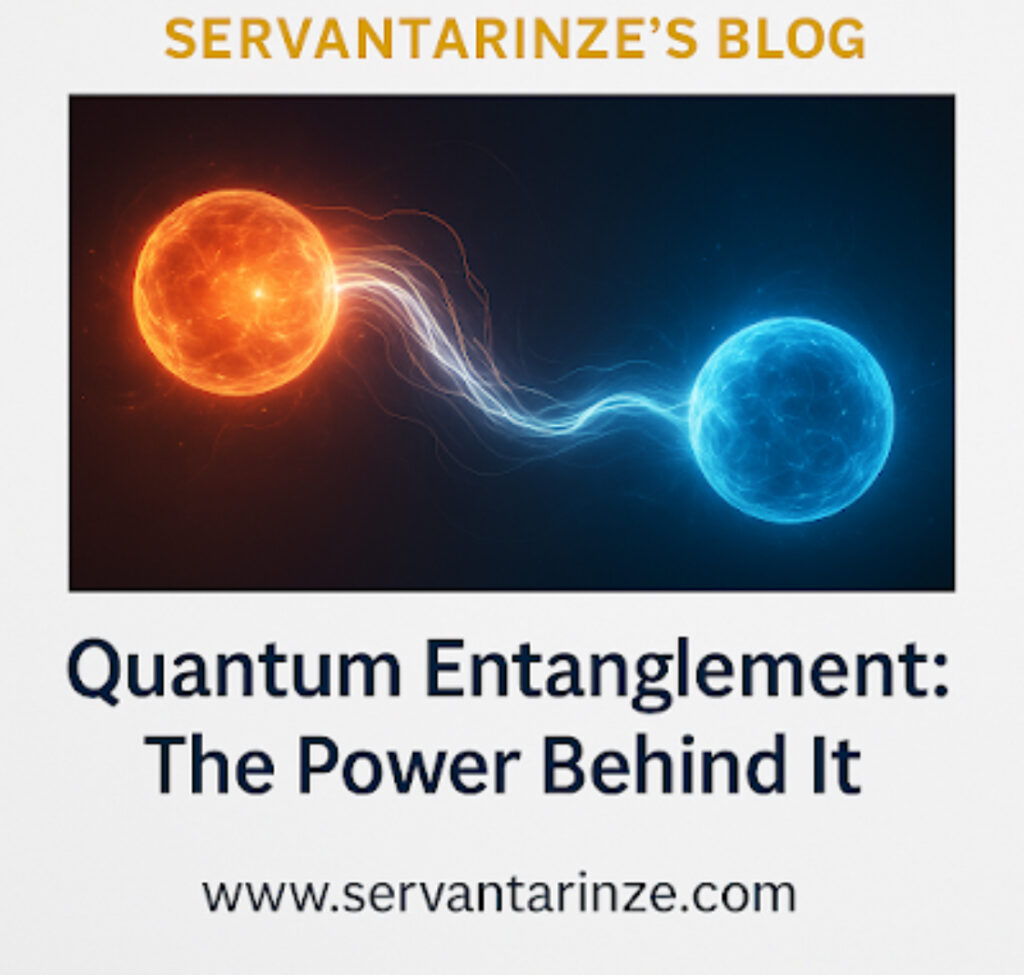
Have you ever imagined two tiny particles behaving like perfectly synchronized twins, even when they are separated by huge distances? That strange, powerful connection is called
quantum entanglement. It is one of the most mysterious ideas in modern physics – a phenomenon that forces scientists to rethink what it means for things to be “separate” or “independent” in our universe.
In classical physics, objects are local and independent. If you push something here, the effect happens here. Information and influence follow clear paths, and nothing travels faster than the speed of light. But in the world of
quantum entanglement, two particles can share a state so deeply that measuring one instantly tells you the state of the other – no matter how far apart they are. It looks as if reality itself is “coordinated” underneath the surface, using rules our everyday intuition cannot see.
This invisible connection is not just a philosophical curiosity. Today, researchers use quantum entanglement to design unbreakable encryption methods, explore ultra-precise sensors, and build quantum computers that can solve certain problems far faster than classical machines. In other words, the same effect that once confused Einstein is now becoming a real engine of technology.
In this guide, we will explore the power behind quantum entanglement in a way that is clear, practical, and deeply connected to real-world applications. You will see how entangled particles are created, why they behave so strangely, and how this single phenomenon sits at the center of quantum communication, quantum computing, and the future of secure digital systems.
By the end, you will not only understand what quantum entanglement is – you will see why scientists treat it as one of the most important resources in the whole quantum world. Think of this as your personal roadmap through the most powerful and surprising connection nature has ever revealed.
What Is Quantum Entanglement?
To understand quantum entanglement, start with a simple contrast. In the classical world, you can describe each object separately: a ball has a position, a car has a speed, a planet has a path. In the quantum world, particles are described by wavefunctions – mathematical objects that encode probabilities instead of fixed values. When two particles become entangled, their combined wavefunction can no longer be split into “particle A” and “particle B.” Instead, they form one shared state.
This means you can no longer talk about the properties of each particle independently. You can only talk about the properties of the pair as a whole. If one particle is measured to have a certain spin, energy, or polarization, the other particle’s result is instantly fixed, even if it is far away. The important point is that these outcomes are strongly correlated in ways classical physics cannot reproduce.
A simple way to visualize this is to imagine two coins that are prepared in a special quantum state. Before you look at them, each coin is not just “heads or tails” – it exists in a superposition of possibilities. But the coins are prepared so that whenever you finally check them, you always find opposite results: if one is heads, the other is tails. In a classical world, you might say, “they were fixed from the beginning.” In a quantum world, the results are not fixed until the moment of measurement, yet they still come out perfectly coordinated. That deep, non-classical coordination is the signature of entanglement.
Crucially, quantum entanglement does not mean that information is sent faster than light. No usable message is transmitted during this correlation. Instead, entanglement reveals that nature stores information in joint states that cannot be described by local pieces alone. It tells us that the universe keeps certain relationships “locked together” beneath space and time, and our measurements simply reveal the pattern that was already woven into the shared quantum state.
Because of this, physicists now treat entanglement as a kind of resource, similar to energy or information. If you can generate, maintain, and control entangled states, you can build technologies that classical systems cannot match. That is why understanding this phenomenon at a basic level is so important: it is the foundation on which much of the quantum revolution is being built.
Read also: Quantum Gates: 14 Powerful Insights into How They Actually Work
Why Quantum Entanglement Is So Revolutionary
Quantum entanglement is not just strange — it represents a complete break from how we normally understand reality. In classical science, objects are separate. If something happens to one object, it cannot instantly affect another object far away. But entanglement shows that separation itself might be an illusion at the deepest level of nature.
This single idea is what makes entanglement so powerful. It challenges the boundaries of space and time, it forces us to rethink causality, and it opens the door to technologies that rely on correlations no classical machine can imitate. It is the reason modern physicists call entanglement “the fuel of the quantum world.”
Einstein’s “Spooky Action at a Distance”
Albert Einstein understood how shocking this phenomenon was. He famously rejected the idea that two particles could remain linked across distance, calling it
“spooky action at a distance.” To him, this looked like a violation of causality and the speed of light limit in relativity. Einstein believed something was missing in quantum mechanics — hidden information not yet discovered.
But later experiments proved that quantum mechanics was complete. Using a series of breakthrough tests called Bell experiments, physicists demonstrated that no hidden classical variables could explain the results of entanglement. Nature’s correlations were simply stronger than anything allowed by classical physics.
In other words, Einstein’s instincts were understandable, but the universe surprised him. Entanglement is real, measurable, and fundamental to how particles behave.
The Quantum Link: Why Distance Doesn’t Matter
One of the most incredible aspects of quantum entanglement is that distance does not weaken the connection. Whether two entangled particles are centimeters apart or on opposite sides of the galaxy, the correlation remains perfect the moment one is measured.
This does not mean faster-than-light messaging. Instead, it means the universe stores certain information in a shared quantum state rather than in individual particles. Measurement “collapses” the shared wavefunction, revealing outcomes that were linked from the start.
This is why entanglement is often described not as communication, but as coordination. The particles are not sending signals. They are behaving as one extended system, no matter how far the parts are separated.
How Scientists Create Entangled Particles
In the laboratory, entanglement is created through controlled interactions. Some of the most common methods include:
- Spontaneous parametric down-conversion (SPDC): A photon is sent through a special crystal and splits into two lower-energy entangled photons.
- Atomic or ionic trapping: Two ions or atoms interact inside a magnetic trap or laser chamber, forming a shared quantum state.
- Superconducting qubits: Used by companies like IBM and Google, where entanglement is created using microwave pulses on superconducting circuits.
- Quantum dots and nitrogen-vacancy centers: Solid-state systems that create stable entanglement at room temperature.
Each method has different advantages depending on whether researchers want long-distance entanglement, stable qubits for computation, or high-speed photon generation for communication networks.
The Fragility of Entanglement
Quantum entanglement is extremely powerful, but also fragile. When an entangled particle interacts with the environment — heat, vibration, light, or electromagnetic noise — the entangled state can break. This is called decoherence.
To preserve entanglement, scientists use:
- ultra-cold cryogenic systems
- vacuum chambers
- noise-isolated fiber networks
- error-correction codes
Mastering decoherence is one of the biggest challenges in building scalable quantum computers and quantum networks.
How Entanglement Works Inside Quantum Mechanics
To see entanglement more clearly, consider two particles prepared in a “singlet state” — a perfectly anti-correlated configuration. Neither particle has a definite spin until measured, but their joint state is precisely defined. When you measure the first particle, its state collapses. Instantly, the other particle collapses into the opposite state.
This behavior is only possible because the two particles are not truly independent. They share a wavefunction — a mathematical bond that connects them beyond space. That unified wavefunction is the true source of entanglement.
Understanding this simple but profound idea is essential for everything that follows. Quantum entanglement is not teleportation, not messaging, not energy transfer — it is a global correlation built into the structure of quantum states.
Real-World Examples of Quantum Entanglement
Even though entanglement sounds like science fiction, it is already used in real laboratories and early-stage technologies. Here are some of the most impressive real-world demonstrations:
- The Micius Quantum Satellite (China): Achieved entanglement distribution over 1,200 km between ground stations, proving long-distance quantum communication is possible.
- Delft University (Netherlands): Teleported quantum information between solid-state qubits across campus buildings — the foundation of a future quantum internet.
- MIT and Harvard researchers: Used entangled electrons inside diamonds to maintain quantum links at room temperature.
- CERN: Experiments on entanglement in high-energy particle collisions, exploring how entanglement behaves in extreme environments.
These milestones show that entanglement is not a theoretical dream — it is the backbone of next-generation communication and computing systems already being tested worldwide.
Quantum Entanglement in Computing
The heart of quantum computation is the qubit — a unit that can represent 0 and 1 simultaneously. However, the true computational advantage appears only when qubits become entangled. This allows quantum processors to explore enormous numbers of possibilities at once.
This is why early quantum computers from IBM, Google, IonQ, and Rigetti focus so heavily on improving entanglement fidelity. Stronger, longer-lasting entanglement means:
- more stable quantum algorithms
- higher error resistance
- faster solutions for optimization problems
- better performance for machine learning models
Without entanglement, a quantum computer is merely a classical machine with unstable bits. With entanglement, it becomes a system capable of solving deep scientific, financial, and cryptographic challenges far beyond conventional limits.
Quantum Teleportation and Communication
One of the most fascinating applications of entanglement is quantum teleportation.This process transfers the state of a particle to another particle instantly — again, without sending any physical object. It uses three key components:
- Two entangled particles
- A particle holding the information you want to “send”
- A measurement that links the new particle to the old state
Teleportation is the foundation for quantum repeaters — devices that will extend the quantum internet over thousands of kilometers. Researchers at Caltech, Fermilab, and NASA are already testing prototypes.
Entanglement and the Coming Quantum Internet
Imagine an internet where hacking becomes nearly impossible — not because of stronger passwords, but because the laws of physics expose any attempt to intercept information. This is the promise of the quantum internet, built on entangled-photon networks.
The quantum internet will enable:
- Quantum-safe communication: Encryption that cannot be intercepted invisibly.
- Interconnected quantum computers: Global sharing of computing power.
- Ultra-precise sensing: Scientific instruments synchronized beyond classical limits.
Cities in Europe, the U.S., and Asia are already building prototype quantum networks that use entanglement to send keys, perform teleportation, and conduct distributed quantum computing tests.
The Global Race to Master Entanglement
From government labs to private companies, the world is racing to understand and harness entanglement. These efforts include:
- IBM Quantum: Large-scale superconducting qubit machines with high entanglement fidelity.
- Google Quantum AI: Entanglement-based error correction for fault-tolerant quantum computing.
- NIST and ETSI: Developing quantum standards for communication and measurement.
- European Quantum Flagship: Building entanglement networks across entire cities.
Every step brings us closer to a future where entanglement-enabled devices are as common as today’s smartphones.
The Challenge: Decoherence and Noise
Despite its power, entanglement is delicate. Heat, vibrations, stray photons, and even cosmic rays can break the quantum link. This makes scaling up quantum systems extremely challenging.
To fight decoherence, engineers use:
- deep cryogenic cooling
- ultra-stable fiber channels
- quantum error-correction codes
- vacuum-based photon transmission
The challenge is enormous — but so is the reward. Solving decoherence means unlocking the full potential of quantum technologies.
Read also: Quantum vs Classical: 12 Powerful Differences Explained
Final Thoughts
Quantum entanglement is more than a scientific curiosity — it is a window into the universe’s underlying unity. What once seemed like an impossible paradox is now the engine behind quantum computing, secure communication, advanced sensing systems, and revolutionary experiments worldwide.
As researchers continue to push boundaries, entanglement reminds us that the universe is built on connection, not separation. It challenges our classical worldview and inspires breakthroughs that may reshape science, technology, and human progress.
To dive deeper into how these quantum principles shape modern computing, explore the research breakthroughs happening today at
IBM Quantum — one of the leading institutions advancing entanglement-based technologies.
Frequently Asked Questions About Quantum Entanglement (FAQ)
What is quantum entanglement in simple terms?
Quantum entanglement is a phenomenon where two particles become so deeply connected that whatever happens to one instantly affects the other — even if they are separated by long distances. They act as one system, not two objects.
How does quantum entanglement actually work?
It works through shared quantum states. When particles interact and become entangled, their properties merge into a single combined state. Measuring one particle immediately reveals the state of the other because they no longer behave independently.
Why did Einstein call entanglement “spooky action at a distance”?
Einstein disliked the idea that information could appear to travel faster than light. To him, entanglement seemed impossible because it allowed instant correlations between distant particles. Modern experiments later proved this “spooky action” is real and fundamental to quantum physics.
What is quantum entanglement used for today?
Entanglement is used in quantum computing, unbreakable encryption, secure communication networks, advanced sensors, and experimental quantum teleportation. It is also a core principle behind emerging quantum internet technology.
Can quantum entanglement break the laws of physics?
No. Entanglement does not send signals faster than light — it only creates perfect correlations. It fits within quantum physics but challenges classical ideas about locality, separateness, and how information behaves in the universe.