
Introduction
Quantum technology often feels mysterious, but beneath the headlines, one truth anchors everything: quantum gates are the real engine driving quantum computation. They are not abstract magic, and they are not futuristic fantasies. They are precise, physical operations that shape the behavior of qubits — the fundamental building blocks of quantum processors.
If classical computers rely on AND, OR, and NOT to push bits through predictable pathways, quantum computers use gates that rotate, phase-shift, and entangle qubits in ways that classical logic can’t imitate. A single operation can create superposition, synchronize two particles across distance, or manipulate probability waves so the “right answer” becomes more visible while the wrong ones fade.
For students, engineers, and tech enthusiasts, understanding how quantum gates actually work is the key to understanding the entire quantum revolution. Without these gates, there is no quantum advantage, no interference, no speedup, and no difference between a quantum machine and a classical one.
This guide breaks everything down simply and visually — not with heavy equations, but with intuition and clear mental models. You’ll learn why gates are unitary, how they manipulate the Bloch sphere, how entanglement is formed, why phase matters, and how real circuits combine these moves into algorithms that classical chips cannot match. By the end, you won’t just know the names of quantum gates — you will understand their logic, power, and purpose.
Let’s begin by comparing classical logic to the wave-based reasoning that makes quantum gates such a breakthrough in modern computing.
Quantum Logic vs Classical Logic
To understand why quantum gates are so powerful, you must first see the difference between classical logic and the new logic that governs quantum systems. Classical computers operate on certainty. A bit is either 0 or 1, and every gate simply pushes that value forward. Flip it, combine it, or check it — but the value never leaves the realm of definite states.
Quantum logic works on an entirely different foundation. A qubit can hold a mixture of states — not metaphorically, but physically. Instead of choosing between 0 and 1, it exists in a weighted blend of both. These “weights” are called amplitudes, and they carry not only magnitude but also phase, which determines how different computational paths interfere with one another.
This interference is why quantum gates matter so much. In classical systems, interference doesn’t exist — combining two signals only adds noise or cancels everything entirely. In quantum logic, however, interference is programmable. Gates can rotate a qubit so that some outcomes strengthen each other while others fade away. This is the core of quantum advantage: using physics itself to filter out wrong solutions.
Another key difference is reversibility. Classical gates discard information constantly — once you OR two values together, you cannot recover the original inputs. Quantum gates must be reversible because they follow the laws of unitary evolution. Nothing is destroyed; everything evolves. This property allows qubits to carry rich superposition states until the final measurement collapses them into definite outcomes.
So while classical logic draws straight lines from input to output, quantum logic draws circles, arcs, and spirals through complex probability space. And the instruments that sculpt these paths are the quantum gates that form the backbone of every quantum algorithm.
Recommended: Quantum Basics: Learn Qubits the Easy Way
What Exactly Is a Quantum Gate?
A quantum gate is a precise, reversible operation that changes the state of a qubit without destroying information. Unlike classical logic gates that flip fixed bits, quantum gates manipulate the amplitudes and phases of a qubit to produce controlled interference — the heart of quantum computation.
Mathematically, every quantum gate is represented by a unitary matrix. This means the transformation preserves probability and can always be reversed. In simple terms, a quantum gate doesn’t “overwrite” the qubit; it rotates it on the Bloch sphere, steering the quantum state toward the patterns needed for a specific algorithm.
Different gates perform different kinds of steering:
- Rotation gates tilt the qubit around specific axes.
- Phase gates shift timing so some outcomes interfere constructively while others cancel.
- Entangling gates connect qubits, making their states interdependent in ways impossible for classical machines.
Each of these operations affects amplitude and phase in a way that prepares the system for the next step in the algorithm.
On real hardware, quantum gates are not abstract math. They are implemented using physical controls: microwave pulses for superconducting qubits, laser pulses for trapped-ion qubits, or photonic interferometers for optical systems. When you write a circuit in Qiskit, Cirq, or Azure Quantum, the compiler translates those mathematical gates into extremely precise timing instructions that shape how the qubit behaves at the quantum level.
The reason quantum gates are so important is simple: they let engineers sculpt complex probability landscapes that classical computers cannot imitate efficiently. With the right sequence of gates, a quantum computer can explore massive solution spaces, filter patterns through interference, and surface the most meaningful results — all in fewer steps than classical processors would require.
Superposition on the Bloch Sphere
To understand how quantum gates create computational power, you must first understand superposition. A classical bit lives at one of two points: 0 or 1. A qubit, however, lives on the surface of a geometric object called the Bloch sphere. The north pole represents |0⟩, the south pole represents |1⟩, and every other point represents a unique blend of both states.
When a qubit is in superposition, it does not “become both 0 and 1” in a literal sense. Instead, it holds a distribution of possibilities encoded as complex amplitudes. The magnitude controls how likely each outcome is, while the phase controls how the wave behaves when it interacts with others. This is where quantum gates come into play — they rotate and reshape this vector in ways that classical logic can’t replicate.
Visualize it this way: a point on the Bloch sphere behaves like a tiny arrow. A quantum gate rotates that arrow around specific axes with perfect precision. A Hadamard gate swings it to the equator, creating an evenly balanced superposition. A phase gate twists the arrow around the vertical axis, subtly changing timing relationships that determine whether certain outcomes reinforce or cancel out later in the circuit.
The reason this matters is that quantum algorithms rely on building and sculpting wave-like patterns. Superposition spreads the qubit across many possibilities at once, and later gates refine those possibilities. When the algorithm reaches a critical point, interference pushes the correct answers forward and suppresses the wrong ones. Without superposition, quantum gates would be no more powerful than classical logic.
This Bloch sphere intuition is what helps engineers truly “see” how quantum transformations work. Every gate is a rotation — a deliberate move designed to prepare the qubit for entanglement, interference, and measurement. Knowing how these rotations behave gives you the mental toolkit required to design circuits that take full advantage of quantum behavior.
From Gates to Quantum Circuits
Understanding individual quantum gates is useful, but the real computational power emerges when they are combined into complete circuits. A quantum circuit is a structured sequence of operations that prepares qubits, transforms them through carefully chosen gates, and finally measures the results. Each layer of the circuit shapes the probability landscape so that meaningful patterns appear when the computation ends.
A typical workflow begins with initialization. Every qubit starts in the |0⟩ state, a clean canvas. The first layer often introduces superposition using gates like Hadamard to spread possibilities. The next stage introduces entanglement: CNOT, CZ, or other two-qubit operations bind qubits together so their outcomes become interdependent. Once entanglement is in place, the circuit applies rotations, phase shifts, and controlled operations to steer the system toward the solution encoded by the algorithm.
Each gate alters amplitudes in a reversible way, meaning quantum circuits behave more like choreography than linear computation. A classical program moves step by step, updating variables irreversibly. A quantum program flows through structured waves of probability, with each transformation preparing the system for the next one. This is why circuit depth — the number of gate layers — matters. A deep circuit allows complex interference patterns to form, but too much depth risks error on today’s noisy devices.
Different hardware platforms influence how quantum circuits are built. On superconducting systems like those from IBM or Google, CNOT gates depend on physical coupling between qubits. If two qubits aren’t adjacent, the compiler inserts SWAP operations to move their states closer, increasing circuit depth. On trapped-ion hardware, all-to-all connectivity simplifies entanglement but introduces timing constraints. Compilers translate logical gates into native operations that the physical chip can perform reliably.
For learners and engineers, visualizing circuits is essential. Notebooks in Qiskit, Cirq, Azure Quantum, and PennyLane let you draw circuits gate by gate and observe how amplitudes evolve. This makes abstract mathematics tangible: you can literally watch how sequences of quantum gates build superposition, create entanglement, manipulate phase, and guide the system toward the outcome the algorithm is designed to reveal.
When a circuit reaches the measurement stage, the carefully sculpted probability landscape collapses into a classical output. The beauty of a well-designed quantum algorithm lies in how many incorrect paths are canceled through interference, while correct results are amplified. This is the heart of quantum advantage — not brute force, but precise manipulation of waves through circuits built from the right gates in the right order.
A Tour of Essential Quantum Gates
Before you can read or design meaningful circuits, you need a clear vocabulary of the most important quantum gates. Each gate acts like a building block, shaping amplitude, phase, and correlation in specific ways. In classical computing, you could build everything from AND, OR, and NOT. In quantum computing, the toolkit is richer, more flexible, and far more expressive.
Some gates encode simple rotations, others flip probability distributions, and a few create the entanglement necessary for multi-qubit computation. What makes quantum gates especially powerful is that every one of them is reversible and described mathematically by a unitary matrix. This reversibility forces the system to evolve in a structured way, preserving total probability and enabling interference — the phenomenon that lets correct answers emerge from the noise of possibilities.
Here is the core set of gates every learner, researcher, and engineer must understand:
- Identity (I): A gate that does nothing but matters for timing, alignment, and clarity in circuit design.
- Pauli X: A bit-flip operation that swaps |0⟩ and |1⟩, similar to the classical NOT but embedded in quantum amplitude space.
- Pauli Y: A combined flip-and-phase operation that rotates a qubit 180° around the Y-axis of the Bloch sphere.
- Pauli Z: A phase-flip that leaves measurement outcomes unchanged but alters interference by flipping the sign of |1⟩.
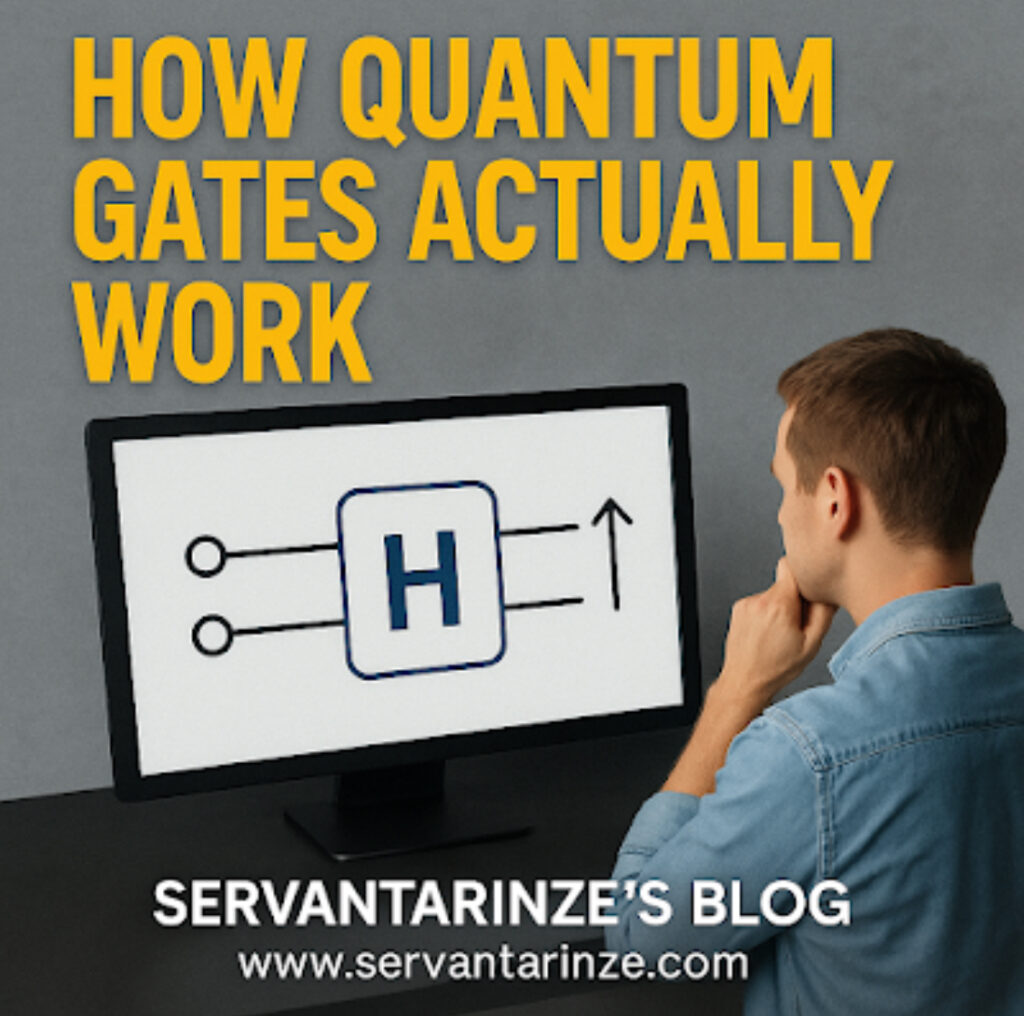
- Hadamard (H): One of the most influential quantum gates. It creates superposition by placing a qubit into an equal mixture of |0⟩ and |1⟩. Most algorithms start with layers of H gates.
- Phase Gates (S and T): These introduce controlled Z-axis phase shifts that fine-tune interference patterns. They are essential in algorithms like Grover’s search and the Quantum Fourier Transform.
- Rotation Gates (Rx, Ry, Rz): Continuous-angle gates that give fine-grained control over a qubit’s position on the Bloch sphere. These are crucial in variational algorithms and quantum machine learning.
- CNOT (Controlled-NOT): The gateway to entanglement. It flips the target qubit only when the control qubit is |1⟩. Without CNOT or its equivalents, multi-qubit algorithms cannot function.
- CZ and Controlled-Phase Gates: Provide phase-based entanglement and often match the native operations available on real hardware.
- Toffoli (CCNOT): A three-qubit controlled gate foundational in reversible computing and error correction, although expensive on real devices.
Each of these gates plays a distinct role in the quantum computation ecosystem. Some manipulate individual qubits with surgical precision; others bind qubits into correlated units that behave as a single mathematical object. Together, they give quantum algorithms the expressive power to explore large solution spaces more efficiently than classical logic alone.
As we move deeper into specific gates like Hadamard, Pauli rotations, and CNOT, you will start seeing how circuits use these primitives to sculpt probability waves. This understanding is what separates someone who reads about quantum computing from someone who can actually reason through it.
Hadamard (H): The Superposition Engine
Among all quantum gates, the Hadamard gate is often the first one students fall in love with — and for good reason. It is the operation that unlocks the uniquely quantum behavior that classical computers cannot imitate: superposition. The Hadamard doesn’t just “mix” states; it reshapes how probability waves behave, making later interference steps possible.
When a qubit starts in |0⟩ and passes through an H gate, it transforms into an equal-weight blend of |0⟩ and |1⟩. In mathematical terms, the Hadamard creates:
(|0⟩ + |1⟩) / √2
This does two things at once:
- It spreads the qubit’s probability mass across multiple computational paths.
- It sets the stage for interference — the heart of every meaningful quantum algorithm.
A classical bit has only one definite value at a time. But a qubit after a Hadamard gate is now prepared to explore many possibilities simultaneously. This doesn’t mean the qubit “contains both answers”; it means its amplitude landscape now includes multiple branches, each of which can be shaped by later quantum gates like phase rotations or entanglers.
What makes the Hadamard especially powerful is that it affects both magnitude and phase. When applied to |1⟩ instead of |0⟩, the result is:
(|0⟩ − |1⟩) / √2
The minus sign is a phase difference — invisible to direct measurement but crucial for interference. This subtle change lets algorithms amplify correct answers and suppress wrong ones through constructive and destructive interference. Grover’s search, the Quantum Fourier Transform, and many quantum machine learning models depend on this phase behavior to function correctly.
Another reason H stands at the center of so many circuits is its role in basis changes. Many operations are easier to perform not in the standard computational basis (|0⟩, |1⟩), but in a rotated basis. The Hadamard acts like a basis switch, allowing gates like Z-phase rotations to behave like an X flip in the transformed space. This trick reduces circuit depth and improves efficiency on noisy devices.
In real hardware, the Hadamard gate is not always implemented as a single primitive pulse. On superconducting devices (like those from IBM or Google), it is decomposed into a sequence of rotation gates — fine-tuned microwave pulses that rotate the qubit vector on the Bloch sphere. In ion-trap systems, laser pulses achieve the same rotation. The intuitive idea remains the same: H is a precisely timed maneuver that drops the state vector onto the equator of the Bloch sphere, ready for interference.
If you want to see the Hadamard in action visually, tools like IBM’s Qiskit offer live Bloch-sphere viewers. One click and you’ll watch the qubit’s arrow tilt from the north pole directly onto the equator — the perfect picture of superposition.
Pauli X, Y, Z: The Axes of Control
Every discussion about quantum gates eventually leads to the Pauli family — X, Y, and Z. They are the fundamental rotations that shape how a qubit behaves on the Bloch sphere. While the Hadamard spreads probability, the Pauli operators act like precise steering tools, rotating the quantum state around specific axes. Understanding these three gates gives you the intuition needed to read and design circuits like an engineer.
The Pauli-X gate is the easiest place to start. It flips the qubit state: |0⟩ becomes |1⟩ and |1⟩ becomes |0⟩. In classical terms, X behaves like a NOT gate. But quantum mechanically, it’s a 180° rotation around the Bloch sphere’s X-axis — meaning it doesn’t just “change” the state; it moves it smoothly along the sphere’s surface. This geometric interpretation becomes powerful when you start composing X with phase shifts and other rotations.
Next is the Pauli-Y gate, which many beginners overlook. Y combines both a flip and a phase rotation. It sends |0⟩ to i|1⟩ and |1⟩ to –i|0⟩, introducing a complex phase that is invisible to direct measurement but crucial in interference-based computations. Quantum circuits often use Y when manipulating states for algorithms that rely on wave interactions, especially in simulations and quantum machine learning workflows.
The Pauli-Z gate is where quantum behavior becomes unmistakably different from classical logic. Z leaves the probability amplitudes intact — |0⟩ stays |0⟩ and |1⟩ stays |1⟩ — but it applies a phase flip to |1⟩. This might seem minor, but in quantum gates work, phase is everything. A Z gate can change how two computational paths interfere later in the circuit, shifting peaks, cancelling valleys, and steering outcomes toward the correct solution.
When composers write music, they think in terms of rhythm and timing. In the same way, quantum engineers think in terms of rotations and phases. X, Y, and Z are the timing and direction tools that shape the qubit’s path across algorithms. Combined with fractional rotations (Rx, Ry, Rz), these gates allow you to create virtually any single-qubit transformation needed for advanced quantum algorithms.
In hardware, Pauli gates are usually implemented as carefully timed control pulses — microwave bursts for superconducting qubits or laser rotations in ion traps. Despite their abstract mathematical definitions, they are grounded in real physical actions. Understanding their behavior not only makes circuits easier to read but also gives insight into how noise and errors accumulate in practical systems.
Most importantly, the Pauli set acts as the foundation for more complex gates. Controlled versions (like controlled-Z or controlled-X) become essential for entanglement, error correction, and multi-qubit logic. In short, if the Hadamard opens the door to superposition, the Pauli gates give you the steering wheel to navigate the quantum landscape.
CNOT & Entanglement: Controlled Power
If single-qubit operations are the alphabet of quantum gates, then the CNOT gate is where those letters finally form meaningful sentences. It is the bridge between individual qubits and the powerful correlations that make quantum computing fundamentally different from classical logic. The Controlled-NOT gate (CNOT) flips a target qubit only when the control qubit is in the state |1⟩. This simple rule unlocks entanglement — a phenomenon so unique that no classical system has an equivalent.
To see why CNOT is special, imagine two qubits starting in the state |00⟩. Apply a Hadamard gate to the first qubit and then feed both into a CNOT. The result is a Bell pair: a perfectly entangled state where measuring one qubit instantly tells you the state of the other, no matter how far apart they are. These pairs are the foundation of quantum communication protocols, teleportation, quantum key distribution, and the error-correction codes that will support future large-scale processors.
In practical circuits, CNOT is used to spread information across qubits, create multi-qubit interference patterns, and control the flow of computation. When designing algorithms, engineers often visualize CNOT as a “locking” mechanism that ties two qubits together so their evolutions are no longer independent. Without this entangling power, quantum gates would collapse into a fancy version of classical probability — interesting, but nowhere near transformative.
However, CNOT is also one of the most expensive gates physically. Real hardware must coordinate timing, control pulses, and qubit connectivity. On superconducting chips, for example, CNOT operations are slower and noisier than single-qubit rotations. This is why circuit optimization is such an important skill: every unnecessary CNOT can increase error, reduce fidelity, and limit the depth of what the processor can run.
Despite its cost, the CNOT remains the backbone of multi-qubit systems. It allows you to build parity checks, reversible operations, and the entanglement structures needed for algorithms like Shor’s, Grover’s, and VQE. In a sense, single-qubit rotations shape the “sound” of a qubit, while CNOT arranges the harmonies between them. Together, they create the multi-layer logic that makes quantum computation possible.
As technology improves, researchers experiment with alternatives such as CZ, iSWAP, and native two-qubit gates that fit better with specific qubit platforms. But the logic they embody remains the same: coordinated control between qubits that lets quantum gates generate correlations no classical switch can replicate. Understanding CNOT deeply prepares you for every advanced topic that follows in quantum computing.
Read also: Quantum Bits vs Binary Bits: 7 Powerful Differences You Must Know
Phase & Rotation Gates: Steering Interference
If the Hadamard spreads possibilities and the CNOT ties qubits together, then phase and rotation gates decide how those possibilities interfere. These gates are the steering mechanisms of quantum gates — the subtle adjustments that determine whether waves reinforce, cancel, or redirect each other. Unlike operations that flip states, phase-based gates act on the timing and alignment of probability amplitudes, shaping the hidden structure of a computation long before results appear.
The most important concept here is that quantum algorithms succeed not because qubits “try every answer at once,” but because interference is engineered to make the correct answers stand out. Phase gates such as S, T, and especially the continuous rotation gate Rz(θ) adjust the angle of the state vector around the Z-axis. These adjustments may not change how often you measure 0 or 1 immediately, but they determine how later gates combine those amplitudes. A single misplaced phase can ruin the constructive peaks that an algorithm relies on.
Rotation gates like Rx(θ), Ry(θ), and Rz(θ) provide fine control across all axes of the Bloch sphere. This precision is what allows algorithms to mirror physical systems or encode optimization landscapes. In chemistry simulations, for example, tiny rotation adjustments correspond to energy levels in molecular orbitals. In variational methods, these angles are parameters the classical optimizer tweaks continuously to minimize a cost function. Together, rotation gates form the programmable backbone of many modern quantum workflows.
Phase steering also underpins iconic algorithms. In Grover’s search, a phase inversion marks the desired state as “special,” and the diffusion operator amplifies that phase difference into higher sampling probability. In the Quantum Fourier Transform, layers of controlled-phase gates arrange waves so that periodic structures snap into clarity. Without these subtle tools, quantum gates would lose their sharpness, and interference patterns would degrade into random noise.
On real hardware, these gates are some of the most accurate operations available. Single-qubit rotations can be implemented with short, well-calibrated pulses that outperform multi-qubit operations. Because of this, compilers often rewrite complex sequences into combinations of rotations to improve fidelity. Engineers view rotation gates as both a precision instrument and an error-mitigation strategy, letting circuits express rich behavior while keeping noise manageable.
Understanding phase and rotation gates helps you read circuits at a deeper level. They reveal whether a layer is preparing a superposition, marking an answer, shaping interference, or undoing a previous transformation. When you can see how phase choices influence outcomes, quantum circuits no longer feel mysterious — they become logical, intentional constructions built from waves rather than bits.
Measurement: From Waves to Answers
Measurement is the moment where everything hidden inside a quantum state becomes visible. After all the rotations, entanglement, and phase adjustments from earlier quantum gates, measurement samples the final probability landscape and turns it into concrete outcomes. A qubit that exists as a delicate mixture of possibilities collapses to either |0⟩ or |1⟩, and the frequency of those outcomes is the story the algorithm tells.
This collapse often feels counterintuitive because quantum circuits don’t behave like classical programs that compute a single final value. Instead, a quantum circuit shapes a distribution. Each run gives you one sample, and you must run the same circuit many times to uncover the pattern. If the gates were arranged correctly, the right answers appear far more often than the wrong ones. This is why quantum computing is not just about performing operations; it is about sculpting probabilities before measurement freezes them.
A key idea is that measurement destroys superposition. Once a qubit collapses, the richness of its wave structure disappears. Because of this, circuits must finish all meaningful interference work before the first measurement occurs. This is why you see quantum algorithms follow the rhythm: prepare → apply quantum gates → entangle → shape phases → measure. Any measurement placed too early would cut the algorithm short, removing the very quantum effects it depends on.
On today’s hardware, measurement is also one of the noisiest operations. Real devices introduce small biases — some qubits favor reporting a 0 slightly more often than they should, or the electronics introduce timing drift. To correct this, frameworks apply error-mitigation techniques that calibrate measurement results using pre-characterized behavior of the device. These adjustments don’t create perfect accuracy, but they significantly improve fidelity when running circuits repeatedly.
In more advanced architectures, measurement is no longer just the final step. Some systems allow mid-circuit measurement, where results from one qubit control later gates in real time. This enables protocols like teleportation, adaptive error correction, and certain forms of quantum simulation that rely on feedback. It’s a preview of the hybrid future where classical logic and quantum gates interact more tightly, giving algorithms new levels of expressiveness.
Ultimately, measurement is where quantum computation becomes human-readable. You never “see” superpositions directly. You only see the footprints they leave behind. And when a circuit is designed well, those footprints — the distribution of outcomes — reveal structure that would be impossible for classical machines to uncover. Measurement transforms waves into information, and it marks the moment where physics hands you an answer you can finally hold.
Visualizing and Simulating Circuits
One of the most important steps in understanding how quantum gates behave is visualizing them. Unlike classical circuits—where you can simply trace 0s and 1s through logic blocks—quantum circuits evolve through complex rotations, phase shifts, and entanglement patterns that happen simultaneously. Because of this, visual tools and simulators play a crucial role in helping learners and developers build intuition long before running anything on real hardware.
Simulators can show you the full quantum state, something real hardware will never reveal directly. They allow you to observe amplitudes, phases, and interference in a way that mirrors how a physicist reasons about quantum behavior. When you apply a Hadamard gate, you can watch a state lift from the north pole of the Bloch sphere into a superposition on the equator. When you apply a CNOT, you can see two qubits become entangled, their probabilities no longer independent. These visual cues make abstract concepts feel concrete.
Circuit drawers, available in many frameworks, help you design and debug circuits step by step. They show each layer of quantum gates as a sequence of operations, making it clearer how rotations stack, how entangling gates align, and where interference might occur. For example, seeing an H-gate placed before a Z-rotation immediately communicates that you’re shaping a phase pattern rather than performing a simple flip. This clarity improves both accuracy and creativity when experimenting with new ideas.
Statevector simulations go deeper, presenting the exact mathematical state after each operation. This is especially helpful when learning why phase matters. Two states might appear identical in measurement counts, yet their phases differ—and those phase differences determine how later gates interfere. By stepping through a circuit one gate at a time in a simulator, you can see precisely when a small rotation causes a major shift in the final output distribution.
Density-matrix simulations extend this further by modeling noise, decoherence, and other imperfections found in real devices. They help you predict how fragile a particular circuit is and whether it will survive long enough on actual hardware to produce meaningful results. This is essential when working with multi-qubit circuits, where every additional gate increases exposure to noise.
These visualization and simulation tools are not just for beginners. Even experts use them daily to design algorithms, test assumptions, and compare hardware platforms. They help bridge the gap between theoretical models and real-world devices, ensuring that the quantum gates you write on paper behave the way you expect once compiled and executed.
Because full quantum simulations scale exponentially, they won’t replace hardware forever. But right now, while devices are still maturing, simulators provide a safe, flexible environment to explore, learn, and refine ideas. They let you practice the same mental habits that professionals use: predicting how waves will shift, how interference will align, and how small adjustments to quantum gates can flip an outcome entirely.
Real Hardware: From Labs to Cloud
Understanding how quantum gates behave on real hardware is a major step toward mastering quantum computing. Simulators give perfect results, but physical devices introduce constraints—noise, decoherence, crosstalk, limited connectivity—that shape what’s practical. Real quantum chips are not abstract math objects; they are engineered physical systems that must maintain fragile quantum states long enough for circuits to run successfully.
Different hardware platforms implement quantum gates using different physical technologies. Superconducting qubits, used by IBM and Google, operate at extremely low temperatures where microwave pulses manipulate the energy levels of each qubit. Trapped-ion systems, such as IonQ and Quantinuum, use laser pulses to rotate qubits encoded in atomic states. Photonic systems rely on light-based interferometers to perform similar operations. Each platform offers a unique combination of gate fidelity, speed, connectivity, and error characteristics.
On superconducting chips, the execution of quantum gates is shaped by device topology. Qubits are arranged in a grid where only certain pairs are directly connected. This means a simple two-qubit operation may require additional routing gates to move quantum information across the chip. These extra operations introduce noise, which affects accuracy. For this reason, hardware-aware compilation is essential: compilers optimize gate placement to reduce unnecessary movements and preserve coherence.
In trapped-ion systems, qubits interact through shared motional modes, giving nearly all-to-all connectivity. This allows entangling gates to occur between distant qubits without routing. However, these gates are slower than those on superconducting platforms, so circuit depth must be managed carefully. Each hardware model comes with trade-offs that influence how quantum gates perform and how algorithms must be adapted.
Running circuits on real devices introduces the reality of noise. Qubits lose coherence over time, accumulating errors from the environment. Gate imperfections, measurement randomness, frequency drift, and interference between qubits all compound the challenge. To handle this, modern platforms apply active error mitigation techniques—such as zero-noise extrapolation and measurement calibration—to improve outcomes without requiring full error correction.
Cloud access has made real quantum hardware more accessible than ever. Developers can submit circuits through platforms like IBM Quantum, Azure Quantum, or Google’s quantum services. Jobs run on actual devices, and the results can be compared to simulator outputs to understand the gap between theory and hardware. This “prototype → run → analyze” workflow is now standard practice for students, engineers, and researchers.
One of the biggest lessons from working on real hardware is how sensitive circuits are to structure. A design that works beautifully in simulation may struggle when compiled onto a specific device, especially if the circuit requires many entangling gates. Learning to adapt circuits—reducing depth, rearranging gates, or leveraging device-native operations—is a core skill. This hardware awareness strengthens your intuition and makes your understanding of quantum gates far more practical.
As quantum devices evolve, gate fidelity continues to improve. New materials, better fabrication, refined control electronics, and smarter compilers all push the limits of what’s possible. Each leap moves us closer to fault-tolerant systems where circuits can run long enough to outperform classical computers consistently. But even today, real hardware offers a unique opportunity: experiencing the beauty and fragility of quantum behavior firsthand. It transforms theory into reality and gives learners a clearer sense of what is achievable right now.
How Algorithms Orchestrate Quantum Gates
Quantum algorithms are not random collections of operations. They are carefully choreographed sequences where quantum gates manipulate probability waves to expose structure hidden inside a problem. When viewed from afar, a quantum algorithm looks almost like a dance: each gate rotates, flips, entangles, or phases qubits at just the right moment to produce a meaningful outcome when measured. Understanding this choreography is the key to understanding why certain problems bend in favor of quantum advantage.
Classical algorithms follow deterministic steps, but quantum algorithms operate on amplitudes—values that encode both magnitude and phase. Each application of a gate shifts the landscape of these amplitudes. The goal is simple: amplify the correct answers and diminish the incorrect ones. The mechanism, however, is rooted in interference. Constructive interference boosts desirable states, while destructive interference suppresses unwanted ones. Quantum gates are the mathematical tools that create these interference patterns.
For example, in Grover’s search algorithm, the sequence begins with Hadamard gates spreading probability across all possible inputs. A specific phase-flip marks the “good” answer, and a diffusion operator amplifies that answer by reflecting the distribution around its mean. After repeating this sequence the optimal number of times, measuring the qubits yields the correct result with high probability. Every step of Grover’s algorithm relies on precise control of phase and amplitude through gates.
In Shor’s algorithm, which factors large integers, the Quantum Fourier Transform plays a central role. The QFT is a layered arrangement of Hadamards and controlled phase rotations that reveal periodicity in number-theoretic structures. Without the exact sequence of quantum gates arranged in its characteristic triangular pattern, the QFT would fail to extract the repeating pattern needed for factoring. This highlights a deeper idea: quantum circuits operate on mathematical symmetries embedded within physical wavefunctions.
Variational algorithms, such as VQE and QAOA, introduce a hybrid model where classical optimizers tune gate parameters. These circuits rely on parameterized rotations—Rx, Ry, and Rz gates—to adjust angles that represent energy landscapes or cost functions. The algorithm evaluates a circuit, measures results, feeds them into a classical optimizer, and updates the parameters. Through iteration, it discovers angles that minimize energy or maximize an objective. The interplay of quantum gates and classical feedback is what makes the approach flexible and powerful.
Another crucial concept is entanglement management. Algorithms often require specific patterns of entanglement to reflect complex correlations within a problem. Too little entanglement limits the circuit’s expressiveness; too much entanglement introduces noise or makes classical simulation unnecessarily difficult. Strategically placing CNOT or CZ gates allows the algorithm to encode relationships among variables, making quantum circuits behave like richly structured mathematical graphs.
Algorithm designers must also be mindful of hardware constraints. Not all qubits can connect directly, and not all native gates map cleanly to textbook circuits. Compilers translate ideal algorithms into hardware-optimized layouts—sometimes rewriting entire sections using device-native quantum gates to reduce depth. This step is invisible to most learners but essential for running practical circuits without losing fidelity to noise and decoherence.
As quantum processors grow, algorithmic orchestration will become more dynamic. Future systems may adapt gate placement in real time based on live calibration data or noise predictions. Some architectures may support mid-circuit measurement and conditional branching, allowing algorithms to change behavior as results come in—unlocking possibilities like adaptive phase estimation or more efficient error correction routines.
In summary, a quantum algorithm is not magic; it is structured manipulation of amplitude landscapes. When you understand how quantum gates work together—Hadamards to create superposition, phases to steer interference, entangling gates to build structure—you gain the ability to read quantum circuits like a story. Each algorithm becomes a method for turning the physics of waves into meaningful computational advantage. That is the beauty of quantum thinking: logic expressed through interference rather than pure arithmetic.
Quantum vs. Classical Chips in Practice
Many people imagine that quantum computers will replace classical machines outright, but that is not how the field works in reality. Classical chips excel at deterministic logic—billions of rapid, reliable operations every second—while quantum chips manipulate delicate wavefunctions through finely controlled quantum gates. Each technology shines in different domains, and understanding their strengths reveals why the future is hybrid rather than competitive.
Classical processors follow binary logic: transistors open or close to produce predictable outcomes. They are unrivaled for tasks like browsing the web, running spreadsheets, training neural networks, or handling databases. Their architecture is built for stability, repeatability, and precision. Quantum processors, by contrast, operate on qubits that hold superpositions and phases. Every evolution of the qubit state depends on carefully orchestrated rotations and entanglement through quantum gates. These operations are reversible, wave-based, and sensitive to noise, which makes them powerful but also fragile.
In practice, quantum chips are designed for problems where interference patterns encode useful mathematical shortcuts. Optimization landscapes, molecular simulations, quantum chemistry, and certain cryptographic challenges are examples where wave-based computation can offer exponential structure that classical bits cannot capture. But for day-to-day computing—video editing, gaming, financial dashboards—classical silicon remains the king. No quantum hardware can perform these tasks with the speed or reliability of classical transistors.
The real-world architecture is a hybrid loop: a classical computer orchestrates the workflow, preparing data, optimizing parameters, and sending instructions to a quantum processor. The quantum chip executes a sequence of quantum gates to transform the qubits, then returns measurement results back to the classical machine. This loop repeats until the algorithm converges. It’s similar to having a highly specialized co-processor—powerful for very specific tasks but dependent on the classical system for structure and direction.
Hardware differences deepen this divide. Classical chips operate at room temperature in compact devices. Quantum machines require cryogenic refrigerators, precise lasers, vacuum chambers, or photonic networks depending on the qubit platform. Superconducting qubits (like IBM and Google) rely on microwave pulses at near-zero temperatures; trapped ions (like IonQ) require laser pulses and meticulous control; photonic qubits use interference of light to implement quantum gates through beam splitters and phase shifters. Each platform has its strengths, native operations, and noise profiles, which influence how algorithms must be compiled.
Another practical difference is scale. Classical chips have billions of stable transistors; quantum chips have tens or hundreds of physical qubits, and only a fraction of those can form stable logical qubits once error correction is applied. This is why circuit depth, gate fidelity, and noise suppression matter so much. A classical chip does not worry about decoherence timing out a calculation, but a quantum chip must perform all its quantum gates before the qubits lose coherence.
Despite these challenges, progress is steady. Error rates continue to fall, coherence times are growing, and compilers are becoming more efficient at transforming algorithms into hardware-friendly circuits. As quantum chips scale, they won’t replace classical computing—they’ll complement it. The most realistic picture of the future is a system where classical logic handles structure, memory, and general computation, while quantum hardware provides specialized acceleration for problems modeled through interference patterns.
Understanding this relationship grounds your expectations: classical chips remain the everyday workhorses; quantum processors extend the frontier. The magic happens in how quantum gates sculpt wave functions into answers classical machinery would struggle to uncover. When both systems work together, computation becomes richer, faster, and more capable than either approach alone.
Where Quantum Logic Is Heading
The future of quantum logic is not a mystery—it is an engineering race toward stability, scalability, and precision. Today’s devices succeed on small demonstrations, but tomorrow’s machines must perform long computations built from millions of precise quantum gates without collapsing under noise. This requires more than clever mathematics; it demands new materials, cleaner fabrication, and smarter compilers that shape circuits around hardware limits.
The most important milestone ahead is fault-tolerant quantum computing, where qubits no longer behave like fragile particles that decohere after a few hundred microseconds. Instead, they are woven together into logical qubits that can automatically detect and correct their own errors. To achieve this, each logical qubit may require hundreds or even thousands of physical qubits, all working together in a structured pattern. In such systems, sequences of quantum gates can run far deeper without noise overwhelming the computation.
Error-corrected systems unlock new kinds of gates as well. Techniques like lattice surgery allow devices to perform operations equivalent to controlled-phase or entangling gates by manipulating entire regions of encoded qubits. These new approaches reduce overhead and shrink circuit depth, making complex algorithms more feasible. Instead of relying on delicate analog pulses, engineers will be able to manipulate stable logical blocks that behave predictably—an enormous shift from the noisy hardware of today.
Another frontier is connectivity. Current quantum chips often have limited patterns of interaction—certain qubits can only perform entangling operations with their neighbors. Future architectures aim to expand this connectivity, either through modular quantum networks, photonic links, or redesigned chip layouts. Better connectivity reduces the number of routing operations, which in turn cuts down on extra quantum gates and the noise they introduce.
Quantum logic is also moving toward automation. Modern compilers already translate high-level code into low-level gate sequences, but the next generation will be far smarter. They will analyze noise maps, qubit lifetimes, and hardware calibration data to automatically restructure circuits in real time—choosing the cleanest pathways, minimizing depth, and optimizing interference patterns. In other words, compilers will become co-pilots, shaping quantum gates around each device’s strengths and weaknesses.
Finally, the field is expanding beyond single-model platforms. Superconducting qubits, trapped ions, neutral atoms, and photonic systems each have unique strengths. Future quantum processors may combine multiple approaches, allowing different components to run the types of quantum gates they execute best. A hybrid architecture—much like classical computers mixing CPUs, GPUs, TPUs, and accelerators—could become the standard.
The direction is clear: fewer errors, more qubits, smarter compilers, and richer logical operations. As these improvements accumulate, the promise of quantum computing becomes practical rather than theoretical. The algorithms we discuss today—built from layers of quantum gates—will run longer, cleaner, and on larger systems, opening the door to breakthroughs in chemistry, materials, optimization, and beyond.
Final Thoughts
Understanding how quantum gates work is more than a technical skill—it is a doorway into an entirely new style of computation. Classical logic solves problems step by step, but quantum logic shapes probability, timing, and interference to reveal solutions that would be unreachable through traditional means. When you learn how gates like Hadamard, Pauli, CNOT, and rotation operations sculpt the behavior of qubits, you begin to see quantum programs not as strange physics, but as carefully designed wave-based strategies.
The deeper you go, the more intuitive the landscape becomes. Superposition stops feeling mysterious and becomes a tool for exploring many possibilities at once. Phase shifts stop feeling abstract and become the steering mechanism that guides interference toward the results you want. And entanglement—once described as “spooky”—becomes the backbone of multi-qubit logic and the foundation of every major algorithm running on quantum devices today.
As hardware improves and circuits grow longer and cleaner, this field will only become more practical. Engineers, students, researchers, and even creators outside the scientific world will have access to systems that execute millions of precise quantum gates with stability. Already, companies and institutions worldwide are preparing for this next wave of computation—and anyone who learns these fundamentals now will be far ahead when quantum becomes part of everyday technology.
If you want to build a strong foundation for the future, start with simple circuits, simulate them, read the amplitudes, and follow how each gate leaves its fingerprint on the qubit. A helpful place to expand your learning is this clear beginner guide:
IBM’s introduction to quantum computing principles — one of the most credible resources for understanding real hardware behavior.
Whether you plan to design algorithms, analyze scientific problems, contribute to cybersecurity, or simply stay informed about the next era of computing, mastering quantum gates gives you a durable, lifelong advantage. Come back to this guide whenever you need clarity, and keep building your understanding step by step. The future belongs to those who learn early, stay curious, and lean into new possibilities with confidence.
Frequently Asked Questions About How Quantum Gates Actually Work (FAQ)
What does a quantum gate actually change in a qubit?
A quantum gate changes the amplitude and phase of a qubit, not just its value. This allows quantum circuits to use interference, superposition, and entanglement to reveal solutions classical logic cannot reach.
Why is the Hadamard gate important in quantum circuits?
The Hadamard gate creates superposition, spreading the qubit into multiple possibilities at once. It is the foundation of most quantum algorithms because it unlocks the parallelism that gives quantum computing its power.
Are quantum gates the same as classical logic gates?
No. Classical gates output fixed 0s and 1s, but quantum gates rotate states on the Bloch sphere. They manipulate probability waves instead of deterministic bits, making them fundamentally different tools with deeper capabilities.
Do quantum gates make errors when running on real hardware?
Yes. Real quantum devices suffer from noise, decoherence, and imperfect gate operations. This is why circuit depth must remain low and why error mitigation is critical when running quantum gate operations on today’s hardware.
Can beginners experiment with quantum gates without expensive machines?
Absolutely. Platforms like IBM Qiskit and Google Cirq let anyone simulate quantum gates for free—offering Bloch-sphere visualizations, circuit drawers, and real-device access for simple experiments.