
Introduction
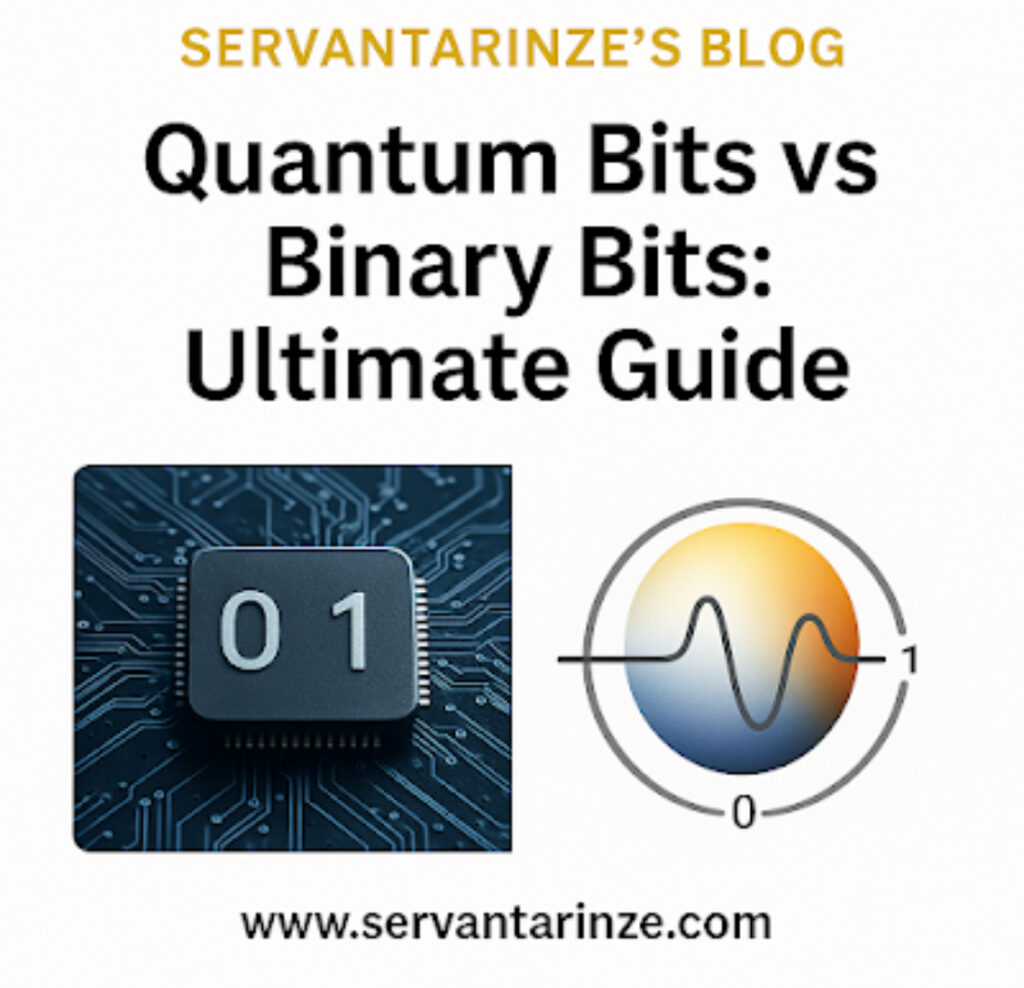
Quantum bits are rewriting the rules of computation, but most people still rely on outdated definitions that barely scratch the surface. Classical computers work with binary bits—solid, predictable units that are always either 0 or 1. Quantum computers, on the other hand, use quantum bits that behave according to the physics of atoms, electrons, and photons. This means they can hold combinations of states, form powerful correlations, and process information in ways that classical devices simply cannot replicate.
This isn’t about sci-fi magic or exaggerated speed claims. It’s about understanding a new information model. Binary bits represent certainty; quantum bits represent possibility. A classical system moves through one path at a time. A quantum system manipulates probability landscapes, interferes with unwanted outcomes, and amplifies the ones that matter. That makes certain classes of problems—like molecular modelling, quantum chemistry, and high-complexity optimization—fundamentally better suited to quantum processes.
But quantum bits also come with limitations. They are fragile, noise-sensitive, and expensive to maintain. They demand new programming principles, new hardware, and new error-handling strategies. In this guide, you’ll see a clean, deep explanation of how quantum bits truly differ from binary bits, when each type of bit wins, and how both will coexist in future hybrid computing systems. No hype, no oversimplification—just clarity, depth, and real understanding.
Bits 101: How Binary Bits Encode Certainty
Before we can appreciate how powerful quantum bits are, we need to understand the strength of classical binary bits. A binary bit is the simplest and most reliable form of information ever engineered. It always exists in one definite state: either a 0 or a 1. There is no ambiguity, no probability, and no interpretation by nature. The value is fixed, and every layer of classical technology is built on that stability.
Inside your laptop or phone, billions of transistors switch between two voltage levels to represent these binary states. This deterministic behavior allows engineers to design processors, memory systems, network protocols, operating systems, and applications with perfect repeatability. If the same program runs on the same input, the output will always be the same—something that quantum bits cannot promise because they follow a different set of physical laws.
Binary bits also scale well. As long as you can pack more transistors onto a chip or coordinate more processing cores, you can increase performance while keeping the logic predictable. Even as traditional scaling slowed down, engineers built new pathways like multi-core CPUs, GPUs, caches, pipelining, and specialized accelerators. All of these rely on the guaranteed stability of binary bits, making them ideal for everyday applications like banking, web services, security systems, graphics rendering, and large-scale databases.
For most tasks, binary bits remain unbeatable. They offer the reliability, speed, and low error rates required for global digital infrastructure. When we compare them to quantum bits, it is important to honor this foundation: classical bits dominate the world because they are cheap, efficient, and exceptionally consistent. Quantum technology must offer advantages powerful enough to overcome this maturity—and that advantage only appears under specific conditions, which we explore next.
Read also: Quantum vs Classical: 12 Powerful Differences Explained
Qubits 101: Superposition, Amplitudes & Measurement
Now let’s step into the world of quantum bits, where information behaves nothing like the classical logic we are used to. A binary bit can only be 0 or 1. A qubit, however, can be in a state that is a combination of both at the same time. This property is called superposition, and it is the core reason quantum computing opens new doors in mathematics, cryptography, chemistry, and optimization.
To understand superposition, imagine a spinning coin. While it spins, it is not strictly heads or tails—it carries the possibility of both outcomes. Similarly, quantum bits exist in a blended state defined by complex probability amplitudes. These amplitudes determine the likelihood of getting 0 or 1 when the qubit is eventually measured. Before measurement, the qubit stores far richer information than a classical bit ever could.
Manipulating qubits requires unitary gates, which are smooth, reversible rotations in a mathematical space. These gates allow us to rotate a qubit around the Bloch sphere, entangle it with other qubits, or set up interference patterns that increase the probability of correct answers and suppress the wrong ones. Unlike classical logic gates—which discard intermediate states—quantum operations must preserve information, making quantum programming more like steering a wave than flipping a switch.
There is a catch: the moment you measure a qubit, superposition disappears. The qubit “collapses” into a definite 0 or 1. The beauty and difficulty of working with quantum bits is that you can manipulate these rich probabilities as long as you avoid measurement. Once you observe the system, nature forces a single, final answer. This is why quantum algorithms are carefully structured sequences of gates that shape the probability landscape before any measurement takes place.
Understanding this fundamental difference—certainty for bits, probability for qubits—is the first step to appreciating why classical computers excel at stability while quantum systems excel at exploring complex, high-dimensional spaces. In the next section, we move deeper into the magic that separates quantum computers from the classical world: entanglement and interference.
Entanglement & Interference: Why Scaling Quantum Bits Works Differently
Once you understand superposition, the next leap in quantum computing is entanglement — a phenomenon that links quantum bits so tightly that the state of one instantly reflects the state of another, no matter how far apart they are. This isn’t storytelling or sci-fi physics; it is a real, measurable property confirmed in thousands of experiments and used today in quantum communication, sensing, and algorithm design.
To visualize entanglement, imagine two qubits created in a paired state. Neither qubit has a definite value on its own, but the moment you measure one, the other instantly assumes a consistent, correlated value. This correlation is stronger than anything classical bits can express, and it gives quantum computers their ability to model complex systems with far fewer resources. Where classical bits must store each possible configuration separately, entangled qubits encode relationships directly into their shared state.
Interference is the second core ingredient. While classical systems add and subtract numbers, quantum systems add and subtract probability amplitudes. With the right sequence of gates, an algorithm can amplify the probability of correct answers while suppressing the wrong ones. This is how algorithms like Grover’s search achieve square-root speedups: by using interference as a steering wheel instead of brute-force enumeration.
These two forces — entanglement and interference — mean that when you scale from one qubit to two, you don’t just double capacity. You open access to a 4-state system. With three qubits, it becomes 8 states. With ten qubits, it’s 1024 states. And with fifty well-behaved quantum bits, you’re exploring more states than a classical supercomputer can store in memory. This exponential state space is the foundation of any quantum advantage.
But nature is strict. Entanglement requires precise control, isolation from noise, and stable interactions between qubits. Deep circuits can unravel quickly if gate errors or decoherence dominate. This is why the frontier today is not simply “more qubits” but “better qubits” — systems with stronger coherence times, low error rates, and physical layouts that support rich connectivity between qubits. Without that, interference collapses into randomness instead of insight.
When you hear that quantum computers are powerful, it’s not because they run faster clocks or handle more instructions. It’s because quantum bits allow us to represent and manipulate entire landscapes of possibilities at once. Entanglement lets them speak collectively. Interference lets us shape outcomes. Together, they form the engine behind the quantum algorithms we rely on today — and the ones still being discovered.
Read also: Quantum Entanglement: 12 Powerful Ways It Shapes Reality
Errors, Noise & Quantum Error Correction: The Hard Reality of Quantum Bits
Classical bits enjoy a luxury that most people never think about: they are almost perfect. A 0 stays 0, a 1 stays 1, and error rates are so small that everyday users never see corruption. That stability is what makes our phones, banks, aircraft, and global networks reliable. In contrast, quantum bits live in a world where stability is not guaranteed. They are incredibly sensitive, fragile, and influenced by their environment in ways classical bits never experience.
Every qubit is constantly battling forms of noise. Decoherence — the tendency of quantum states to leak information into the environment — gradually destroys superposition and entanglement. Gate errors occur because real hardware cannot apply perfectly precise rotations every time. Readout errors arise when measurement devices misinterpret the final state. Crosstalk happens when one qubit unintentionally affects a neighbor. Together, these challenges create a landscape where maintaining the delicate properties that make quantum bits powerful is a continuous fight against nature.
The difficulty is not trivial. A quantum circuit that looks simple on paper may require dozens of precisely aligned microwave pulses, laser operations, or photonic paths. If the qubits lose coherence even a few microseconds too early, the interference pattern collapses, and the output becomes indistinguishable from noise. This is why current devices are called NISQ machines — Noisy Intermediate-Scale Quantum. They can perform meaningful tasks, but only within limits, and only with carefully structured circuits.
The answer to this fragility is quantum error correction (QEC). Instead of protecting a qubit directly, the idea is to encode a single logical qubit across many physical quantum bits. Special codes detect and correct certain errors without destroying the underlying quantum information. The most promising approach today is the surface code, which arranges qubits in a 2D grid and continuously performs checks to catch errors as they occur.
However, the trade-off is enormous: one stable logical qubit may require hundreds or even thousands of physical qubits. That overhead explains why even companies with 100–1000 qubit processors cannot yet run large-scale fault-tolerant algorithms. We need both higher-quality qubits and smarter architectures before QEC becomes cost-effective.
This challenge is not a failure — it is a roadmap. Every improvement in coherence time, gate fidelity, or qubit connectivity brings us closer to practical fault-tolerant quantum computing. Until then, developers and researchers focus on circuits that fit within the limits of today’s hardware, often using error mitigation techniques to reduce noise without full correction. It’s a hybrid era: creative algorithms, optimized hardware, and classical assistance working together to extract value from imperfect quantum bits.
Understanding noise is not discouraging — it is empowering. When you know why qubits fail, you also understand what makes genuine quantum breakthroughs meaningful. Every extra microsecond of coherence, every improvement in fidelity, and every optimized pulse sequence pushes us closer to unlocking the full computational landscape that quantum bits make possible.
Hardware Reality: Transmons, Ions, Photons vs Classical CMOS
To understand why quantum bits behave so differently from classical bits, you must look beneath the algorithms and down into the hardware itself. Classical computers run on CMOS transistors, one of the most successful engineering achievements in human history. Billions of transistors operate reliably inside your phone or laptop, switching billions of times per second with microscopic error rates. They work at room temperature, scale cheaply, and maintain stability for years without degradation.
Quantum hardware is nothing like that. Each platform uses completely different physics to store and manipulate quantum bits, and every approach comes with advantages and severe engineering trade-offs. The three leading qubit technologies today are superconducting transmons, trapped ions, and photonic qubits. Understanding their differences helps you see why the field is progressing in steps — and why the hardware race is still wide open.
Superconducting transmons, used by companies like IBM and Google, operate at temperatures near absolute zero. At these millikelvin conditions, electrons flow without resistance and form non-linear oscillators that represent qubit states. Their main strengths are fast gate speeds and compatibility with modern fabrication methods. But they also face challenges: maintaining coherence inside giant dilution refrigerators, controlling interference in densely packed chips, and calibrating operations that drift over time.
Trapped-ion qubits follow a different path. Here, individual ions float in electromagnetic traps while lasers manipulate their internal energy levels. These qubits are extremely coherent — some of the longest-lasting quantum states ever engineered. They also enable high-fidelity operations. The trade-off is speed: gates are slower, and scaling large systems requires complex optical control networks. Yet for algorithms that depend on precision and stability, trapped ions show unique promise.
Photonic qubits store information in particles of light. They can travel long distances, operate at room temperature, and integrate naturally with optical networks. This makes them appealing for quantum communication and future distributed quantum systems. However, reliably generating identical photons, guiding them through large interferometers, and performing two-qubit operations remain deep technical challenges that require exquisite engineering.
Against this backdrop, classical CMOS hardware looks almost magical. It is cheap, rugged, and deeply optimized after decades of refinement. In contrast, every qubit platform today is still at the edge of engineering limits. The refrigeration, lasers, vacuum chambers, superconducting films, and microwave electronics required to run quantum bits demonstrate that we are not simply building “faster computers”—we are building physics experiments that double as processors.
But this complexity is exactly why progress is exciting. Each new breakthrough — longer coherence times, better fabrication processes, higher-fidelity gates, improved cryogenic controls — directly expands what quantum algorithms can do in the real world. No single hardware platform has “won,” and that diversity keeps the field healthy. Some may scale better, some may excel at communication, and some may enable specialized algorithms long before fault-tolerant machines arrive.
In the end, classical CMOS remains the backbone of modern computing, but quantum bits represent a new class of hardware — one that operates on the rules of physics that classical machines could never use. The future will not be classical versus quantum; it will be an integrated ecosystem where each technology contributes its strengths to solve problems neither could tackle alone.
Read related: Quantum Hardware Explained
Final Thoughts
Understanding the difference between quantum bits and binary bits is more than learning definitions — it’s learning how information itself changes shape when we move from classical physics to quantum mechanics. Binary bits remain the backbone of every digital system you rely on, from cloud platforms to mobile apps, because they offer stability, predictability, and cost-effective scale. Qubits, on the other hand, introduce a new way of representing reality — one built on probability amplitudes, entanglement, and interference — and that shift unlocks entirely new computational possibilities.
But the real power isn’t in choosing one over the other; it’s in learning where they meet. The future is hybrid: classical systems doing what they excel at, and quantum systems stepping in only where physics gives them an undeniable edge. Even major research teams like
IBM Quantum
emphasize this blended future, where quantum processors work alongside classical supercomputers to solve problems neither can tackle alone.
So as you explore the world of quantum bits vs binary bits, keep this mindset: you’re not replacing anything — you’re expanding your toolbox. The more you understand these two worlds, the more confidently you can spot opportunities, avoid hype, and build ideas that stand the test of time. And if this guide helped you see the bigger picture more clearly, share it with someone who needs a simple, grounded way to navigate the next era of computing.
Frequently Asked Questions About Quantum Bits(FAQ)
What makes a quantum bit different from a classical bit?
A classical bit holds a definite value—0 or 1—while a quantum bit (qubit) can exist in a superposition of both states until measured. This gives qubits a richer state space and enables quantum speed-ups in specific tasks.
Can quantum bits really be 0 and 1 at the same time?
Yes. Through superposition, a qubit occupies a blend of 0 and 1 represented by probability amplitudes. The final value appears only after measurement collapses the state.
Do more qubits automatically mean a better quantum computer?
No. More qubits only help if they maintain coherence, operate with high-fidelity gates, and support good connectivity. Unstable qubits add noise, not power.
Why are qubits so fragile compared to classical bits?
Qubits are extremely sensitive to temperature, vibrations, magnetic fields, and control imperfections. Even tiny disturbances cause decoherence, destroying the quantum state.
Will quantum bits replace classical bits someday?
No. Qubits will complement classical bits, not replace them. Classical bits will run everyday computing, while qubits will handle specialized tasks like quantum simulation and certain optimization problems.