
Imagine trying to build a skyscraper on a foundation made of sand that shifts every second. No matter how brilliant the design or how strong the materials, the structure would collapse before it ever reached the sky. This is exactly what running meaningful algorithms on today’s quantum hardware feels like without quantum error correction. The promise of quantum computing has never been in doubt, but its physical reality has always been fragile.
Quantum computers are powerful not because they are fast versions of classical machines, but because they operate under entirely different physical rules. Qubits exist in superposition, become entangled with one another, and evolve in ways that allow certain problems to be solved exponentially faster than classical computers ever could. However, those same quantum properties that make qubits powerful also make them extremely delicate. The slightest disturbance from heat, electromagnetic noise, or even cosmic radiation can introduce errors that quickly spiral out of control.
This fragility is the central obstacle that has kept quantum computing in the experimental phase for so long. While classical computers can copy bits freely and correct mistakes with simple redundancy, quantum information cannot be cloned without destroying it. As quantum circuits grow deeper and more complex, errors compound exponentially, causing calculations to fail long before they produce useful results. Without a solution to this problem, large-scale quantum computing simply cannot exist.
That solution is quantum error correction. Often described as the invisible shield of quantum computing, quantum error correction transforms noisy, unreliable hardware into systems capable of supporting long and complex computations. Rather than eliminating noise entirely, it works by detecting and correcting errors in real time, preserving quantum information without collapsing it. This technology is not optional or theoretical; it is the single most important requirement for building fault-tolerant, scalable quantum machines.
As the field moves deeper into the late 2020s, demonstrations of error-corrected logical qubits are becoming more frequent and more convincing. Major hardware platforms are now showing that error correction is no longer a laboratory curiosity, but a practical engineering discipline. Understanding quantum error correction is therefore essential for anyone who wants to understand how quantum computing will move from promise to reality.
Why Quantum Computers Are So Error-Prone
To understand why quantum error correction is necessary, it helps to first understand why quantum computers are so vulnerable to errors in the first place. Classical computers operate using bits that exist in one of two stable states: zero or one. These states are robust, easy to copy, and resistant to small disturbances. Even when errors occur, classical systems can detect and fix them using straightforward redundancy techniques.
Qubits behave very differently. Instead of existing as a definite zero or one, a qubit can exist in a superposition of both states at the same time. It can also become entangled with other qubits, meaning their states are no longer independent. While these properties unlock immense computational power, they also make quantum information extremely sensitive to its environment.
There are several major sources of noise that affect quantum hardware. Thermal vibrations can disrupt delicate quantum states, electromagnetic interference can introduce unwanted phase shifts, and imperfections in control electronics can cause gates to behave unpredictably. Even high-energy particles from space, such as cosmic rays, have been shown to trigger correlated errors across multiple qubits simultaneously.
These errors are not rare events. In current quantum devices, physical qubit error rates typically fall between a fraction of a percent and a few percent per operation. That may sound small, but quantum algorithms often require thousands or millions of operations to complete. Without correction, the probability of a successful computation drops to nearly zero in a very short time.
This creates what is known as the error threshold problem. As quantum circuits grow larger and deeper, errors accumulate faster than useful computation. A quantum processor with thousands of qubits may appear impressive on paper, but without effective error correction, it cannot run meaningful algorithms for more than a fleeting moment. This is why raw qubit count alone is not a reliable measure of quantum progress.
How Quantum Error Correction Actually Works
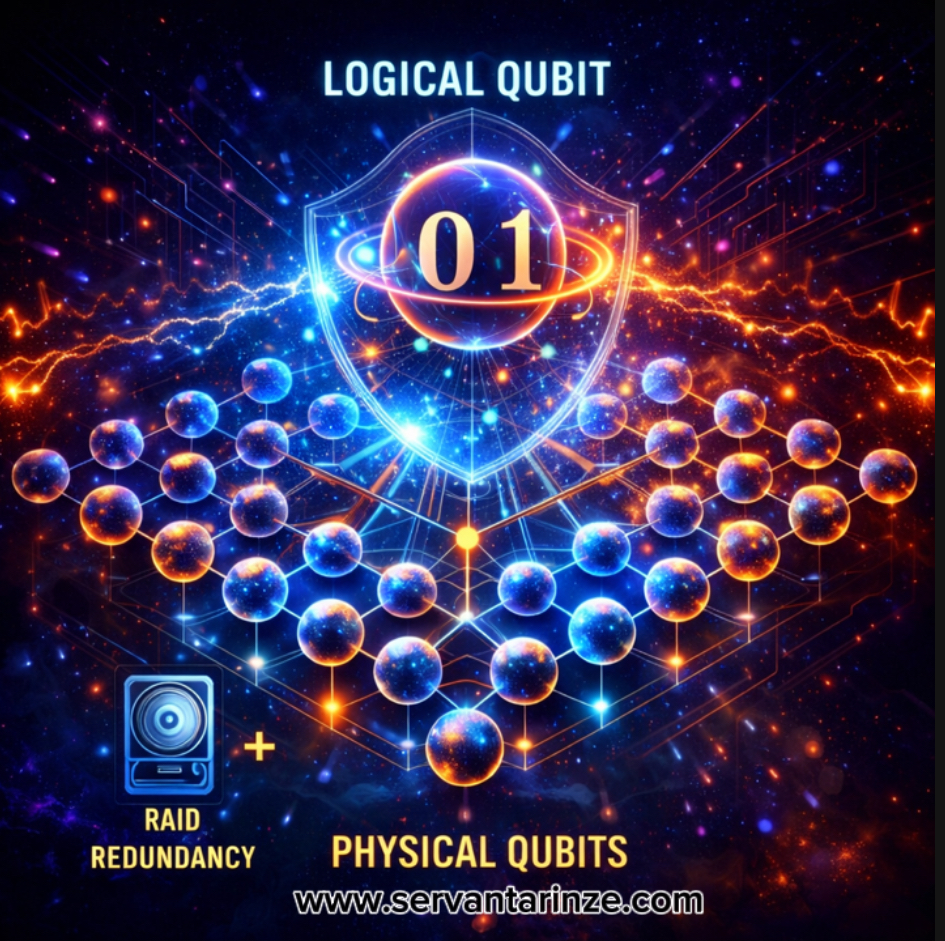
The key insight behind quantum error correction is both simple and profound: instead of relying on a single fragile qubit, quantum information can be spread across many physical qubits in a carefully structured way. Together, these physical qubits form a single logical qubit that is far more resilient to noise than any individual component.
A helpful analogy is data storage in classical systems. Hard drives fail, sectors become corrupted, and bits flip unexpectedly. To protect against this, modern storage systems use redundancy schemes similar to RAID, where information is distributed across multiple drives. If one component fails, the system can reconstruct the original data using the remaining pieces. Quantum error correction applies a similar idea, but in a way that respects the laws of quantum mechanics.
Rather than copying quantum information directly, quantum error correction uses carefully designed measurements known as syndrome measurements. These measurements do not reveal the value of the quantum information itself. Instead, they reveal whether an error has occurred and what type of error it was. This allows the system to correct mistakes without collapsing the underlying quantum state.
At the heart of this approach lies the quantum threshold theorem. It states that if the error rate of physical qubits is kept below a certain threshold, then logical error rates can be suppressed to arbitrarily low levels by increasing the number of physical qubits used for encoding. In practical terms, this means that noisy hardware can still support reliable computation, provided it is paired with sufficiently robust error correction.
This is why quantum error correction is often described as an invisible shield. It operates continuously in the background, detecting and correcting errors as they occur, allowing quantum algorithms to proceed as if the hardware were far more stable than it actually is. Without this shield, large-scale quantum computing remains impossible. With it, fault-tolerant quantum machines become an achievable engineering goal rather than a distant dream.
The Leading Quantum Error Correction Codes Powering Fault-Tolerant Quantum Computing
Quantum error correction is not a single technique but a family of carefully designed codes, each with its own strengths, trade-offs, and historical importance. These codes determine how physical qubits are organized, how errors are detected, and how reliably logical qubits can be preserved over time. Understanding these approaches is essential for appreciating how quantum error correction turns fragile hardware into something usable.
The Shor Code: The First Quantum Error Correction Breakthrough
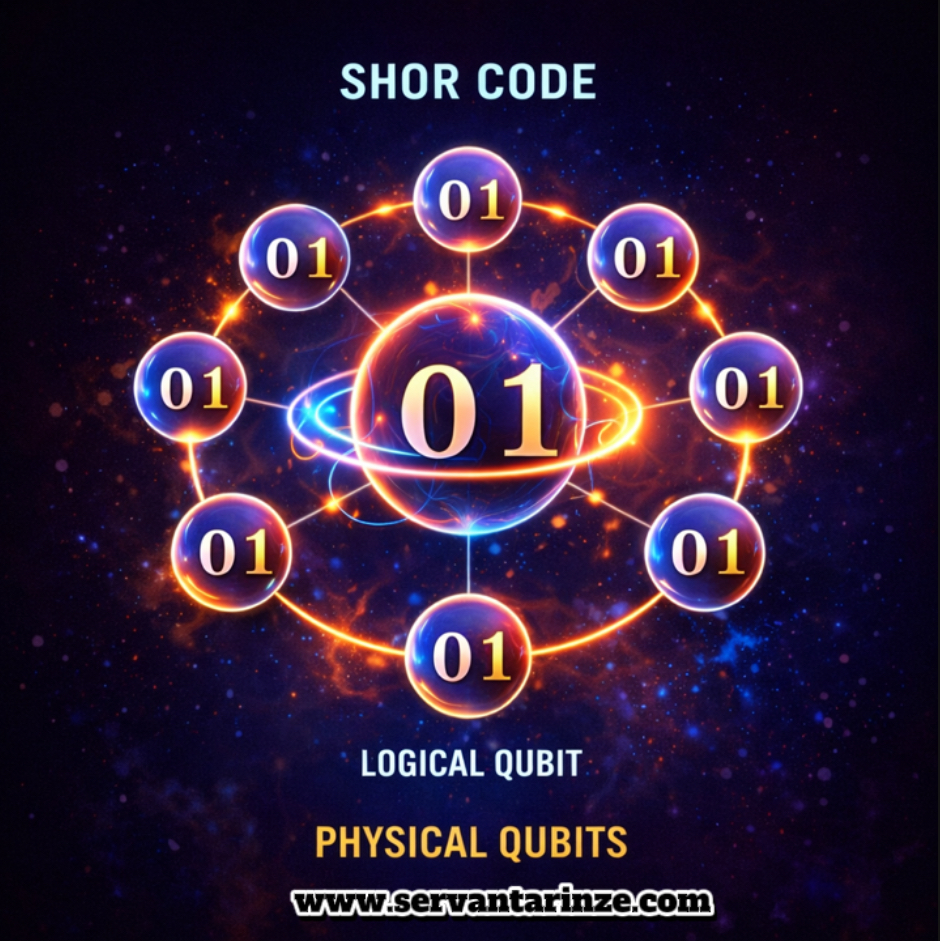
The Shor code holds a special place in the history of quantum computing. Introduced in the mid-1990s, it was the first proof that quantum error correction was even possible. At the time, many researchers believed that the no-cloning theorem made error correction fundamentally incompatible with quantum mechanics. The Shor code shattered that assumption.
This code encodes a single logical qubit using nine physical qubits. By carefully entangling these qubits, it can detect and correct both bit-flip and phase-flip errors affecting any one of them. Conceptually, it separates the protection of quantum information into layers, ensuring that different types of errors can be handled independently.
While the Shor code is elegant and historically important, it is highly inefficient. Using nine physical qubits to protect one logical qubit creates too much overhead for practical systems. As a result, the Shor code is rarely used in modern hardware. Instead, it serves as a foundational teaching tool, demonstrating the core principles behind quantum error correction and inspiring more efficient designs.
The Steane Code and CSS Codes: Building Efficiency Into Error Correction

The Steane code represents a major step forward in efficiency. Instead of nine physical qubits, it encodes one logical qubit using seven. More importantly, it belongs to a broader family known as CSS codes, named after the researchers who developed the underlying framework.
CSS codes work by combining two classical error-correcting codes in a way that allows quantum information to be protected from both bit-flip and phase-flip errors. This structure simplifies error detection and makes certain logical operations easier to implement in a fault-tolerant manner.
The Steane code strikes a balance between conceptual clarity and practical utility. Although it still requires significant overhead, it laid the groundwork for many modern approaches. Its structure influenced how researchers think about transversal gates, syndrome extraction, and fault-tolerant operations, all of which remain central topics in quantum error correction research.
The Surface Code: The Industry’s Practical Favorite
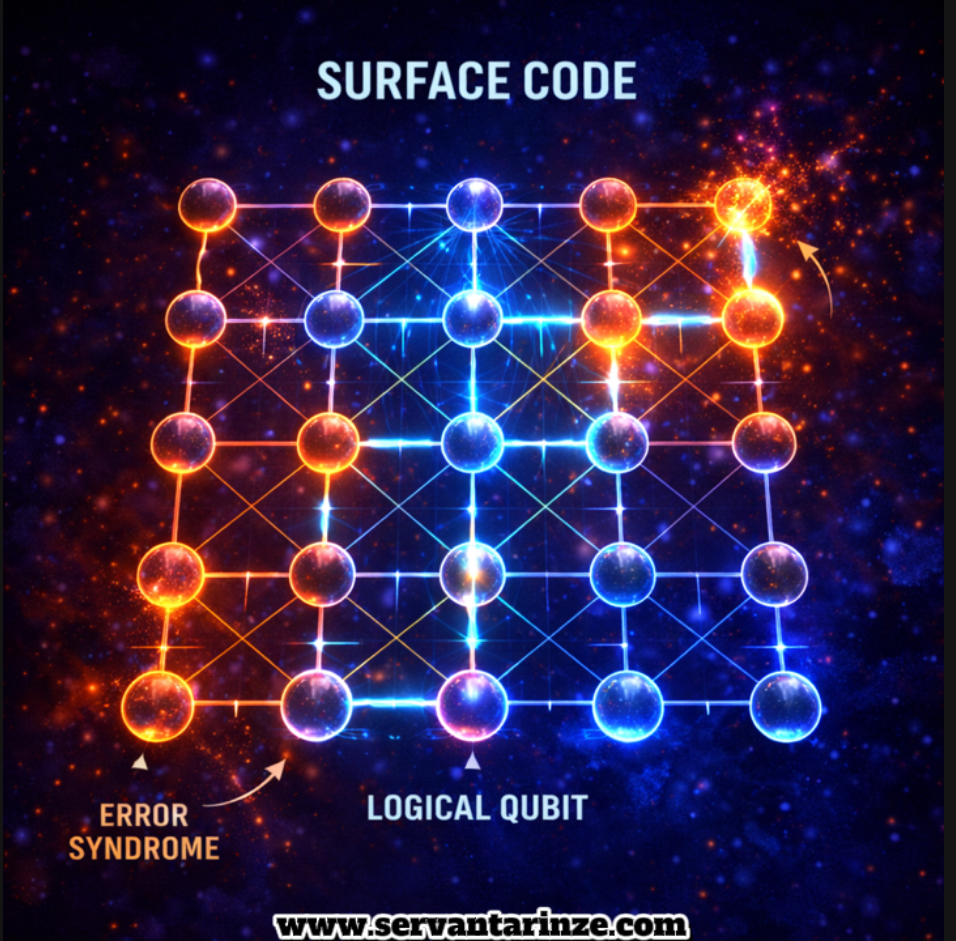
Among all known quantum error correction schemes, the surface code has emerged as the most practical choice for real-world hardware. Unlike earlier codes that rely on complex connectivity between distant qubits, the surface code is designed to work on a two-dimensional grid where each qubit interacts only with its nearest neighbors.
This local structure makes the surface code especially well suited for today’s quantum processors. Errors are detected by repeatedly measuring simple parity checks across the grid, allowing the system to identify where faults have occurred without disturbing the encoded quantum information. As the grid grows larger, logical qubits become exponentially more robust.
One of the surface code’s most important features is its relatively high error threshold. If physical qubit error rates remain below this threshold, logical errors can be suppressed dramatically by increasing the code distance. This property has made the surface code the centerpiece of most major fault-tolerant quantum computing roadmaps.
The trade-off is overhead. A single high-quality logical qubit may require hundreds or even thousands of physical qubits when implemented using the surface code. Despite this cost, its scalability, locality, and resilience make it the leading candidate for turning quantum error correction into an engineering reality rather than a theoretical exercise.
Color Codes and Toric Codes: Alternative Paths to Fault Tolerance
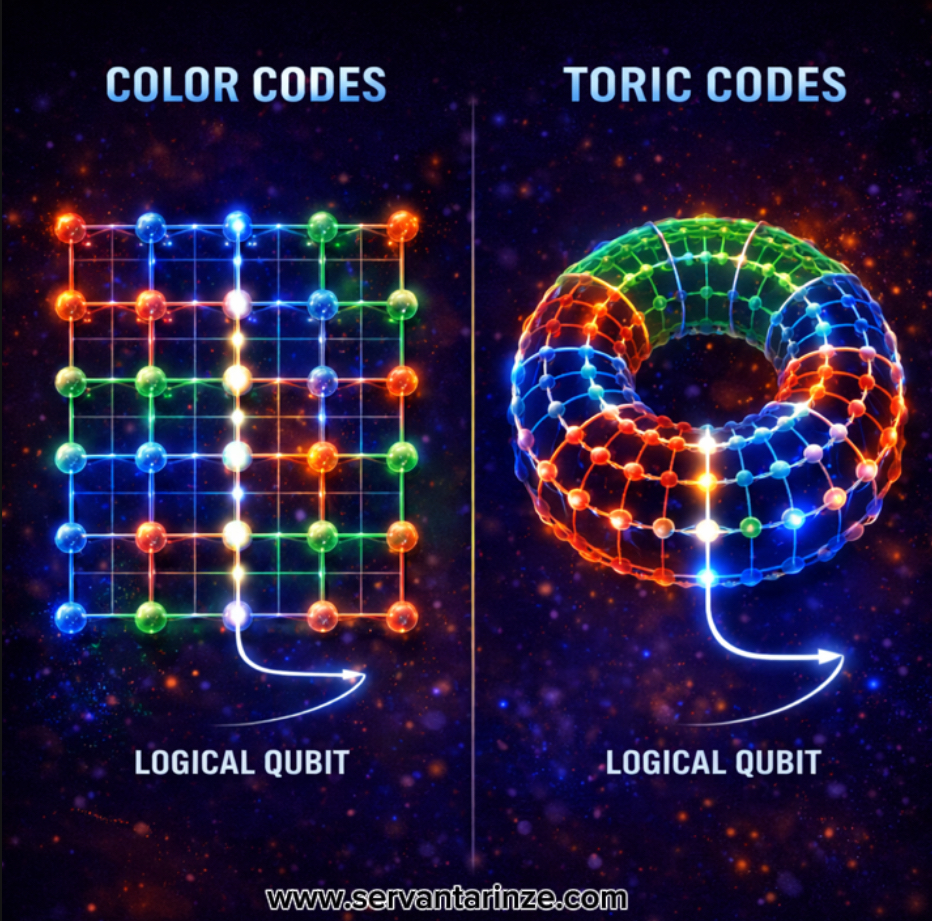
Beyond the surface code, several alternative quantum error correction schemes continue to attract research interest. Among the most notable are color codes and toric codes, which share conceptual similarities with surface codes but differ in structure and operational trade-offs.
Toric codes were among the earliest topological quantum error correction schemes. Like surface codes, they arrange qubits on a lattice and protect information through global topological properties rather than local details. Their strength lies in conceptual elegance and strong theoretical foundations. However, toric codes typically assume idealized boundary conditions that are difficult to implement on real hardware, limiting their practical adoption.
Color codes build on similar lattice-based ideas but introduce additional symmetry that can simplify certain logical operations. In some cases, color codes allow a broader set of fault-tolerant gates to be implemented more naturally than with surface codes. This advantage makes them attractive for specific algorithmic workloads, even though they often come with higher measurement complexity and more demanding hardware requirements.
While neither toric nor color codes have displaced the surface code as the industry standard, they play an important role in the broader ecosystem of quantum error correction research. They offer alternative design philosophies and continue to influence how future codes are evaluated for efficiency, flexibility, and fault-tolerant operation.
Concatenated Codes and Quantum LDPC Codes: Reducing Overhead
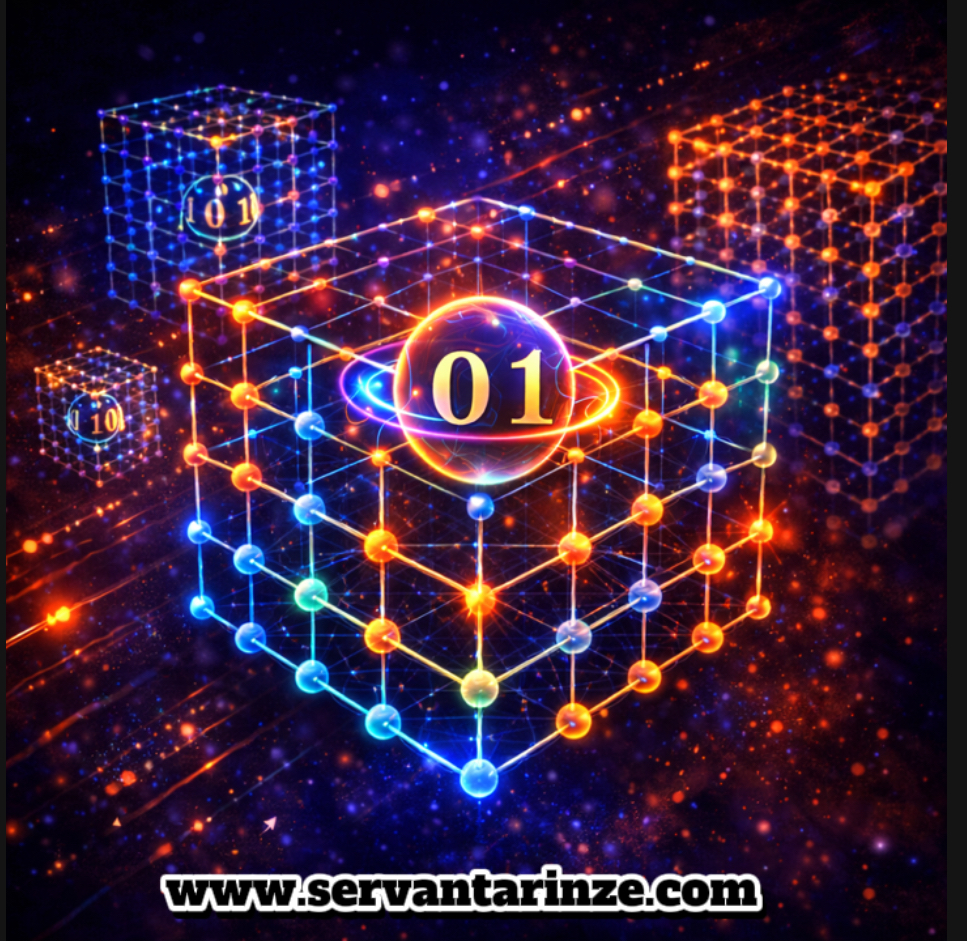
One of the biggest challenges facing quantum error correction is overhead. Protecting a single logical qubit often requires hundreds or thousands of physical qubits, placing enormous demands on hardware scalability. This has motivated growing interest in concatenated codes and quantum low-density parity-check (LDPC) codes, which aim to reduce the number of physical qubits required.
Concatenated codes work by nesting one error correction code inside another. A logical qubit protected by one code is further encoded using a second code, creating layers of protection. This approach can dramatically suppress errors, but it often increases circuit complexity and decoding requirements. As a result, concatenated codes tend to be more challenging to implement in near-term hardware.
Quantum LDPC codes represent a more recent and promising direction. These codes are designed to achieve strong error suppression with relatively sparse connections between qubits, potentially lowering overhead while maintaining fault tolerance. Advances in decoding algorithms and hardware-friendly constructions have renewed interest in LDPC-based approaches as a complement to surface code architectures.
Although these methods are still emerging, they highlight an important reality: quantum error correction is not a solved problem with a single final answer. It is an evolving engineering discipline, where different codes may dominate at different stages of hardware maturity.
Real-World Progress and Milestones in Quantum Error Correction
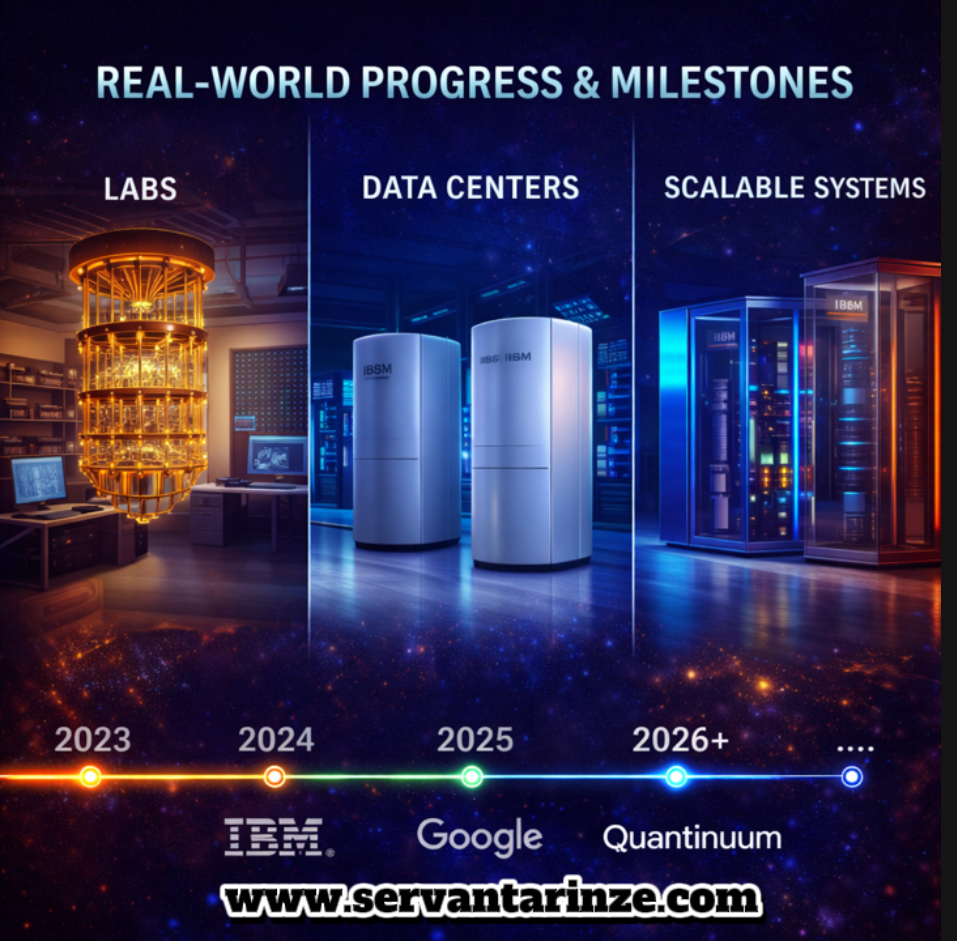
For many years, quantum error correction was viewed as a purely theoretical achievement, essential in principle but unreachable in practice. That perception is now changing. Experimental demonstrations across multiple hardware platforms are showing that logical qubits protected by quantum error correction can outperform their physical counterparts, even in noisy environments.
Recent experiments have demonstrated logical qubits with error rates lower than the underlying physical qubits, a milestone that marks a true turning point. These results confirm that error correction can see through noise rather than merely adding complexity. Instead of errors accumulating faster as systems scale, they can now be actively suppressed.
Different hardware approaches are contributing to this progress. Superconducting systems have shown repeated rounds of syndrome measurement with improving stability, while trapped-ion platforms have demonstrated high-fidelity logical operations over extended periods. Neutral-atom architectures are also emerging as a promising candidate, offering dense qubit arrays and flexible connectivity.
Despite this progress, the overhead remains substantial. Current logical qubits often require hundreds or more physical qubits, and large-scale algorithms will demand many logical qubits working together reliably. This reality underscores why quantum error correction is best understood as an engineering challenge rather than a single breakthrough moment.
The progress achieved so far makes one thing clear: fault-tolerant quantum computing is no longer a distant theoretical concept. It is an active area of development, with tangible milestones already reached and a clear roadmap toward more capable systems in the years ahead.
Challenges Remaining Before Fault-Tolerant Quantum Computing Becomes Practical
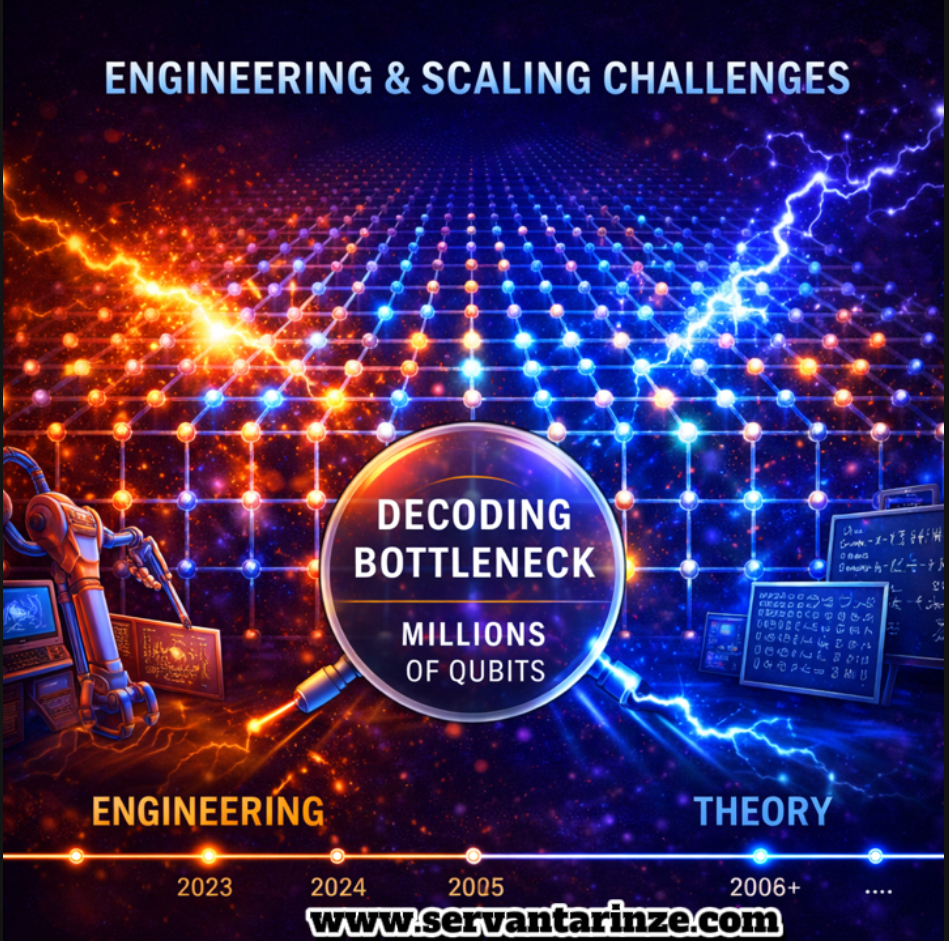
Despite the impressive progress made so far, quantum error correction still faces significant challenges before it can fully unlock large-scale, fault-tolerant quantum computing. The most visible challenge is sheer scale. Protecting a single logical qubit can require hundreds or even thousands of physical qubits, and useful quantum algorithms may need hundreds of logical qubits operating together. This means future quantum systems must grow by orders of magnitude while maintaining precise control.
Another major hurdle is decoding speed. Quantum error correction relies on rapidly processing syndrome measurements to determine which corrections should be applied. These decisions must be made in real time, often within microseconds, while the quantum system continues to evolve. Designing classical processors and algorithms capable of keeping up with this demand is a nontrivial engineering problem.
Fault-tolerant gate implementation remains an active area of research as well. While error correction protects stored quantum information, performing complex operations on logical qubits without reintroducing errors is far more difficult. Techniques such as magic state distillation enable universal computation, but they add substantial overhead and complexity. Improving the efficiency of these processes is essential for practical applications.
Taken together, these challenges make it clear that quantum error correction is not a single invention but an ongoing engineering effort. The field has moved beyond proof-of-principle demonstrations and into a phase focused on optimization, scalability, and system integration. Progress will come through steady refinement rather than dramatic overnight breakthroughs.
Conclusion: The Invisible Shield That Makes Quantum Computing Real
Quantum error correction is the quiet foundation upon which real-world quantum computing will be built. While qubits and algorithms often capture public attention, it is error correction that determines whether those ideas can survive contact with physical reality. Without it, quantum computers remain fragile experiments. With it, they become machines capable of tackling problems beyond the reach of classical computation.
The progress achieved so far shows that fault-tolerant quantum computing is no longer a distant theoretical aspiration. Logical qubits are now being protected, errors are being actively suppressed, and scalable architectures are taking shape. These advances signal a transition from possibility to practicality, even if the road ahead remains challenging.
As this invisible shield continues to strengthen, the true potential of quantum computing comes into view. Chemistry, materials science, optimization, and secure communication stand to benefit once error-corrected systems reach sufficient scale. The coming years will determine how quickly these possibilities become reality.
If you’re looking to deepen your understanding of the foundations that make quantum error correction necessary in the first place, these guides will help complete the picture. Our breakdown of quantum bits vs binary bits explains why qubits behave so differently from classical bits—and why they are inherently more fragile. To see how quantum sensitivity becomes a strength rather than a weakness, explore what quantum sensors are and how they exploit quantum effects in the real world. Finally, quantum vs classical computing puts everything into perspective, clarifying what is genuinely possible today, what remains experimental, and why error correction is the bridge between theory and practical quantum advantage.
What do you think? Will quantum error correction enable practical quantum advantage within this decade, or will the engineering hurdles take longer to overcome? Explore more guides on qubits, quantum hardware, and programming on this site, and join the discussion as we follow the evolution of fault-tolerant quantum computing.
Frequently Asked Questions About Quantum Error Correction (FAQ)
What is quantum error correction?
Quantum error correction is a method used to protect quantum information from errors caused by noise, decoherence, and imperfect operations. It works by encoding one logical qubit across many physical qubits so that errors can be detected and corrected without destroying the quantum state.
Why do quantum computers need error correction?
Quantum computers are extremely sensitive to their environment. Even tiny disturbances can introduce errors that grow rapidly as calculations become more complex. Without quantum error correction, useful quantum algorithms would fail long before producing meaningful results.
What is the difference between physical qubits and logical qubits?
A physical qubit is a single hardware unit that stores quantum information but is highly error-prone. A logical qubit is an error-corrected qubit formed by combining many physical qubits, making it far more stable and suitable for long computations.
How many physical qubits are needed for one reliable logical qubit?
The number depends on the error correction code and the desired reliability. Current approaches often require hundreds or even thousands of physical qubits to create a single high-quality logical qubit capable of running complex algorithms.
What is the surface code and why is it so important?
The surface code is a leading quantum error correction scheme that arranges qubits on a two-dimensional grid and uses local measurements to detect errors. It is popular because it has a high error threshold and works well with current quantum hardware designs.
Does quantum error correction violate the no-cloning theorem?
No. Quantum error correction does not copy quantum information directly. Instead, it spreads information across entangled qubits and uses indirect measurements to detect errors without revealing or duplicating the quantum state itself.
Is quantum error correction already working in real hardware?
Yes. Experimental systems have demonstrated logical qubits whose error rates are lower than those of individual physical qubits. While still early and resource-intensive, these results confirm that quantum error correction works in practice.
What are syndrome measurements in quantum error correction?
Syndrome measurements are special checks that reveal whether an error has occurred without revealing the quantum information itself. They allow a quantum computer to detect and correct errors while preserving superposition and entanglement.
Will quantum error correction make quantum computers faster?
Quantum error correction does not directly make quantum computers faster. Instead, it makes them reliable. By preventing errors from overwhelming calculations, it allows quantum algorithms to run long enough to achieve real-world advantage.
When will fully fault-tolerant quantum computers become practical?
Fully fault-tolerant quantum computers are still under development, but steady progress in quantum error correction suggests that practical systems will emerge as hardware scales and error rates continue to improve over the coming years.
Why is quantum error correction called the “invisible shield” of quantum computing?
Quantum error correction operates continuously in the background, detecting and correcting errors without interfering with computation. Like an invisible shield, it protects fragile quantum information and makes real-world quantum computing possible.
Is quantum error correction the biggest obstacle to large-scale quantum computing?
Yes. While qubit quality and hardware design are important, quantum error correction is the key requirement for scaling quantum systems. Without it, increasing qubit counts alone cannot deliver reliable or useful quantum computation.