
In 2026, logistics has become one of the most computationally demanding industries on the planet. Every day, global delivery networks must decide how to move millions of packages across cities and continents while accounting for traffic congestion, fuel prices, weather disruptions, labor constraints, sustainability targets, and unpredictable demand. These decisions are not made once. They are recalculated continuously, often under tight time pressure, with real financial and environmental consequences. 1
Time spent inside large optimization systems shows where theoretical limits stop being abstract. It is one thing to talk about computational complexity on paper. It is another to watch routing systems collapse into approximations as networks grow, deadlines tighten, and real-world constraints refuse to simplify. Logistics exposes those limits faster than almost any other industry. What looks simple on the surface—choosing the ‘best route’—breaks down almost immediately at scale. As networks grow larger, classical algorithms stop finding optimal answers and settle instead for approximations that are merely good enough. In a world where margins are thin and emissions matter, “good enough” is no longer enough.
This is where quantum logistics enters the conversation, not as a futuristic promise, but as a response to a very specific kind of computational pressure. Quantum systems do not solve problems by running faster versions of classical logic. They represent problems differently. By encoding many possible states at once, qubits allow optimization systems to probe solution spaces that classical methods can only sample selectively. In routing-heavy domains, that shift changes what is practically reachable.
The pressure driving this shift is not theoretical. E-commerce volumes continue to climb. Same-day and next-day delivery expectations are now global norms. At the same time, companies are under increasing scrutiny to reduce fuel consumption and carbon emissions. A single percentage improvement in routing efficiency can translate into millions of dollars saved and thousands of tons of emissions avoided. These are the conditions under which new computational approaches stop being experimental and start becoming operational.
Logistics optimization problems such as the Traveling Salesman Problem, Vehicle Routing Problem, and their many real-world variants have been studied for decades. They are classified as NP-hard for a reason. The number of possible solutions grows exponentially as routes, vehicles, and constraints are added. Classical computers cope by relying on heuristics, shortcuts that work well enough for small or moderately sized systems but degrade as complexity increases. At global scale, these shortcuts leave value on the table. 2
Quantum systems approach this challenge from a different angle. Techniques such as quantum annealing allow optimization problems to be framed as energy landscapes, where the best solution corresponds to the lowest energy state. Instead of searching sequentially, the system naturally settles toward better configurations. 3 Gate-based quantum processors explore similar ideas through variational algorithms that combine quantum circuits with classical optimization loops. In practice, the most effective deployments today are hybrid, using quantum processors to tackle the hardest subproblems while classical systems handle orchestration and scaling.
What matters most is that this is already happening outside the lab.5 By 2026, companies in automotive manufacturing, urban mobility, cargo transport, and last-mile delivery have run real pilots using quantum or quantum-inspired systems. These efforts have produced measurable improvements in route efficiency, fleet utilization, and emissions reduction, often ranging between ten and thirty percent in targeted scenarios. In logistics, those margins compound rapidly.
This article is grounded in research, public pilot results, and ongoing industry experimentation. I am not approaching quantum logistics as a futurist promise or a marketing slogan. I am examining it as an emerging computational toolset that addresses a specific class of problems better than classical approaches alone. The goal is to understand where qubits genuinely help, where they do not, and how logistics organizations are beginning to integrate them responsibly.
What follows is a closer look at why logistics is such a natural fit for quantum optimization, how quantum systems actually model delivery routes, and which real-world deployments have demonstrated value so far. Along the way, I will also address the limitations that remain and the conditions under which quantum logistics makes sense today. This is not about replacing logistics professionals or existing systems. It is about expanding the computational lens through which the world’s most complex delivery networks are designed.
Why Logistics Is a Perfect Fit for Quantum: The Optimization Challenge
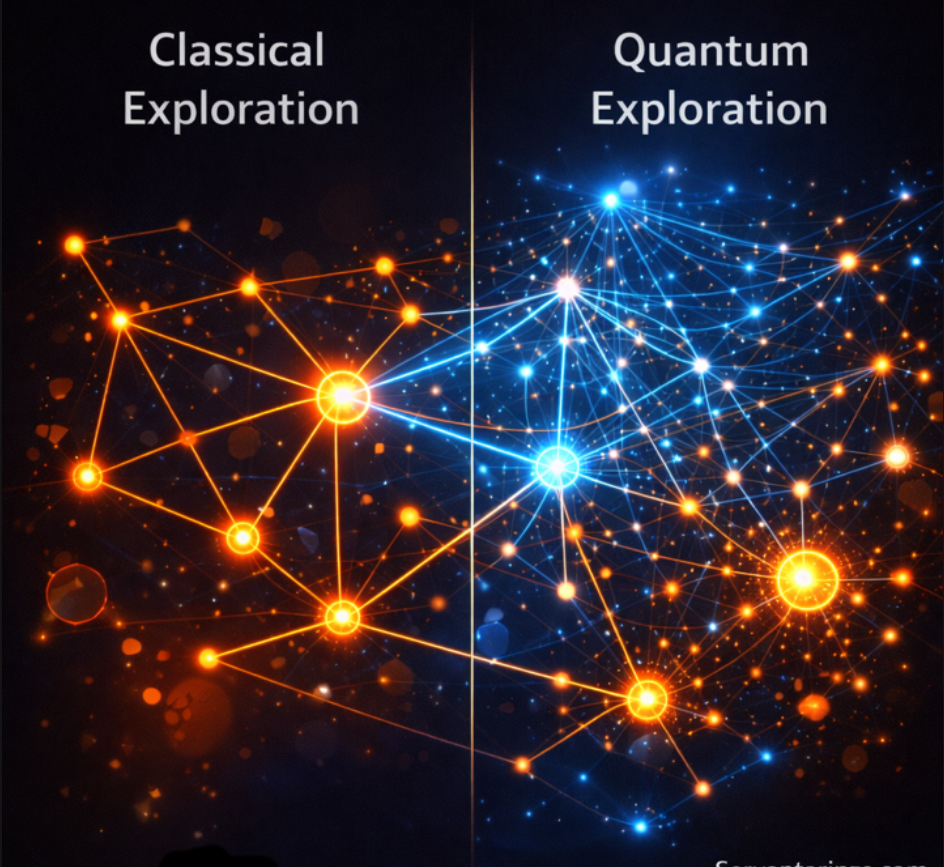
To understand why quantum logistics has attracted serious attention, it helps to look closely at the nature of logistics problems themselves. At their core, logistics decisions are optimization problems constrained by reality. Routes must respect time windows, vehicle capacities, driver availability, fuel limits, traffic patterns, and increasingly, emissions targets. Each added constraint multiplies the number of possible solutions rather than narrowing them in a simple way.
The most well-known example is the Traveling Salesman Problem, where the objective is to find the shortest possible route that visits a set of locations exactly once. In theory, it sounds straightforward. In practice, the number of possible routes grows factorially as stops are added. With just fifty locations, the number of potential routes exceeds the number of atoms in the observable universe. Real logistics problems are far more complex, involving multiple vehicles, depots, delivery windows, and dynamic disruptions.
Vehicle Routing Problems extend this complexity further. Modern delivery networks must solve variants that include capacity limits, time-sensitive deliveries, heterogeneous fleets, multi-depot coordination, and real-time re-routing. Warehousing and cargo loading introduce three-dimensional packing constraints. Fleet scheduling must balance utilization against maintenance cycles and labor rules. Each of these layers adds exponential complexity to the solution space.
Classical computing approaches have evolved sophisticated ways to cope with this explosion. Heuristics such as genetic algorithms, simulated annealing, tabu search, and greedy approximations dominate industrial optimization today. These methods are fast and practical, but they do not guarantee optimal solutions. Instead, they search selectively, guided by rules that work well most of the time. As problem sizes grow, the gap between the best-known solution and the true optimum widens.
I have seen this trade-off repeatedly in large-scale systems. When networks are small, classical solvers perform admirably. As scale increases, optimization shifts from finding the best solution to finding an acceptable one within time limits. This compromise is not always visible to end users, but it manifests as longer routes, underutilized vehicles, higher fuel consumption, and fragile schedules that break under disruption.
Quantum systems approach these problems from a fundamentally different perspective. Instead of evaluating one candidate solution at a time, quantum representations allow many possibilities to be encoded and explored simultaneously. In optimization contexts, this parallelism does not mean instant answers. It means a richer exploration of the solution landscape, with a greater ability to escape local minima that trap classical heuristics.
Quantum annealing is particularly well suited to this task. By translating logistics problems into energy-based formulations, complex constraints become part of an energy landscape. The system naturally evolves toward low-energy states that correspond to better solutions. For certain classes of routing and scheduling problems, this process can identify higher-quality solutions faster than classical methods constrained by sequential exploration.
Gate-based quantum approaches address the same challenge through variational algorithms that combine quantum circuits with classical feedback loops. These methods do not replace classical solvers; they augment them. The quantum component explores hard combinatorial regions of the problem, while classical systems manage scaling, constraint handling, and post-processing. This hybrid structure reflects the practical reality of quantum logistics in 2026.
When people struggle to grasp why optimization breaks down at scale, I often point to how search actually feels in practice. Classical systems are forced to make decisions about where to look next, committing early and hoping those commitments pay off. In large logistics networks, those early choices harden quickly. Once the system settles into a local pattern, escaping it becomes expensive, even when better global configurations exist.
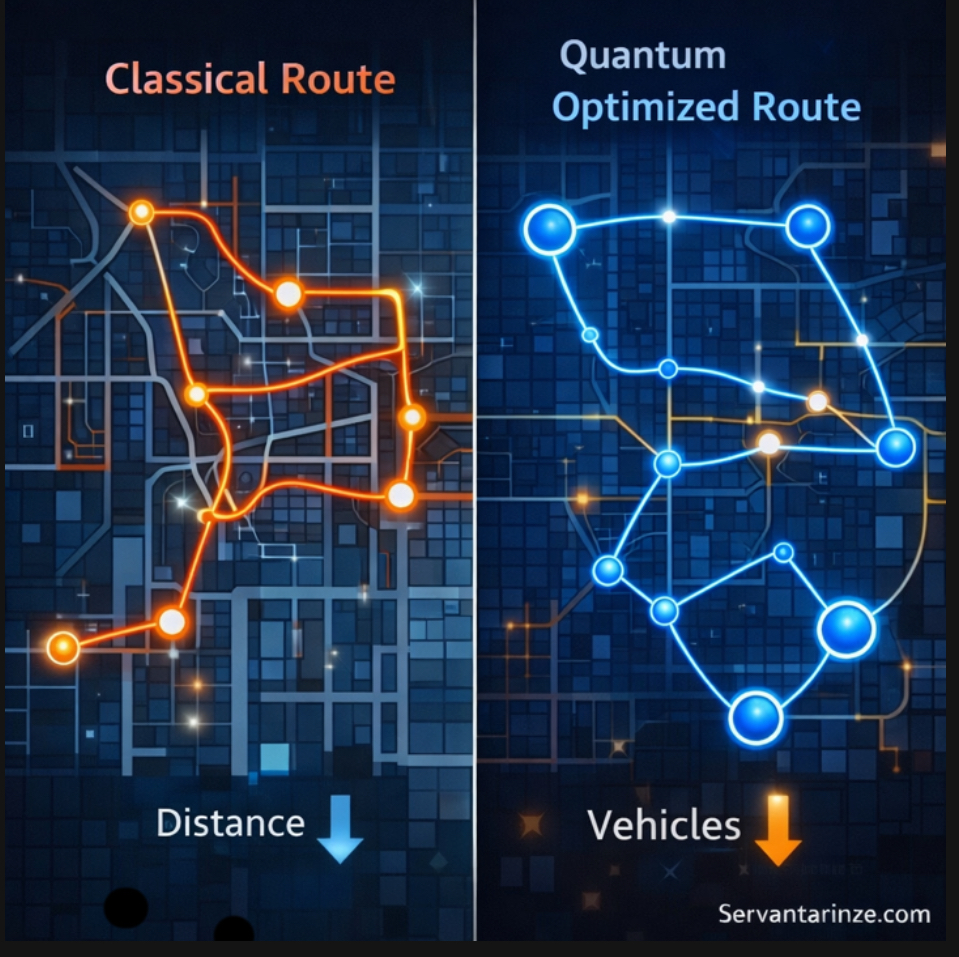
What makes logistics such a compelling testbed is that success does not require perfect solutions. Even modest improvements in route quality or scheduling efficiency can deliver outsized benefits. A ten percent reduction in total distance traveled can mean fewer vehicles on the road, lower fuel costs, reduced emissions, and more resilient delivery schedules. These gains are large enough to justify experimentation, even when quantum hardware is still evolving.
This alignment between problem structure and payoff explains why logistics was one of the first industrial domains willing to move beyond purely theoretical quantum advantage. The complexity is real, the inefficiencies are measurable, and the value of better optimization is immediate. In this context, quantum computing is not being asked to perform miracles. It is being asked to do what it does best: explore complexity more effectively than classical systems alone.
How Quantum Solves Delivery Routes: Algorithms, Techniques, and Practical Models
When logistics organizations first encounter quantum computing, the natural question is not philosophical but operational. How, exactly, does a quantum system take a real delivery network and produce a better route? The answer is less mysterious than it appears, but it requires reframing how routing problems are represented and solved.
Most quantum approaches to logistics begin by translating routing decisions into mathematical objects that quantum hardware can manipulate. In practice, this often means expressing delivery routes, vehicle assignments, and scheduling constraints as binary variables within an optimization framework. Each variable represents a decision, whether a vehicle visits a location, whether a delivery happens within a specific time window, or whether a constraint is satisfied. The objective is to minimize a cost function that encodes distance, time, fuel use, or emissions.
Quantum annealing has emerged as the most mature approach for this class of problems. In annealing-based systems, the optimization task is reformulated as a quadratic unconstrained binary optimization problem. Constraints are folded into the objective through penalty terms, shaping an energy landscape where valid and efficient routes correspond to low-energy states. The quantum processor then explores this landscape, guided by physical dynamics rather than explicit step-by-step search.
This approach maps naturally to routing and scheduling problems because it treats optimization as a global property of the system rather than a sequence of local improvements. Instead of iteratively adjusting routes, the system evaluates many configurations at once, allowing it to discover combinations that classical heuristics might overlook. In logistics terms, this can mean identifying route structures that reduce congestion or balance workloads more evenly across a fleet.
Gate-based quantum processors address routing problems through a different mechanism.4 Variational algorithms such as the Quantum Approximate Optimization Algorithm use parameterized quantum circuits to represent candidate solutions. These circuits are evaluated, measured, and adjusted through a classical feedback loop. Over multiple iterations, the system converges toward better solutions. While current gate-based hardware is more limited in scale, these methods are important because they point toward future fault-tolerant systems capable of handling richer problem representations.
In practice, pure quantum solutions are rare. The most effective deployments in 2026 rely on hybrid architectures that combine quantum and classical computation. Large logistics problems are decomposed into smaller subproblems, such as clustering delivery zones or isolating time-critical routes. Quantum processors are then applied to the most complex components, while classical solvers manage orchestration, constraint handling, and integration with existing systems.
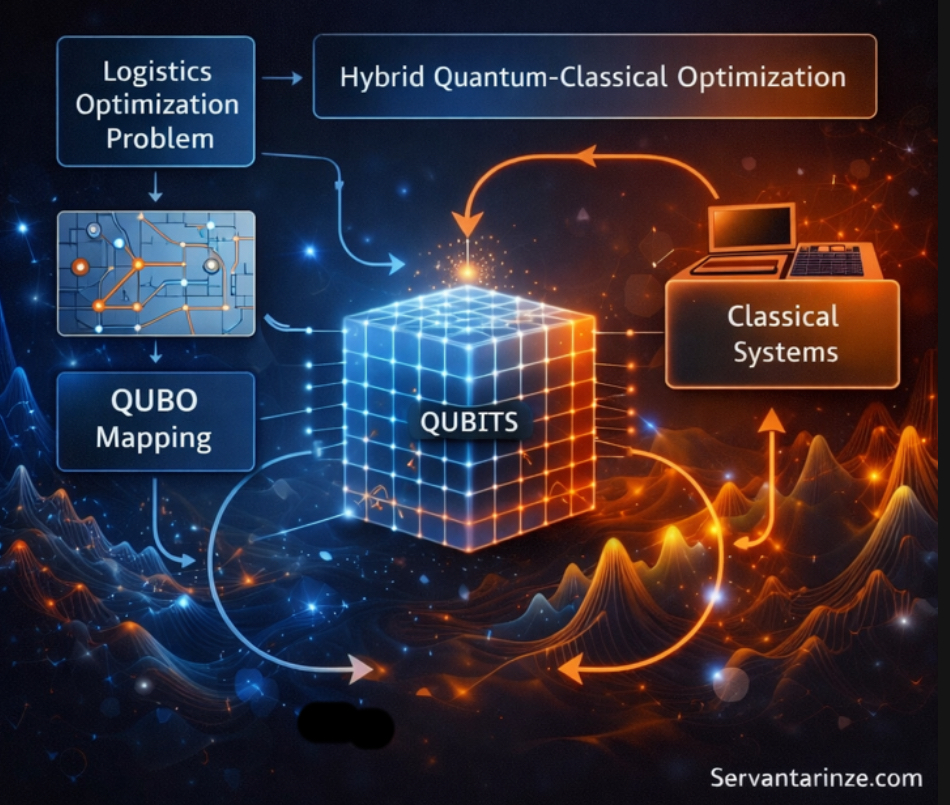
This hybrid workflow reflects both necessity and design choice. Quantum hardware remains constrained by noise, connectivity, and embedding overhead. Rather than forcing entire logistics networks onto quantum devices, practitioners focus on extracting value where classical methods struggle most. The result is not a replacement for existing optimization pipelines, but an enhancement layered on top of them.
In simplified demonstrations, routing problems are often presented as clean abstractions. Real deployments are messier. Locations may be optional, constraints may conflict, and data may be incomplete. What quantum formulations offer is not elegance, but flexibility. By treating routing decisions as interacting variables rather than fixed sequences, these systems can accommodate ambiguity in ways that rigid heuristics struggle with.
Supporting this approach is a growing ecosystem of tools designed to bridge theory and application. Quantum cloud platforms provide hybrid solvers that automatically manage decomposition and embedding. Quantum-inspired systems apply similar mathematical techniques on classical hardware, offering a practical stepping stone for organizations building internal expertise. These tools reduce the barrier between logistics models and quantum experimentation.
What is often overlooked is that formulation matters as much as hardware. Two mathematically equivalent routing problems can behave very differently when mapped onto quantum systems. Success depends on careful encoding, thoughtful constraint weighting, and realistic expectations about where quantum methods add value. This is why logistics teams experimenting with quantum optimization tend to involve both domain experts and quantum specialists.
At this stage, quantum logistics is less about speed and more about quality. The goal is not to compute routes faster than classical systems, but to compute better ones under complex constraints. When evaluated in terms of distance saved, vehicles reduced, or emissions avoided, these improvements justify the additional complexity of hybrid quantum approaches.
Understanding these mechanisms is essential for interpreting real-world results. When a pilot reports a ten or twenty percent efficiency gain, it is not because qubits magically solved an impossible problem. It is because quantum methods explored the solution space differently, uncovering configurations that classical heuristics were unlikely to reach within practical time limits.
Real-World Examples and Case Studies in 2025–2026
The credibility of quantum logistics does not come from theoretical benchmarks. It comes from deployments that had to operate under real constraints, imperfect data, and organizational pressure. By 2026, several pilots had reached that threshold, not because they promised disruption, but because they addressed narrow inefficiencies classical systems had learned to tolerate.
One of the earliest and most cited examples comes from automotive and urban mobility experiments that explored traffic flow and route coordination. In collaboration with quantum technology providers, vehicle routing and traffic optimization problems were mapped onto quantum annealing systems. The objective was not to compute perfect city-wide routes, but to improve coordination among vehicles in congested environments. In controlled pilots, these approaches reduced congestion indicators and improved fleet utilization compared with baseline classical heuristics.
Taxi dispatch optimization offers a particularly clear illustration of quantum logistics in practice. Urban dispatch systems must balance passenger demand, vehicle availability, travel time, and fairness constraints across a city. Classical systems approximate these decisions continuously, but the combinatorial explosion grows quickly as cities scale. In pilot deployments conducted in dense urban environments, hybrid quantum approaches demonstrated reductions in fleet size requirements and average travel distance while maintaining service quality. Even modest percentage improvements translated into fewer vehicles on the road and lower fuel consumption.
Last-mile delivery has emerged as another fertile testing ground. Delivery routes in dense cities are shaped by narrow time windows, unpredictable traffic, and customer availability. Classical solvers often rely on fixed heuristics that perform well on average but degrade under disruption. Quantum-enhanced optimization has been applied to reroute deliveries dynamically, focusing on subsets of routes where classical methods show instability. Reported results from pilot programs indicate distance reductions in the range of ten percent, alongside improvements in on-time delivery rates.
Cargo loading and packing present a different class of logistics challenge. Three-dimensional bin packing problems arise when loading aircraft, ships, or trucks with heterogeneous cargo. These problems are notoriously difficult to optimize fully, and classical solvers often rely on greedy strategies. In controlled evaluations, quantum-inspired solvers and annealing-based approaches identified packing configurations that improved space utilization and load balance. In freight contexts, even small gains in packing efficiency can reduce the number of required trips, amplifying downstream savings.
Manufacturing logistics has also benefited from quantum optimization experiments. Assembly line scheduling, parts sequencing, and internal transport routes involve tightly coupled constraints that change in real time. Hybrid quantum-classical systems have been used to reschedule production flows under disruption, such as delayed components or sudden demand shifts. The value here lies not only in optimality, but in resilience. Systems that can recompute higher-quality schedules quickly reduce downtime and waste.
Distribution networks for consumer goods offer another perspective. Large-scale distribution involves balancing regional demand, warehouse capacity, transportation costs, and delivery deadlines. Quantum and quantum-inspired approaches have been applied to optimize distribution routes and inventory flows across networks of vending machines and retail points. Reported outcomes include reductions in total distance traveled and improvements in stock availability, achieved without expanding fleet size.
Across these case studies, a consistent pattern emerges. Quantum methods are not replacing classical logistics systems. They are augmenting them. The most successful deployments identify specific subproblems where classical heuristics leave measurable inefficiencies, apply quantum optimization to those components, and reintegrate the results into existing pipelines. This targeted approach limits risk while capturing value.
Efficiency gains reported in these pilots typically fall between ten and thirty percent, depending on the problem and context. In logistics, such gains are not incremental. They compound across fleets, routes, and time. Reduced distance traveled lowers fuel costs and emissions. Improved scheduling increases asset utilization. Better packing reduces the need for additional trips. These outcomes explain why logistics has become one of the first industrial domains willing to invest in quantum experimentation despite hardware limitations.
It is also notable that many of these gains are achieved without requiring full-scale quantum hardware. Quantum-inspired algorithms running on classical systems often deliver part of the benefit by adopting similar problem formulations. This blurs the boundary between quantum and classical approaches, reinforcing the idea that the real innovation lies in how optimization problems are framed and solved, not solely in the hardware executing them.
The evidence is now clear enough to move the conversation beyond speculation. Quantum logistics has demonstrated practical value in targeted scenarios. The challenge now is not proving that it can work, but understanding where it works best, how to scale it responsibly, and how to integrate it into decision-making processes that already govern global supply chains.
Challenges and Limitations in 2026
Despite the progress described so far, quantum logistics in 2026 remains constrained by technical, operational, and organizational realities. These limitations do not invalidate the results achieved to date, but they shape how and where quantum methods can be applied responsibly. Understanding these boundaries is essential for separating meaningful progress from exaggerated expectations.
The most immediate constraint is hardware maturity.6 Current quantum systems operate in what is commonly described as the noisy intermediate-scale era. Qubits are susceptible to errors, coherence times are limited, and connectivity between qubits imposes practical constraints on how problems can be embedded. For annealing-based systems, this means that not every optimization problem maps cleanly onto available hardware without simplification or decomposition.
Gate-based quantum processors face even stricter limits in 2026. While research systems continue to scale, the number of usable qubits remains far below what would be required to encode large, real-world logistics networks directly. Variational algorithms show promise, but they rely on shallow circuits and hybrid feedback loops that trade expressiveness for stability. As a result, gate-based approaches are largely exploratory for logistics today, rather than production-ready.
These hardware constraints make hybrid architectures unavoidable. Real logistics problems often involve thousands of locations, vehicles, and constraints. Quantum systems can address only carefully selected subproblems within this larger context. Decomposition strategies introduce their own complexity, requiring expertise in both optimization theory and domain-specific logistics knowledge. Poorly chosen decompositions can erase potential quantum gains.
Cost and access also shape adoption. Quantum computing resources are typically accessed through cloud platforms, which lowers the barrier to experimentation but introduces new dependencies. Organizations must weigh the cost of quantum experimentation against uncertain returns, particularly when classical heuristics already deliver acceptable performance. For many logistics operators, the business case hinges on narrow margins and long-term efficiency gains rather than immediate transformation.
Another often overlooked consideration is energy consumption. Quantum hardware requires specialized infrastructure, including cryogenic cooling and precision control systems. While the absolute energy use of quantum processors is currently small compared with large classical data centers, it is not negligible. The sustainability benefits of quantum logistics arise primarily from downstream efficiency gains in transportation and routing, not from the intrinsic efficiency of the hardware itself.
There are also organizational challenges. Integrating quantum optimization into existing logistics systems requires changes to workflows, decision-making processes, and performance metrics. Many logistics operations are optimized around speed and reliability rather than experimentation. Introducing quantum components demands tolerance for uncertainty, iteration, and learning, which can clash with established operational cultures.
Finally, there is the risk of overgeneralization. Not every logistics problem benefits equally from quantum optimization. Some routing and scheduling tasks are already well served by classical heuristics. Others are constrained more by data quality or organizational friction than by computational limits. Treating quantum logistics as a universal solution would undermine its credibility and slow meaningful adoption.
These limitations do not suggest failure. They impose discipline. Quantum logistics works best when it is treated as a constrained capability rather than a general solution. The organizations making progress are not those chasing headlines, but those willing to accept that improvement often comes from narrow gains accumulated patiently.
Recognizing these boundaries is a sign of maturity, not skepticism. Technologies that survive their early hype cycles are those that learn where they belong. In the case of quantum logistics, that place is emerging clearly, defined by constraint, opportunity, and disciplined application rather than sweeping claims.
The Future of Quantum Logistics in 2030 and Beyond

Looking beyond 2026, the trajectory of quantum logistics depends less on dramatic breakthroughs and more on steady progress across hardware, software, and integration practices. The most likely future is not one in which quantum computers suddenly take over global supply chains, but one in which quantum capabilities become increasingly embedded within hybrid decision-making systems.
Hardware advances will play an important role. As error rates decline and qubit connectivity improves, larger and more expressive optimization problems will become tractable. Fault-tolerant quantum systems, when they arrive, will allow deeper circuits and richer representations of logistics constraints. This would enable more direct modeling of full-scale routing problems without the aggressive decomposition required today. Even incremental improvements in qubit stability could expand the class of problems where quantum methods offer a measurable edge.
Equally significant will be progress in algorithms and problem formulation. Quantum optimization techniques are still evolving, and many of the most effective approaches may not resemble those currently in use. Hybrid algorithms that adapt dynamically, shifting work between classical and quantum components based on problem structure and real-time conditions, are likely to become the norm. In logistics, this adaptability aligns well with environments that change continuously due to traffic, demand fluctuations, and disruptions.
The integration of quantum optimization with artificial intelligence will further shape this future. Machine learning systems already forecast demand, predict congestion, and detect anomalies in supply chains. Coupling these predictive models with quantum-enhanced optimization could enable logistics systems that not only anticipate change but respond to it with higher-quality decisions. The value lies in coordination rather than replacement, where AI provides foresight and quantum methods expand the space of feasible responses.
Sustainability considerations will increasingly influence adoption. Transportation and logistics are major contributors to global emissions, and optimization remains one of the most effective levers for reducing environmental impact without compromising service levels. As regulatory and corporate pressure to decarbonize intensifies, tools that can deliver even modest efficiency gains at scale will attract sustained interest. Quantum logistics fits naturally into this narrative, not as a green technology by itself, but as an enabler of greener operations.
Economic projections reflect this potential. Analysts estimate that advanced optimization technologies could unlock tens of billions of dollars in value across global supply chains over the coming decades. Whether quantum computing captures a significant share of this value will depend on its ability to integrate seamlessly with existing systems and deliver consistent improvements. The most impactful applications are likely to be those that remain invisible to end users, embedded quietly within routing engines and scheduling platforms.
It is also likely that the boundary between quantum and classical approaches will continue to blur. Quantum-inspired algorithms already demonstrate that much of the benefit comes from rethinking problem structure rather than relying solely on hardware. As these ideas diffuse, logistics optimization as a whole may improve, regardless of whether quantum processors are involved in every instance. In that sense, quantum logistics may influence the field even where quantum hardware is not directly deployed.
The most important factor shaping the future may be expectation management. Organizations that treat quantum logistics as a long-term capability, investing gradually and aligning experimentation with real operational needs, are more likely to see durable benefits. Those seeking immediate, universal advantage are likely to be disappointed. The lesson from early adopters is that patience and precision matter more than ambition.
By the early 2030s, quantum logistics may no longer be discussed as a distinct category. Instead, it may be absorbed into the broader toolkit of advanced optimization, its quantum origins acknowledged but no longer emphasized. If that happens, it will be a sign of success rather than obscurity, indicating that the technology has found its place within the infrastructure that quietly keeps the world moving.
Conclusion
Quantum logistics in 2026 stands at an important threshold. It is no longer confined to theoretical discussions or laboratory demonstrations, yet it has not become a universal solution adopted across every supply chain. Instead, it occupies a more interesting and credible position: a specialized computational approach that delivers real value when applied to the right problems under the right conditions.
The evidence from recent pilots and deployments shows that qubits can help address some of the most stubborn challenges in logistics optimization. By exploring complex solution spaces more effectively than classical heuristics alone, quantum and hybrid systems have delivered measurable improvements in route efficiency, fleet utilization, and emissions reduction. These gains may appear modest in percentage terms, but in an industry defined by scale, they translate into significant operational and environmental impact.
What makes this development noteworthy is not the promise of disruption, but the discipline with which it is unfolding. Successful applications of quantum logistics are grounded in realistic expectations, careful problem formulation, and close integration with existing systems. They recognize that quantum computing does not replace human expertise or classical infrastructure. It extends them, offering a new way to navigate complexity rather than escape it.
As hardware and algorithms continue to mature, the scope of quantum logistics will expand. Yet its long-term success will depend less on raw computational power and more on how thoughtfully it is deployed. Logistics professionals who treat quantum optimization as a tool to be tested, measured, and refined are likely to benefit most. Those who approach it as a cure-all risk disappointment.
The broader implication is clear. In a world where delivery networks must be faster, cheaper, and more sustainable, better optimization is no longer optional. Quantum computing has begun to earn its place in that effort, not through spectacle, but through quiet, cumulative gains. If that trajectory continues, quantum methods may eventually fade into the background of logistics optimization, not because they failed to matter, but because they became quietly useful.
References
- McKinsey & Company. Operations and Logistics Optimization.
https://www.mckinsey.com/capabilities/operations/our-insights - MIT OpenCourseWare. Introduction to Algorithms – NP-Complete Problems.
https://ocw.mit.edu/courses/6-006-introduction-to-algorithms-fall-2011/ - D-Wave Systems. Quantum Optimization and Annealing.
https://www.dwavesys.com/solutions/optimization/ - IBM Quantum. Variational Algorithms and Hybrid Quantum Computing.
https://www.ibm.com/quantum/learn/quantum-algorithms - D-Wave Systems. Case Studies in Traffic and Route Optimization.
https://www.dwavesys.com/case-studies/ - Preskill, J. (2018). Quantum Computing in the NISQ Era and Beyond.
https://quantum-journal.org/papers/q-2018-08-06-79/
Frequently Asked Questions About Quantum Logistics (FAQ)
What is quantum logistics?
Quantum logistics refers to the use of quantum computing or quantum-inspired optimization methods to solve complex logistics problems such as route planning, fleet scheduling, and cargo optimization. In practice, most real-world applications in 2026 rely on hybrid quantum-classical systems rather than purely quantum solutions.
How does quantum computing improve delivery route optimization?
Quantum systems explore large numbers of possible routing configurations simultaneously by representing decisions as optimization landscapes. This allows them to identify higher-quality route combinations than classical heuristics in certain high-complexity scenarios, especially when many constraints interact.
Is quantum logistics already being used in real companies?
Yes. By 2026, several logistics, mobility, and manufacturing organizations have tested quantum or quantum-inspired optimization in pilots and production-adjacent systems. These deployments typically report efficiency gains between ten and thirty percent in targeted routing or scheduling tasks.
Does quantum logistics replace classical optimization or human planners?
No. Quantum logistics complements classical optimization and human expertise rather than replacing them. Most successful implementations use quantum methods to address specific bottlenecks while classical systems handle scaling, constraints, and operational integration.
When will fully quantum logistics systems become practical?
Fully quantum logistics systems capable of modeling entire global networks directly are unlikely before the arrival of fault-tolerant quantum hardware, which is generally expected in the 2030s. Until then, hybrid and quantum-inspired approaches will remain the most practical path.