
In 2026, artificial intelligence no longer feels abstract. It answers questions, writes code, generates images, summarizes documents, and quietly supports decisions across finance, medicine, logistics, and research. What is easier to forget is that every one of these capabilities is powered by physical infrastructure: data centers, cooling systems, chips, electricity grids, and water. AI may appear digital, but its footprint is unmistakably material.
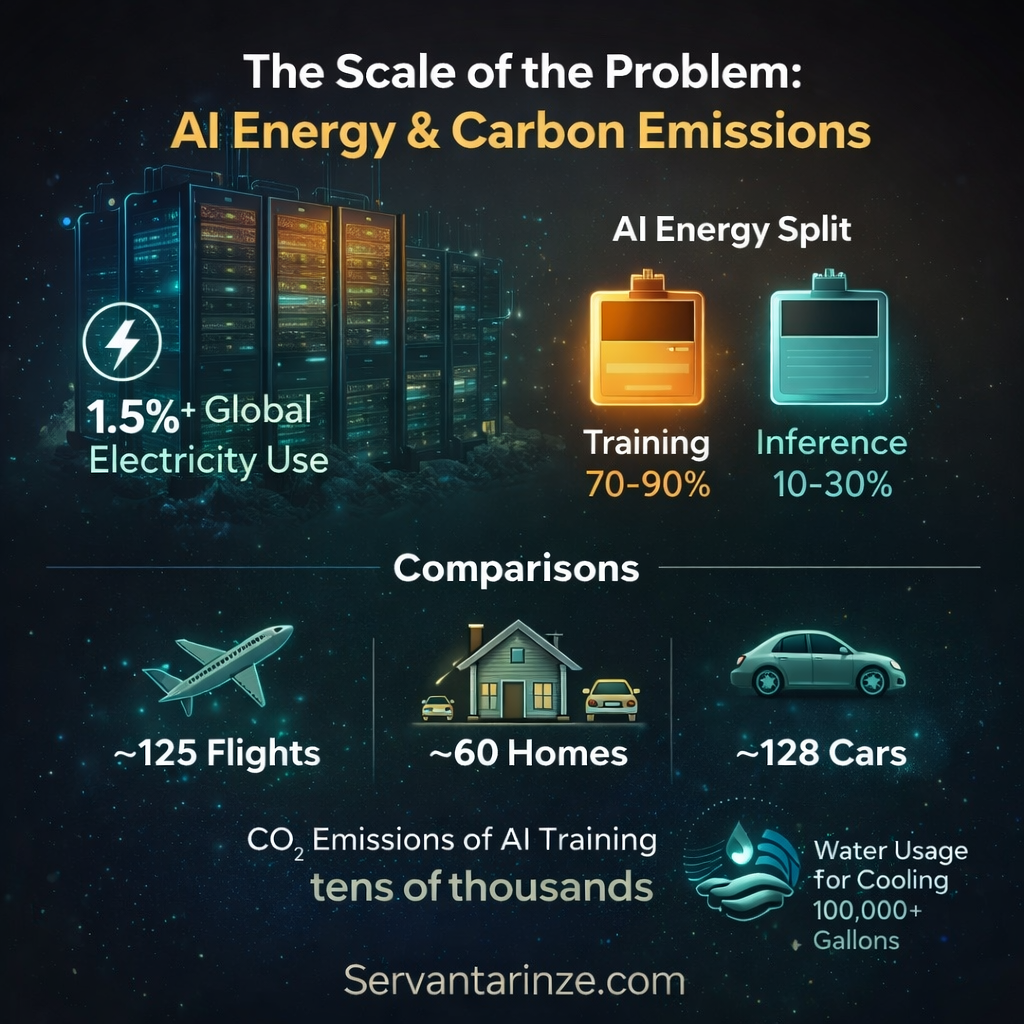
A few years ago, discussions about AI sustainability rarely left academic circles. Today, they are grounded in numbers that are difficult to ignore. Training a single large language model at modern scale can emit hundreds of tons of carbon dioxide equivalents, comparable to the lifetime emissions of multiple cars. Data centers now consume an estimated 1.5 to 2 percent of global electricity, and the share driven by AI workloads is rising faster than efficiency gains can offset. These figures are not speculative. They are drawn from energy reports, corporate disclosures, and infrastructure data already shaping policy discussions.
The carbon footprint of AI training sits at the center of this tension. While inference happens millions or billions of times per day, training remains the most energy-intensive phase of the lifecycle. Massive clusters of GPUs or specialized accelerators run continuously for weeks or months, drawing power, generating heat, and requiring cooling that often depends on water-intensive systems. Even as per-query efficiency improves, the scale of model ambition continues to expand.
It would be easy to frame this as a moral failure or a technological dead end. I do not see it that way. AI is already being used to optimize energy grids, model climate systems, and reduce waste across industries. The problem is not AI itself. The problem is how we choose to design, train, and deploy it. Sustainability is not an external constraint imposed on AI development; it is becoming a core engineering challenge.
This article is grounded in research, analysis, and observation of how AI systems are actually built and operated today. I am not approaching this as an activist or a pessimist. I am approaching it as someone who believes the environmental cost of AI can be reduced substantially through practical decisions that developers, companies, and researchers can make right now. The numbers are real, the risks are measurable, and the solutions are already emerging.
The discussion begins with the scale of the problem as it stands in 2026, before turning to seven concrete ways to train AI models more sustainably without sacrificing performance or innovation. These approaches range from hardware choices and algorithmic efficiency to carbon-aware scheduling and transparent measurement. None of them require abandoning progress. They require paying attention to where energy is consumed and why.
The future of AI will not be decided solely by model size or benchmark scores. It will also be shaped by whether we treat energy and carbon as externalities, or as first-class design considerations. The difference between those two paths is already visible.
The Scale of the Problem: AI Energy Use and Carbon Emissions in 2026
To understand why the carbon footprint of AI training has become such a pressing issue, it helps to step back and look at the broader energy landscape. Data centers worldwide now consume well over four hundred terawatt-hours of electricity annually, placing them in the same category as some mid-sized countries. This figure includes cloud infrastructure, enterprise servers, and hyperscale facilities, but AI workloads are increasingly responsible for the fastest-growing share of demand.
Estimates vary, but most credible analyses place AI’s current contribution to data center electricity consumption between five and fifteen percent, depending on region and workload type. What makes this figure unsettling is not the present share, but the trajectory. Projections suggest that AI-driven workloads could account for more than a third of data center electricity use by the end of the decade if current trends continue. Efficiency gains are real, but demand growth has been faster.
Training large models illustrates this imbalance clearly. A single training run for a frontier-scale model can require millions of kilowatt-hours of electricity. When powered by grids that rely heavily on fossil fuels, the associated carbon emissions can reach tens of thousands of tons of CO₂ equivalents. These numbers are not theoretical extremes; they have been documented in academic studies and industry disclosures over the past few years.
Inference, by contrast, appears modest on a per-query basis. A single AI response may consume only fractions of a watt-hour. But scale changes everything. Billions of daily interactions accumulate into a continuous energy draw that rivals entire categories of consumer electronics. In some regions, water usage for cooling has become an additional concern, with large training runs consuming hundreds of thousands of liters to maintain thermal stability.
What complicates the picture is that AI efficiency has improved dramatically. Companies have reported reductions of more than an order of magnitude in energy consumed per query through better hardware, model optimization, and software engineering. Yet total energy consumption continues to rise, because usage expands faster than efficiency improves. This is a familiar pattern in the history of technology, and AI is no exception.
The environmental significance of this trend extends beyond abstract climate targets. Governments are beginning to scrutinize data center energy use more closely. Corporate sustainability reporting increasingly includes AI workloads under Scope 2 and Scope 3 emissions. For organizations operating in regions affected by regulations such as the EU AI Act or broader ESG frameworks, the carbon footprint of AI training is no longer invisible.
This is why the conversation has shifted. The question is no longer whether AI has an environmental cost. It clearly does. The more relevant question is how much of that cost is necessary, and how much is the result of avoidable design decisions. That distinction matters, because it determines whether sustainability becomes a brake on innovation or a catalyst for better engineering.
Seven Ways to Train AI Models More Sustainably
When discussions about the environmental impact of AI surface, they often stall at awareness. Acknowledging the carbon footprint of AI training is necessary, but it is not sufficient. What matters is whether that awareness translates into concrete technical choices. Over the past few years, I have seen a quiet shift in how engineers and researchers approach this problem. Sustainability is no longer treated as a philosophical concern. It is increasingly handled as an optimization problem, one that sits alongside cost, latency, and accuracy.
These approaches are already being applied, tested, and refined in real-world systems. They are already being used, tested, and refined in real systems. None of them eliminate energy use entirely. What they do is reduce waste, narrow inefficiencies, and challenge the assumption that larger and more resource-intensive training runs are always justified.
1. Energy-Efficient Hardware and Model Design
Hardware decisions shape the carbon footprint of AI training long before the first line of code is executed. General-purpose GPUs made large-scale deep learning possible, but they are no longer the only option. Specialized accelerators such as tensor processing units, inference-focused chips, and emerging low-latency architectures have demonstrated substantial gains in performance per watt. In some workloads, these gains translate directly into double-digit reductions in energy consumption for the same training objective.
What is often overlooked is that hardware efficiency is inseparable from model architecture. Certain architectures are inherently more energy-hungry than others, not because they perform better, but because they were designed without efficiency constraints in mind. Recent architectural innovations emphasize sparsity, modularity, and reduced parameter redundancy. These design choices can lower both compute requirements and memory access, which together account for a significant portion of training energy.
The practical implication is simple but uncomfortable. Training on the most powerful available hardware is not always the most responsible choice. In many cases, matching the model and workload to the right accelerator can reduce emissions by thirty percent or more without sacrificing outcome quality. That requires resisting default configurations and taking time to profile energy use alongside performance metrics.
2. Optimizing Model Size Through Pruning, Quantization, and Distillation
One of the most persistent myths in modern machine learning is that performance scales linearly with model size. The last few years have demonstrated that this assumption is fragile. Techniques such as pruning, quantization, and knowledge distillation consistently show that large models contain substantial redundancy. Removing or compressing parts of a model often yields only marginal accuracy losses while dramatically reducing training and inference costs.
Quantization, for example, reduces numerical precision from thirty-two-bit floating point representations to lower-bit formats. In practice, this can shrink memory usage and accelerate computation with surprisingly little impact on results. Distillation takes a different approach, transferring knowledge from a large, expensive model into a smaller one that can be trained and deployed more efficiently. Both techniques directly lower the carbon footprint of AI training by reducing the total amount of computation required.
What makes these methods particularly compelling from a sustainability perspective is that they encourage restraint. Instead of celebrating scale for its own sake, they reward careful evaluation of what a model actually needs to perform its task. In environments where energy costs or carbon constraints are visible, this shift in mindset can have outsized effects.
3. Improving Training Efficiency Through Algorithms and Frameworks
Not all efficiency gains come from hardware. Some of the most meaningful reductions in energy use emerge from algorithmic decisions that determine how models learn. Mixed-precision training, gradient checkpointing, and sparse updates are no longer experimental techniques. They are mature strategies that reduce unnecessary computation without altering model intent.
Efficient fine-tuning methods deserve particular attention. Instead of retraining entire models from scratch, approaches that adjust only a subset of parameters can achieve competitive performance at a fraction of the energy cost. In practice, this means fewer training steps, lower memory requirements, and shorter runtimes. The cumulative effect is a smaller carbon footprint per experiment, multiplied across countless iterations.
What stands out to me is that these optimizations often improve developer experience as well. Faster experiments mean quicker feedback loops. Lower costs mean more room for iteration. Sustainability and productivity are not at odds here. They align more often than many assume.
4. Scheduling Training With Carbon Awareness in Mind
One of the most overlooked contributors to the carbon footprint of AI training is not the model or the hardware, but the timing and location of computation. Electricity is not equally clean everywhere, nor is it equally clean at all hours. The same training run can produce vastly different emissions depending on whether it is executed on a fossil-heavy grid during peak demand or on a grid dominated by renewables during surplus production.
Carbon-aware scheduling treats this variability as a first-class constraint. Instead of running training jobs whenever resources are available, workloads are shifted geographically or temporally to periods when the carbon intensity of electricity is lower. In regions with high penetration of solar or wind, this can mean aligning training with daylight hours or periods of strong wind generation. In other cases, it involves selecting data center regions that rely more heavily on hydroelectric or nuclear power.
The impact of these choices can be substantial. Studies and industry pilots have shown that carbon-aware scheduling alone can reduce emissions by twenty to fifty percent for certain workloads, without changing the underlying model architecture or training algorithm. The trade-off is often a modest increase in wall-clock time or scheduling complexity, which many teams find acceptable once carbon is treated as a measurable cost.
What I find compelling about this approach is that it reframes sustainability as a coordination problem rather than a sacrifice. Training still happens. Progress still continues. The difference is that computation is aligned with cleaner energy availability instead of ignoring it.
5. Powering Training With Renewable Energy and Transparent Offsets
Renewable energy has become a central part of sustainability narratives in technology, but its role in AI training deserves careful scrutiny. Simply claiming renewable usage does not guarantee that a training workload is carbon neutral. What matters is whether renewable generation actually displaces fossil-based electricity at the time and place where computation occurs.
Some organizations address this by locating training infrastructure in regions with consistently low-carbon grids or by matching energy consumption with renewable generation on an hourly basis. Others rely on long-term power purchase agreements or on-site generation to reduce exposure to carbon-intensive electricity. When implemented rigorously, these approaches can meaningfully reduce the emissions associated with large training runs.
Carbon offsets occupy a more ambiguous space. Offsets can compensate for unavoidable emissions, but they are not a substitute for efficiency or clean energy sourcing. In practice, offsets are most defensible when paired with direct reductions and when they are transparent, verifiable, and conservatively accounted for. Treating offsets as a last resort rather than a primary strategy helps prevent sustainability claims from drifting into abstraction.
The broader lesson here is that energy sourcing decisions are inseparable from training design. Sustainability is not achieved by a single checkbox. It emerges from how compute, power, and accountability intersect.
6. Reducing Centralized Load Through Federated and Edge Training
Centralized data centers dominate contemporary AI training, but they are not the only viable model. Federated and edge-based approaches distribute parts of the training process across devices or local infrastructure, reducing the need for continuous, large-scale centralized computation. While these methods introduce their own complexities, they offer an alternative path that aligns privacy, resilience, and sustainability.
From an energy perspective, distributing training can lower peak demand on hyperscale data centers and take advantage of existing device usage patterns. Instead of concentrating energy consumption in a few locations, computation is spread across many nodes, each contributing incrementally. This does not eliminate energy use, but it changes its profile.
These approaches are not universally applicable. They work best for specific classes of problems and data distributions. Still, their growing adoption suggests that sustainability can emerge from architectural diversity, not just incremental efficiency improvements within existing paradigms.
7. Measuring, Reporting, and Iterating on Energy and Emissions
Perhaps the most consequential shift in sustainable AI practice is the move from intuition to measurement. Without visibility into energy use and emissions, sustainability remains an aspiration rather than an engineering discipline. Over the past few years, tools that estimate the carbon footprint of AI training have matured significantly, allowing teams to track emissions alongside accuracy and runtime.
Measurement changes behavior. When energy and carbon metrics are recorded, compared, and reported, trade-offs become explicit. Teams begin to ask whether marginal performance gains justify additional emissions. Training configurations are evaluated not only for speed or cost, but for environmental impact. Over time, this feedback loop encourages designs that are efficient by default.
What stands out is how quickly norms shift once metrics are available. Sustainability stops being a moral argument and becomes a technical one. In that transition, meaningful progress becomes possible.
Case Studies and Emerging Evidence From Practice
The ideas discussed so far are not confined to theory. They are reflected in how leading organizations and open-source communities are already adapting their AI workflows. Over the past few years, companies operating at massive scale have reported dramatic reductions in energy consumed per training run and per inference, driven by a combination of hardware efficiency, algorithmic optimization, and carbon-aware infrastructure choices.
In parallel, open-source ecosystems have demonstrated that high-quality models do not always require maximal resource expenditure. Fine-tuned models built on efficient foundations have achieved competitive results with a fraction of the training cost previously considered necessary. These examples challenge the assumption that sustainability is achievable only by the largest organizations with the deepest resources.
What ties these cases together is not a single technique, but a willingness to treat sustainability as an integral part of system design. When energy and carbon are treated as constraints rather than afterthoughts, innovation does not slow. It becomes more disciplined.
Read also: Emerging Technologies Shaping the Future
Limits, Trade-Offs, and the Direction Ahead
Despite the progress described so far, it would be dishonest to suggest that sustainable AI training is frictionless. Every meaningful reduction in the carbon footprint of AI training involves trade-offs, and those trade-offs surface differently depending on context. Energy-efficient hardware can be expensive or difficult to access. Carbon-aware scheduling may delay experiments or complicate coordination across teams. Smaller or compressed models sometimes require additional validation to ensure reliability.
There is also a geographic dimension that is hard to ignore. Access to low-carbon electricity varies widely across regions. Organizations operating in areas dominated by fossil-based grids face steeper challenges than those with abundant hydro, nuclear, or renewable energy. These disparities raise uncomfortable questions about global equity in AI development and the distribution of environmental costs.
At the same time, the trajectory of the field suggests that these constraints are not static. Hardware efficiency continues to improve. Software tooling for energy measurement is becoming more standardized. Policy frameworks are beginning to reward transparency and penalize waste. In several jurisdictions, reporting the energy and emissions associated with digital infrastructure is no longer optional.
One of the more intriguing developments is the use of AI itself to optimize training efficiency. Systems that dynamically adjust batch sizes, precision levels, or scheduling based on real-time energy signals point toward a future in which sustainability is not manually enforced, but embedded. This does not eliminate responsibility, but it lowers the barrier to making better choices.
It is also worth remembering that AI’s relationship with sustainability is not one-directional. The same models that consume energy can be used to model climate systems, optimize renewable grids, reduce industrial waste, and improve resource allocation. The environmental cost of AI training must be weighed against the environmental value of the applications it enables. That balance is not fixed. It depends on how deliberately systems are designed.
Check this out: Technologies Transforming Everyday Life
Conclusion
The carbon footprint of AI training is no longer a peripheral concern. In 2026, it sits alongside accuracy, cost, and scalability as a defining constraint on how artificial intelligence evolves. The evidence is clear: training large models consumes significant energy and produces measurable emissions. Just as clearly, much of this impact is avoidable.
The seven approaches explored here reflect a broader shift in mindset. Sustainability is moving from aspiration to practice. Engineers are choosing more efficient hardware. Researchers are questioning unnecessary scale. Teams are scheduling computation with awareness of carbon intensity and measuring emissions as carefully as they measure performance. None of these actions require abandoning progress. They require discipline.
I do not believe AI is destined to become a climate burden. I also do not believe that efficiency alone will save us if demand continues to expand without restraint. The outcome depends on whether sustainability is treated as a core design principle or as an external correction applied after the fact. History suggests that technologies mature when their hidden costs become visible and negotiable.
If artificial intelligence is to remain a net positive force, its growth must be coupled with responsibility. The tools exist. The data exists. The question is whether we are willing to use them consistently. By treating energy and carbon as first-class concerns in AI training, we move closer to a future where innovation and environmental stewardship reinforce rather than undermine each other.
Editorial note: This article reflects the state of AI energy use and sustainability practices as observed through public research, infrastructure reporting, and industry experimentation in the mid-2020s. As hardware, policy, and deployment patterns evolve, the figures and methods discussed here should be revisited and updated accordingly.
Frequently Asked Questions About the Carbon Footprint of AI Training (FAQ)
The carbon footprint of AI training varies widely by model size, hardware, and energy source. Training large-scale models can consume millions of kilowatt-hours of electricity and emit hundreds to tens of thousands of tons of CO₂ equivalents, especially when powered by fossil-heavy grids.
Training is typically the most energy-intensive phase because it requires sustained high-performance computation over long periods. Inference consumes less energy per request, but at global scale, inference can still contribute significantly to total energy use.
Yes. Techniques such as model pruning, quantization, efficient fine-tuning, and hardware optimization often reduce energy use substantially while preserving most of a model’s performance. In many cases, efficiency improves both sustainability and experimentation speed.
Carbon-aware training adjusts when and where AI workloads run based on the carbon intensity of electricity. By scheduling training during periods of high renewable availability or in regions with cleaner grids, emissions can be reduced without changing the model itself.
Developers can estimate energy use and associated emissions with monitoring libraries that track hardware utilization and map it to regional carbon intensity. Measuring emissions makes sustainability a concrete engineering metric rather than an abstract concern.
In practice, sustainability efforts often improve innovation discipline. Efficient training reduces costs, shortens iteration cycles, and encourages better model design. The main shift is not slower progress, but more intentional progress.