Introduction: Learn Qubits the Easy Way
What if one tiny unit of information could be both 0 and 1 at the same time? That strange idea is not science fiction – it’s the everyday reality of qubits, the basic building blocks of quantum computers. If “quantum” has ever felt too hard or too abstract, breathe. This guide is written for curious people who want clear English, not heavy formulas.
In classical computing, everything is built from bits – tiny switches that are either 0 or 1. Qubits are different. They use the rules of quantum physics to live in a blend of possibilities, which lets quantum computers explore many paths in parallel. Understanding these quantum bits is the first real step into quantum computing basics, and that’s exactly what we’ll do together in this article.
My goal here is simple: to help you learn qubits the easy way. You’ll see how they behave, why they’re powerful, and where their limits are – using mental pictures you can remember, not equations you’ll forget. We’ll talk about superposition, entanglement, quantum gates, noise, and real hardware, but always with concrete examples and plain explanations.
Think of this guide as a friendly map. You don’t need a physics degree; you just need curiosity. By the end, you should feel confident when you hear terms like “quantum state” or “Bloch sphere,” and you’ll understand what people really mean when they say qubits can solve special problems that classical computers struggle with. This foundation will prepare you for more practical topics like quantum programming, quantum careers, and real-world use cases.
If you’ve ever typed searches like “how do qubits work in simple terms” or “beginner’s guide to quantum computing,” you are exactly the kind of reader this article is written for. Let’s start from the beginning and build your intuition step by step, without rushing and without confusion.
What Exactly Is a Qubit?
A qubit — short for quantum bit — is the basic unit of information in quantum computing. Unlike a classical bit that must be either 0 or 1, a qubit can exist in a blended state of both at the same time. This ability is called superposition, and it’s what gives quantum computers their unusual power.
To picture this easily, imagine a coin. If it is lying flat, it is either heads or tails. That’s a classical bit. But if the coin is spinning in the air, it represents the potential for both outcomes. That spinning moment represents a qubit in superposition. It’s not magic — it’s simply information governed by quantum rules.
When we finally measure a qubit, it “collapses” into either 0 or 1, just like catching the coin and seeing the result. But the computation happens while the qubit is in motion — exploring many possibilities before settling on one. This is why qubits help solve specific problems faster than classical bits.
Once you understand a qubit as a sphere of possibilities rather than a one-dimensional switch, quantum computing becomes much less intimidating. You begin to see why industries like finance, cybersecurity, chemistry, and AI are investing heavily in this technology.
Understanding Superposition Without Heavy Math
Superposition is simply the idea that a qubit can hold multiple states at once. Think of a light that isn’t just ON or OFF. Instead, imagine the brightness dimming smoothly between full light and darkness. Classical bits can’t do this — they only snap between 0 and 1. A qubit can exist anywhere in between, like a slider instead of a button.
This flexibility lets quantum computers test many pathways at once. Instead of checking each possibility one by one, the qubit explores multiple possibilities simultaneously. This is why quantum algorithms can outperform classical ones for certain problems, such as simulating molecules or optimizing complex systems.
But superposition is delicate. If the environment interferes — heat, vibrations, EM noise — the qubit loses its balance. This is why quantum machines operate in extreme conditions like cryogenic temperatures. Researchers spend enormous effort protecting superposition long enough to complete calculations.
Understanding superposition in simple terms:
A qubit is not both 0 and 1 because of confusion — it is both because it’s exploring multiple paths at the same time.
Entanglement: Why Qubits Become Powerful in Groups
If superposition makes a single qubit powerful, entanglement is what transforms multiple qubits into something extraordinary. When two qubits become entangled, their states become linked. Changing one affects the other — no matter how far apart they are physically.
Think of entangled qubits as two dice that are rolled separately but always produce results that work together. Even if one die rolls in Lagos and the other in London, their values would remain perfectly correlated. This correlation allows quantum processors to perform operations no classical system can mimic efficiently.
Entanglement is the engine behind:
- quantum teleportation
- quantum networking
- quantum error correction
- multi-qubit algorithms
- secure quantum communication
When beginners first learn about entanglement, it often sounds mysterious. But the real secret is simple: the qubits share a state, not a message. Their connection is mathematical, not magical.
Entanglement is what allows quantum computers to scale. One qubit is interesting. Two entangled qubits are powerful. But dozens or hundreds? That’s where exponential computational advantages begin.
Quantum States and Measurement Explained Simply
A quantum state is the full description of a qubit’s possibilities. Instead of being just 0 or 1, the state represents the probabilities of both. You can think of it as a “cloud of potential outcomes” that settles only when you measure it. This is one of the most surprising parts of quantum mechanics: measurement doesn’t just reveal the result — it forces the result.
When you measure a qubit, the smooth mixture of possibilities collapses into a definite 0 or 1. Before measurement, the qubit behaves like a spinning coin in mid-air. After measurement, it lands. This collapse is essential for extracting meaningful answers from quantum algorithms.
Quantum computing works by shaping these probabilities using gates and interference patterns. The goal is to make the correct answer highly probable and the wrong answers cancel out. This is why quantum circuits look like sequences of carefully arranged operations — they’re tuning the probability landscape until measurement yields the most useful outcome.
Understanding quantum states in simple terms:
The state is the story; the measurement is the final chapter.
You can only read the ending after you close the book.
Quantum Gates: Rotations, Not Classical Switches
In classical computing, logic gates flip bits from 0 to 1 or perform operations like AND, OR, or NOT. Quantum gates are different. They are smooth, reversible transformations that rotate a qubit’s state on a sphere of possibilities. These rotations change the probability amplitudes — the ingredients that determine what result you’ll get when the qubit is measured.
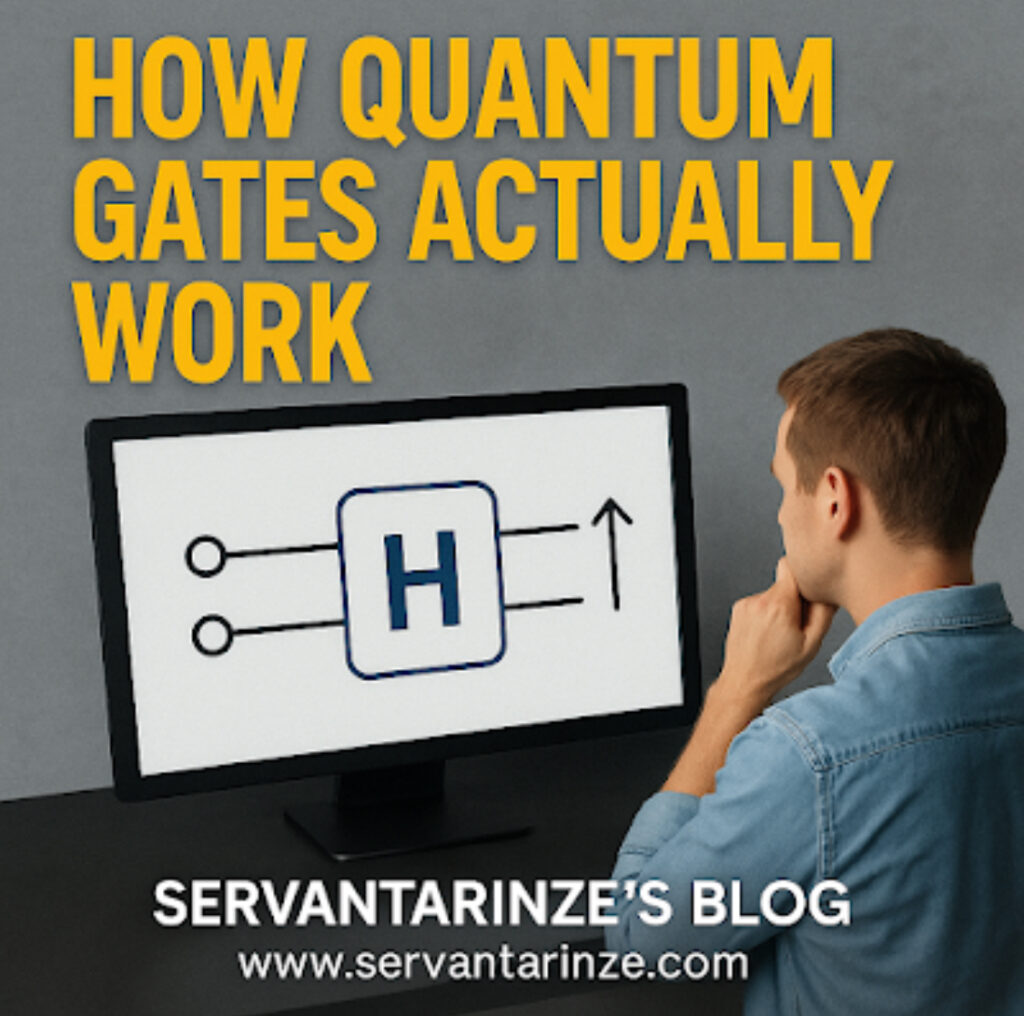
A simple example is the Hadamard gate. It takes a definite 0 and turns it into an equal superposition of 0 and 1. Instead of flipping the bit, it spreads it evenly across both outcomes. Another powerful gate is the CNOT, which entangles two qubits by letting one qubit’s state influence the other.
These gates are reversible because quantum mechanics doesn’t allow information to be destroyed. Every gate gently rotates the qubit, like turning a dial instead of pressing a switch. This is why quantum algorithms look like sequences of rotations — you’re guiding the qubit through a landscape of possibilities until the correct interference pattern emerges.
If you remember only one thing about quantum gates, remember this:
Classical gates flip bits; quantum gates sculpt probabilities.
The Bloch Sphere: Your Visual Map of a Qubit
The Bloch sphere is one of the most intuitive tools in quantum computing. If you ever feel lost, come back to this mental picture. It’s a simple sphere representing every possible state a single qubit can hold. The top of the sphere is the pure 0 state. The bottom is the pure 1 state. Every other point on the surface represents a unique blend of these two.
When a quantum gate acts on a qubit, it’s like rotating a point on this sphere. That makes quantum behavior easier to visualize: instead of thinking about abstract math, just imagine a compass needle moving gracefully across a globe. This is why the Bloch sphere is used in labs, classrooms, and simulations — it turns complex ideas into something you can picture instantly.
For beginners, the sphere also answers an important question:
Why can a qubit hold more information than a classical bit?
Because a classical bit has only two positions — up or down — while a qubit can point anywhere on the sphere, representing infinitely many possible states.
Master the Bloch sphere, and all the fundamental quantum concepts — superposition, phase, rotations, measurement — begin to connect naturally in your mind.
Noise and Decoherence: The Biggest Challenge in Quantum Computing
If you’ve ever tried to record a voice note outside on a windy day, you already understand quantum noise. Qubits are extremely sensitive. A tiny vibration, a slight temperature fluctuation, or an unexpected electromagnetic ripple can disturb their state. This disturbance — called decoherence — causes the qubit to lose its information before the computation finishes.
This fragility is the main challenge in building large, reliable quantum computers. To fight decoherence, engineers cool superconducting qubits close to absolute zero, isolate trapped ions in vacuum chambers, and use lasers to manipulate and protect atomic states. Even with all this, coherence times are still short.
This is where quantum error correction comes in. Instead of relying on a single qubit, scientists combine several physical qubits into one logical qubit that can detect and repair small errors. It’s similar to having multiple engine backups in an airplane — if one part fails, the entire system stays stable.
Understanding this helps you appreciate the current phase of quantum computing. Today’s devices are called NISQ machines — Noisy Intermediate-Scale Quantum systems. They are powerful but imperfect. They teach us how to design better hardware and run algorithms that tolerate noise.
A simple takeaway:
Quantum computers are not held back by theory — they are held back by noise.
Qubits vs Bits: Understanding the Real Differences
Comparing qubits to classical bits isn’t a battle — it’s a partnership. Bits are reliable, cheap, and perfect for tasks like web browsing, video editing, social media, apps, and storage. Qubits are built for a different world: one where probability, interference, and quantum mechanics give advantages over classical logic.
By this point in our quantum basics learn qubits easy way guide, you can already see how qubits behave very differently from classical bits.
A classical bit stores a single, definite value at any moment. A qubit stores a continuous blend of possibilities. Because of this, qubits can explore many outcomes at the same time. For problems like molecule simulation, route optimization, or cryptographic factoring, this flexibility gives quantum computers a unique advantage.
But it’s important to know the limits. Qubits are unstable, expensive, and require extreme environments. A 50-qubit system is incredibly difficult to control, while a classical system can easily manage billions of bits.
The future is not “quantum vs classical,” but hybrid computing — quantum processors as accelerators inside classical systems. Each technology does what it does best, and together they solve problems neither could solve alone.
Different Types of Qubits: Superconducting, Ions, Photons and More
Not all qubits are created the same way. Different companies and research labs build them using different physical principles. This diversity is similar to the early days of classical computers, when vacuum tubes, magnetic cores, and transistors competed for dominance.
Here are the major types of qubits in use today:
- Superconducting Qubits – Used by IBM, Google, and Rigetti. They rely on electrical currents in circuits cooled near absolute zero.
- Trapped Ion Qubits – Used by IonQ and Quantinuum. Individual charged atoms are held in place by electromagnetic fields and controlled with lasers.
- Photonic Qubits – Use single particles of light. They operate at room temperature and are promising for quantum networking.
- Spin Qubits – Use the spin of electrons in tiny semiconductor structures. Intel and Silicon Quantum Computing explore this approach.
- Topological Qubits – A theoretical approach aiming for extremely stable qubits, still under research.
Each type has strengths. Some are fast, some are extremely stable, and others are easier to connect in large networks. No one knows which design will dominate — and that’s the beauty of this moment. We are still at the beginning, with breakthroughs happening almost every month.
Understanding these qubit technologies helps you follow global developments and evaluate which companies or platforms are shaping the future.
Small Quantum Circuits You Can Understand Today
A quantum circuit is simply a sequence of gates applied to qubits. Think of it like a recipe: each gate is a step, and each step gradually shapes the final outcome. The beauty is that even simple circuits can demonstrate quantum behavior.
For example, if you apply a Hadamard gate followed by a CNOT gate on a pair of qubits, you create an entangled state — one of the most famous experiments in quantum computing. You can run this in any online simulator and watch the two qubits become linked.
Even beginners can build circuits that:
- create superposition
- produce entanglement
- demonstrate interference
- simulate simple algorithms
These experiments make quantum concepts feel real. You can visualize Bloch sphere rotations, observe probability distributions, and test how noise affects results. This is why hands-on practice is one of the fastest ways to build intuition — you’re not just reading about qubits, you’re manipulating them.
As you progress, small circuits become the foundation for understanding bigger algorithms like Grover’s search, quantum teleportation, and variational models used in AI research.
If you want to turn these ideas into something practical, read my step-by-step guide:
Build Your First Quantum Circuit Online. It shows you how to create and run simple circuits using real quantum tools.
What Quantum Computing Is Good At — And What It’s Not
Quantum computing is powerful, but not in the way many people think. It’s not designed to replace your laptop, run mobile apps, or process everyday data. Instead, quantum computers shine in very specific areas where classical machines struggle because the complexity grows too fast.
Quantum systems are especially good at:
- Simulating molecules and materials — something classical computers can barely approximate.
- Optimizing routes and resources — useful in logistics, manufacturing, and portfolio management.
- Breaking certain cryptographic systems (in theory) — using Shor’s algorithm on fault-tolerant quantum machines.
- Searching unstructured data using techniques like Grover’s algorithm.
But there are also clear limits. Quantum computers are not ideal for tasks like:
- running social media apps
- storing huge files
- video rendering or gaming
- large-scale database operations
The future belongs to hybrid computing — classical and quantum devices working together. Classical machines handle stability and storage; quantum machines handle probability and complexity. Understanding this balance keeps your expectations realistic and your learning focused.
Debunking the Most Common Quantum Myths
Quantum computing attracts a lot of myths, mostly because the underlying physics sounds mysterious. But reality is more grounded — and more exciting — than the fiction.
Here are some myths worth clearing up:
- “Quantum computers will instantly crack all encryption.”
Not true. They would need millions of stable qubits to run Shor’s algorithm effectively. We are still far from that. - “Quantum computers think like humans.”
False. They process mathematical amplitudes, not emotions or intuition. - “Quantum results are just random magic.”
They are probabilistic, but controlled by precise operations. Nothing is magic — just physics. - “Quantum machines will replace classical computers.”
They won’t. They are accelerators for special problems, not general-purpose replacements.
Clearing these misconceptions positions you as a credible, informed voice — especially in a field that is still misunderstood by the general public.
Read also: Quantum Bits vs Binary Bits: 7 Powerful Differences You Must Know
Your Step-by-Step Roadmap to Learning Quantum Computing
Learning quantum computing may sound overwhelming, but the roadmap is surprisingly simple when you break it into stages. You don’t need a physics degree. You need curiosity, consistency, and the willingness to experiment.
Here’s a beginner-friendly path you can follow:
- Step 1: Understand the intuition — superposition, entanglement, measurement.
- Step 2: Try visual tools like IBM Quantum Composer or Quirk.
- Step 3: Build small circuits to create superposition and entanglement.
- Step 4: Experiment with simple algorithms (Deutsch–Jozsa, Grover’s search).
- Step 5: Learn how noise affects real devices and how error correction works.
- Step 6: Explore Qiskit or Braket to run code on real quantum processors.
Learning quantum computing is like learning coding — your understanding grows every time you try something new. Don’t chase perfection. Focus on steady progress, and your intuition will build naturally.
You don’t need your own quantum computer to practice. You can experiment for free using
IBM Quantum Composer or explore tutorials on
Qiskit Learn. These platforms let you build circuits,
visualize Bloch spheres, and even run experiments on real quantum hardware in the cloud.
Real-World Quantum Use Cases Emerging Right Now
Quantum computing is still young, but real applications are already taking shape across different industries. Many breakthroughs are happening in pilot programs, research labs, and enterprise environments.
Some examples include:
- Finance: portfolio optimization, risk modeling, fraud detection.
- Chemistry: simulating reactions and designing new materials.
- Energy: optimizing grid stability and power distribution.
- Cybersecurity: quantum key distribution and secure networks.
- Logistics: improving delivery routes and warehouse efficiency.
These use cases show that quantum computing is not theoretical — it is moving into practical territory. Even if the hardware is still noisy, the potential is clear and accelerating fast.
Final Thoughts
Quantum computing can feel intimidating at first, but once you understand the core ideas — qubits, superposition, entanglement, gates, and noise — the field becomes far less mysterious. Each concept builds on the next, giving you a foundation that grows stronger with practice.
If you follow this quantum basics learn qubits easy way roadmap, you’ll quickly feel at home with terms like superposition, entanglement, and the Bloch sphere.
You don’t need advanced math to begin. You need curiosity, clear explanations, and simple experiments you can try anytime. If you stay consistent, you’ll reach a point where words like “Bloch sphere,” “Hadamard gate,” or “decoherence” feel natural. That’s when the learning truly becomes enjoyable.
Remember: the quantum world rewards patience, imagination, and steady effort. You’re not late — you’re early. And every step you take now positions you ahead of millions around the world.
If this guide helps you, save it for later and share it with someone who wants to understand quantum computing without confusion. Knowledge grows when we pass it forward.
Frequently Asked Questions About Qubits and Quantum Computing (FAQ)
What exactly is a qubit in simple terms?
A qubit is the quantum version of a bit. Instead of being only 0 or 1, it can be in a blended state of both. This allows quantum computers to explore many possibilities at once, giving them unique power for certain types of problems.
How is a qubit different from a classical bit?
A classical bit holds one definite value at any time. A qubit can exist in superposition — a mixture of 0 and 1 — until it is measured. This flexibility lets quantum algorithms process information in ways classical computers cannot.
What is superposition, and why does it matter?
Superposition is the ability of a qubit to be in multiple states at once. It’s the core principle that enables quantum parallelism, allowing quantum computers to test many paths simultaneously before collapsing to a final result.
What does entanglement mean in quantum computing?
Entanglement links two or more qubits so strongly that measuring one instantly determines the state of the other, no matter how far apart they are. It enables secure communication, quantum networking, and multi-qubit algorithms.
Can beginners learn quantum computing without physics knowledge?
Yes. With modern tools, visualizers, and step-by-step tutorials, many people learn quantum computing through intuition and experiments rather than complex equations. You only need curiosity and consistency.
What practical uses does quantum computing have today?
Today, quantum computers are used in research for chemistry, risk modeling, optimization, and cryptography. They are still early-stage, but companies are already testing them in finance, logistics, materials science, and energy.
How can I practice building quantum circuits online?
You can start using free platforms like IBM Quantum Composer, Quirk, or Qiskit Playground. These tools let you build circuits visually and even run them on real quantum hardware through the cloud.
Do quantum computers replace classical computers?
No. Quantum computers are accelerators designed for special types of problems. Classical computers remain far better for everyday tasks like browsing, editing, and storage. The future is hybrid systems combining both strengths.
Are quantum computers dangerous for cybersecurity today?
Not yet. Breaking modern encryption requires millions of stable qubits — something we do not have today. However, both governments and tech companies are preparing future-proof encryption for the post-quantum era.
What should I learn after understanding qubits and superposition?
After the basics, move into quantum circuits, simple algorithms, Qiskit programming, and understanding noise and error correction. These areas give you the skills needed to build real quantum experiments.
How long does it take to understand the basics of quantum computing?
With consistent learning, most beginners grasp the core ideas — qubits, gates, entanglement, measurement — within a few weeks. Mastery takes longer, but the fundamentals come faster than people expect.
Is quantum computing really the future of AI?
Quantum computing won’t replace AI, but it will enhance it. Quantum algorithms can speed up optimization, sampling, and complex modeling. The strongest future breakthroughs will combine AI + quantum together.