
Python has become the default language for quantum computing. If you’ve touched Qiskit, Cirq, or PennyLane, you already know why. Python is readable, flexible, and incredibly fast to prototype with. It lowered the barrier of entry for an entire generation of quantum developers. But as quantum hardware scales and simulations push beyond toy problems, a quiet shift is happening beneath the surface. Researchers and engineers who care deeply about performance are starting to look seriously at quantum programming languages beyond Python.
The reason is not philosophical — it’s practical. Python excels at orchestration, but when you simulate large quantum systems, run variational algorithms with thousands of iterations, or experiment with error correction and fault-tolerant designs, performance stops being optional. State-vector simulations explode exponentially. Hybrid quantum–classical loops demand low latency. Memory efficiency becomes a limiting factor long before algorithms become interesting. At that point, Python’s interpreted nature starts to show its limits.
As we move toward larger quantum devices and more realistic workloads later this decade, performance is no longer a niche concern. Quantum processors with hundreds or thousands of qubits demand better simulators, tighter compiler stacks, and languages that can stay close to the hardware without sacrificing developer productivity. This is where Julia and C++ enter the picture — not as replacements for Python, but as powerful complements that unlock speed, control, and scale.
This article explores what lies beyond Python for serious quantum development. We’ll look at Julia, particularly through the Yao.jl ecosystem, as a modern language designed for numerical performance without syntactic pain. We’ll also examine C++, the workhorse behind many quantum backends, compilers, and hardware control systems, through tools like the Intel Quantum SDK and TKET. If you are interested in high-performance quantum programming, this guide is meant to help you understand when and why moving beyond Python makes sense.
Why Go Beyond Python? Performance Needs in Quantum Development
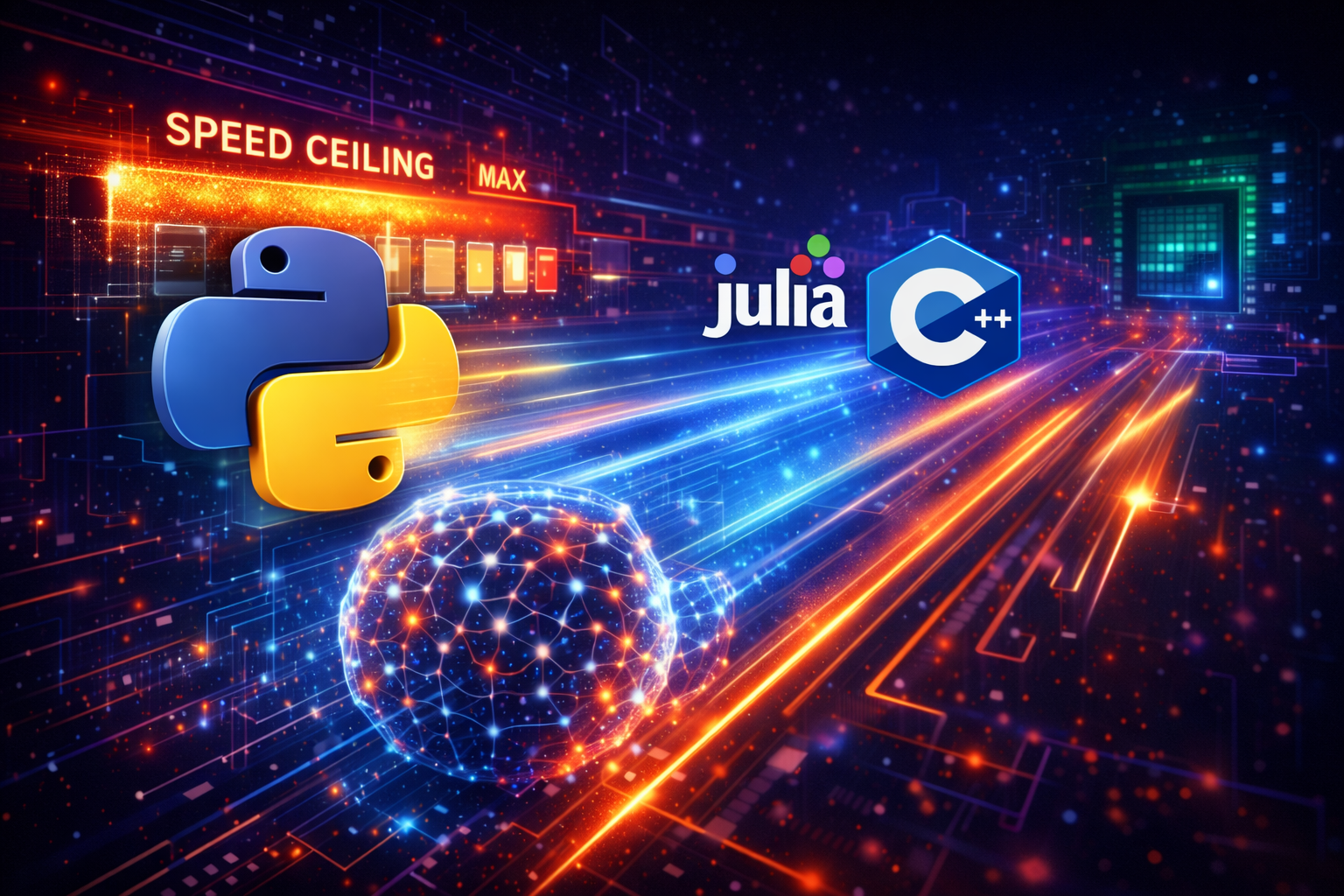
Python’s dominance in quantum computing is well earned. It allows researchers to express complex ideas quickly, glue together powerful libraries, and experiment without friction. Most major quantum frameworks expose Python APIs for a reason: accessibility accelerates innovation. But accessibility alone does not solve performance bottlenecks, and quantum computing is fundamentally a performance-driven field.
The first bottleneck appears in simulation. Simulating quantum systems on classical hardware is brutally expensive. A full state-vector simulation scales as 2ⁿ, meaning even modest increases in qubit count dramatically increase memory and compute requirements. While Python frameworks often rely on optimized C or C++ backends under the hood, the Python layer still introduces overhead when simulations become deeply iterative or tightly coupled with classical optimization loops.
The second bottleneck emerges in hybrid algorithms. Variational algorithms, quantum machine learning models, and error mitigation techniques all rely on fast feedback between classical optimizers and quantum circuit evaluations. When latency matters, language overhead matters. In these cases, fine-grained control over memory layout, execution order, and parallelism can significantly impact overall runtime.
Finally, as quantum hardware matures, developers increasingly need closer interaction with compilers, schedulers, and hardware abstractions. Python is excellent for coordination, but it is rarely the language used to write low-level compilers, real-time decoders, or hardware-facing control software. Those layers are almost always implemented in high-performance languages.
This is why serious quantum engineers are expanding their toolkits. Quantum programming languages beyond Python are not about abandoning what works — they are about choosing the right level of abstraction for the problem at hand. Julia and C++ represent two distinct but complementary paths toward performance-driven quantum development.
Julia: High-Performance Quantum Computing Without the Pain
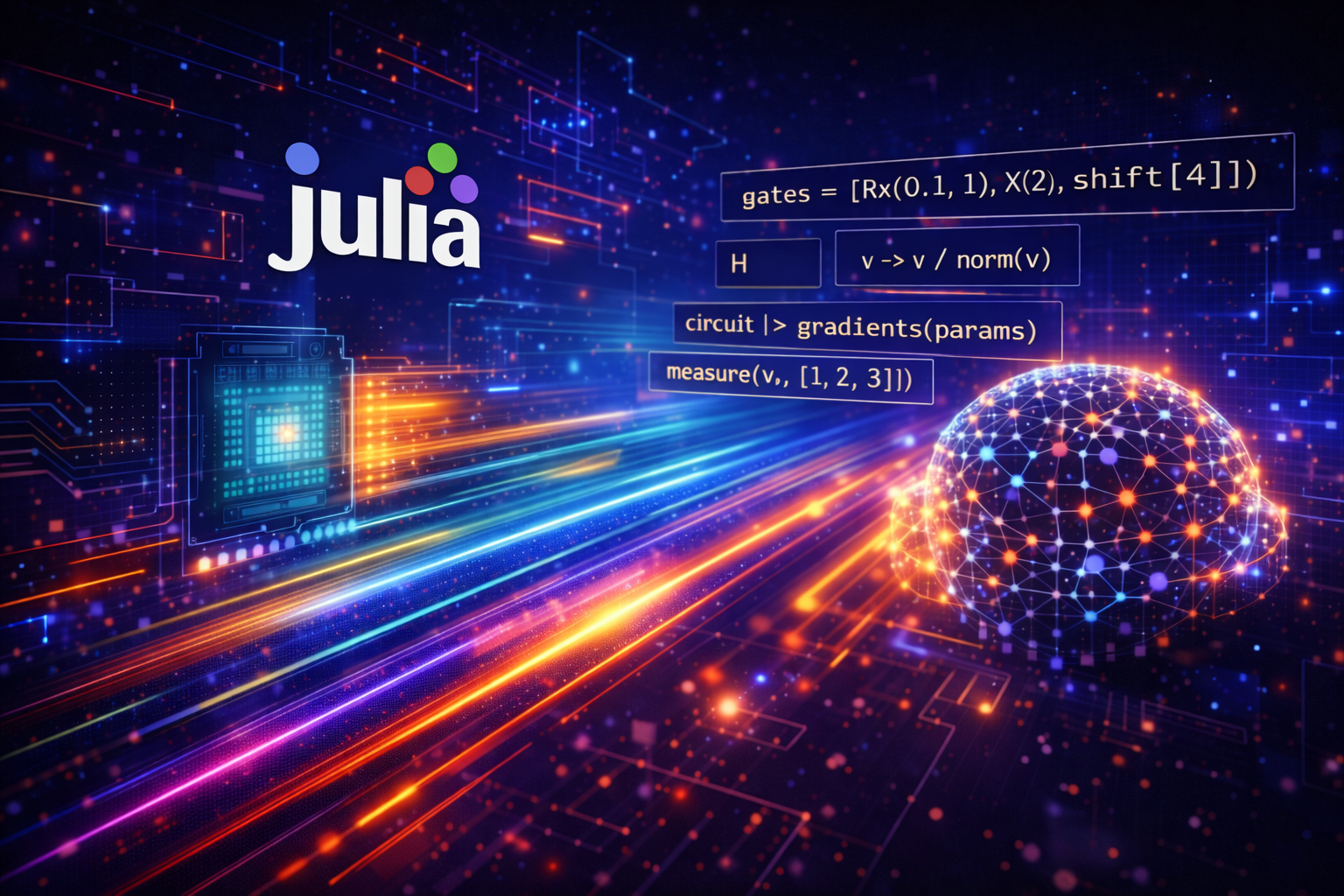
Julia occupies a unique position in the programming language landscape. It was designed from the ground up for numerical computing, scientific workloads, and high-performance simulations. Unlike Python, Julia is compiled just-in-time and can achieve speeds comparable to C or Fortran while retaining a clean, expressive syntax. For quantum developers who want performance without sacrificing readability, this combination is hard to ignore.
In the quantum ecosystem, Julia’s most prominent framework is Yao.jl. Yao is a flexible and extensible quantum circuit framework designed for simulation, algorithm development, and research experimentation. It treats quantum circuits as first-class objects and integrates naturally with Julia’s strengths in linear algebra, automatic differentiation, and GPU acceleration.
One of Julia’s biggest advantages in quantum development is that performance is not an afterthought. When you write numerical code in Julia, you are often writing the code that actually runs — not a thin wrapper around a hidden backend. This makes it easier to reason about performance, memory usage, and scaling behavior, especially for large simulations or custom algorithmic research.
Julia also shines in research-heavy workflows. Variational algorithms, quantum machine learning models, and error correction simulations often require custom cost functions, gradient-based optimization, and rapid iteration on mathematical ideas. Julia’s ability to express mathematics clearly while compiling to efficient machine code makes it particularly attractive for these use cases.
A practical way to understand Julia’s appeal is to look at how it handles performance by default. In Python-based quantum workflows, it is common to prototype in Python while relying on hidden C or C++ layers for speed. In Julia, that separation largely disappears. The same code you write for clarity is often the code that executes efficiently. For quantum developers exploring simulations with dozens of qubits, tensor networks, or custom noise models, this transparency is a major advantage.
Yao.jl takes full advantage of this design philosophy. Circuits are represented as composable blocks, making it easy to build complex quantum operations from smaller components. Because Julia treats functions and data structures as first-class citizens, researchers can extend the framework without fighting the language. Custom gates, noise channels, and measurement strategies can be added naturally, which is particularly valuable for experimenting with quantum error correction or algorithm variants.
Another strength of Julia in quantum computing is automatic differentiation. Many modern quantum algorithms rely on gradients, especially in variational quantum eigensolvers, quantum neural networks, and hybrid optimization loops. Yao integrates well with Julia’s differentiation tools, allowing gradients to be computed efficiently without awkward workarounds. This makes Julia an excellent environment for quantum machine learning research and advanced algorithm development.
GPU acceleration further strengthens Julia’s position. Through extensions like CuYao, developers can offload parts of quantum simulations to GPUs with relatively little friction. While GPU-based quantum simulation remains challenging due to memory constraints, the ability to experiment with GPU acceleration using a high-level yet performant language gives Julia a distinct edge in exploratory research.
That said, Julia is not without trade-offs. Its ecosystem is smaller than Python’s, and fewer educational resources exist for beginners. Compilation latency can also surprise newcomers, especially during the first execution of complex code. However, for developers focused on performance rather than tutorials, these drawbacks are often outweighed by the gains in speed and control. For many researchers, Julia represents the most balanced entry point into quantum programming languages beyond Python.
C++: Maximum Control for Performance-Critical Quantum Systems
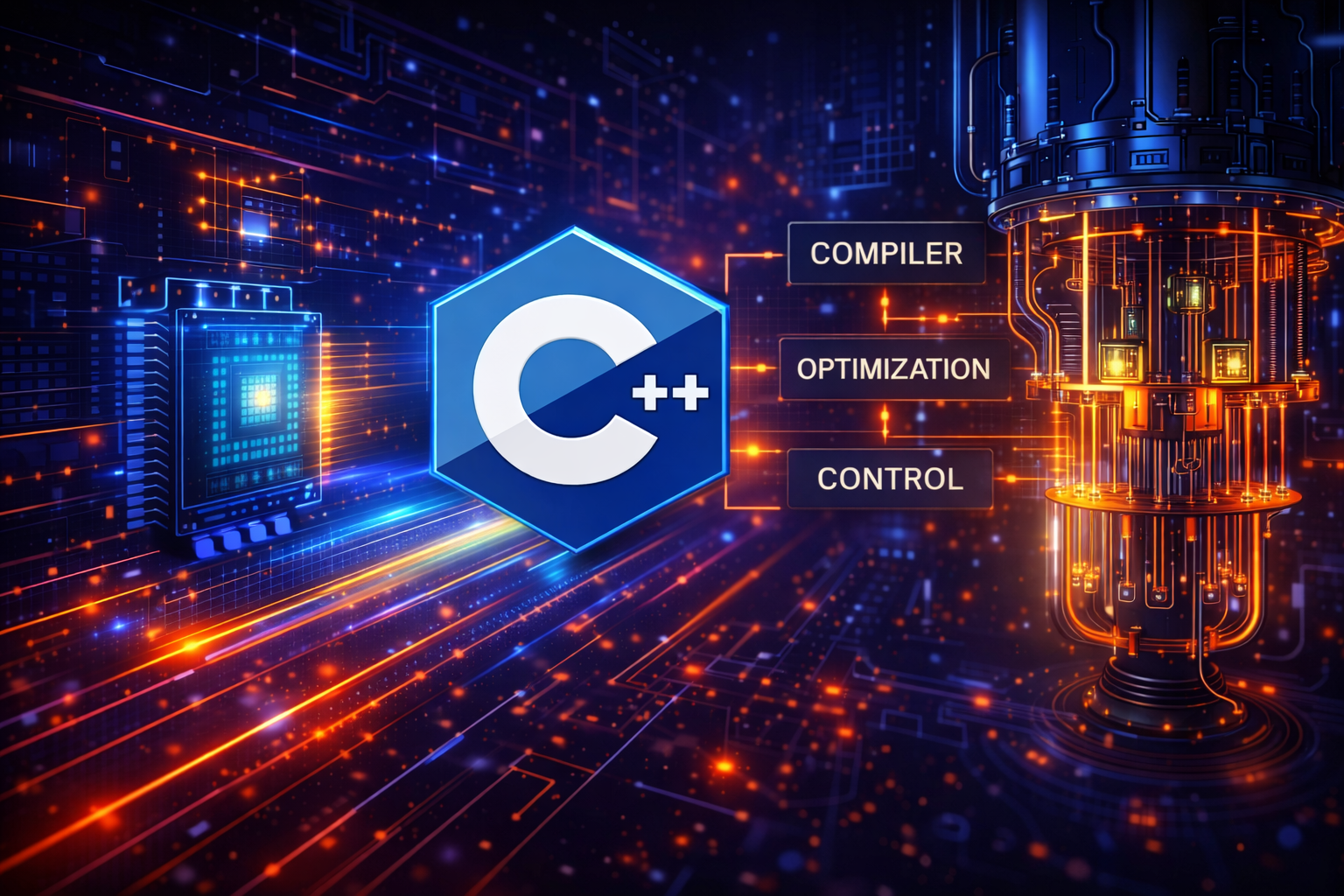
If Julia represents a modern balance between productivity and performance, C++ sits firmly at the extreme end of control and efficiency. Much of the quantum software stack that Python developers rely on every day is already written in C++. Simulators, compilers, schedulers, and hardware interfaces frequently use C++ under the hood, even when exposed through high-level APIs.
Working directly in C++ removes layers of abstraction and overhead. This matters in performance-critical contexts such as large-scale simulation, real-time error decoding, and low-latency hybrid quantum–classical workflows. C++ offers fine-grained control over memory allocation, data structures, parallelism, and hardware-specific optimizations — all of which can be decisive when scaling quantum workloads.
One of the most notable tools in this space is the Intel Quantum SDK. It provides C++ extensions specifically designed for quantum programming, allowing developers to write quantum kernels alongside classical code in a unified environment. This approach is particularly well suited for hybrid algorithms where classical preprocessing and postprocessing must be tightly integrated with quantum execution.
Another major C++ player is TKET, developed by Quantinuum. TKET focuses on quantum circuit compilation, optimization, and routing. It plays a critical role in mapping abstract circuits to real hardware constraints, a task that becomes increasingly complex as quantum devices grow. For developers interested in compiler design, fault-tolerant architectures, or hardware-aware optimization, C++ frameworks like TKET are difficult to avoid.
C++ also underpins several high-performance simulators used in research and industry. Libraries such as Quantum++ and components of Qiskit Aer demonstrate how much performance can be extracted when simulation code is written close to the metal. These tools are rarely beginner-friendly, but they are invaluable for developers pushing the limits of classical simulation or building infrastructure for future quantum systems.
The downside of C++ is, of course, complexity. Development time is longer, memory management must be handled carefully, and debugging can be more demanding. For this reason, C++ is rarely the first language new quantum programmers learn. Instead, it becomes relevant once performance constraints dominate and architectural decisions matter more than rapid prototyping. In that sense, C++ is less about accessibility and more about mastery.
Julia vs C++ vs Python: Choosing the Right Tool for Quantum Work
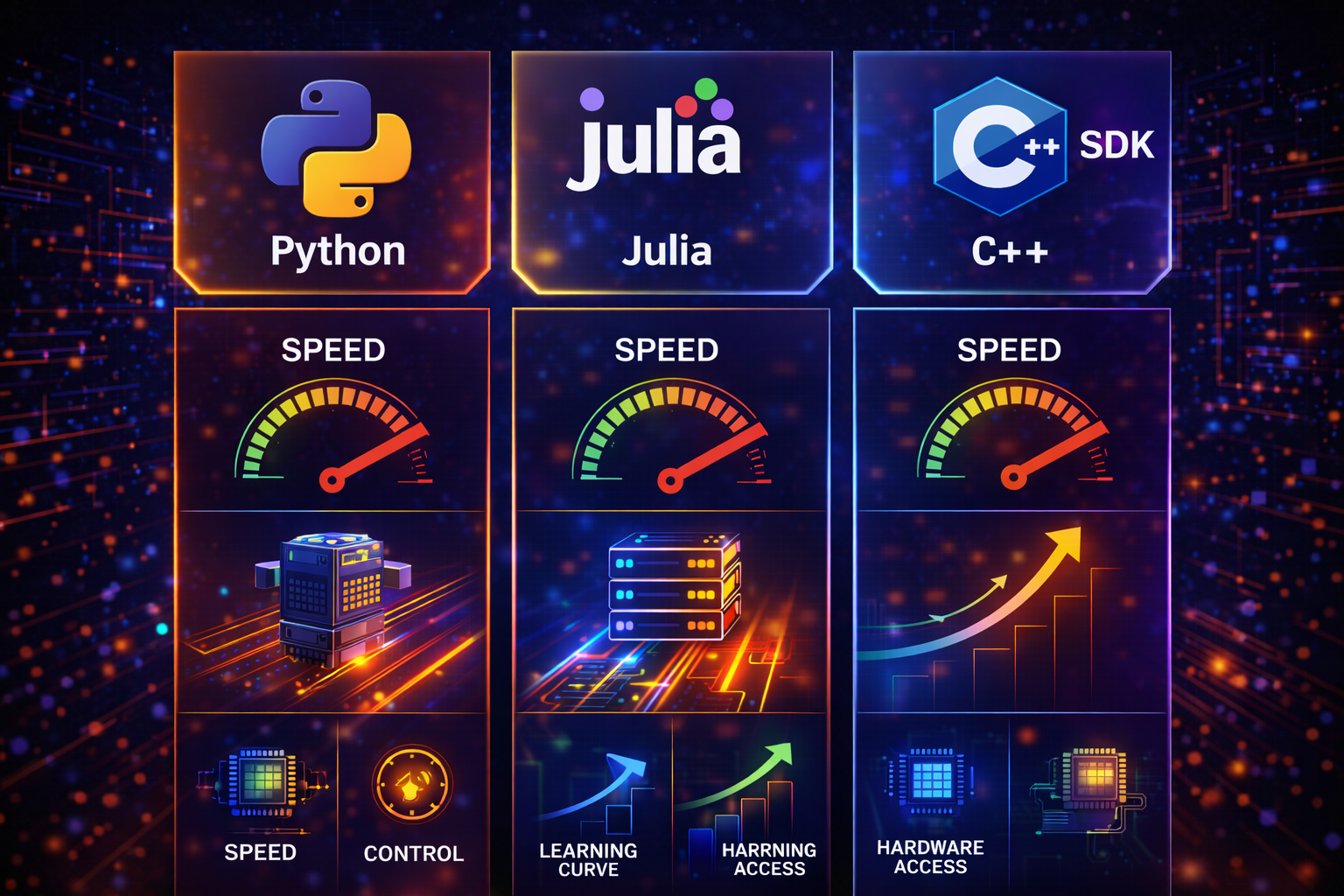
When discussions turn to quantum programming languages beyond Python, the question is rarely about which language is “best” in absolute terms. The more useful question is when each language makes sense. Python, Julia, and C++ occupy different points on the spectrum of productivity, performance, and control, and understanding those trade-offs is essential for making informed decisions.
Python remains unmatched for accessibility and rapid development. Its ecosystem is rich, its syntax is friendly, and most quantum hardware providers expose Python APIs first. For learning quantum concepts, building proofs of concept, or orchestrating experiments across different backends, Python continues to be the natural choice. In many workflows, Python acts as the glue that ties everything together.
Julia steps in when performance begins to matter but developer productivity cannot be sacrificed. For researchers running large simulations, experimenting with new algorithms, or developing quantum machine learning models, Julia offers a compelling middle ground. Its ability to express mathematical ideas clearly while compiling to efficient machine code makes it especially attractive for state-vector simulations, variational algorithms, and research-heavy workloads.
C++ occupies a different role entirely. It is the language of infrastructure, compilers, and performance-critical systems. When memory efficiency, execution speed, and hardware integration are non-negotiable, C++ is often the only viable option. This is why so many quantum simulators, circuit optimizers, and control systems are implemented in C++, even if they are accessed through higher-level languages.
Rather than competing directly, these languages often coexist in modern quantum stacks. A common pattern is to use Python as a front-end for experiment orchestration, Julia for high-performance simulation or algorithm development, and C++ for the underlying execution engine. This layered approach reflects the reality of quantum software today: no single language solves every problem efficiently.
As quantum computing moves beyond experimentation into performance-driven research and early production systems, the choice of programming language becomes more than personal preference. Python, Julia, and C++ each play distinct roles in modern quantum development, especially as simulations grow larger, hardware becomes more complex, and error correction and optimization demand speed and precision. Understanding how these languages compare in real-world quantum workloads helps developers choose the right tool for the right stage of development.
| Criteria | Python | Julia | C++ |
|---|---|---|---|
| Execution Speed | Moderate (backend-dependent) | High (near C-level performance) | Very High (native compiled) |
| Learning Curve | Very Easy | Moderate | Steep |
| Quantum Frameworks | Qiskit, Cirq, PennyLane | Yao.jl, QuantumBFS | Intel Quantum SDK, TKET, Quantum++ |
| Simulation Scale | Small–Medium | Medium–Large | Very Large |
| Hardware Access | Abstracted via APIs | Limited but improving | Direct / Low-level |
| Best Use Case | Learning, prototyping | Research & fast simulations | Production & hardware control |
Python remains the most accessible entry point into quantum computing. Frameworks like Qiskit, Cirq, and PennyLane have made it possible for students, researchers, and engineers to express quantum algorithms with minimal friction. Its readable syntax and massive ecosystem lower the barrier to entry and accelerate experimentation. However, Python’s interpreted nature becomes a bottleneck when simulations scale beyond a few dozen qubits or when tight feedback loops are required for variational algorithms and error correction studies. In practice, many Python quantum frameworks quietly rely on C or C++ backends to overcome these limitations.
Julia occupies a powerful middle ground. Designed from the start for numerical computing, Julia delivers performance close to C while maintaining a syntax that feels familiar to Python users. In quantum development, frameworks such as Yao.jl allow researchers to build and simulate large quantum circuits efficiently, including state-vector and tensor-network approaches that would be impractical in pure Python. Julia’s native support for automatic differentiation and GPU acceleration makes it especially attractive for quantum machine learning, variational quantum eigensolvers, and hybrid quantum-classical workflows where performance matters but rapid iteration is still essential.
C++ represents the performance ceiling. It offers fine-grained control over memory, execution, and hardware interaction that no high-level language can fully match. Many of today’s most advanced quantum compilers, simulators, and control systems are written in C++ because it allows developers to optimize every layer of the stack. Tools such as the Intel Quantum SDK and TKET enable developers to work directly with quantum kernels, circuit optimization, and low-level execution paths. The trade-off is complexity: C++ demands more expertise, longer development cycles, and careful engineering discipline.
Choosing the right language depends on intent. Python is ideal for learning, teaching, and early-stage experimentation. Julia is best suited for researchers pushing simulation limits, developing new algorithms, or running performance-sensitive studies without sacrificing productivity. C++ becomes essential when building production-grade systems, compilers, hardware interfaces, or fault-tolerant quantum infrastructure.
In practice, many high-performance quantum systems use a hybrid approach. Python often serves as the orchestration layer, while Julia or C++ handles computationally intensive tasks behind the scenes. This layered model combines accessibility with speed and is increasingly common as quantum software stacks mature.
Getting Started and Looking Ahead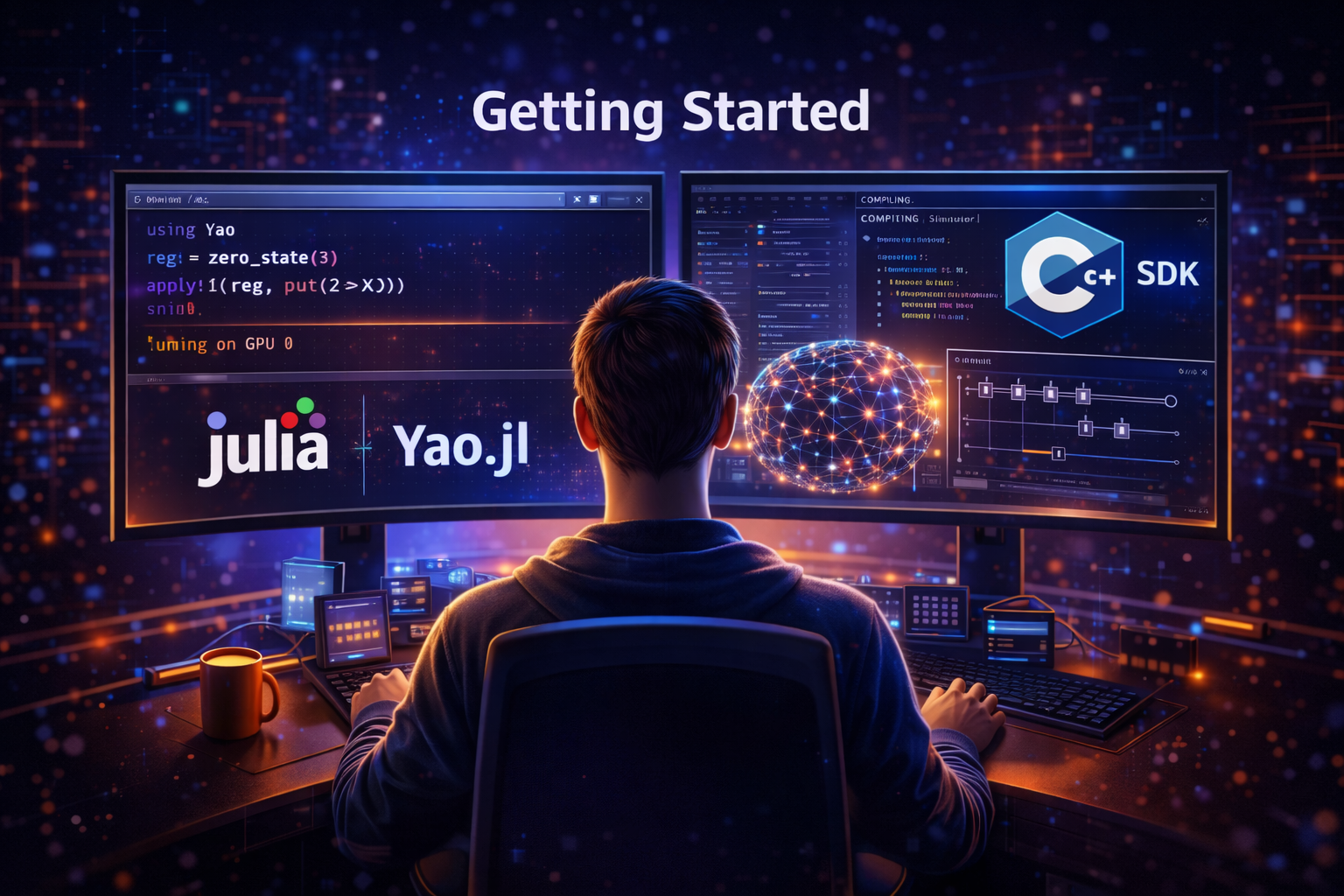
For developers curious about expanding their toolkit, getting started with Julia or C++ does not require abandoning Python entirely. Julia can be explored incrementally, especially for simulation-heavy tasks where performance gains are immediately visible. Installing Yao.jl and experimenting with small circuits or variational algorithms is often enough to appreciate the difference.
C++ typically demands a more deliberate commitment. Learning the Intel Quantum SDK or exploring compiler frameworks like TKET requires comfort with lower-level programming concepts and build systems. However, for those interested in quantum compilers, hardware integration, or fault-tolerant architectures, this investment pays off by unlocking parts of the quantum stack that remain inaccessible from higher-level languages.
Looking ahead, the role of high-performance languages in quantum computing is only expected to grow. As fault-tolerant systems move closer to reality, the demand for efficient simulation, compilation, and control will intensify. Quantum software will increasingly resemble classical high-performance computing, where layered architectures and performance-aware language choices are the norm.
Conclusion: High-Performance Quantum Development Starts Beyond Python
Python will continue to play a central role in quantum computing, especially as an entry point and coordination layer. But as the field matures, serious quantum development requires tools that can keep pace with growing hardware capabilities and algorithmic complexity. Exploring quantum programming languages beyond Python is not about rejecting what works — it is about extending your reach.
Julia offers an elegant path toward high-performance simulation and research without sacrificing readability. C++ provides unmatched control for developers building the engines, compilers, and systems that power quantum computing at scale. Together with Python, they form a complementary toolkit that reflects the real demands of advanced quantum work.
If you are ready to move past prototypes and into performance-driven quantum development, now is the time to look beyond Python. The future of quantum software will be shaped not by a single language, but by developers who understand how to choose the right tool for each layer of the stack.
Frequently Asked Questions About Quantum Programming Languages Beyond Python (FAQ)
Is Python still useful for quantum computing?
Yes. Python remains extremely useful for learning, prototyping, and orchestrating quantum experiments. Most quantum frameworks expose Python APIs first. However, for performance-critical simulations and low-level system development, Python is often complemented by faster languages.
Why look at quantum programming languages beyond Python?
As quantum workloads scale, performance, memory efficiency, and low-latency execution become essential. Python’s interpreted nature can introduce overhead in large simulations and hybrid algorithms, making Julia and C++ attractive alternatives for advanced development.
Is Julia faster than Python for quantum simulations?
In many cases, yes. Julia is compiled and designed for numerical computing, allowing it to achieve near-C performance while retaining readable syntax. Frameworks like Yao.jl make Julia particularly well suited for large-scale quantum simulations and variational algorithms.
What is Yao.jl and why is it important?
Yao.jl is a Julia-based quantum computing framework focused on high-performance simulation and algorithm research. It supports composable circuits, automatic differentiation, and GPU acceleration, making it popular among researchers working on advanced quantum algorithms.
When should I use C++ for quantum development?
C++ is best suited for performance-critical tasks such as simulator development, quantum compilers, real-time decoders, and hardware-level integration. It offers maximum control over memory, execution, and optimization but requires more development effort.
What is the Intel Quantum SDK used for?
The Intel Quantum SDK enables developers to write hybrid quantum-classical programs in C++. It is designed for performance-driven quantum development, including simulation, compilation, and future hardware integration.
Can Julia and C++ be used together with Python?
Yes. A common approach is to use Python as a high-level interface while delegating performance-critical components to Julia or C++. This hybrid model combines productivity with speed and reflects how modern quantum software stacks are built.
Is learning Julia or C++ necessary for a quantum career?
It depends on your goals. Python is sufficient for many roles, but developers aiming for research, compiler design, or hardware-focused positions increasingly benefit from Julia or C++ skills due to their performance advantages.
Which language is best for quantum machine learning?
Python remains popular for experimentation, but Julia is often preferred for performance-intensive quantum machine learning research. Its support for automatic differentiation and numerical speed makes it well suited for training variational models.
Will high-performance languages dominate quantum development in the future?
As quantum systems scale and fault-tolerant architectures emerge, high-performance languages like Julia and C++ are expected to play a larger role. Python will remain important, but advanced quantum development will increasingly rely on performance-driven tools.
Where should I start if I want to move beyond Python?
A practical path is to start with Julia and frameworks like Yao.jl for simulation-heavy work, then explore C++ tools such as the Intel Quantum SDK or TKET if your focus shifts toward compilers or hardware integration.
Is this the future of professional quantum development?
Yes. Professional quantum development increasingly mirrors high-performance classical computing, where multiple languages coexist across different layers of the stack. Moving beyond Python is a natural step for developers pushing the boundaries of quantum technology.