
Introduction
Emerging technologies are rewriting the rules of what businesses can create, what societies can achieve, and how individuals live and work. We are standing at the edge of a transformation unlike anything the world has seen before — a moment where scientific breakthroughs, intelligent machines, and powerful digital systems begin to merge into a new era of human progress.
What makes today’s emerging technologies so important is not just their novelty, but their speed of impact. Innovations that once took decades to mature now evolve in months. Industries rise and fall in real time. Skills become outdated within a few years. And the organizations that adapt early become tomorrow’s global leaders.
In this newly reorganized guide, you won’t simply read a list of trends. You will understand the forces shaping the next decade and how each breakthrough connects to business, security, creativity, health, climate, and the global economy. If you want to thrive in a fast-changing world, this deep, human-written breakdown will show you exactly where the future is heading — and how to prepare for it.
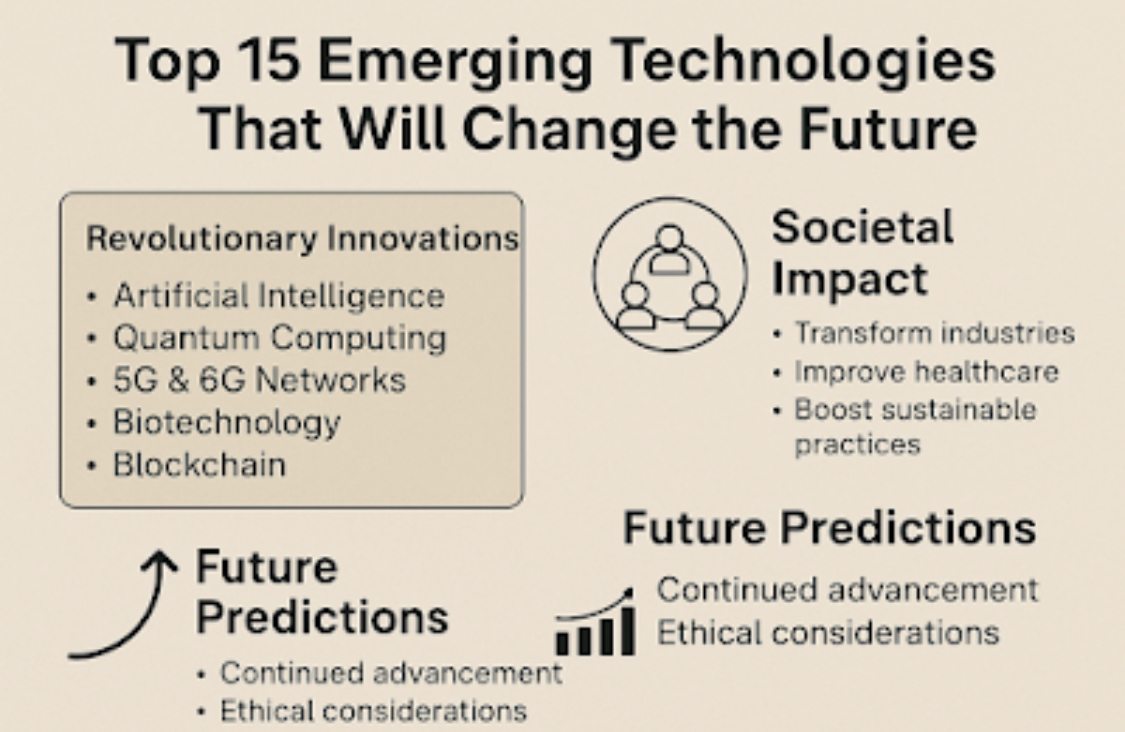 Infographic showing key emerging technologies and their impact on the future.
The Acceleration Era: Why the Future Is Arriving Faster Than Expected
We often talk about technology as if it advances in a straight line. But today’s innovations do not move linearly — they compound. When one technology accelerates, it amplifies the others around it. AI boosts robotics. Quantum computing boosts drug discovery. Advanced materials boost renewable energy. This creates a powerful feedback loop where progress feeds progress.
There are three forces behind this acceleration:
- Convergence: Different fields — computing, biology, materials science, energy — are merging into unified systems.
- Computation: The world is generating more data than ever, and emerging technologies are built specifically to extract value from that data.
- Capital: Governments and companies are investing billions into technologies that once existed only in labs.
This is why the next decade will be defined by emerging technologies that don’t just improve our tools — they rewrite our capabilities. With that foundation set, let’s explore the innovations leading this transformation and how they will reshape the world more profoundly than any generation before us.
1. Artificial Intelligence: The Engine Behind Modern Innovation
Artificial Intelligence is the most influential force among today’s emerging technologies because it enhances every other field — from medicine to finance, manufacturing, cybersecurity, and education. What makes modern AI different from earlier computing is its ability to learn patterns, adapt to new information, and improve continuously without being explicitly programmed for every task.
Today’s AI does far more than automate simple processes. It analyzes medical scans, designs new materials, predicts climate patterns, writes code, improves logistics, and strengthens digital security. Businesses using AI see measurable results: faster operations, fewer errors, better customer experiences, and dramatically lower operating costs.
AI tools now assist content creators, engineers, researchers, and entrepreneurs. A single founder with access to AI can often outperform a team of five without it — a shift that completely rewrites the economics of productivity. In the workplace, AI becomes a collaborator rather than a replacement, amplifying human ability instead of eliminating it.
But AI’s rise also requires responsibility. Issues like data privacy, algorithmic bias, and over-dependence on automated systems must be addressed with strong ethics and governance frameworks. The organizations that balance innovation with responsibility will set the global standards that define AI’s future.
2. Quantum Computing: A New Class of Computational Power
Quantum computing stands out as one of the rare emerging technologies capable of breaking the limits of classical computing entirely. Instead of relying on bits (0 or 1), quantum computers use qubits, allowing them to explore multiple states at once. This gives quantum machines the potential to compute in minutes what today’s supercomputers would need centuries to process.
The real value of quantum computing lies in domains where nature itself behaves quantum mechanically: molecular structures, chemical reactions, and high-dimensional optimization. This gives quantum devices immense promise in fields such as drug discovery, climate modeling, encryption, and materials science.
For example, simulating a complex molecule with classical computers can be nearly impossible. A quantum machine, however, can model atomic interactions directly, accelerating the discovery of new medicines, vaccines, and sustainable materials. In cybersecurity, quantum computers could break many existing encryption systems — which is why organizations are already shifting toward quantum-safe cryptography.
While we are still early in the journey — dealing with unstable qubits and error correction challenges — the progress is relentless. Major companies, research labs, and governments are investing billions, seeing quantum computing as a long-term strategic asset.
When quantum power becomes reliable and accessible, it won’t just strengthen other emerging technologies — it will redefine them entirely.
3. Biotechnology: Engineering Life to Solve Humanity’s Biggest Problems
Biotechnology is one of the most powerful emerging technologies because it allows scientists to modify living organisms to improve health, agriculture, energy, and the environment. Unlike traditional medicine or farming, biotechnology works at the genetic and cellular level, unlocking solutions that were impossible just a decade ago.
Major breakthroughs such as CRISPR gene editing now make it possible to correct genetic diseases, design personalized treatments, and grow safer, more resilient crops. Instead of reacting to illness, biotechnology shifts humanity toward prevention and precision care.
In agriculture, biotech is fighting hunger by creating crops that survive drought, heat, and pests — especially important for countries facing climate challenges. In environmental science, engineered microbes are being used to clean oil spills, break down plastics, and restore polluted ecosystems.
The economic impact is extraordinary. The global biotechnology market is projected to grow into the trillions as nations invest heavily in genomic research, bio-based materials, and synthetic biology platforms. These innovations will affect medicine, food, energy, textiles, and even manufacturing.
But ethical and safety concerns must be handled carefully. Genetic modification raises questions about long-term ecological impact, access, affordability, and misuse. This is why governance frameworks and transparent practices are essential as biotechnology accelerates.
In short, biotechnology is reshaping what humans can cure, create, and sustain — making it one of the most transformative emerging technologies of our time.
4. Nanotechnology: Tiny Innovations with Massive Real-World Impact
Nanotechnology is the science of manipulating matter at the atomic and molecular scale, and it remains one of the most versatile emerging technologies influencing medicine, electronics, energy, and materials science.
By working with structures as small as a billionth of a meter, scientists can create materials with new abilities — stronger than steel, lighter than plastic, more conductive than copper, and more reactive than conventional chemicals.
In medicine, nanoparticles are used to deliver treatments directly to diseased cells, reducing side effects and increasing effectiveness. Cancer therapies, vaccines, and diagnostic tools are becoming more precise because of nanoscale engineering.
In energy, nanotechnology powers breakthroughs like high-capacity batteries, ultra-efficient solar panels, and thermal coatings that reduce energy waste. These advancements are crucial as the world shifts toward sustainable technologies.
Consumer products also benefit: smartphones have nanocoatings that prevent scratches, clothing has self-cleaning fabrics, and sports equipment is lighter and stronger thanks to nano-enhanced materials.
Despite its promise, nanotechnology also requires careful regulation. Because materials behave differently at the nanoscale, researchers must study potential toxicity and long-term environmental impacts.
Even so, the momentum is unstoppable. As manufacturing becomes more advanced and costs decrease, nanotechnology is positioned to influence nearly every industry — making it a key pillar in the global rise of emerging technologies.
5. Renewable Energy: The Clean Power Revolution Reshaping Global Industries
Renewable energy is one of the most transformative emerging technologies because it replaces fossil fuels with cleaner, cheaper, and more sustainable power sources. Solar, wind, hydropower, and geothermal systems are no longer experimental — they are now the backbone of modern energy transition.
The economics tell the story clearly. Solar and wind power have dropped more than 80% in cost over the last decade, making them more affordable than coal or gas in many regions. Countries are racing to install large-scale solar farms, offshore wind turbines, and next-generation batteries capable of storing energy for hours or even days.
In developing regions, renewable energy is improving daily life. Rural areas in Africa and Asia are using microgrids to power homes, schools, and hospitals without relying on unstable national grids. Businesses are cutting costs and attracting climate-conscious investors by switching to clean energy sources.
The next wave of innovation focuses on storage. Solid-state batteries, green hydrogen, and advanced superconducting grids will reshape how energy is stored and transported. Combined with AI-powered energy management systems, renewable energy becomes not just clean, but intelligent — adjusting output based on real-time demand.
While challenges remain, especially around rare materials and infrastructure costs, renewable energy is accelerating faster than any previous energy revolution. Its role in global sustainability makes it one of the defining emerging technologies of this century.
6. Blockchain Beyond Cryptocurrency: Building Trust in a Digital, Decentralized World
Blockchain is evolving far beyond digital currencies to become a foundational technology for trust, transparency, and secure data exchange. As one of today’s most impactful emerging technologies, it transforms how individuals, companies, and governments verify information.
Unlike traditional databases controlled by a central authority, blockchain distributes data across many nodes, making it nearly impossible to alter records without detection. This is why industries like supply chain, healthcare, finance, and governance are adopting it rapidly.
Real-world impact is already visible. Hospitals use blockchain to verify patient histories, preventing medical fraud and improving continuity of care. Logistics companies track goods from origin to shelf, giving consumers confidence in food safety and product authenticity. Governments explore digital identities that reduce corruption and streamline public services.
For businesses, blockchain offers efficiency: faster transactions, lower operational costs, and verifiable audit trails. Smart contracts automate agreements without intermediaries, reducing human errors and delays.
However, adoption is not without hurdles. Scalability, regulation, and energy use (in older blockchain models) remain challenges. But with new proof-of-stake networks and enterprise-grade frameworks, blockchain continues to mature into a trusted global infrastructure.
Its rise signals a fundamental shift in how the world handles data, identity, and digital ownership — placing blockchain firmly among the most influential emerging technologies shaping the future.
7. Space Technology: The New Frontier Driving Global Connectivity and Exploration
Space technology has evolved from government-led missions to a competitive commercial ecosystem shaping communication, navigation, climate monitoring, and scientific discovery. As one of the fastest-growing emerging technologies, it pushes human capability beyond planetary boundaries.
Companies like SpaceX, Blue Origin, and Rocket Lab have dramatically reduced launch costs by introducing reusable rockets. This shift has opened access to startups, research labs, and developing countries that previously could not participate in the space economy.
One of the biggest impacts is in communication. Satellite constellations now deliver high-speed internet to remote and underserved locations, bridging digital divides and enabling new economic opportunities. In agriculture, satellite imaging helps farmers monitor crops, track soil moisture, and optimize irrigation, improving yields and reducing waste.
Climate scientists also rely heavily on space technology. Orbiting sensors track forest loss, glacier melts, methane leaks, and weather patterns, helping nations prepare for extreme climate events and plan sustainable policies.
Looking ahead, space mining, lunar manufacturing, and planetary exploration are becoming realistic long-term goals. The global space economy is on track to surpass one trillion dollars as these innovations mature.
Space technology is no longer just about rockets; it’s about building new industries, expanding scientific understanding, and extending human presence beyond Earth — making it a central force among emerging technologies shaping the next era.
8. Robotics: Smarter Machines Working Side-by-Side With Humans
Robotics is one of the most practical emerging technologies because it blends mechanical precision with intelligent software, creating machines that can work safely and efficiently alongside people. From factories to hospitals, robots are taking on tasks that require accuracy, speed, and consistency.
In manufacturing, modern robots assemble products with near-perfect precision, reducing defects and improving production speed. Warehouses use autonomous robots to sort packages, manage inventory, and deliver items to human workers. This collaboration boosts efficiency while freeing people to focus on complex tasks that require judgment and creativity.
Healthcare is another area transformed by robotics. Surgeons now use robotic-assisted systems to perform delicate operations with greater stability and reduced recovery time for patients. Rehabilitation robots help stroke survivors regain movement, providing consistent, repeatable therapy sessions.
Outside industries, service robots are becoming common in hospitality, agriculture, and even household settings. Drones inspect infrastructure, spray crops, monitor construction sites, and support emergency rescue operations. These intelligent machines reduce risks in dangerous environments and speed up work that would take humans significantly longer.
Despite the benefits, robotics also raises concerns about workforce displacement. However, experts emphasize that robots typically replace repetitive manual labor, not creative or strategic jobs. The future workforce will shift toward supervising, programming, maintaining, and integrating robotic systems — new career paths created by this emerging technology.
9. Extended Reality (XR): The Fusion of Real and Digital Worlds
Extended Reality — which includes Virtual Reality (VR), Augmented Reality (AR), and Mixed Reality (MR) — is reshaping how people interact, learn, shop, and collaborate. As one of today’s fastest-growing emerging technologies, XR is transforming experiences across education, entertainment, training, healthcare, and retail.
VR creates fully immersive digital environments, making it ideal for training high-risk professions. Pilots learn flight operations in VR simulators, surgeons practice procedures, and engineers explore digital prototypes before building physical versions. This reduces errors and saves millions in development costs.
AR overlays digital information onto the real world using phones or smart glasses. Retailers use AR to let customers try products virtually — from clothing to makeup to furniture. Students explore 3D models in science classes, making learning more interactive and memorable. In the workplace, technicians receive AR-guided instructions during repairs, boosting accuracy and speed.
Mixed Reality blends real and digital objects so naturally that users can manipulate virtual tools as if they were physical. This is extremely valuable in architecture, industrial design, and remote collaboration. Teams from different countries can stand in the same virtual workspace, examine prototypes, and make real-time changes.
With hardware becoming more affordable, XR adoption is accelerating. While challenges like motion sickness, content creation costs, and device weight still exist, continuous innovation is rapidly improving user experience. XR is not just entertainment — it is a foundational emerging technology shaping how humans learn, communicate, and work.
10. 5G & 6G Networks: The Connectivity Backbone of the Future
5G and the upcoming 6G revolution are critical emerging technologies because they enable hyperfast, reliable connectivity that supports intelligent systems, automation, and real-time interactions. These networks are the invisible force powering smart cities, advanced robotics, autonomous vehicles, and next-generation communication tools.
5G networks deliver low latency — often under 10 milliseconds — allowing instant feedback for safety-critical operations like remote surgery, drone coordination, and industrial automation. Businesses use private 5G networks inside factories to connect machines, sensors, and robots with guaranteed reliability and security.
Consumers benefit too. 5G enhances video streaming, mobile gaming, virtual meetings, and XR applications, making digital experiences smoother and more realistic. For remote areas, 5G fixed wireless access provides high-speed broadband without traditional cables, reducing connectivity gaps.
Looking ahead, 6G is expected to achieve speeds up to one terabit per second and latency far below 1 millisecond. This level of performance will unlock advanced technologies such as holographic communication, tactile internet, and real-time digital twins of entire cities and industries.
The combination of 5G and 6G will create a network infrastructure capable of supporting billions of connected devices, enabling smarter transportation, energy systems, healthcare platforms, and industrial operations.
While rollout challenges remain — including spectrum allocation, high deployment costs, and regulatory considerations — the benefits far outweigh the obstacles. These ultra-fast networks will underpin nearly every emerging technology, making connectivity one of the most powerful drivers of future innovation.
11. Edge Computing: Bringing Intelligence Closer to the Real World
Edge computing is one of the most practical emerging technologies because it processes data closer to where it is generated, instead of sending everything to distant cloud servers. This reduces delay, improves privacy, and enables instant decisions in environments where every millisecond matters.
In modern factories, edge devices run AI models right on the production line, detecting defects in real time before a faulty product moves further down the assembly process. Retail stores use edge cameras to analyze visitor flow and monitor shelves, helping staff restock efficiently while protecting customer privacy by keeping sensitive data on-site.
Cities are adopting edge-powered solutions to manage traffic, detect accidents, and respond to emergencies with faster coordination. Even autonomous vehicles depend heavily on edge computing — they analyze camera feeds, sensor data, and navigation inputs within microseconds to ensure safe driving.
This shift reduces the load on cloud infrastructure and cuts operational costs. It also supports remote areas with low connectivity by enabling devices to operate independently when offline. As edge hardware becomes more powerful and energy-efficient, this emerging technology will play a central role in industrial automation, healthcare monitoring, agriculture, and smart homes.
To succeed with edge computing, organizations must focus on secure device management, timely software updates, and strong identity authentication for each connected node. The combination of edge and cloud creates a balanced architecture where speed meets global scalability.
12. Brain-Computer Interfaces (BCIs): Reconnecting Mind and Machine
Brain-computer interfaces are among the most fascinating emerging technologies because they create a direct bridge between the human brain and external devices. BCIs interpret neural signals and convert them into actions, allowing people to control technology with thoughts alone.
In clinical settings, BCIs are helping patients with paralysis move robotic arms, type messages, or operate wheelchairs. Early trials have shown that individuals who lost mobility can regain a sense of independence using implanted or non-invasive neural sensors.
For rehabilitation, BCIs combined with AI analyze brain activity to help stroke survivors relearn limb movement. Researchers are also exploring BCIs for restoring vision, enhancing memory, and assisting people with neurological disorders.
Beyond medicine, BCIs have potential in gaming, remote work, and immersive experiences. Imagine controlling digital environments or virtual interfaces without physical controllers. Engineers are building prototypes where teams collaborate using mixed-reality headsets enhanced by neural input, creating entirely new forms of interaction.
But BCIs also raise important questions around data privacy, ethics, and consent. Because these systems decode internal thoughts and neural patterns, safeguarding mental autonomy becomes essential. Experts emphasize strict security, clear regulations, and transparent data practices to ensure responsible use.
Despite challenges, BCIs represent a breakthrough emerging technology that could redefine how humans interact with machines over the next decade — not by touching screens or typing, but by thinking.
13. Synthetic Biology: Engineering Life for a Better Future
Synthetic biology is an advanced emerging technology that treats DNA like programmable code, enabling scientists to design living organisms with specific, beneficial functions. This field is transforming medicine, agriculture, materials, and environmental management.
In healthcare, synthetic biology powers the development of personalized therapies, engineered probiotics, and next-generation vaccines. Some biotech companies are creating cells that seek and destroy cancer tumors while leaving healthy tissues unharmed. Others produce essential medicines using engineered microbes instead of resource-heavy chemical manufacturing.
Agriculture is experiencing a similar revolution. Researchers are designing crops that survive heat waves, use water more efficiently, and resist pests without chemical sprays. These innovations could improve food security for regions vulnerable to climate change.
Synthetic biology is also reshaping manufacturing. Startups now grow biodegradable materials in fermentation tanks — everything from fabrics that mimic spider silk to leather-like materials produced without harming animals. These processes reduce waste, cut emissions, and shorten production cycles.
Environmental applications are equally promising. Engineered bacteria can break down plastic pollution or absorb oil spills more safely and efficiently than current clean-up methods. Labs are developing microbes that capture carbon dioxide from the atmosphere, contributing to climate mitigation efforts.
Of course, synthetic biology must be governed responsibly. Safety mechanisms like genetic “kill switches” prevent engineered organisms from surviving outside controlled environments. Regulatory boards and bioethics groups emphasize transparency, containment, and equitable distribution of benefits.
With careful oversight, synthetic biology stands among the most transformative emerging technologies — one capable of reshaping industries while addressing some of humanity’s biggest challenges.
14. Autonomous Vehicles: Redefining Mobility and Safety
Autonomous vehicles are one of the most visible emerging technologies because they promise safer roads, smoother logistics, and entirely new transportation models. These systems use a combination of cameras, radar, lidar, and advanced algorithms to understand the environment and make driving decisions in real time.
In freight transportation, autonomous trucks are already completing controlled highway routes with minimal human intervention. This approach reduces fuel usage, avoids driver fatigue, and ensures more predictable delivery times. Logistics companies are investing heavily in self-driving fleets because even small improvements in efficiency translate to massive savings across thousands of miles.
Urban pilot programs are also expanding. Cities in the United States, China, and the UAE are testing robotaxis that operate within specific districts under close supervision. Early results show safer braking patterns, fewer collisions, and smoother traffic flow compared to human drivers.
For individuals, autonomous vehicles could change daily routines dramatically. Commutes may become time for work, entertainment, or rest. Elderly people, visually impaired individuals, and those unable to drive may gain new independence with reliable, automated mobility.
However, the path to full autonomy includes challenges such as unpredictable human behavior, harsh weather conditions, real-time ethics decisions, and precise mapping. Regulations, liability rules, and insurance models must also evolve to support widespread deployment.
Industry experts expect the first large-scale adoption in freight corridors and controlled environments, followed by city shuttles and eventually consumer vehicles. With continuous testing and stronger safety metrics, autonomous systems will gradually become a normal part of global transportation networks.
15. Advanced Materials: Building the Infrastructure of Tomorrow
Advanced materials are an emerging technology category that underpins breakthroughs in transportation, electronics, energy storage, healthcare, and construction. These materials are engineered at the molecular level to deliver properties far beyond what traditional materials can offer.
One of the most promising examples is graphene — a single layer of carbon atoms with extraordinary strength, flexibility, and conductivity. Manufacturers are exploring its use in ultra-fast batteries, flexible screens, and lightweight vehicle components. Its ability to transmit electricity quickly makes it ideal for next-generation electronics.
Another rapidly growing material is perovskite, which has shown remarkable efficiency in solar cell research. Perovskite-based panels are lighter, easier to produce, and potentially cheaper than traditional silicon panels. Combined with tandem cell designs, this technology could dramatically increase renewable energy adoption.
Metamaterials add another dimension by manipulating electromagnetic waves in ways not possible with natural substances. This enables high-performance antennas, advanced imaging systems, and even experimental stealth technologies for defense.
In construction and infrastructure, self-healing materials are gaining attention. These materials can automatically repair cracks or damage when exposed to heat, light, or moisture, significantly extending the lifespan of buildings, roads, and industrial equipment. This reduces maintenance costs and improves sustainability in resource-intensive industries.
Advanced materials also support safer medical devices, lighter aircraft, and more efficient power systems. Engineers are combining them with AI-driven design tools to simulate and discover material structures that were previously unimaginable.
As global demand grows for durability, energy efficiency, and performance, advanced materials will form the foundation of many future products and megastructures.
Read also: 12 Breakthrough Technologies Transforming Everyday Life
Final Thoughts
The future is not arriving slowly—it’s unfolding in real time through emerging technologies that are reshaping how we learn, build, work, travel, heal, and interact. The most powerful shift is that these technologies don’t evolve in isolation; they reinforce one another. Artificial intelligence accelerates research in biotechnology, quantum breakthroughs push cybersecurity forward, advanced materials improve renewable energy systems, and robotics relies on next-generation connectivity for real-time precision.
For individuals, the biggest advantage comes from staying curious and adaptable. The people who learn continuously—regardless of age or background—will thrive the most. For businesses, the winners will be those that run small experiments early, analyze results honestly, and scale solutions that show real value. Innovation doesn’t reward perfection; it rewards momentum, clear thinking, and the courage to test new possibilities.
One of the most practical ways to keep pace is to follow credible, science-backed insights on how new technologies evolve and connect. If you want a deeper look into how these breakthroughs influence one another, explore analyses like this guide on breakthrough algorithms shaping the next era of computing. It offers a strong foundation for understanding how today’s discoveries ripple across industries.
As you think about the next decade, remember this: emerging technologies are not just tools—they are leverage. They allow small teams to compete with giants, give students access to global knowledge, help developing countries leapfrog old infrastructure, and open creative paths that didn’t exist before. If you approach this era with curiosity, structured learning, and a willingness to adapt, you won’t just keep up with the future—you’ll help build it.