

Quantum computing has reached a turning point. After years of theoretical promise and experimental breakthroughs, the conversation has shifted from what quantum computers might do someday to what they can realistically do today. In 2026, that answer is increasingly clear: meaningful progress is happening not through purely quantum solutions, but through carefully designed hybrid quantum-classical algorithms.
If you have explored quantum programming — building circuits in Qiskit, Cirq, or PennyLane — you may have encountered this reality firsthand. Small demonstrations work well. Simulators behave nicely. But when real-world problems enter the picture, things change quickly. Noise accumulates, error rates rise, and deep quantum circuits become unreliable long before they reach useful scale.
This is not a flaw in quantum theory. It is the natural limitation of the current Noisy Intermediate-Scale Quantum (NISQ) era. Today’s quantum hardware, typically operating with tens to hundreds of imperfect qubits, cannot sustain long, fault-tolerant computations. Expecting near-term devices to deliver standalone quantum advantage is both unrealistic and unnecessary.
Instead, the most practical path forward has emerged through hybrid quantum-classical algorithms — systems that deliberately divide responsibility between quantum and classical computation. In these workflows, quantum processors focus on the parts of a problem that grow exponentially in classical cost, while classical computers handle optimization, control logic, data processing, and convergence.
This collaboration creates a powerful feedback loop. A parameterized quantum circuit prepares and measures quantum states. Classical algorithms analyze the results, adjust parameters, and send updated instructions back to the quantum device. Iteration by iteration, the system converges toward solutions that neither quantum nor classical computing could efficiently achieve alone.
Far from being a compromise, this hybrid approach has become the foundation of real-world quantum progress. Algorithms such as the Variational Quantum Eigensolver (VQE) and the Quantum Approximate Optimization Algorithm (QAOA) are now central to quantum research in chemistry, optimization, and materials science. In 2026, these methods are no longer confined to academic papers — they are actively shaping early-stage pharmaceutical research, molecular simulation, and large-scale optimization workflows.
The significance of hybrid quantum-classical algorithms lies in their realism. They acknowledge the constraints of current hardware while extracting genuine value from quantum mechanics. Short, shallow quantum circuits reduce exposure to noise. Classical optimization absorbs uncertainty and stabilizes results. Together, they transform fragile quantum experiments into usable computational tools.
This article explores hybrid quantum-classical algorithms as the practical bridge to quantum advantage. We will examine why hybrid approaches dominate the NISQ era, break down six key hybrid algorithms with real 2026 milestones, and show how modern frameworks make these methods accessible to developers and researchers. Along the way, we will focus not just on theory, but on where hybrid quantum computing delivers tangible results today — and why it will continue to do so for years to come.
Why Hybrid Quantum-Classical Algorithms Are the Practical Reality in 2026
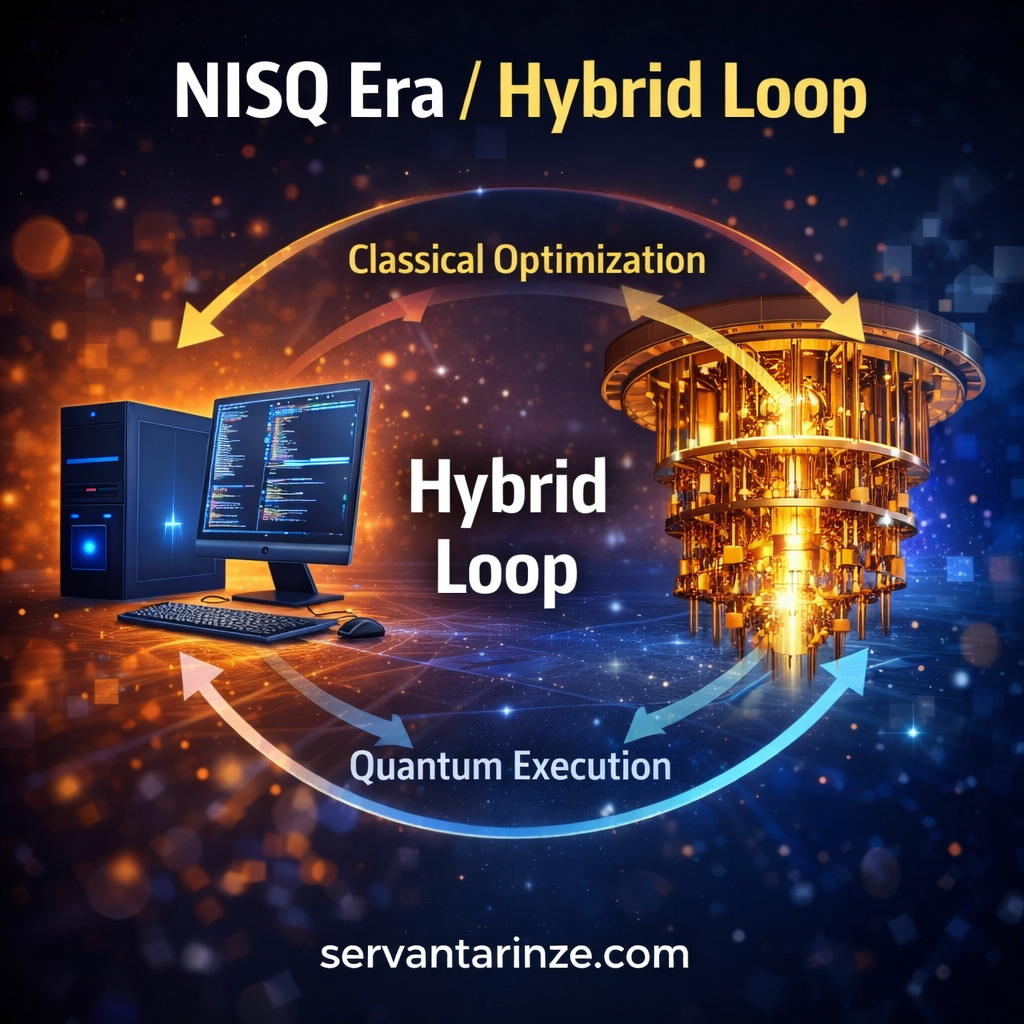
To understand why hybrid quantum-classical algorithms dominate real-world quantum computing today, it helps to be honest about the state of current hardware. In 2026, quantum processors are more capable than ever, but they remain fundamentally constrained by noise, decoherence, and limited circuit depth. These limitations make long, fully quantum programs fragile and difficult to scale beyond carefully controlled demonstrations.
Pure quantum algorithms often assume fault-tolerant devices with error correction and stable qubits — conditions that are still years away from widespread availability. When these assumptions break down, results degrade rapidly. Measurements become unreliable, parameter drift increases, and the computational advantage disappears before it can be realized.
Hybrid quantum-classical algorithms emerge as a practical response to this reality. Rather than forcing quantum hardware to do everything, hybrid workflows assign tasks strategically. Quantum processors evaluate specific subproblems that are inherently quantum in nature, while classical computers manage optimization, control flow, and iterative refinement. This division of labor allows useful computation to happen within the physical limits of NISQ devices.
In practical terms, this means running short, parameterized quantum circuits repeatedly instead of executing deep, monolithic programs. Classical optimizers analyze measurement results, update parameters, and guide the system toward convergence. The quantum component remains shallow and resilient, while the classical side absorbs noise and instability.
This approach also aligns naturally with modern software ecosystems. Developers already rely on classical tools for data processing, optimization, and machine learning. Hybrid quantum computing integrates seamlessly into this workflow, extending existing pipelines rather than replacing them. As a result, teams can experiment with quantum enhancements without discarding proven classical infrastructure.
Frameworks designed specifically for hybrid development have accelerated this transition. Differentiable programming libraries, automatic gradient computation, and tight integration with Python-based tooling make it easier to prototype and refine hybrid algorithms. For developers who already work across multiple programming paradigms, exploring hybrid quantum workflows often begins alongside broader discussions about language choice and performance trade-offs in quantum software development, including when alternatives to Python become relevant for scaling and performance-critical components.
From a practical standpoint, hybrid algorithms also reduce the barrier to entry for quantum experimentation. Developers do not need to master every aspect of quantum hardware to build meaningful applications. Instead, they can focus on algorithm design, optimization strategies, and problem decomposition — skills that translate well from classical computing. This is why many learning paths now emphasize hands-on hybrid development, guiding readers through step-by-step implementations that combine quantum circuits with classical control logic.
The dominance of hybrid quantum-classical algorithms in 2026 is also reflected in where early utility has emerged. In chemistry and materials science, hybrid approaches are used to approximate molecular ground states and reaction energies. In optimization, hybrid methods tackle combinatorial problems by alternating between quantum evaluations and classical heuristics. In machine learning, quantum feature maps and kernels are paired with classical models to explore new representational spaces.
Importantly, these are not isolated experiments. They represent a growing pattern of hybrid utility — where quantum components deliver incremental but measurable improvements within larger classical systems. This pattern mirrors the broader evolution of quantum software tooling, where practical development increasingly relies on a curated set of frameworks and platforms designed to support hybrid execution rather than purely quantum abstraction.
From a strategic perspective, hybrid quantum-classical algorithms should not be viewed as a temporary workaround. They form the foundation upon which future quantum advantage will be built. As hardware improves and error rates decline, hybrid workflows will naturally evolve, shifting more responsibility toward quantum processors while retaining classical oversight. This gradual transition is far more sustainable than waiting for a sudden leap to fault-tolerant quantum computing.
Leading research efforts reinforce this view. Reviews and experimental studies published through open scientific platforms such as arXiv consistently highlight hybrid strategies as the most effective way to extract value from near-term quantum devices. Rather than signaling compromise, hybrid quantum-classical algorithms represent maturity — a recognition that progress comes from working with reality, not against it.
1. Variational Quantum Eigensolver (VQE)
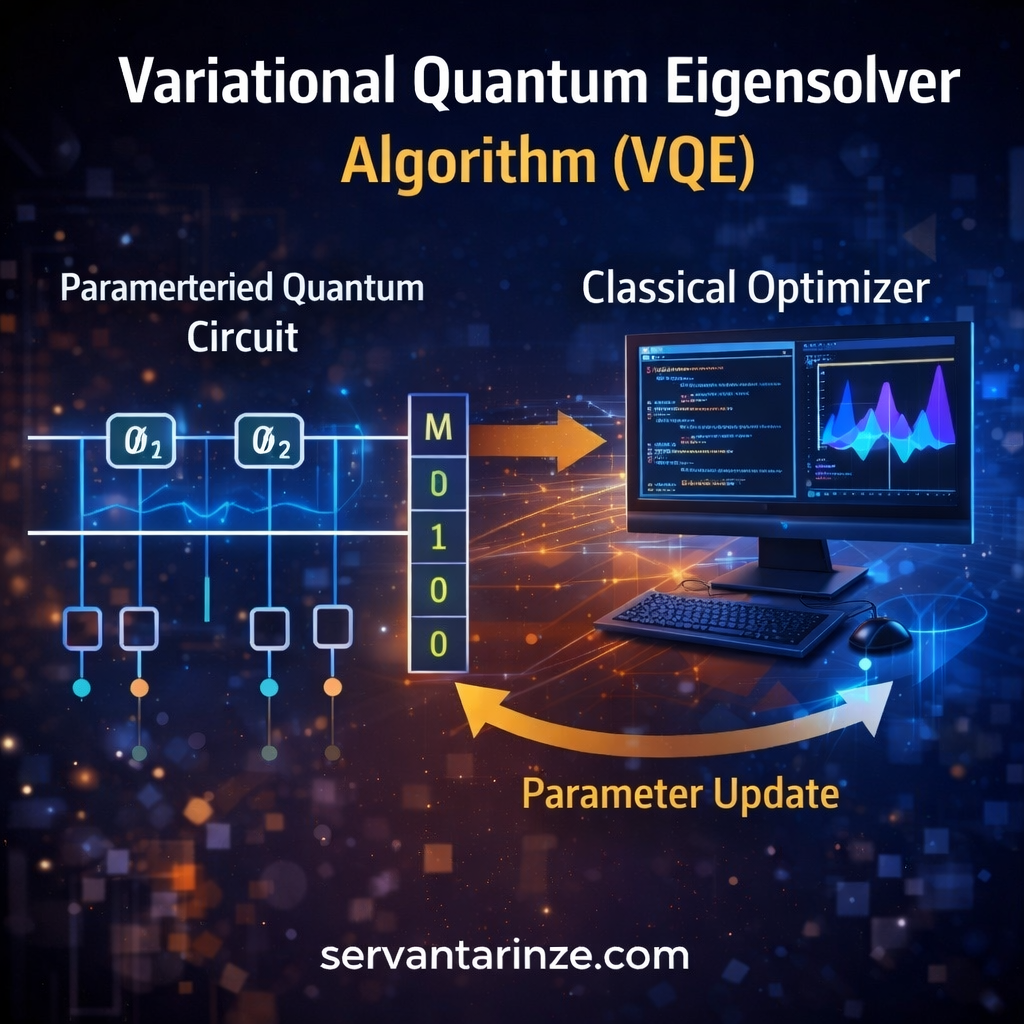
The Variational Quantum Eigensolver (VQE) is often the first algorithm people encounter when they move from quantum theory into practical hybrid quantum computing. That is not by accident. VQE was designed specifically to work within the limitations of noisy quantum hardware while still addressing problems that are fundamentally quantum in nature.
At a high level, VQE tackles a familiar challenge in chemistry and physics: finding the lowest energy state of a quantum system. This task lies at the heart of molecular simulation, materials science, and drug discovery. Classical methods rely on approximations that become increasingly inaccurate as molecular complexity grows, while exact solutions scale exponentially and quickly become infeasible.
VQE approaches this problem using a hybrid quantum-classical loop. A parameterized quantum circuit prepares a trial quantum state, which is then measured to estimate the energy of the system. A classical optimizer evaluates the result and adjusts the circuit parameters. This process repeats iteratively, gradually lowering the estimated energy until the system converges toward its ground state.
What makes VQE practical in the NISQ era is its reliance on shallow quantum circuits. Instead of executing long, error-prone programs, VQE runs short circuits many times, trading circuit depth for repetition. Noise still exists, but it is managed rather than amplified. The classical optimizer absorbs uncertainty and steers the system toward stable solutions.
In real-world applications, this structure has proven especially valuable in quantum chemistry. Hybrid VQE workflows are being explored to model molecular ground states, reaction intermediates, and hydration effects that are difficult to capture accurately with classical simulations alone. By 2026, these approaches have moved beyond toy problems and into early-stage pharmaceutical and materials research pipelines.
From a developer’s perspective, VQE is also approachable. Modern frameworks abstract much of the underlying complexity, allowing practitioners to focus on ansatz design, optimization strategy, and problem formulation. This makes VQE an ideal entry point for understanding how hybrid quantum-classical algorithms operate in practice.
To illustrate the structure of VQE, consider a simplified example using a hybrid framework. The quantum circuit prepares a parameterized state, while a classical optimizer updates the parameters based on measured energy values:
import pennylane as qml
import numpy as np
dev = qml.device("default.qubit", wires=2)
@qml.qnode(dev)
def circuit(params):
qml.RX(params[0], wires=0)
qml.RY(params[1], wires=1)
qml.CNOT(wires=[0, 1])
return qml.expval(qml.PauliZ(0))
def cost(params):
return circuit(params)
optimizer = qml.GradientDescentOptimizer(stepsize=0.2)
params = np.array([0.5, 0.5])
for _ in range(50):
params = optimizer.step(cost, params)
print("Optimized parameters:", params)
While this example is intentionally simple, it captures the essence of VQE. The quantum device evaluates expectation values, and the classical optimizer drives convergence. In real applications, the Hamiltonian, ansatz, and optimization landscape are far more complex, but the hybrid structure remains the same.
Despite its strengths, VQE is not a universal solution. Poor ansatz design can limit expressiveness, and optimization landscapes may suffer from flat regions that slow convergence. Noise mitigation and parameter initialization play a critical role in practical performance. Understanding when VQE is appropriate — and when alternative hybrid strategies are better suited — is essential for productive use.
Nevertheless, VQE remains one of the clearest examples of why hybrid quantum-classical algorithms matter. It demonstrates how near-term quantum hardware can contribute meaningful insight when paired with classical computation. Rather than waiting for fault-tolerant machines, VQE shows how progress can happen now — incrementally, pragmatically, and with real scientific relevance.
Read also: Code Quantum Algorithms in Python: 7 Proven Steps for Developers
2. Quantum Approximate Optimization Algorithm (QAOA)
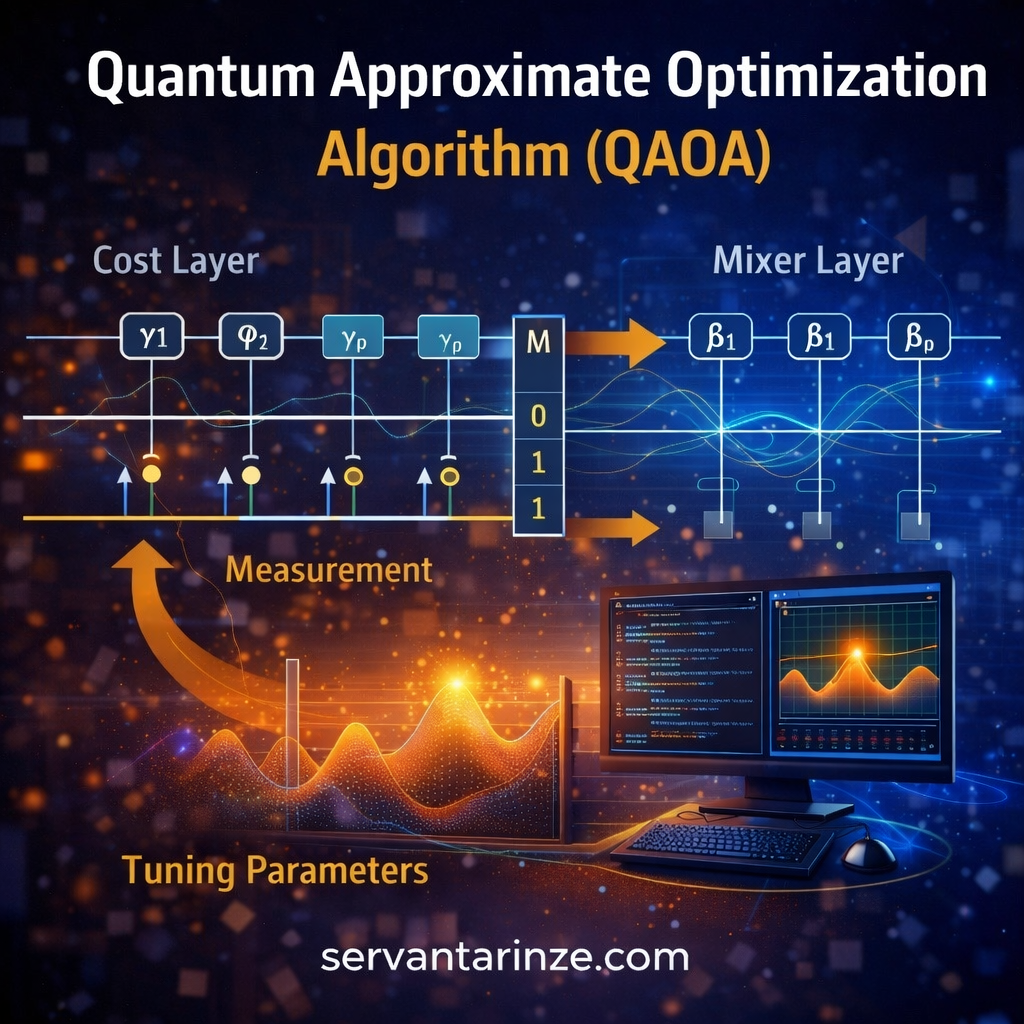
While VQE focuses on estimating energies in quantum systems, the Quantum Approximate Optimization Algorithm (QAOA) targets a different but equally important class of problems: combinatorial optimization. These are problems where the goal is to find the best solution among an enormous number of possibilities, such as scheduling, routing, portfolio selection, or molecular candidate optimization.
Classical algorithms can handle many optimization tasks efficiently, but certain problem instances scale poorly as size increases. The number of possible configurations grows exponentially, and even powerful heuristics may struggle to explore the search space effectively. QAOA was introduced as a hybrid quantum-classical approach designed to navigate these complex landscapes more efficiently using quantum resources.
At its core, QAOA alternates between two types of operations. One encodes the cost function of the optimization problem into a quantum circuit, while the other mixes quantum states to explore new configurations. These operations are applied in layers, each controlled by a set of tunable parameters. A classical optimizer adjusts these parameters to maximize or minimize the objective function based on measurement outcomes.
Like VQE, QAOA relies on a hybrid feedback loop. The quantum processor evaluates candidate solutions by sampling from a quantum state, and the classical computer analyzes the results, updates parameters, and decides the next iteration. This iterative structure allows QAOA to function effectively on noisy quantum hardware by keeping circuits relatively shallow.
One of QAOA’s most important strengths is flexibility. By increasing the number of layers, developers can trade off circuit depth for solution quality. In the NISQ era, this adaptability is crucial. Shallow circuits can be tested quickly, while deeper configurations can be explored cautiously as hardware improves.
By 2026, QAOA-based hybrid workflows have found traction in applied optimization scenarios where speed and exploration matter more than exact optimality. In pharmaceutical research, for example, hybrid optimization pipelines have been used to narrow vast chemical search spaces, identifying promising drug candidates far more efficiently than brute-force classical approaches. Similar strategies are being explored in logistics, energy systems, and financial modeling.
From a developer’s perspective, QAOA highlights a key principle of hybrid quantum-classical algorithms: the quantum component does not need to solve the entire problem. Instead, it enhances exploration by sampling from probability distributions that are difficult to replicate classically. The classical optimizer then exploits this information to guide the search toward better solutions.
Implementing QAOA typically involves choosing an appropriate cost function, designing a circuit that reflects the problem structure, and selecting an optimizer that balances convergence speed with stability. While these choices can be challenging, modern quantum frameworks provide abstractions that simplify experimentation and tuning.
However, QAOA is not a universal optimizer. Performance depends heavily on problem encoding, parameter initialization, and noise levels. In some cases, classical heuristics may outperform shallow QAOA circuits. Understanding these limitations is part of using QAOA responsibly and effectively.
Despite these challenges, QAOA remains one of the most compelling examples of hybrid quantum-classical algorithms in action. It demonstrates how quantum sampling, combined with classical optimization, can deliver practical value today — not by replacing classical methods, but by augmenting them in targeted, problem-specific ways.
3. Quantum Kernel Methods & Hybrid Machine Learning
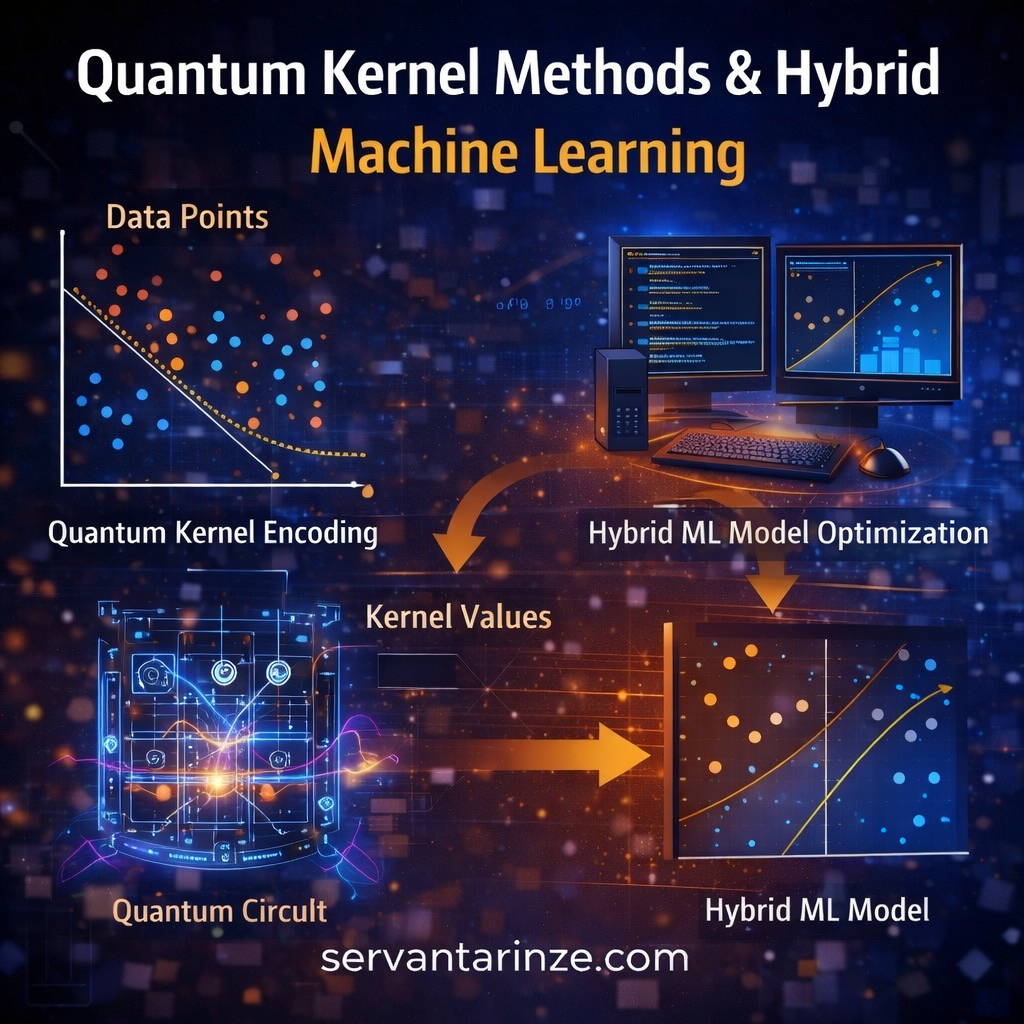
Not all hybrid quantum-classical algorithms focus on physics or optimization. Some of the most explored hybrid approaches in recent years sit at the intersection of quantum computing and machine learning, where quantum circuits are used to transform data while classical models perform training and inference.
Quantum kernel methods are a representative example of this hybrid strategy. Instead of replacing classical machine learning models, quantum circuits are used to map classical data into a high-dimensional feature space. A classical algorithm, such as a support vector machine or kernel-based classifier, then operates on these transformed representations.
The intuition behind quantum kernels is straightforward. Certain quantum feature maps generate probability distributions and correlations that are difficult to compute or approximate classically. By embedding data into these quantum states, hybrid models may uncover structure that classical kernels struggle to represent efficiently.
In practice, the workflow remains firmly hybrid. Classical data is encoded into quantum circuits, measurements are performed, and the resulting kernel values are computed on a classical processor. Training, validation, and evaluation all happen using familiar classical machine learning techniques.
By 2026, quantum kernel methods have been explored across a range of applications, including classification tasks, anomaly detection, and pattern recognition in small to medium-sized datasets. These experiments are not about outperforming deep classical neural networks across the board, but about identifying specific regimes where quantum feature spaces provide an advantage.
One of the key strengths of hybrid quantum-classical machine learning is compatibility. Existing ML pipelines can incorporate quantum kernels without major architectural changes. This lowers the barrier to experimentation and allows teams to evaluate quantum-enhanced features using established benchmarks and validation methods.
From a developer’s perspective, quantum kernel methods also highlight an important lesson: quantum advantage in machine learning is subtle and highly problem-dependent. Performance gains depend on data structure, encoding strategy, and noise resilience. Blindly applying quantum kernels rarely yields benefits.
As a result, successful hybrid quantum machine learning workflows emphasize careful problem selection and empirical testing. Small-scale experiments are used to assess whether quantum feature maps add meaningful expressiveness before committing resources to larger studies.
Despite these constraints, quantum kernel methods remain an important part of the hybrid quantum-classical landscape. They demonstrate how quantum circuits can enhance classical models without requiring end-to-end quantum learning systems. This pragmatic integration reflects the broader philosophy of hybrid quantum computing in the NISQ era.
Rather than replacing classical machine learning, hybrid quantum-classical algorithms extend it. Quantum kernels serve as specialized tools — valuable in certain contexts, limited in others — reinforcing the idea that progress comes from collaboration between quantum and classical computation, not competition.
Check out: Essential Quantum Tools You Can Use to Build Real Projects
4. Hybrid Quantum Phase Estimation Variants
Quantum Phase Estimation (QPE) is one of the most powerful algorithms in quantum computing. In theory, it enables precise estimation of eigenvalues associated with quantum operators, forming the backbone of many algorithms for chemistry, materials science, and cryptography. In practice, however, full-scale QPE is largely impractical on today’s noisy quantum hardware.
Standard implementations of QPE require deep quantum circuits, long coherence times, and a high degree of control over entanglement. These requirements place it well beyond the capabilities of most NISQ-era devices. As a result, researchers have shifted attention toward hybrid variants that retain the core idea of phase estimation while dramatically reducing quantum resource demands.
Hybrid quantum phase estimation approaches distribute the workload between quantum and classical systems. Instead of performing all phase estimation steps on a quantum processor, these methods rely on repeated short quantum experiments combined with classical post-processing. The quantum device provides probabilistic measurements, while classical algorithms reconstruct phase information from aggregated results.
This strategy reduces circuit depth and limits exposure to noise. By avoiding long sequences of controlled operations, hybrid phase estimation becomes feasible on near-term hardware. Classical signal processing techniques, statistical inference, and optimization play a central role in extracting useful information from imperfect quantum measurements.
In chemical and physical simulations, hybrid phase estimation techniques are particularly relevant for estimating energy spectra and transition frequencies. When combined with variational approaches, they can refine energy estimates beyond what purely variational methods achieve, improving accuracy without sacrificing robustness.
From a practical standpoint, hybrid quantum-classical algorithms based on phase estimation emphasize adaptability. Developers can tune the balance between quantum sampling effort and classical computation depending on hardware quality and problem complexity. This flexibility is essential in environments where noise characteristics vary across devices and over time.
Hybrid phase estimation also illustrates an important design principle for near-term quantum algorithms: precision does not always require deeper circuits. In many cases, carefully orchestrated repetition and classical aggregation outperform fragile, monolithic quantum procedures.
While hybrid variants do not fully replace fault-tolerant QPE, they provide a realistic pathway for leveraging phase information today. They allow researchers to probe quantum systems with greater resolution than purely variational methods, while remaining compatible with the constraints of NISQ hardware.
As hybrid quantum-classical algorithms continue to mature, phase estimation variants will likely play a supporting role alongside VQE, QAOA, and other hybrid techniques. Together, these approaches form a layered toolkit for extracting quantum insight incrementally, rather than waiting for perfect hardware.
5. Hybrid Optimization & Annealing-Inspired Workflows
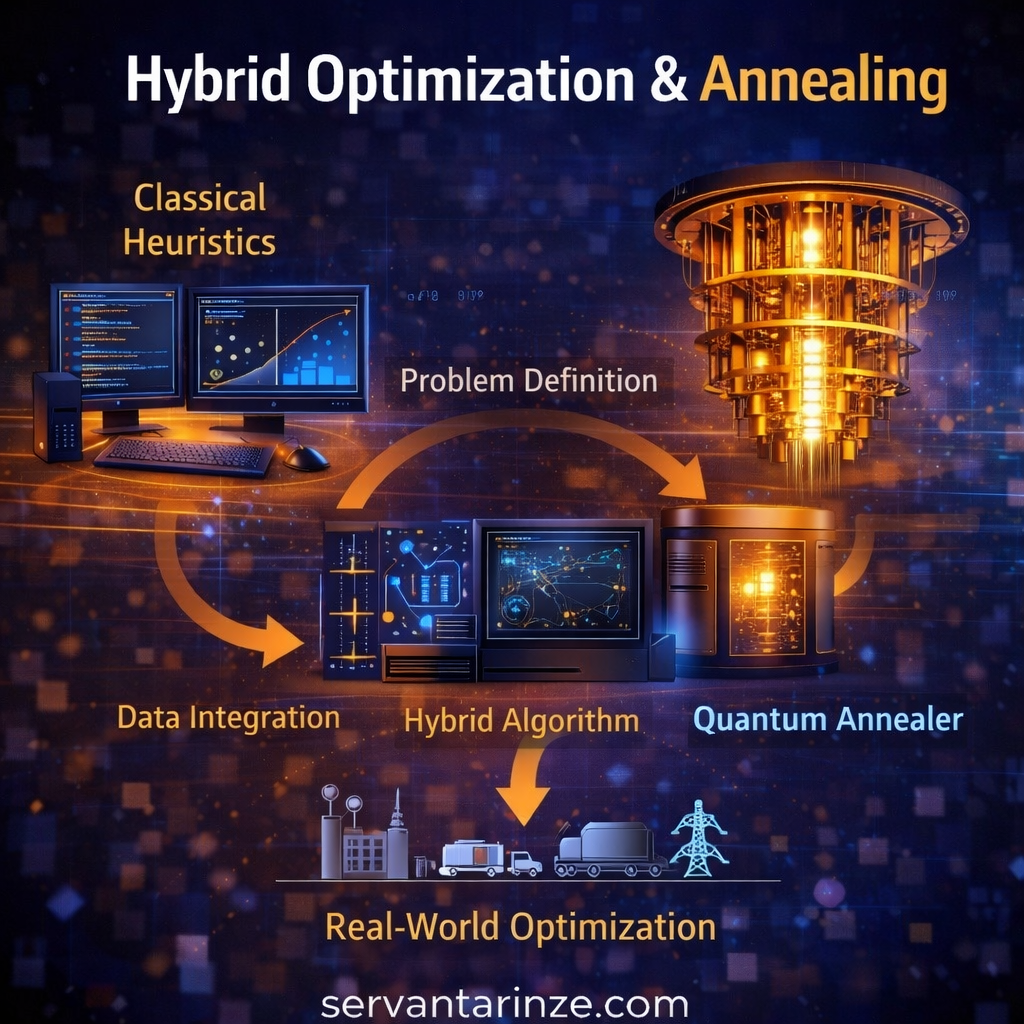
Beyond gate-based quantum algorithms such as VQE and QAOA, another important class of hybrid quantum-classical algorithms draws inspiration from quantum annealing and energy-based optimization. These approaches focus less on exact quantum state preparation and more on using quantum dynamics to explore complex optimization landscapes efficiently.
Quantum annealing devices and annealing-inspired workflows are particularly well suited to problems that can be expressed as energy minimization tasks. In these settings, the quantum system samples candidate solutions according to an energy function, while classical algorithms refine, validate, and improve upon those samples.
The hybrid nature of these workflows is essential. Quantum hardware provides probabilistic sampling that can escape local minima more effectively than many classical heuristics. Classical solvers then take over, applying domain knowledge, constraint handling, and fine-grained optimization to turn promising samples into usable solutions.
In practical deployments, annealing-inspired hybrids rarely operate in isolation. Instead, they are embedded within larger classical pipelines that manage data preparation, solution filtering, and post-processing. The quantum component acts as a specialized accelerator, contributing insight at specific stages rather than controlling the entire workflow.
By 2026, such hybrid optimization strategies have been explored across a range of domains, including molecular design, logistics, scheduling, and resource allocation. In drug discovery, for example, hybrid pipelines have been used to reduce enormous chemical search spaces by identifying subsets of candidates that merit deeper classical or quantum analysis.
From a developer’s standpoint, hybrid optimization and annealing-inspired workflows reinforce an important lesson: quantum advantage often emerges from collaboration rather than replacement. Classical algorithms remain responsible for enforcing constraints, incorporating heuristics, and ensuring robustness, while quantum sampling enhances exploration where classical methods struggle.
These workflows also emphasize the importance of problem formulation. Mapping a real-world optimization task into an energy-based representation is often more challenging than running the quantum hardware itself. Success depends on careful encoding, thoughtful decomposition, and iterative refinement — skills that closely mirror best practices in classical optimization.
Despite their promise, annealing-inspired hybrids are not universally applicable. Performance depends on problem structure, hardware characteristics, and integration quality. In many cases, purely classical methods remain competitive or superior. Recognizing when quantum sampling adds value — and when it does not — is key to responsible adoption.
Nevertheless, hybrid optimization and annealing-inspired workflows represent a practical and scalable approach to near-term quantum computing. They demonstrate how quantum devices can contribute meaningfully today, even in the absence of full fault tolerance, by acting as targeted components within classical systems.
6. Advanced Hybrid Pipelines (Adaptive & Self-Optimizing Hybrids)
As hybrid quantum-classical algorithms mature, research attention has begun shifting from individual algorithms toward more flexible, adaptive pipelines. These advanced hybrid systems do not rely on a single fixed strategy. Instead, they dynamically adjust how quantum and classical components interact based on feedback from the computation itself.
Adaptive hybrid pipelines extend the basic hybrid loop by introducing decision-making at multiple levels. Classical controllers monitor convergence behavior, noise levels, and resource usage, then modify circuit structure, optimization strategy, or sampling depth in response. In effect, the algorithm learns how to use the quantum hardware more efficiently over time.
One example of this trend is the emergence of adaptive variational methods, where the structure of the quantum circuit evolves during execution. Rather than choosing a fixed ansatz upfront, the algorithm incrementally builds circuit elements based on measured performance. This approach helps balance expressiveness against noise, a critical concern in the NISQ era.
Self-optimizing hybrid workflows also integrate noise mitigation, parameter scheduling, and classical heuristics into a single control layer. Classical models analyze intermediate results and determine whether additional quantum evaluations are worthwhile, reducing wasted quantum runs and improving overall efficiency.
By 2026, these advanced hybrid pipelines remain largely experimental, but they represent an important direction for near-term quantum computing. Early studies suggest that adaptability may be just as important as raw quantum power when working with imperfect hardware. Algorithms that respond intelligently to hardware behavior often outperform rigid approaches that assume ideal conditions.
From a developer’s perspective, adaptive hybrid pipelines highlight the growing role of classical intelligence in quantum systems. Building effective hybrid workflows increasingly resembles systems engineering rather than isolated algorithm design. Success depends on orchestration, monitoring, and continuous refinement.
These advanced hybrids also reinforce a broader theme: quantum advantage is unlikely to arrive as a single breakthrough moment. Instead, it will emerge gradually through layers of hybridization, automation, and adaptation. Each improvement strengthens the bridge between noisy hardware and useful computation.
While still evolving, adaptive and self-optimizing hybrid pipelines point toward a future where quantum computing becomes a responsive component within larger computational ecosystems. They embody the long-term vision of hybrid quantum-classical algorithms as living systems — capable of learning, adjusting, and improving as both hardware and software advance.
Recommended: Quantum Circuits Without Coding
Best Frameworks for Building Hybrid Quantum-Classical Algorithms in 2026
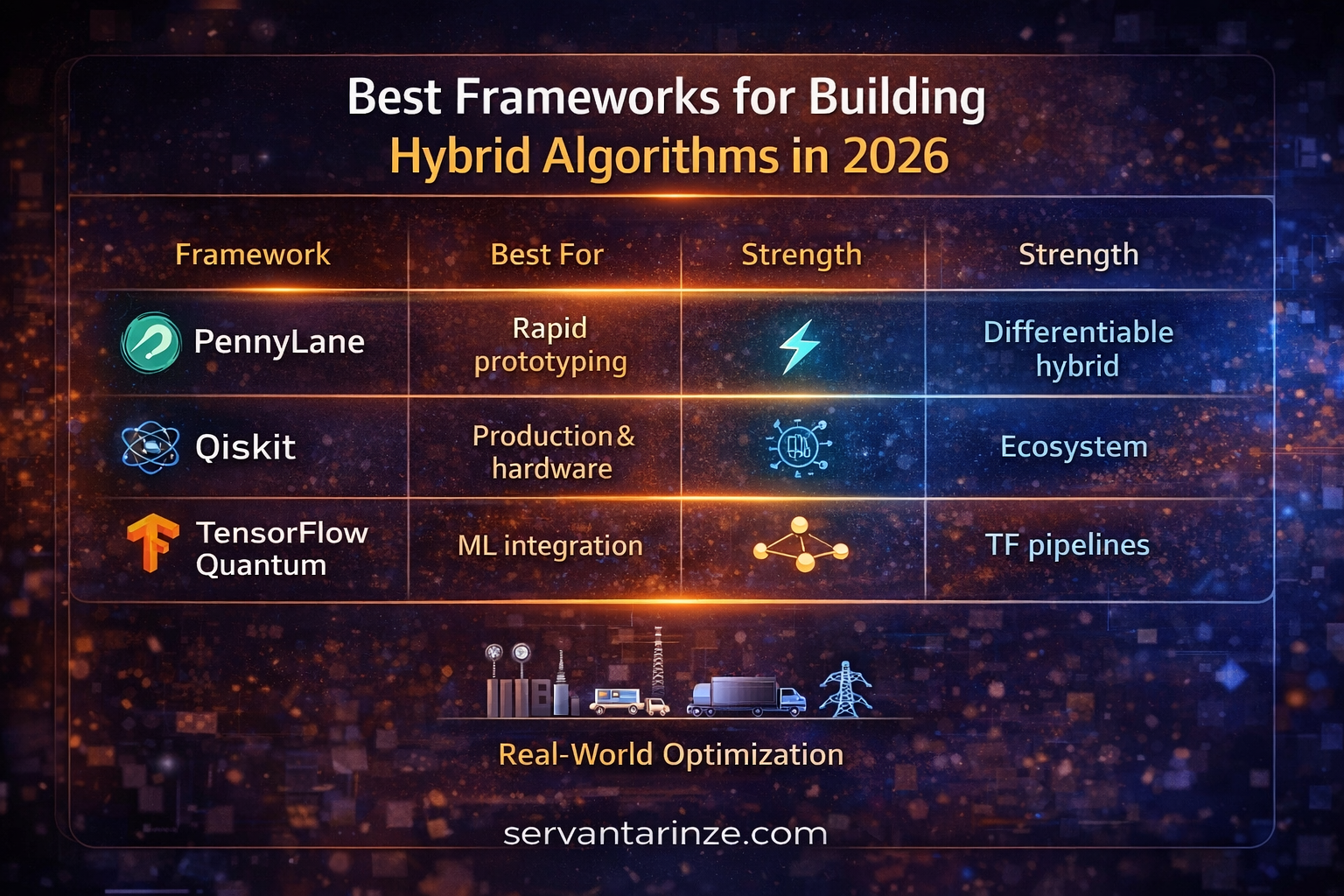
Hybrid quantum-classical algorithms depend as much on software infrastructure as they do on hardware. In practice, the choice of framework often determines how quickly a developer can prototype, test, and iterate on hybrid workflows. By 2026, several quantum software platforms have matured enough to support real hybrid development, each with distinct strengths and trade-offs.
Rather than competing directly, most frameworks occupy different positions along the development spectrum. Some prioritize rapid experimentation and machine learning integration, while others focus on production readiness and direct access to quantum hardware. Understanding these differences is essential when building hybrid quantum-classical algorithms that move beyond tutorials.
Below is a high-level comparison of the most widely used hybrid quantum frameworks in 2026, focusing on practical developer concerns rather than theoretical completeness.
| Framework | Primary Strength | Hybrid Capabilities | Best Use Case | Limitations |
|---|---|---|---|---|
| PennyLane | Differentiable programming | Native hybrid loops, automatic gradients, ML integration | Rapid prototyping, VQE, hybrid ML | Less hardware-centric than Qiskit |
| Qiskit | Full ecosystem & hardware access | VQE, QAOA, runtime primitives | Production pipelines, hardware execution | Steeper learning curve |
| TensorFlow Quantum | Deep ML integration | Hybrid ML workflows with quantum circuits | Quantum-enhanced machine learning research | Limited chemistry support |
| Cirq | Low-level circuit control | Composable hybrid workflows | Custom algorithm research | Less abstraction for beginners |
For most developers entering hybrid quantum computing, PennyLane offers the fastest path to experimentation. Its support for differentiable programming allows quantum circuits to integrate seamlessly with classical optimization and machine learning workflows. This makes it particularly well suited for variational algorithms such as VQE and quantum kernel methods.
Qiskit, on the other hand, excels when hardware execution and production alignment matter. Its ecosystem includes transpilation, error mitigation tools, and runtime primitives that bridge development and deployment. Teams aiming to move hybrid quantum-classical algorithms from research into real hardware environments often rely on Qiskit for this reason.
TensorFlow Quantum occupies a more specialized niche. It is most valuable when quantum circuits are embedded directly into machine learning models built on the TensorFlow stack. While less flexible for chemistry or optimization, it remains relevant for hybrid quantum machine learning experiments.
Importantly, framework choice is not permanent. Many hybrid workflows begin in PennyLane for rapid iteration, then transition to Qiskit or lower-level tooling as requirements evolve. This progression mirrors how hybrid quantum-classical algorithms themselves mature — starting simple, then becoming more structured as confidence grows.
In practice, the most successful teams treat frameworks as tools rather than commitments. The goal is not to master every platform, but to select the one that aligns best with the problem being solved, the maturity of the hardware, and the skills of the development team.
Real-World Applications & 2026 Milestones
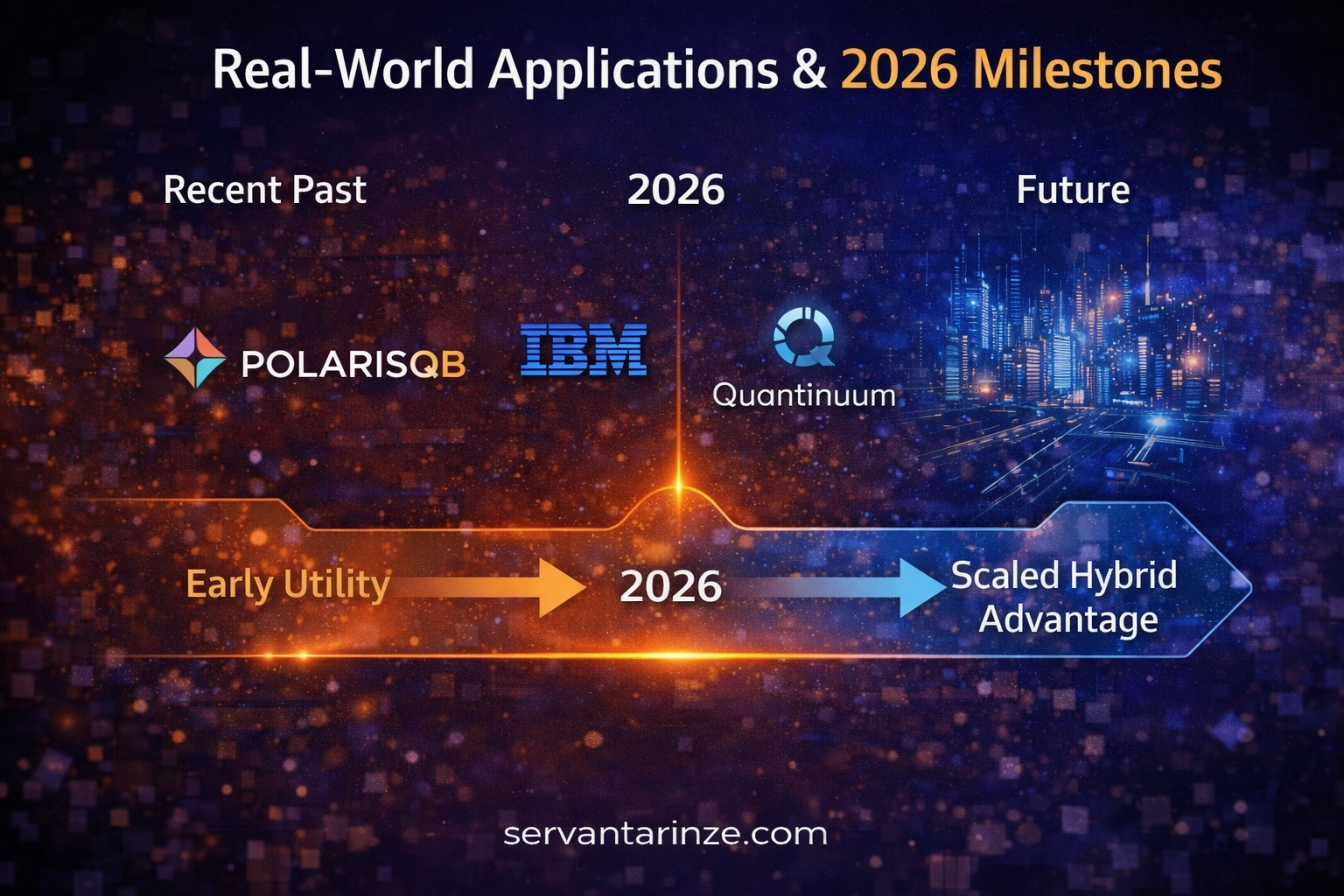
Hybrid quantum-classical algorithms are no longer confined to experimental benchmarks or isolated demonstrations. By 2026, they are being actively explored across several domains where incremental improvements can translate into meaningful real-world impact. While these applications do not yet represent universal quantum advantage, they clearly demonstrate hybrid utility — practical gains achieved by combining quantum and classical computation.
One of the most visible areas of progress is chemistry and pharmaceutical research. Hybrid variational algorithms are being used to estimate molecular ground states, explore reaction pathways, and analyze protein–ligand interactions. These tasks are computationally demanding for classical methods alone, particularly as molecular size and complexity increase.
In early-stage drug discovery, hybrid workflows help narrow vast chemical search spaces. Quantum evaluations guide classical screening pipelines toward promising candidates, reducing the time and cost associated with brute-force exploration. Rather than replacing classical simulations, hybrid quantum-classical algorithms act as accelerators within existing research frameworks.
Optimization is another domain where hybrid approaches have shown tangible progress. Combinatorial problems such as scheduling, routing, and resource allocation are well suited to hybrid strategies that combine quantum sampling with classical heuristics. In these settings, quantum components assist with exploration, while classical solvers refine solutions and enforce constraints.
Logistics and supply chain optimization have benefited from this model, particularly in scenarios where near-optimal solutions delivered quickly are more valuable than exact solutions delivered slowly. Hybrid quantum-classical algorithms align naturally with these requirements, providing flexible trade-offs between speed, accuracy, and computational cost.
Hybrid quantum machine learning applications have also matured, though more cautiously. Quantum kernel methods and feature maps have been tested on structured datasets where classical models struggle to capture complex correlations. While results vary by problem, these experiments have helped clarify where quantum-enhanced representations offer genuine value.
A key milestone by 2026 is the shift from isolated experiments to integrated pipelines. Hybrid algorithms are increasingly embedded within broader software systems that include data ingestion, classical preprocessing, optimization loops, and post-analysis. This integration signals a transition from proof-of-concept toward operational relevance.
Importantly, these milestones reflect a broader change in mindset. The goal is no longer to demonstrate that quantum computers can outperform classical ones in abstract terms. Instead, the focus is on identifying specific tasks where hybrid quantum-classical algorithms improve outcomes, even modestly, within realistic constraints.
Taken together, these developments show that hybrid approaches are not speculative. They are shaping how organizations experiment with quantum computing today, laying the groundwork for deeper quantum integration as hardware continues to evolve.
Challenges & the Path to Quantum Advantage
Despite the steady progress of hybrid quantum-classical algorithms, significant challenges remain. Understanding these limitations is essential for setting realistic expectations and making informed decisions about where quantum computing adds value today.
Noise continues to be the dominant constraint in the NISQ era. Gate errors, decoherence, and measurement uncertainty limit circuit depth and affect result stability. While hybrid approaches reduce exposure to these issues, they do not eliminate them. Careful circuit design, error mitigation techniques, and repeated sampling remain necessary.
Optimization landscapes present another challenge. Many hybrid algorithms rely on classical optimizers navigating high-dimensional parameter spaces. These landscapes can contain flat regions or local minima that slow convergence. Choosing appropriate ansätze, initialization strategies, and optimizers is often more important than increasing quantum resources.
Scaling also remains difficult. As problem size grows, the number of required measurements increases, and classical post-processing becomes more demanding. Hybrid quantum-classical algorithms must balance precision with practicality, ensuring that additional quantum evaluations justify their cost.
Yet these challenges do not undermine the value of hybrid approaches. Instead, they clarify their role. Hybrid algorithms are not a temporary detour — they are the bridge that connects today’s imperfect hardware to tomorrow’s fault-tolerant systems.
As quantum devices improve, hybrid workflows will evolve rather than disappear. More computation will gradually shift toward quantum processors, while classical systems continue to provide orchestration, optimization, and error handling. This gradual transition is far more realistic than expecting a sudden leap to full quantum advantage.
In this sense, hybrid quantum-classical algorithms define the roadmap for quantum computing. They allow progress to happen incrementally, responsibly, and with measurable impact — building confidence, expertise, and infrastructure along the way.
Conclusion: The Bridge Is Built — Now It’s Time to Cross
Hybrid quantum-classical algorithms represent the most practical and impactful path forward for quantum computing in 2026. They acknowledge the limitations of current hardware while extracting genuine value from quantum mechanics through thoughtful collaboration with classical computation.
Across chemistry, optimization, and machine learning, hybrid approaches have demonstrated that quantum systems do not need to operate in isolation to be useful. By focusing quantum resources on the hardest parts of a problem and relying on classical systems for stability and scale, these algorithms turn fragile devices into productive tools.
More importantly, hybrid quantum-classical algorithms change how we think about quantum advantage. Rather than waiting for a distant future defined by perfect hardware, they allow progress to happen now — incrementally, transparently, and with real-world relevance.
For developers and researchers, this shift opens the door to experimentation and learning. Building hybrid workflows is not about chasing hype; it is about understanding how quantum and classical systems complement each other, and how that collaboration can be shaped into useful solutions.
If you want to take the next step, start small. Implement a basic VQE workflow. Experiment with QAOA on a simple optimization problem. Observe how classical optimization guides quantum computation. Each iteration builds intuition and confidence.
The bridge to quantum advantage is no longer theoretical. It is being built today, one hybrid algorithm at a time. Now is the moment to step onto it — thoughtfully, realistically, and with purpose.
Frequently Asked Questions About Hybrid Quantum-Classical Algorithms (FAQ)
What are hybrid quantum-classical algorithms?
Hybrid quantum-classical algorithms combine quantum processors and classical computers in a single workflow. Quantum hardware handles specific subproblems that are difficult to solve classically, while classical systems manage optimization, control, and data processing to make the computation practical.
Why are hybrid algorithms important in the NISQ era?
Current quantum devices are noisy and limited in scale. Hybrid algorithms reduce circuit depth and rely on classical optimization to stabilize results, allowing useful quantum computation even with imperfect hardware.
Are VQE and QAOA hybrid quantum algorithms?
Yes. Both the Variational Quantum Eigensolver (VQE) and the Quantum Approximate Optimization Algorithm (QAOA) use a hybrid loop where quantum circuits generate measurements and classical optimizers update parameters iteratively.
Can hybrid quantum-classical algorithms deliver quantum advantage today?
Hybrid algorithms can provide task-specific advantages in areas like chemistry and optimization, but they do not yet deliver universal quantum advantage. Their value lies in practical, incremental improvements rather than outright replacement of classical computing.
Which framework is best for building hybrid quantum algorithms?
There is no single best framework. PennyLane is well suited for rapid prototyping and hybrid machine learning, while Qiskit is preferred for production workflows and hardware execution. The right choice depends on project goals and infrastructure.
Will hybrid quantum-classical algorithms remain relevant in the future?
Yes. Even as fault-tolerant quantum computers emerge, hybrid approaches will remain important for orchestration, optimization, and scalable system design, making them a long-term foundation rather than a temporary solution.