
Quantum Teleportation is often misunderstood because of its name. It does not involve moving people, objects, or physical particles across space. Instead, it describes a scientific process that transfers the quantum state of a particle from one location to another without physically sending that particle.
This idea may sound abstract, but it plays a critical role in modern quantum science. The ability to move quantum information without copying it is essential for secure communication, advanced computing, and future quantum networks. Understanding how this process works gives you a clearer picture of why quantum technologies are fundamentally different from classical systems.
If you are still building your foundation, it helps to first understand how quantum systems differ from classical ones. A helpful starting point is Quantum vs Classical: Powerful Differences Explained, which shows why information behaves so differently at the quantum level.

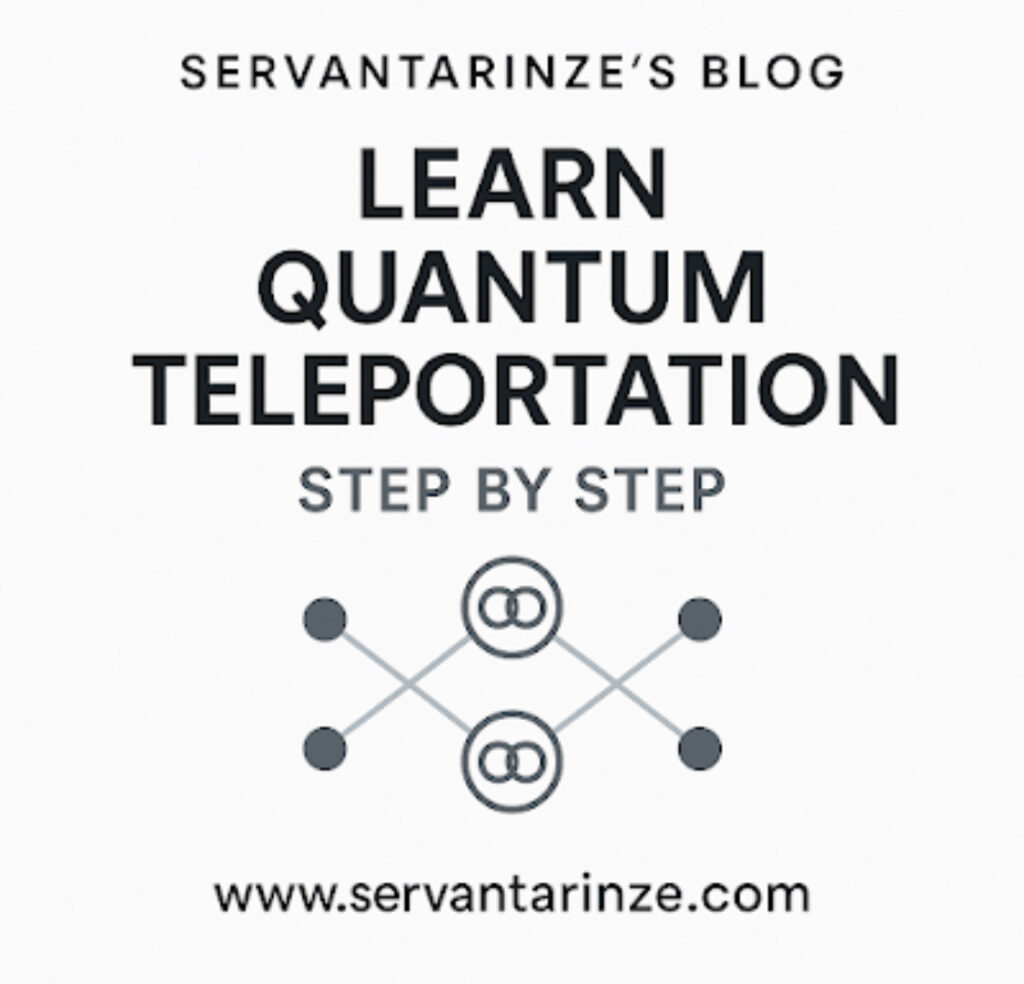
A simple visual guide explaining quantum teleportation step by step using entanglement.
What Quantum Teleportation Actually Means
At its core, Quantum Teleportation is a protocol that allows an unknown quantum state to be transferred from one system to another using entanglement and classical communication. The sender does not learn the state, and the receiver does not receive a copy. The original state disappears from the sender and reappears at the destination.
This process respects one of the most important rules in quantum physics: unknown quantum states cannot be cloned. Rather than copying information, the teleportation protocol transfers it in a way that preserves its integrity.
Why This Process Matters in Quantum Science
The importance of Quantum Teleportation lies in its practical consequences. Quantum information is extremely fragile. Direct transmission over long distances introduces noise and loss that can destroy the state entirely.
Teleportation solves this problem by allowing quantum states to be reconstructed at distant locations without forcing them to travel through noisy channels. This is why it is considered a foundational tool for quantum networking and secure communication.
The Core Concepts You Need First
To fully understand how this works, three ideas must be clear: qubits, superposition, and entanglement. These concepts form the backbone of the teleportation protocol.
Qubits and Superposition
A qubit is the basic unit of quantum information. Unlike classical bits, qubits can exist in combinations of states until measured. This behavior, known as superposition, is what makes quantum information powerful—but also difficult to handle.
If you want a clearer and beginner-friendly explanation of how qubits behave, see Quantum Basics: Learn Qubits the Easy Way. It provides the intuition needed before tackling teleportation.
Entanglement
Entanglement is a unique quantum relationship where two particles share a combined state, even when separated by distance. This shared connection is the key resource that makes teleportation possible.
Without entanglement, transferring an unknown quantum state would be impossible. For a deeper explanation of why this phenomenon is so powerful, read Quantum Entanglement: Powerful Ways It Shapes Reality.
How the Teleportation Protocol Works
To explain the process clearly, imagine three qubits. One holds the unknown state to be transferred. The other two form an entangled pair shared between the sender and the receiver.
At the beginning, the sender holds two qubits: the unknown state and one half of the entangled pair. The receiver holds the remaining entangled qubit. What follows is a precise sequence of operations that allow the state to be transferred without copying it.
Step 1: Sharing an Entangled Pair
The teleportation process begins before anything is sent. The sender and receiver must first share an entangled pair of qubits. One qubit stays with the sender, while the other is delivered to the receiver. This shared entanglement acts as the invisible channel that makes quantum state transfer possible.
Without this shared resource, teleporting a quantum state would be impossible. Classical communication alone cannot move unknown quantum information, which is why entanglement is the foundation of the entire protocol.
Step 2: Combining the Unknown State with Entanglement
The sender now interacts the qubit holding the unknown state with their half of the entangled pair. This interaction prepares the system for a special type of measurement. Importantly, the sender is not trying to read or inspect the state. The goal is to link the unknown information to the shared entangled system.
This step highlights why superposition plays such a critical role. The quantum state exists as a combination of possibilities until measurement occurs. If you want to see how this principle appears beyond theory, Quantum Superposition in Real Life offers practical examples that make this behavior easier to understand.
Step 3: Measurement Without Learning the State
The sender performs a joint measurement on the two qubits they hold. This measurement produces one of four possible outcomes, which can be expressed as two classical bits. At this moment, the original quantum state no longer exists at the sender’s location.
This is a crucial point. The measurement does not reveal the unknown state itself. Instead, it determines which transformation the receiver must apply to recover that state. This is why the process respects the no-cloning rule of quantum physics.
Step 4: Sending Classical Information
After the measurement, the sender transmits the two classical bits to the receiver using an ordinary communication channel. This step ensures that the protocol remains consistent with physical limits. The receiver cannot complete the transfer until this classical message arrives.
Because of this requirement, quantum state transfer does not enable faster-than-light communication. Entanglement provides correlation, but classical signals still govern timing.
Step 5: Reconstructing the State
Once the receiver gets the classical message, they apply a specific correction to their qubit. This correction depends entirely on the two bits sent by the sender. After applying it, the receiver’s qubit becomes the exact quantum state that originally existed at the sender’s side.
At this point, the transfer is complete. The quantum information has moved from one location to another without ever being copied or directly transmitted as a particle.
Why Quantum Teleportation Matters in Practice
Quantum Teleportation is not just a teaching tool. It is a working mechanism used in modern quantum research. One of its most important applications is in quantum networks, where fragile quantum states must be transferred across distance without being destroyed by noise.
Teleportation allows networks to move quantum information between nodes using pre-shared entanglement rather than long, error-prone transmission paths. This approach is central to the development of quantum repeaters and scalable quantum communication systems.
Research institutions and standards bodies actively study and validate these technologies. For example, the National Institute of Standards and Technology provides authoritative research and guidance on quantum information science and secure communication.
Clearing Common Misunderstandings
Does this process move particles?
No. Only the quantum state is transferred. The physical particle at the destination is different from the one at the source.
Does it break the laws of physics?
No. The protocol follows all known physical limits, including causality and the speed of light.
Is this only theoretical?
No. The process has been demonstrated repeatedly in laboratories and experimental networks, confirming that it works exactly as predicted.
Final Thoughts
Quantum Teleportation shows that information at the quantum level behaves in ways that challenge everyday intuition. While quantum states cannot be copied or examined without disturbance, they can still be transferred perfectly when entanglement and classical communication are combined in the right sequence.
What makes this process so important is not its name, but its implications. It provides a reliable method for moving quantum information across distance without violating the fundamental rules of physics. This single idea supports the development of quantum networks, secure communication systems, and future distributed quantum technologies.
As quantum science continues to advance, understanding Quantum Teleportation helps connect many core concepts—from superposition and entanglement to information security and computation. It is not a theoretical trick, but a proven protocol that reveals how the quantum world truly handles information.