
Originally published: November 25, 2025 • Last updated: December 10, 2025
When people discuss sustainability, they often focus on cars, planes, farms, and factories. Almost no one thinks about the invisible systems behind our favourite movies, music, and livestreams. Yet every time you hit “Play” on Netflix, YouTube, Spotify, Prime Video, TikTok, or any platform, a massive digital chain begins—data centers activate, global networks push billions of data packets, and bright screens stay on for hours. All of this activity consumes real energy.
This brings us to a crucial modern question: can our online entertainment ever become energy-efficient? Not by removing streaming from our lives, but by transforming how it works. That transformation is called eco-smart streaming.
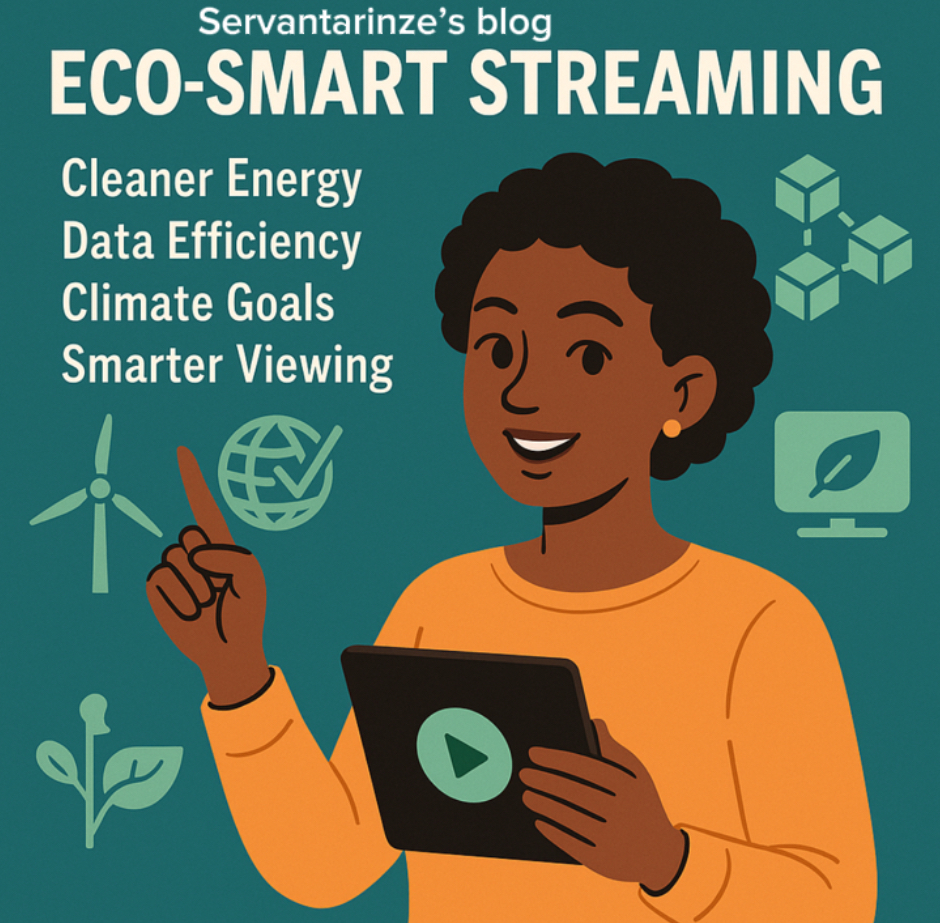
Eco-smart streaming is a new approach to digital entertainment that focuses on reducing energy waste, increasing efficiency, and aligning streaming platforms with global climate goals. Instead of asking people to stop watching their favourite shows, eco-smart streaming pushes companies, engineers, and viewers to rethink how content is delivered and consumed.
At its core, eco-smart streaming aims to:
- Use cleaner, more efficient energy sources,
- Deliver video and audio using smarter, low-waste technologies,
- Reduce unnecessary data traffic, and
- Enable viewers to enjoy entertainment without silently damaging the planet.
This guide breaks down how eco-smart streaming works, where emissions truly come from, what platforms must change, and how viewers can adopt energy-aware habits without losing convenience, comfort, or quality.
Why the Eco-Smart Streaming Debate Matters Now
In less than a decade, streaming has evolved from a convenience into the default way billions of people consume entertainment, news, education, and social content. Whether you’re watching movies, scrolling through TikTok, attending virtual classes, or joining a work meeting, streaming now powers daily life. This massive shift is why eco-smart streaming has become a global priority.
Every stream requires electricity—sometimes a little, sometimes a lot. Studies estimate that the broader internet uses about 2–3% of global electricity, and video platforms account for a large portion of that usage. As the world upgrades from HD to 4K, 8K, and high-frame-rate formats, the energy demand grows even faster.
If all electricity came from clean, renewable energy, this wouldn’t be a major concern. But many regions still depend heavily on fossil fuels. That means every hour of streaming carries a hidden carbon cost. When billions of people stream every day, these invisible emissions multiply dramatically.
This is why eco-smart streaming is now more than a technical idea—it is an environmental responsibility. Governments, climate researchers, investors, and consumers are all paying attention. They want platforms to:
- Measure their true environmental footprint,
- Be transparent about energy sources, and
- Adopt sustainability practices that match modern climate goals.
The question is no longer “Should people stream?” Streaming is here to stay. The real question is: Can we redesign streaming systems to be cleaner, smarter, and genuinely sustainable? That’s the core promise of eco-smart streaming.
Read also: 10 Game-Changing Eco-Friendly Streaming Platforms to Watch Guilt-Free
Where Streaming’s Emissions Really Come From
Most viewers assume the environmental impact of streaming comes mainly from the device in their hand or the TV on the wall. But the truth is far bigger. To understand why eco-smart streaming matters, we must look deeper into the hidden digital systems that power every video we watch.
Streaming is supported by three major layers: data centers, global networks, and personal devices. Together, these layers determine the true footprint of modern entertainment—and where eco-smart streaming can make the biggest difference.
1. Data Centers: The Heart of Every Stream
Your favorite movies, livestreams, and music files don’t live on your phone—they’re stored in massive buildings filled with servers. These facilities, known as data centers, operate 24/7 and require enormous amounts of electricity.
The servers generate intense heat, so they must be cooled constantly. The combination of computing and cooling often makes data centers the largest contributors to streaming-related emissions. Without renewable energy, their carbon footprint grows rapidly.
This is why companies pushing for eco-smart streaming prioritize renewable power agreements, efficient hardware, and next-generation cooling systems. Greener data centers mean greener streaming for everyone.
2. Network Infrastructure: The Global Delivery Highway
Once content leaves the data center, it travels through a complex web of fiber-optic cables, routers, satellites, telecom towers, and Wi-Fi systems. This global infrastructure consumes electricity every second it operates.
The farther your data travels, the more energy it requires. This is where edge computing and local caching come in—shortening the distance your stream travels and improving the overall efficiency of eco-smart streaming.
3. User Devices: The Final Energy Stage
When the stream reaches your home, the device you watch on determines its final energy cost. A 65-inch smart TV or gaming console uses far more electricity than a smartphone or tablet. Brightness levels, resolution settings, and autoplay features also increase energy usage.
This is why eco-smart streaming encourages smarter habits—matching resolution to screen size, using energy-saving modes, and choosing efficient devices whenever possible.
Individually, one device doesn’t make a big impact. But when billions of people stream daily, device-level decisions become a major part of the sustainability equation.
Understanding these layers is the first step in building a world where eco-smart streaming becomes the standard for entertainment—not just a niche idea.
Streaming vs. Broadcast vs. Physical Media
To understand why eco-smart streaming matters, it’s important to compare modern streaming with older entertainment formats. Before digital platforms took over, people relied mainly on broadcast TV/radio and physical media such as DVDs, CDs, and Blu-ray discs. Each format has a unique environmental impact—and each reveals why the shift toward eco-smart streaming is so essential.
Physical Media: High Environmental Cost
Physical discs may feel “low tech,” but their environmental footprint is surprisingly heavy. Every DVD, CD, or Blu-ray requires:
- Plastic and metal production,
- Ink printing and packaging,
- Transportation across warehouses and stores,
- Long-term storage and eventual disposal.
These steps generate emissions at every stage. And unlike digital formats, physical media cannot be updated or made more efficient after production. Once the carbon cost is spent, it stays permanent. This is why eco-smart streaming—despite its challenges—represents a far more flexible and scalable sustainability path.
Broadcast TV: Efficient but Inflexible
Broadcast television operates differently. A single signal is transmitted to millions of homes at once. Whether ten people or ten million tune in, the energy cost of transmission stays almost the same. This makes broadcast very efficient for large-scale events such as:
- Sports matches,
- Breaking news,
- Award shows,
- Live national programming.
However, broadcast lacks personalization. Viewers cannot choose when or what to watch on demand. This limitation is the opposite of what modern users expect. Eco-smart streaming steps in by offering both convenience and sustainability—delivering content intelligently rather than forcing a one-size-fits-all model.
Streaming: Flexible, Personalized, and Evolving
Streaming changed everything. Instead of one signal for everyone, each viewer receives a separate digital stream tailored to their device and internet speed. This personalization is powerful—but it also increases energy demand across data centers, networks, and devices.
The advantage? Streaming is software-driven. Unlike physical media or broadcast towers, digital systems can be updated and optimized continuously. Through renewable-powered infrastructure, smarter encoding, and efficient delivery networks, eco-smart streaming becomes more achievable every year.
In short:
- Physical media → high emissions, no flexibility.
- Broadcast TV → energy-efficient, limited personalization.
- Streaming → evolving, adaptable, and capable of becoming fully eco-smart.
This evolution is exactly why the future of entertainment depends on pushing platforms toward eco-smart streaming—where high-quality digital experiences coexist with responsible energy use.
Codecs, Bitrate, and Resolution: The Hidden Levers of Eco-Smart Streaming
One of the most overlooked parts of eco-smart streaming is the invisible technology that controls how video is delivered. Every movie, series, livestream, or short-form clip you watch depends on three technical elements: codecs, bitrate, and resolution. These factors determine how much data a video requires—and therefore how much energy is consumed across data centers, networks, and devices.
By improving these elements, streaming platforms can dramatically reduce their environmental impact without lowering video quality. This is one of the strongest and most immediate ways to make digital entertainment more sustainable, and it lies at the core of true eco-smart streaming.
Codecs: Smarter Compression for Cleaner Streaming
A codec is a digital tool that compresses video so it takes less space while keeping the visuals sharp. Older codecs like H.264 still dominate the internet, but they are far less efficient compared to modern standards. Newer codecs such as:
- H.265 / HEVC – 30–40% more efficient,
- AV1 – designed for streaming at massive scale,
- VVC (H.266) – the next big leap in ultra-efficient compression,
can deliver the same video quality using significantly less data. Less data means:
- Lower energy use in data centers,
- Reduced workload on global networks,
- Fewer emissions per hour of streaming.
This makes codec innovation one of the most powerful tools for eco-smart streaming. When even a single major platform upgrades its encoding pipeline, the global environmental impact shifts instantly.
Bitrate: Delivering Only the Data That Matters
Bitrate refers to how much data is transmitted per second of video. Higher bitrates often mean cleaner visuals—but only when the screen and content actually require it. Sending unnecessarily high bitrates wastes bandwidth and increases energy consumption across the entire streaming chain.
To fix this, platforms use adaptive bitrate streaming, which automatically adjusts video quality based on:
- Your screen size,
- Your internet speed,
- Your device capabilities.
Smarter bitrate management is a core requirement of eco-smart streaming because it ensures that viewers receive the best possible quality without wasting energy on invisible details that do not improve the experience.
Resolution: When Higher Quality Is Not Always Greener
Resolution describes the sharpness of a video. But higher resolution comes with higher data consumption. For example:
- 4K uses about 4× the data of 1080p,
- 8K uses about 8–10× more than 1080p.
The problem is that many people watch 4K on devices where the difference is barely noticeable—like small TVs, tablets, and smartphones. This dramatically increases energy usage without delivering meaningful visual benefits.
Eco-smart streaming encourages:
- Using 4K only on large screens,
- Using 1080p (Full HD) on laptops and mid-size TVs,
- Using 720p or adaptive modes on phones where needed.
Some platforms are already experimenting with an eco-quality mode that automatically chooses sustainable settings while keeping the viewing experience smooth and enjoyable.
Why These Three Levers Matter
When codecs, bitrate, and resolution are optimized together, eco-smart streaming becomes a reality. These hidden levers:
- Reduce overall electricity use,
- Lower the strain on global networks,
- Cut operational emissions for streaming companies,
- Allow viewers to enjoy high-quality content sustainably.
Even though viewers may not see these systems directly, they shape the carbon footprint of every single video stream. Improving them is one of the fastest, most scalable ways to make streaming greener on a global level.
Data Centers: Renewable Power and Cooling Innovations
If eco-smart streaming were a building, data centers would be its foundation. Every movie, song, livestream, tutorial, or TikTok you watch passes through these massive digital warehouses. They store content, process requests, deliver video files, and keep the entire streaming world alive 24/7. But behind the scenes, data centers consume enormous amounts of electricity — both to power the servers and to cool them.
Because they run nonstop, data centers are among the most energy-intensive parts of the global internet. This makes them one of the biggest focus areas for eco-smart streaming. And the good news is: the industry is rapidly evolving to make these digital giants cleaner, smarter, and dramatically more efficient.
Why Data Centers Matter So Much in Eco-Smart Streaming
Every second of streaming activates servers somewhere in the world. For high-quality formats like 4K and 8K, the workload becomes even heavier. Multiply that by millions of people streaming at the same time, and data centers quickly become massive energy users.
This is why the future of eco-smart streaming depends heavily on how these servers are powered, cooled, and maintained. Cleaner data centers mean cleaner streaming — globally.
1. Renewable Energy Is Becoming the New Standard
Leading tech companies are racing to power their data centers using 100% renewable energy. Solar, wind, hydro, and geothermal power are replacing fossil fuels at incredible speed. This shift alone can transform the climate impact of streaming.
When a data center switches from coal-powered electricity to renewable power, the carbon footprint of every single stream delivered from that location drops significantly. This is the heart of modern eco-smart streaming: replacing dirty energy with clean, sustainable alternatives.
2. Smarter Cooling Systems Are Reducing Waste
Servers generate huge amounts of heat — and cooling them safely often consumes as much energy as running the servers themselves. Traditional air-conditioning systems are no longer enough.
Modern eco-smart data centers now use:
- Free-air cooling — bringing in naturally cold outside air instead of using AC.
- Liquid cooling — circulating chilled fluids around hot chips.
- Immersion cooling — submerging entire servers in cooling liquid.
- Underwater data centers — storing servers below the ocean surface for natural cooling.
These innovative cooling techniques dramatically cut energy waste and help data centers deliver cleaner, more efficient eco-smart streaming at scale.
3. Geographic Placement Matters More Than Ever
Not all data centers are created equal. A data center located in a coal-dependent region produces far more emissions than one built in a country with abundant hydropower or natural cold air.
This is why companies are now strategically placing data centers in:
- Cold climates (Iceland, Norway, Finland),
- Regions with cheap renewable energy,
- Locations with natural cooling advantages.
By choosing greener regions, streaming companies dramatically reduce emissions without changing a single viewer’s experience — a perfect example of eco-smart streaming at work.
4. Hardware Efficiency Is Improving Fast
Modern servers are becoming more energy-efficient thanks to:
- Smarter chips designed for low power usage,
- Efficient cloud storage systems,
- AI-driven power management tools,
- Better server rack designs.
All of these upgrades lower the energy cost per stream and push the digital world closer to true eco-smart streaming.
5. Circular Infrastructure and Recycling Programs
Data centers also generate a lot of electronic waste when old servers are replaced. To support eco-smart streaming, major companies now:
- Recycle old server components,
- Refurbish functional hardware instead of discarding it,
- Use modular server designs for easy upgrades.
Reducing e-waste is a crucial part of building a sustainable digital ecosystem.
The Bottom Line
Cleaner data centers mean cleaner streams. By switching to renewable power, introducing advanced cooling systems, using more efficient hardware, and choosing strategic locations, tech companies are reshaping the backbone of online entertainment. These improvements allow millions of people to enjoy movies, music, and games with a far smaller environmental footprint.
As the world continues this shift, eco-smart streaming becomes not just possible — but inevitable.
CDNs, Edge Servers, and Network Efficiency
After data centers, the next critical pillar of eco-smart streaming is the global delivery network that moves videos from storage to your screen. This “middle layer” — made up of Content Delivery Networks (CDNs), fiber cables, routers, and edge servers — determines how fast, smooth, and energy-efficient every stream becomes.
Even the cleanest, greenest data center cannot achieve true sustainability if the content must travel thousands of kilometers across energy-heavy networks. That is where CDNs and edge computing step in. They reduce distance, cut energy waste, and make eco-smart streaming possible at massive scale.
Why Networks Play a Huge Role in Eco-Smart Streaming
Every time you press “Play”, your video travels through multiple layers of infrastructure. The longer the journey, the more electricity is consumed — not just by your local network, but by every router, switch, and transmission line involved.
This is why optimizing delivery routes is just as important as optimizing data centers. Shorter paths mean:
- Less energy per stream,
- Lower latency and buffering,
- Reduced load on global infrastructure,
- A faster, cleaner streaming experience.
Eco-smart streaming depends on bringing content physically closer to viewers. CDNs and edge servers make this possible.
1. Content Delivery Networks (CDNs): The Backbone of Modern Streaming
A CDN is a distributed network of servers that store cached copies of popular content. Instead of sending your stream from a distant data center, a CDN delivers it from the server closest to your geographic location.
This dramatically reduces:
- Energy used in long-distance data transport,
- Network congestion,
- Latency and buffering issues.
Because billions of viewers stream similar content — movies, major shows, viral videos — caching them locally makes the streaming ecosystem far more energy-efficient. This is one of the core strategies behind eco-smart streaming.
2. Edge Servers: Streaming Gets Even Closer
Edge servers push the idea of CDNs further by processing data extremely close to end users — often in:
- Local ISPs,
- Telecom towers,
- Regional micro-data centers,
- City-level server nodes.
Instead of traveling through multiple international routes, your video may come from a server only a few kilometers away.
This results in:
- Lower transmission energy per stream,
- Faster performance for high-demand content,
- Better load balancing during peak traffic.
Edge networks are becoming essential as more people stream 4K, 8K, VR, and live events. They are a foundational part of the eco-smart streaming revolution.
3. Fiber Optics: A Cleaner Path for Data
Fiber-optic cables are far more energy-efficient than older copper networks. They deliver higher speeds using less power, which makes them ideal for sustainable digital infrastructure.
Countries that upgrade to modern fiber networks automatically enable cleaner, faster streaming nationwide. This is why many environmental tech studies now consider fiber expansion a key part of long-term eco-smart streaming strategies.
4. Smarter Routing Algorithms
The path your data takes is not random — it is decided by routing algorithms that determine the fastest or least-congested route across global networks. Newer, greener routing systems optimize not only for speed but also for sustainability.
These algorithms help:
- Reduce unnecessary data hops,
- Minimize energy waste across routers,
- Balance load based on renewable energy availability.
By combining smart routing with CDNs and edge servers, platforms can reduce total network energy usage dramatically — without changing anything on the user side.
5. Renewable-Powered Network Infrastructure
Telecom towers, networking facilities, and fiber hubs are also shifting toward renewable power sources. Solar-powered network stations and green telecom operations are becoming more common in Europe, Asia, and North America.
The cleaner the network, the cleaner the stream — this is eco-smart streaming in action.
The Bottom Line
Eco-smart streaming isn’t just about improving data centers. It depends heavily on the networks that carry video to your screen. CDNs reduce distance, edge servers bring content even closer, fiber networks lower energy usage, and smart routing ensures minimal waste.
All these innovations work together to create a delivery system that is faster, more reliable, and far more sustainable.
When billions of streams are delivered through optimized networks, the environmental savings become enormous — making eco-smart streaming a global solution rather than a niche idea.
Devices and Energy Efficiency: How Viewers Shape Eco-Smart Streaming
No matter how efficient data centers and networks become, the final stage of every stream happens on the viewer’s device. This makes personal hardware one of the most influential — yet most overlooked — elements of eco-smart streaming. The truth is simple: the device you choose, and how you use it, has a measurable impact on total energy consumption.
Even if a platform runs on 100% renewable energy, an inefficient TV or overpowered gaming console can still double or triple the amount of electricity used during your viewing session. Understanding how devices consume power is essential for anyone who wants to adopt eco-smart streaming habits.
Why Devices Matter More Than People Think
Every device — whether a smartphone, laptop, smart TV, tablet, or console — has its own energy profile. Some are incredibly efficient, while others burn far more electricity than users realize.
Here’s how different devices compare in terms of energy use:
- Smartphones: Extremely efficient — often the lowest energy usage per hour of streaming.
- Laptops & tablets: Moderate energy draw, generally balanced for everyday streaming.
- Smart TVs: Can use 10–40x more power than a phone because of large displays and higher brightness.
- Gaming consoles (PS5, Xbox Series X): Among the highest energy-consuming streaming devices due to powerful hardware.
This means the same movie streamed on a phone might use a tiny fraction of the electricity used by a 65-inch TV — even when all other factors remain equal.
Screen Size: The Silent Energy Multiplier
Large screens require more light, more processing power, and more graphics output. This is why display size is one of the biggest contributors to total energy usage during streaming.
For example:
- 4K on a large TV → high energy consumption
- 1080p on a laptop → moderate consumption
- HD on a smartphone → very low consumption
Eco-smart streaming encourages matching screen size with appropriate resolution. Watching 4K on a massive TV is justified. Watching 4K on a 6-inch phone is wasted energy with no visual benefit.
Brightness and Display Technology
The brighter your screen, the more energy it consumes. Many users max out brightness even when it’s unnecessary — a habit that silently increases power usage worldwide.
Modern devices help reduce this through features like:
- Adaptive brightness: Adjusts automatically to lighting conditions.
- OLED displays: Use less power for darker scenes because pixels individually turn off.
- Energy saver modes: Reduce background processes and display intensity.
Switching on these features is one of the easiest eco-smart streaming habits anyone can adopt.
Gaming Consoles: The Hidden Energy Drainers
Many viewers stream movies through their PlayStations or Xbox consoles. While convenient, these devices are built for high-performance gaming — not energy-efficient streaming.
On average:
- A PS5 or Xbox Series X may use 10x more power to stream Netflix than a smart TV’s built-in app.
From an eco-smart streaming perspective, using dedicated streaming apps on TVs, phones, or tablets is far more sustainable than streaming through game consoles.
Routers, Modems, and Set-Top Boxes: The Devices That Never Sleep
Streaming isn’t only about the device with a screen. Your router, modem, and set-top boxes also consume electricity — often 24/7.
Eco-friendly upgrades include:
- Energy-efficient routers with automatic sleep modes,
- Wi-Fi 6 and Wi-Fi 7 devices that use power more intelligently,
- Turning off or scheduling off-hours for unused equipment.
These small adjustments multiply across millions of households, contributing significantly to eco-smart streaming efforts.
Eco Modes and Power-Saving Features
Most modern devices include built-in eco features, but users rarely enable them. Manufacturers are now adding:
- Energy-saving presets for TVs,
- Low-power playback modes for phones and tablets,
- Automatic refresh rate adjustments that reduce energy during slow scenes.
Activating these settings helps reduce overall energy usage while maintaining excellent picture quality.
The Viewer’s Role in Eco-Smart Streaming
Unlike data center upgrades or global network restructuring, device choices are fully within the viewer’s control. Adopting eco-smart streaming habits does not require technical knowledge — just awareness.
You can start today by:
- Streaming on smaller devices when top-tier quality isn’t needed,
- Using your TV’s built-in app instead of power-hungry consoles,
- Reducing screen brightness to comfortable levels,
- Enabling eco or energy-saver modes,
- Choosing HD instead of 4K when the difference is minimal.
Individually, these actions may feel small. But when millions of viewers adopt them, they help shape a streaming ecosystem that is more balanced, responsible, and aligned with global sustainability goals.
Eco-smart streaming is not only about how content is delivered — it is also about how consciously we consume it.
Viewer Habits That Influence Eco-Smart Streaming the Most
Technology alone cannot solve the sustainability challenge. Even the most efficient data centers, renewable-powered networks, and optimized codecs still depend on one crucial factor: viewer behavior. The way people stream content — the settings they choose, the devices they use, and the habits they form — has a bigger environmental impact than most realize.
The good news? Eco-smart streaming does not require major sacrifices. Small, intentional changes can significantly reduce energy use without affecting comfort, enjoyment, or convenience. When millions adopt these habits, the global impact becomes massive.
1. Match Your Streaming Quality to Your Screen
This is one of the simplest — and most powerful — eco-smart streaming habits. Many viewers stream 4K or 8K content even when their screen size cannot display the difference. Higher resolutions require more data, more processing power, and more electricity across the entire chain.
Eco-smart recommendation:
- 4K or 8K → Only for large TVs or premium viewing setups.
- 1080p HD → Best for laptops, medium screens, and most everyday use.
- 720p → Perfectly fine for mobile devices and tablets.
Choosing the right resolution instantly reduces your streaming footprint without sacrificing visible quality on small screens.
2. Disable Autoplay When You Don’t Need It
Autoplay keeps videos running long after you intended to stop. One episode becomes five, one short clip becomes a dozen, and energy consumption multiplies silently in the background.
Turning off autoplay is one of the easiest ways to support eco-smart streaming — especially during casual viewing.
Eco-smart benefits:
- Reduces unnecessary data transfer,
- Saves device battery and electricity,
- Encourages more mindful viewing habits.
3. Use Downloads for Repeated Viewing
Streaming the same video multiple times uses data every single time. But downloading it once and watching offline removes repeated network energy usage entirely.
Ideal when:
- Watching your favorite episodes again,
- Using unstable internet,
- Travelling and switching networks frequently.
This simple shift aligns perfectly with eco-smart streaming goals by reducing unnecessary data flow.
4. Prefer Wi-Fi Over Mobile Data
Mobile networks consume significantly more energy per gigabyte than fixed broadband. That means streaming over mobile data has a higher environmental cost — especially at high resolutions.
Eco-smart recommendation:
- Use Wi-Fi whenever available.
- Avoid 4K or HDR streaming on mobile data.
- Update apps and download content via Wi-Fi only.
This not only reduces emissions but also preserves mobile data and battery life.
5. Lower Device Brightness and Enable Power-Saving Modes
Display brightness is one of the biggest energy consumers on any device. Reducing brightness slightly — even by 10–20% — has a measurable impact on overall power usage.
Power-saving or eco modes further optimize CPU usage, background processes, and display intensity.
Eco-smart benefits:
- Longer battery life for mobile devices,
- Lower electricity bills,
- Reduced environmental footprint.
6. Close Background Apps and Unused Tabs
Many users leave apps running in the background or dozens of tabs open in browsers. This keeps CPUs active unnecessarily and increases device energy draw.
Best practice: Before streaming, close apps you don’t need — especially heavy ones like games, editors, or browsers with multiple active tabs.
7. Share Accounts Wisely Instead of Creating Redundant Streams
Multiple profiles on one shared account often require fewer simultaneous streams than multiple isolated accounts. Each stream that isn’t duplicated helps reduce total energy usage across networks and servers.
Eco-smart tip: If appropriate, use shared family profiles instead of separate accounts that trigger separate data workflows.
8. Use Smaller Screens for Casual Watching
Not all streaming sessions require a giant TV. For casual listening, background shows, or educational content, a tablet or smartphone may be more than enough.
Small devices consume far less energy and perfectly complement eco-smart streaming principles.
9. Pause or Stop Streaming When You’re Not Actively Watching
Many people leave videos running in the background even when they aren’t paying attention — wasting energy at every level.
Eco-smart habit: If you’re not watching, press pause. If you’re stepping away, stop the stream entirely.
Why These Habits Matter
Eco-smart streaming is a shared responsibility. Platforms can build greener infrastructure, and engineers can design efficient systems, but the final impact still depends on how billions of people choose to stream content every day.
When viewers adopt simple habits — lowering resolution, using Wi-Fi, disabling autoplay, enabling eco modes — the collective energy savings become immense. These decisions turn ordinary viewers into active participants in global sustainability efforts.
Eco-smart streaming is not about sacrifice. It is about streaming smarter, not harder.
AI’s Expanding Role in Eco-Smart Streaming
Artificial intelligence (AI) is reshaping digital entertainment in ways most viewers never notice. From how videos are encoded to how content is delivered across global networks, AI quietly influences almost every step of the streaming process. When used responsibly, it becomes one of the strongest tools for advancing eco-smart streaming—reducing waste, optimizing energy use, and improving efficiency worldwide.
However, AI also comes with its own environmental challenges. Large models require significant computational power to train, and this training consumes energy. Eco-smart streaming depends on using AI intelligently: maximizing efficiency while minimizing unnecessary energy usage.
How AI Reduces Energy Use in Streaming
Behind every smooth, high-quality video stream is a series of complex decisions powered by algorithms. AI helps platforms deliver content using the least possible energy while maintaining the best possible user experience.
1. Smarter Video Encoding and Compression
AI-enhanced encoding systems analyze each video frame to determine where data can be reduced without hurting quality. This results in:
- Lower file sizes per stream,
- Fewer bits passing through networks, and
- Less work for servers and devices.
For platforms serving billions of views daily, even a small efficiency improvement leads to massive energy savings—one of the core principles of eco-smart streaming.
2. Predictive Content Caching
AI models forecast which movies, episodes, or clips will trend in specific regions. This allows platforms to store (cache) those videos closer to viewers on edge servers.
Eco-smart benefits:
- Shorter data-travel distances,
- Less network congestion,
- Lower electricity usage across global routes.
Instead of pulling a video from another continent, viewers receive it from a server just a few kilometers away—faster, cheaper, and greener.
3. Dynamic Workload Balancing Across Data Centers
Not all electricity is equal. Some regions run mostly on fossil fuels while others are powered by renewables. AI can analyze real-time energy data and shift streaming workloads toward cleaner grids.
This approach, known as carbon-aware routing, directly supports eco-smart streaming by reducing the carbon footprint of each stream.
4. Adaptive Streaming Based on Environment and Context
AI can adjust streaming quality automatically based on:
- Device battery level,
- Screen size,
- Internet strength,
- Local grid emissions,
- User behavior patterns.
For example, if someone is watching on a phone with low battery, AI might lower resolution slightly to save energy with no noticeable difference. This is eco-smart streaming at its finest—improving efficiency without annoying the viewer.
The Hidden Cost of AI — and How to Manage It
While AI brings powerful benefits, training large models can consume enormous amounts of energy. A single global-scale model may require thousands of GPUs running for weeks.
This doesn’t mean AI is bad for sustainability—it means AI must be used strategically.
The eco-smart approach includes:
- Using smaller, task-specific AI models,
- Reusing pretrained models instead of training from scratch,
- Running computations in renewable-powered data centers,
- Monitoring the carbon footprint of AI workloads.
When these practices are combined, AI becomes a powerful ally in achieving eco-smart streaming goals.
AI’s Future Role in Sustainable Digital Entertainment
The next generation of AI-driven innovations will accelerate the shift toward eco-smart streaming, including:
- Ultra-efficient codecs automatically generated by AI,
- Real-time carbon dashboards showing viewers the environmental impact of their settings,
- Predictive scaling that spins servers up or down based on anticipated demand,
- AI-driven cooling systems that cut data center energy consumption dramatically.
These advancements push the industry toward a future where streaming is fast, high-quality, personal, and environmentally responsible.
Why AI Is Essential to Eco-Smart Streaming
Without AI, streaming systems would be far less efficient and far more energy-intensive. AI provides the intelligence needed to optimize encoding, caching, routing, and device settings at a global scale.
In short:
AI is not just improving streaming — it is making eco-smart streaming possible.
When deployed responsibly, AI reduces energy waste, supports renewable adoption, and gives viewers a seamless experience using fewer resources. It is one of the most important technologies driving the future of sustainable digital entertainment.
Measuring the Real Environmental Impact: What Numbers Matter Most
One of the biggest challenges in sustainability is simply understanding the numbers behind streaming. Everywhere online, you’ll see claims like “one hour of streaming equals X kilograms of CO₂,” but these oversimplified formulas rarely reflect how modern systems actually work. To move toward eco-smart streaming, both platforms and viewers need accurate, transparent, and science-based measurements.
The truth is that streaming’s environmental impact varies widely depending on several critical factors. Without understanding these variables, it’s impossible to judge whether one platform or one viewing habit is more sustainable than another.
The Key Factors That Shape Streaming’s Carbon Footprint
Here are the four most important elements that determine the real emissions behind every stream:
- 1. Local Energy Mix: Countries powered by solar, wind, and hydro produce far fewer emissions per stream than regions dependent on coal or oil.
- 2. Data Center Efficiency: Renewable-powered, well-cooled facilities can drastically reduce emissions—while outdated centers consume significantly more energy.
- 3. Network Infrastructure: Fiber networks and modern CDNs require less energy per gigabyte than older copper or long-distance routing systems.
- 4. Device Type & Resolution: A 65-inch 4K TV draws far more power than a smartphone watching in HD. Viewer choices matter more than people realize.
This is why giving a single “universal number” for streaming emissions is misleading. Eco-smart streaming requires context-aware measurement, not outdated one-size-fits-all statistics.
Why Accurate Numbers Matter
When platforms understand the true energy cost of delivering content, they can make better decisions about where to invest—new codecs, greener data centers, more efficient CDNs, or consumer-facing eco modes. And when viewers know what factors actually increase emissions, they can adjust habits in meaningful ways.
For example, a study by the Carbon Trust found that energy usage per gigabyte can vary dramatically depending on both infrastructure and location. This reinforces the need for transparent reporting rather than assumptions.
Standardizing Sustainability in Streaming
To support genuine eco-smart streaming, several global organizations are working on frameworks that help companies measure and disclose their emissions accurately. These frameworks promote:
- Energy-per-stream metrics instead of generic estimates,
- Clear disclosure of renewable energy percentages,
- Yearly goals aligned with international climate targets,
- Transparent methodology so viewers and regulators can verify claims.
This transparency makes it easier to identify which platforms are truly sustainable—and which ones are simply relying on vague “green” marketing language.
What This Means for Viewers
With accurate data, people can understand the difference between meaningful environmental choices and misconceptions. For example, lowering resolution on a small screen has a real effect, while obsessing over minor settings may not. Eco-smart streaming is about focusing on changes that actually reduce energy consumption at scale.
If you want to compare how different platforms are evolving, see our guide on 15 Powerful Ways Green Streaming Is Transforming Online Entertainment — it breaks down some of the most important improvements shaping the future.
Ultimately, eco-smart streaming becomes more achievable when everyone—platforms, creators, and viewers—works with accurate numbers rather than myths. Clear measurement is the bridge between intention and real climate impact.
What Streaming Platforms Must Do Next
The transition to eco-smart streaming cannot rely on viewers alone. Streaming companies control the infrastructure, algorithms, codecs, and design choices that ultimately determine how much energy each stream consumes. Their decisions shape the environmental impact of billions of viewing hours every single day.
To make streaming genuinely sustainable, platforms must treat environmental responsibility as a core product feature—not a marketing afterthought. Several strategic shifts can move the industry toward a cleaner, more eco-smart future.
1. Radical Transparency in Reporting
Many platforms claim to be “greener” or “more sustainable,” but few provide detailed data. True eco-smart streaming requires companies to:
- Publish accurate energy and carbon metrics,
- Share the percentage of renewable energy powering their data centers,
- Provide year-over-year emissions comparisons,
- Disclose progress toward verified climate targets.
Transparency builds trust and helps viewers understand which platforms are making real progress. Without it, sustainability becomes guesswork.
2. Cleaner, Renewable-Powered Infrastructure
The biggest step toward eco-smart streaming is shifting data centers and CDNs to renewable energy. Top tech companies are already moving in this direction, but the transition must accelerate.
Platforms can also reduce their footprint by adopting:
- Advanced cooling systems like free-air or liquid cooling,
- Smart workload balancing to use energy more efficiently,
- Server hardware designed for low-power, high-efficiency performance.
Every improvement multiplies across millions of streams, leading to significant global impact.
3. Adoption of Modern, Efficient Codecs
Codecs are one of the fastest ways to reduce streaming emissions at scale. New technologies like AV1, HEVC, and VVC can cut data usage dramatically without reducing quality. When billions of hours of content are encoded efficiently, the environmental savings are enormous.
Platforms committed to eco-smart streaming should:
- Roll out AV1 or VVC where supported,
- Update older libraries gradually,
- Optimize encoding pipelines using AI tools.
This behind-the-scenes change directly lowers bandwidth and electricity consumption.
4. Eco-Aware User Experience Design
Design choices also influence streaming impact. When platforms prioritize maximum resolution and autoplay defaults, energy use increases across devices and networks.
Eco-smart interfaces can include:
- Eco-mode quality presets for energy-efficient streaming,
- Suggestions for optimal resolution based on screen size,
- Options to disable autoplay by default,
- Indicators showing energy-saving choices.
With millions of users, even small interface nudges create massive collective savings.
5. Carbon-Aware Streaming Technologies
Some platforms are experimenting with a breakthrough concept: carbon-aware streaming. This technology adjusts video quality based on the emissions level of the local power grid.
For example, if a region is currently using more renewable energy (like solar or wind), the platform may allow higher resolution. If the grid shifts toward fossil fuels temporarily, the platform may switch to a more efficient setting to reduce emissions.
This approach blends real-time data with sustainability goals—one of the most promising frontiers in eco-smart streaming.
6. Collaboration With Researchers and Regulators
As streaming grows globally, industry-wide collaboration becomes essential. Platforms must work with scientists, climate organizations, engineers, and policy makers to establish shared standards for energy measurement, transparency, and infrastructure design.
This creates a reliable framework for innovation while preventing greenwashing and vague claims.
By embracing these actions, streaming platforms can lead the world toward a cleaner digital future—one where entertainment remains powerful, accessible, and environmentally responsible.
Creators and Studios: The Hidden Side of Eco-Smart Streaming
When people think about eco-smart streaming, they usually focus on data centers, networks, or the electricity behind each hour of streaming. But the environmental footprint of digital entertainment begins long before a viewer presses “Play.” It starts with the creators, production teams, studios, and equipment that bring stories, music, and livestreams to life.
Production is often overlooked, yet it plays a massive role in determining the total impact of digital content. Eco-smart streaming requires improvements not just in how videos are delivered but also in how they are made.
1. Sustainable Production Practices
Modern productions—whether small YouTube shoots or major studio films—consume energy through lighting, cameras, travel, computing, and storage. To align with eco-smart streaming, creators can adopt sustainable practices such as:
- Energy-efficient lighting including LED panels instead of older, power-hungry lights,
- Optimized camera settings to reduce unnecessary file sizes without losing quality,
- Virtual sets or remote shooting to cut down on travel emissions,
- Recycled or minimalized physical props whenever possible.
Even small creators can contribute—energy-aware shooting routines, reduced unnecessary retakes, and cloud optimization all support eco-smart goals.
2. Greener Post-Production and Editing Workflows
Editing, rendering, exporting, and storing video content can be extremely energy-intensive. High-resolution raw footage, multiple drafts, and large export files require powerful machines and long processing times.
Eco-smart streaming begins with smart post-production choices, such as:
- Editing on energy-efficient hardware when possible,
- Using cloud editing tools that run on renewable-powered servers,
- Compressing and archiving footage responsibly to avoid unnecessary duplicate files,
- Encoding final videos using efficient codecs like AV1 or HEVC.
When millions of creators adopt these habits, the cumulative impact becomes huge.
3. Reducing Travel and Logistics Emissions
Large productions involve transporting actors, crews, and equipment. This creates significant emissions—often more than the digital streaming itself. Eco-smart production encourages:
- Remote collaboration via virtual meetings,
- Localizing shoots to reduce travel distance,
- Virtual production environments using LED walls, where entire scenes can be created in-studio,
- Shared equipment rentals instead of buying new gear for every project.
These shifts save time, money, and carbon output while enhancing creative flexibility.
4. Efficient Storage and Content Management
Creators often store massive amounts of footage across multiple drives, cloud accounts, and backup systems. This creates unnecessary digital waste and requires more server capacity.
Eco-smart storage includes:
- Consolidated cloud archives in renewable-powered data centers,
- Deleting unused drafts and duplicates,
- Using lower-bitrate proxies for editing to reduce strain on machines,
- Optimizing final exports for size and clarity.
These improvements reduce both local device energy usage and broader infrastructure demands.
5. Responsible Livestreaming and Creator Workflows
Livestreams—gaming, events, webinars, music sessions—require continuous data processing. To make livestreaming more eco-smart, creators can:
- Stream at appropriate resolutions (1080p often performs beautifully without 4K’s heavy footprint),
- Use efficient encoder settings that lower bandwidth requirements,
- Limit unnecessary idle streaming time,
- Enable VOD compression for archived streams.
A few tweaks can make high-quality livestreams dramatically more sustainable.
6. Industry-Wide Green Protocols
Film studios, agencies, and streaming partners are now developing sustainability guidelines—sometimes called “green production protocols.” These frameworks help teams:
- Measure their carbon footprint,
- Choose renewable-powered services,
- Reduce material waste on set,
- Optimize equipment and logistics.
This aligns the entire creative ecosystem with eco-smart streaming principles.
7. Why Creator Responsibility Matters
Creators sit at the start of the digital chain. Their choices influence file sizes, editing energy, storage demands, and eventual streaming requirements. When content is produced sustainably from the beginning, the entire distribution system becomes more efficient.
In other words:
Eco-smart streaming begins long before the stream itself—it begins with intentional, responsible creation.
Myths vs Reality: Spotting Greenwashing in Streaming
As sustainability becomes a global priority, more tech companies are racing to position themselves as “eco-friendly” or “carbon-neutral.” But not every claim reflects real progress. Many platforms use vague language or incomplete data to appear greener than they truly are. This makes it difficult for viewers, investors, and even regulators to know what is genuine and what is simply marketing.
For eco-smart streaming to succeed, users must understand how to identify real environmental action—and how to recognize greenwashing when they see it.
Myth 1: “Carbon-Neutral” Always Means Sustainable
Many companies proudly announce that their platforms are carbon-neutral, but this can be misleading. In many cases, they achieve neutrality through carbon offsets—paying for tree planting or clean-energy projects while continuing to run energy-intensive infrastructure.
The reality: Offsets can be helpful, but they don’t solve the underlying problem. Eco-smart streaming depends on reducing emissions at the source—through renewable energy, efficient data centers, and modern codecs—not just buying compensation credits.
If a platform claims neutrality, look for details about:
- How much energy they actually reduced,
- How much renewable power they use,
- How efficient their data centers and networks have become,
- The percentage of operations powered by clean electricity.
Myth 2: “Greener Streaming” Without Numbers Means Progress
Some companies use words like “low-impact,” “eco-conscious,” or “sustainable streaming” without publishing any real data. Without measurable numbers, these claims tell you nothing about actual environmental performance.
The reality: True eco-smart streaming requires transparent metrics—not slogans. Legitimate sustainability programs include:
- Clear energy usage statistics,
- Third-party verification,
- Annual progress updates,
- Specific timelines and goals.
If a platform cannot show evidence, the claim should be viewed with caution.
Myth 3: “High-Resolution = High Quality” (Even When It’s Wasteful)
Some platforms aggressively push 4K or 8K streaming to appear premium, even when the viewer’s device cannot display the extra detail. This creates unnecessary energy demands across data centers, networks, and devices.
The reality: Eco-smart streaming prioritizes context-aware quality—delivering only the resolution that provides visible improvement. For many screens, HD looks nearly identical to 4K and uses a fraction of the data.
Platforms that promote “maximum resolution” by default may not be operating sustainably.
Myth 4: Streaming Is Always Greener Than Physical Media
While streaming removes the need for discs, packaging, and transportation, the energy behind digital streaming still matters. Some assume that streaming is automatically better for the planet, but that depends on:
- The viewer’s device,
- The streaming resolution,
- The energy mix powering local data centers,
- The network infrastructure in use.
The reality: Streaming can be extremely sustainable—but only when paired with eco-smart decisions and renewable-powered infrastructure.
Myth 5: Data Centers Are the Only Problem
Many public discussions blame data centers for all streaming-related emissions. But the truth is more complex.
The reality: Devices and networks also consume massive amounts of electricity. Eco-smart streaming is a full-chain process that requires improvement at every layer—from server architecture to viewer habits.
Myth 6: AI Always Makes Streaming Less Sustainable
AI models do consume energy, especially during training, which creates concerns about their environmental impact. But AI also delivers incredible efficiency improvements that traditional systems cannot match.
The reality: When used responsibly, AI can dramatically improve eco-smart streaming by optimizing:
- video compression,
- content distribution,
- predictive caching,
- energy-aware workload balancing.
The key is ensuring that AI enhancements create more savings than the energy they consume.
How to Tell If a Platform Is Truly Eco-Smart
To separate real sustainability efforts from marketing, look for:
- Published renewable energy percentages,
- Independent sustainability audits,
- Modern codec adoption (AV1, HEVC, VVC),
- Efficient CDN and edge network upgrades,
- Quality settings that adapt intelligently,
- Transparent annual environmental reports.
Platforms that offer real transparency are usually the ones making real progress.
Outbound External Link (Natural Placement)
For readers interested in verifying sustainability claims from tech companies, the Green Software Foundation publishes open guidelines and standards for measuring digital emissions. Their framework is widely respected across the industry.
Visit: https://greensoftware.foundation
This resource helps users understand what genuine eco-smart streaming commitments look like—backed by science, not marketing language.
Action Plans for Individuals, Teams, and Brands
Eco-smart streaming succeeds only when every group in the digital ecosystem participates. Viewers, engineers, developers, business leaders, creators, and streaming platforms all influence how much energy the global entertainment system consumes. Each group has unique power—and unique responsibility. When all three align, streaming becomes dramatically more efficient, more transparent, and more sustainable.
For Individuals: Everyday Choices That Truly Matter
Even though most of the streaming infrastructure sits far away in data centers, viewers still have an important role to play. Small changes in daily habits can create massive collective impact.
- Match resolution to the screen: Use 1080p instead of 4K on laptops and tablets; reserve 4K for large TVs only.
- Disable autoplay: Prevent unnecessary continuous playback that strains networks and data centers.
- Stream over Wi-Fi instead of mobile data: Mobile networks consume significantly more energy per gigabyte.
- Download frequently watched content: Offline viewing reduces repeated transfers and energy requirements.
- Use eco modes on devices: Lower brightness, power-saving modes, and efficient display settings reduce device-level energy use.
One person’s actions may seem small, but eco-smart streaming grows powerful when millions adopt these simple habits every day.
For Engineering & Product Teams: Designing Sustainable Defaults
Engineers and product teams sit at the heart of the eco-smart streaming movement. They control the codecs, server logic, delivery paths, and user experience design that influence energy consumption at scale.
- Adopt energy-efficient codecs: AV1, HEVC, VVC, and next-generation formats reduce data loads significantly.
- Build eco-aware streaming modes: Offer “smart HD,” “eco mode,” or context-aware quality to prevent unnecessary high-resolution playback.
- Improve caching and routing: Use predictive algorithms to store popular content closer to viewers.
- Measure carbon intensity in real time: Track the energy footprint of infrastructure and playback paths.
- Optimize encoding pipelines: Allow automated bitrate adjustments that reduce waste without degrading visual quality.
When engineers design for sustainability from day one, eco-smart streaming becomes the default—not an optional feature.
For Brands & Executives: Leading the Shift to Cleaner Streaming
Business leaders shape the strategic decisions that determine whether a platform truly commits to sustainability or simply adds green language to marketing materials. Eco-smart streaming becomes industry standard only when leadership prioritizes long-term environmental responsibility.
- Commit to renewable energy targets: Transition data centers, CDNs, and edge networks to clean electricity.
- Fund infrastructure upgrades: Invest in efficient cooling, modern hardware, and fiber-optic expansions.
- Publish transparent sustainability reports: Provide real metrics—not vague claims or offset-heavy strategies.
- Partner with independent verification bodies: Build credibility by using third-party audits and certifications.
- Educate users: Offer dashboards, tips, and eco-mode suggestions that empower viewers to make sustainable choices.
When brands take responsibility at the leadership level, eco-smart streaming becomes a measurable, trackable, and industry-wide transformation.
Why These Action Plans Matter
Streaming is no longer a small activity—it’s a global infrastructure millions rely on every minute. Sustainability cannot depend on a single solution. It requires:
- Responsible viewing habits,
- Smart engineering decisions,
- Transparent business leadership, and
- Infrastructure powered by renewables.
Eco-smart streaming grows stronger when these elements work together. The shift to sustainable digital entertainment is not an abstract idea—it is a practical roadmap that starts with the decisions we make today.
Recommended:
Environmental Streaming: 13 Hidden Truths Behind Your Digital Viewing Habits
The Long View: Can Technology Ever Be Truly Green?
The question at the heart of every sustainability conversation is simple but challenging: can technology ever be truly green? The honest answer is that while technology will always require energy and resources, it can evolve into a system that works with the planet instead of against it. This is the philosophy behind eco-smart streaming—a future where digital entertainment becomes cleaner, more responsible, and aligned with global climate goals.
Streaming will never be a zero-impact activity. But it can absolutely become a low-impact, renewable-powered, highly efficient pillar of modern life. The path forward depends on how fast the world transitions from outdated systems to intelligent, sustainable ones.
From Fossil-Powered Infrastructure → Renewable Streaming Ecosystems
Much of the internet still runs on electricity generated from coal, oil, or natural gas. The first step toward eco-smart streaming is replacing these sources with:
- Solar power
- Wind farms
- Hydroelectric systems
- Geothermal energy
When data centers and CDNs operate on renewable electricity, the carbon footprint of every stream drops dramatically. Some platforms are already moving in this direction, but global adoption is the long-term goal.
Inefficient Devices → Intelligent Hardware
Devices in homes contribute significantly to overall energy use. Future hardware will play a huge role in eco-smart streaming by embracing:
- Energy-efficient display panels,
- Adaptive brightness systems,
- ARM-based processors designed for low power,
- Eco modes built directly into TVs and streaming boxes.
As devices evolve, the environmental burden of streaming shifts away from the viewer and toward optimized, intelligent hardware.
Wasteful Defaults → Eco-Smart Experiences
Most streaming platforms still prioritize maximum visual quality even when it isn’t necessary. The future requires:
- Eco modes that balance clarity and sustainability,
- Smarter bitrate allocation,
- Context-aware playback that adapts to screen size and grid emissions,
- Interfaces that encourage responsible viewing habits.
When defaults become eco-smart, sustainability becomes effortless for the viewer.
Guesswork → Transparent Environmental Metrics
For years, the environmental impact of streaming has been misunderstood because platforms rarely share detailed numbers. The future of eco-smart streaming demands:
- Accurate measurements of energy per stream,
- Real carbon-intensity reporting,
- Open transparency dashboards for the public.
Clear data builds trust—and helps companies focus on the areas that matter most.
A Balanced Future: Responsible, Renewable, Climate-Aware
Technology may never be perfectly green, but it can become:
- Responsible — designed with sustainability as a core requirement.
- Renewable-aligned — powered by clean electricity rather than fossil fuels.
- Climate-aware — optimized using real-time energy data.
Eco-smart streaming is the bridge to this future. It represents a shift from convenience-first habits toward an ecosystem where innovation and environmental care work side by side.
The long view is clear: streaming will continue to shape entertainment, education, and global communication. The real question is not whether streaming will grow—but whether it will grow wisely. The more the world invests in renewable power, efficient technologies, and conscious design, the closer we come to a future where digital experiences enrich lives without silently harming the planet.
Eco-smart streaming is not the end goal—it is the beginning of a more sustainable digital era.
Final Thoughts
Streaming has become one of the defining forces of modern life. It shapes how we learn, relax, communicate, and experience the world. But as streaming grows, so does the responsibility to ensure it aligns with the planet’s limits. That is the heart of eco-smart streaming—a model that encourages innovation while respecting environmental realities.
The goal isn’t to reduce human joy, entertainment, or creativity. The goal is to deliver those experiences through systems that are cleaner, smarter, and more efficient at every level—from the data center powering the stream to the device glowing in a viewer’s hand. Eco-smart streaming allows us to enjoy the digital world while still protecting the natural one.
Small improvements add up. When platforms adopt modern codecs, when engineers redesign infrastructure for efficiency, when viewers choose HD over 4K on small screens, when companies embrace renewable energy—each decision contributes to a healthier digital ecosystem. Sustainability is not a single action; it is a continuous discipline built through millions of thoughtful choices.
The future of streaming is not just about sharper resolution, faster servers, or bigger libraries. It’s about higher responsibility. It’s about making the invisible systems of entertainment transparent, efficient, and climate-aware. It’s about building a digital world that future generations can enjoy without inheriting unnecessary environmental burdens.
Eco-smart streaming gives us a path forward—a realistic, achievable way to balance global entertainment with global sustainability. And as technology evolves, so will our ability to create streaming experiences that deliver connection, creativity, and comfort without compromising the planet that sustains us.
The message is simple: stream what you love, but stream smarter. When we blend innovation with intention, entertainment becomes more than a pastime—it becomes part of a responsible, sustainable digital future.
Frequently Asked Questions about eco-smart streaming (FAQ)
Is streaming really harmful to the environment?
Not by itself. The impact comes from the electricity used to power data centers, networks, and devices. When these systems run on fossil fuels, emissions rise. When they use renewables and efficient designs, streaming becomes far more eco-smart and sustainable.
Does watching in 4K or 8K increase carbon emissions?
Yes. Ultra-high resolutions require much more data and processing power across the entire chain. Choosing HD on smaller screens is one of the easiest eco-smart streaming habits—you still get great quality with a lower environmental footprint.
Do individual streaming habits really make a difference?
Absolutely. One person’s choices are small, but when millions of viewers lower resolution where it doesn’t matter, disable autoplay, and use Wi-Fi instead of mobile data, the overall energy savings are enormous. Eco-smart streaming is a collective result of many small decisions.
What is the simplest way to start eco-smart streaming today?
Three quick steps: use HD instead of 4K on small devices, disable autoplay when you don’t need it, and turn on eco or power-saving modes on your TV and other screens. These simple actions instantly reduce energy use without ruining your viewing experience.
Can technology ever be truly green?
Technology will always use some energy and resources, so it may never be 100% impact-free. But with renewable power, efficient design, and conscious viewing habits, eco-smart streaming can move us toward a world where digital entertainment fits within real climate limits and supports a more sustainable future.