
Every time you hit play on a movie, binge a series, watch a live game, or listen to your favourite playlist, you tap into a vast, invisible energy network. Behind every smooth stream sits an army of servers, cooling systems, and network devices running nonstop. For a long time, most of that electricity came from fossil fuels, and the true environmental cost of online entertainment stayed out of sight.
That reality is changing fast. Today, green streaming is becoming the new standard for forward-thinking platforms. Solar farms, wind parks, smarter grids, and energy-efficient data centres are quietly reshaping how content is stored, processed, and delivered. Going green is no longer a PR gesture; it is a strategic move that touches costs, performance, regulation, and reputation all at once.
In this guide, we will unpack how green streaming works, why it matters for platforms and viewers, and how it is redefining the future of online entertainment. From the electricity that powers your favourite apps to the policies and innovations pushing the transition forward, you will see exactly how sustainable energy is turning streaming into a cleaner, smarter digital experience.
Green Streaming and the Digital Energy Explosion
Online entertainment has grown from a niche activity into one of the biggest engines of internet traffic. High-definition films, 4K series, cloud gaming, short-form videos, user-generated content, and live events all compete for bandwidth and processing power. Each request triggers data to move through routers, switches, content-delivery networks, and storage systems spread across the globe.
All of that activity consumes electricity. Data centres are already responsible for a noticeable share of global power demand, and the curve is still rising as more people cut the cord and switch from traditional broadcasting to on-demand digital services. Left unchecked, this growing appetite for energy would lock the entertainment industry into higher emissions and higher long-term costs.
Green streaming offers a different path. Instead of relying mainly on fossil-fuelled grids, platforms are shifting to solar, wind, hydro, and other low-carbon sources, while also improving the efficiency of their infrastructure. According to analysis from the International Energy Agency (IEA), a leading global authority on energy policy and trends, smarter data-centre design and cleaner grids can significantly reduce the climate impact of digital services without slowing innovation.
By combining efficient hardware, intelligent software, and renewable power, green streaming turns the “energy problem” of digital entertainment into an opportunity for cleaner growth.
Why the Streaming Industry Must Embrace Green Streaming
The pressure on streaming companies is coming from every direction. Viewers are more conscious of sustainability, regulators are tightening climate rules, and investors increasingly look at environmental performance before backing large projects. In this environment, staying dependent on fossil fuels is not just bad for the planet; it is risky for business.
First, emissions are becoming a reputational issue. People want to support brands that reflect their values, and entertainment is deeply emotional. When a platform can say that its catalogue is delivered through green streaming, it gains more than a talking point; it wins trust and loyalty from subscribers who want guilt-free enjoyment.
Second, cleaner power supports cost stability. Fossil fuel prices can swing with geopolitics and supply shocks, making long-term planning difficult. Renewable contracts, on the other hand, often lock in predictable pricing over many years. That helps platforms forecast costs, invest in new content, and expand into new regions without being hostage to fuel markets.
Third, green streaming reduces regulatory risk. As governments introduce carbon reporting rules, energy-efficiency standards, and incentives for renewables, companies that move early will be better prepared. Those that delay may face penalties, higher compliance costs, or restrictions on how and where they operate.
How Entertainment Giants Are Leading the Shift to Green Streaming
Major entertainment and technology brands have already recognised that the future of their business depends on sustainable infrastructure. Large streaming platforms, cloud providers, and device manufacturers are signing long-term contracts for clean electricity, investing in their own energy projects, and redesigning their facilities with efficiency at the core.
Big platforms now compete not only on catalogue size and picture quality, but also on how aggressively they pursue green streaming. Many public reports highlight progress on renewable-energy usage, data-centre efficiency, and emissions reductions. While each company takes a different route, the underlying message is the same: clean power is now part of their long-term strategy, not a temporary experiment.
Smaller players are following the same path by hosting their content on cloud providers that prioritise renewables, adopting lightweight website designs, and optimising how video files are encoded and delivered. In effect, the entire supply chain of online entertainment is being pulled toward greener, more efficient models.
Read also: 10 Game-Changing Eco-Friendly Streaming Platforms to Watch Guilt-Free
The Role of Solar and Wind Power in Green Streaming
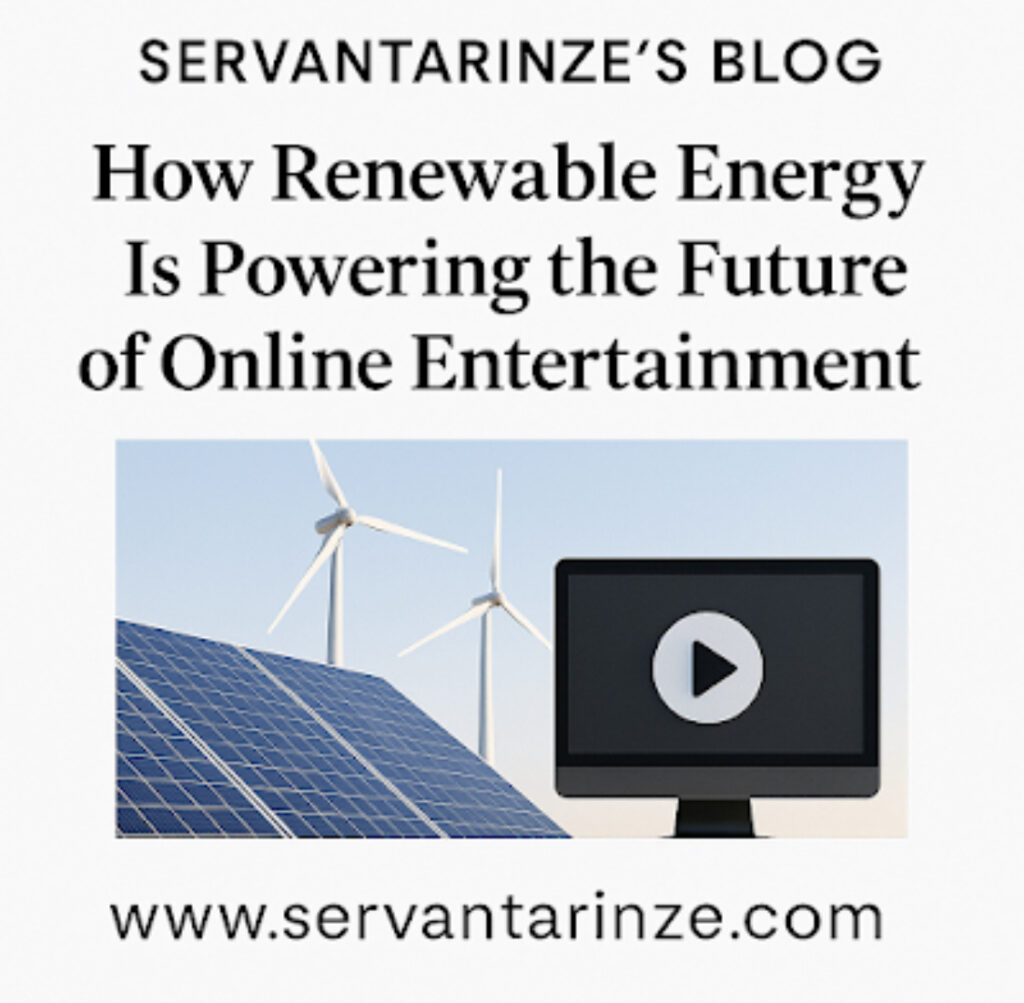
The foundation of green streaming depends on access to clean energy sources that can meet the constant demand of digital services. Solar and wind power are currently the most widely adopted solutions because they scale well and cost far less to operate once installed. Many companies now build data centres directly beside wind farms or solar arrays so energy does not need to travel long distances through the grid. This approach cuts transmission loss, improves reliability, and strengthens long-term sustainability goals.
One of the biggest advantages here is energy independence. Servers powering green streaming operate day and night, and combining solar production with wind generation helps maintain consistency. Solar output peaks during the day, especially in sunny regions, while wind power often performs better at night and in cooler climates. By blending both, streaming platforms can stabilise power in a way traditional fossil sources never matched.
Another advantage is predictability. Renewable energy contracts often secure stable pricing for years, giving green streaming companies a clearer view of future expenses. That predictability becomes a competitive asset when budgeting infrastructure upgrades, expanding to new markets, or supporting new high-demand features such as 8K video streaming or cloud gaming. The more predictable energy becomes, the more confidently companies can innovate.
Cost Savings and Efficiency Benefits of Green Streaming
One of the misconceptions about sustainability is that it is expensive. In reality, once infrastructure is in place, renewable energy delivers some of the lowest operational costs in the energy world. Wind and solar systems have no fuel expenses, and maintenance requirements are lower than those of fossil fuel generators. This makes green streaming financially attractive in addition to environmentally responsible.
Streaming platforms operating with cleaner energy also benefit from incentives, tax credits, and green financing programs, depending on the region. These financial advantages allow platforms to invest more into content acquisition, storage optimisation, and improved video delivery systems. As a result, green streaming becomes a growth enabler—not a financial burden.
Efficiency gains play a major role as well. Many data centres supporting green streaming now use advanced cooling methods, AI-based energy routing, and redesigned server hardware that consumes less electricity while delivering faster processing speeds. With time, these improvements compound. The more efficient the infrastructure becomes, the better the performance and the lower the environmental footprint.
How Green Streaming Uses Cloud Computing and Smarter Networks
Cloud computing is central to how media is stored, processed, and streamed worldwide. Instead of every company owning physical hardware in every region, many services rely on global cloud networks that distribute content intelligently based on demand. Green streaming takes this model further by pairing cloud routing with renewable power availability.
Modern platforms shift workloads based on real-time availability of clean electricity. For example, if a region has a temporary surplus of wind or solar energy, video processing or storage tasks can automatically be redirected there. This approach reduces total carbon emissions without affecting speed or video quality. It also ensures that streaming remains reliable during energy peaks, high-traffic events, or system maintenance.
Compression technology is another part of this evolution. By improving how video files are encoded and delivered, green streaming reduces the amount of data that needs to move through networks. Better compression means less server load, lower bandwidth usage, and reduced energy consumption—without affecting the user’s viewing experience.
Sustainable Production and Post-Processing for Green Streaming
Streaming sustainability does not begin and end with power consumption. The creative process behind film, music, documentaries, interactive media, and gaming also plays a role. Many studios are now applying green streaming principles from the earliest stage of production. This includes using LED panels instead of power-heavy lighting, moving editing workflows to cloud environments powered by cleaner energy, and using digital collaboration tools to reduce travel and logistics waste.
Rendering, colour grading, and motion graphics require significant computing resources, especially in high-end productions. Sustainable studios now use data centres powered by renewables to handle these tasks. Over time, this aligns the full entertainment pipeline with the long-term goals of green streaming: lower emissions, lower waste, and smarter energy usage.
These changes do more than cut electricity use—they shift industry expectations. Creators, developers, publishers, advertisers, and distributors increasingly recognise that a high-quality digital experience can coexist with responsible energy behaviour. Green streaming is slowly becoming a creative standard, not a technical afterthought.
You may like: Green Streaming: 9 Ways Technology Is Becoming More Sustainable
The Growth of Carbon-Neutral Platforms in the Age of Green Streaming
A new generation of platforms is emerging with sustainability at the core of their identity. Instead of transitioning away from fossil-fuel power, these companies were built for green streaming from day one. Their infrastructure, design philosophy, and public messaging reflect a commitment to carbon-neutral operation, efficiency, and environmental responsibility.
Some platforms reduce energy use by simplifying user interfaces, limiting unnecessary autoplay, and optimising mobile streaming to minimise data transfer. Others rely on lightweight site architecture, adaptive resolution systems, and serverless technology that scales energy use only when needed. These decisions prove that green streaming is not only about where energy comes from—it is also about how efficiently a platform consumes that energy.
The rise of these carbon-neutral platforms puts pressure on established giants. When users begin comparing streaming services based on sustainability, companies that lag behind risk losing relevance. What used to be a niche environmental concern is becoming a powerful competitive advantage.
Challenges Slowing the Adoption of Full Green Streaming
Despite strong momentum, the transition to full green streaming faces real-world obstacles. The biggest challenge is energy intermittency. Solar power depends on sunlight. Wind depends on weather. Without advanced storage solutions, supply can fluctuate faster than demand. Battery storage systems are improving rapidly, but they remain expensive and complex to deploy at the scale required for global streaming.
Another barrier is infrastructure inequality. Some regions have well-developed renewable networks and digital grids, while others still rely heavily on traditional fuels. For green streaming to become universal, streaming companies, energy providers, and governments must collaborate to expand renewable access worldwide.
Transparency also remains an issue. Some platforms use broad claims about sustainability without clearly defining how much of their energy actually comes from renewables. Independent reporting, verifiable data, and standardised measurement frameworks will be required to build trust and accountability as green streaming continues to evolve.
The Role of Policy and Regulation in Accelerating Green Streaming
Government action can significantly speed up the shift to clean energy. Many countries now offer tax incentives, subsidies, and grants to support renewable infrastructure, data-centre efficiency upgrades, and cleaner tech deployment. These incentives reduce the financial risk for companies investing in green streaming and encourage long-term planning rather than short-term cost thinking.
Beyond incentives, some regions are introducing stricter regulations requiring large tech companies to report energy usage and emissions data. As these rules expand, green streaming will become less of an optional business strategy and more of an operational requirement. Platforms that transition early will be better positioned for future compliance and innovation.
The combination of public policy, corporate responsibility, and technological progress ensures that green streaming will continue gaining momentum over time—not as a trend, but as the new operating standard for global entertainment.
How Consumers Influence the Future of Green Streaming
The audience plays a bigger role than many realise. Subscription preferences, social media conversations, and buyer expectations influence strategic decisions inside entertainment companies. When users value environmental responsibility, platforms respond. Streaming, gaming, and media companies now track sentiment closely, and sustainability is increasingly seen as part of product quality—not just corporate image.
Viewers also shape demand through their habits. Simple behaviours, such as downloading content for repeated playback instead of streaming it multiple times, choosing optimized streaming settings, or supporting services committed to green streaming, help reduce total energy demand. As these shifts scale across millions of people, the cumulative impact becomes measurable.
This shared responsibility—platforms investing in clean energy and users adopting lighter consumption habits—creates a partnership that strengthens the entire sustainability cycle. In the bigger picture, green streaming becomes a cultural shift, not just a technical upgrade.
Future Innovations That Will Advance Green Streaming
The future of streaming will look very different from what exists today. Technologies such as low-latency 5G networks, edge computing, and decentralised content delivery will reduce the distance data must travel before reaching a screen. The shorter that distance becomes, the less energy is consumed per stream. This positions green streaming as a core pillar of next-generation media delivery.
Artificial intelligence will also help streamline digital energy consumption by automating server scaling, predicting viewer behaviour, and balancing computing loads across renewable-powered regions. As these systems become more sophisticated, they will smoothly connect energy availability and content distribution—making green streaming both smart and adaptive.
Some experimental projects even explore geothermal and kinetic energy sources for media infrastructure. While still early, these approaches highlight how innovation could transform sustainability from a challenge into an advantage for the digital world.
How Green Streaming Shapes the Creator and Platform Ecosystem
Streaming is no longer controlled only by big studios and corporations. Millions of independent creators now upload videos, music, tutorials, documentaries, and live content every day. As these creators depend on hosting platforms and cloud services, the sustainability choices made by these systems indirectly shape their environmental footprint. Green streaming gives creators a way to build influence while supporting climate-aligned digital behaviour.
Brands increasingly collaborate with creators who prioritise sustainability and align with eco-responsible values. A music release celebrated for using renewable-powered editing and cloud rendering, or a documentary processed through cleaner data centres, carries a message larger than content alone. In that sense, green streaming becomes both a technical framework and a cultural movement that extends across the creative economy.
As more creators adopt this mindset, industry values will continue shifting. Green streaming encourages responsibility, transparency, and innovation—qualities that reflect the future of digital entertainment rather than its past.
Global Cooperation and the Future of Green Streaming
No single company or country can transform the streaming industry alone. Partnerships between technology providers, telecom companies, governments, renewable-energy suppliers, and cloud operators are becoming essential. Many corporations are now joining international coalitions focused on adopting cleaner infrastructure, improving reporting standards, and accelerating access to renewables for cloud operations.
Shared research and cross-border technology agreements allow regions with advanced renewable capabilities to support areas still developing their infrastructure. This prevents competitive disadvantages and helps make green streaming a global standard rather than a privilege reserved for a few developed markets.
The more these partnerships expand, the faster the streaming ecosystem can transition to efficient, reliable, and environmentally responsible energy sources. Collaboration ensures that green streaming is not just a trend—it becomes embedded in the way the world delivers entertainment.
Read related: Environmental Streaming: 13 Hidden Truths Behind Your Digital Viewing Habits
The Long-Term Vision for a Fully Sustainable Streaming World
Imagine a world where every stream—every film, playlist, livestream, and interactive experience—is powered entirely by clean energy. In this future, green streaming is no longer discussed as a feature or advantage. It becomes the default foundation of digital entertainment. Platforms will use renewable power as effortlessly as users press play.
That vision is already forming. Renewable power costs are falling, infrastructure is expanding, and awareness is increasing. Innovation continues to shorten the distance between where energy is produced and where content is consumed. As this progress continues, green streaming will become not only feasible but essential to a world where digital consumption keeps rising.
The shift is not only about energy. It is about redefining how technology interacts with the environment—moving from extraction and waste toward balance and accountability. Green streaming is a sign of what is coming next: a digital era capable of growth without sacrificing sustainability.
Final Thoughts
Green streaming signals the beginning of a major transformation inside the entertainment industry. What started as a response to environmental concerns has evolved into a strategic shift affecting infrastructure, innovation, cost management, regulation, and user experience. Clean energy, intelligent routing systems, and efficient production pipelines are reshaping how content is delivered and consumed worldwide.
For viewers, the benefit is simple: entertainment without environmental guilt. For creators and companies, the shift strengthens credibility, reduces long-term risks, and builds a foundation that can scale as demand grows. The more platforms prioritise green streaming, the faster the world moves toward a smarter digital ecosystem powered by renewables instead of fossil fuels.
The movement is already underway. The platforms that embrace green streaming will define the future of entertainment—and the ones that ignore it may eventually be left behind.