
Introduction
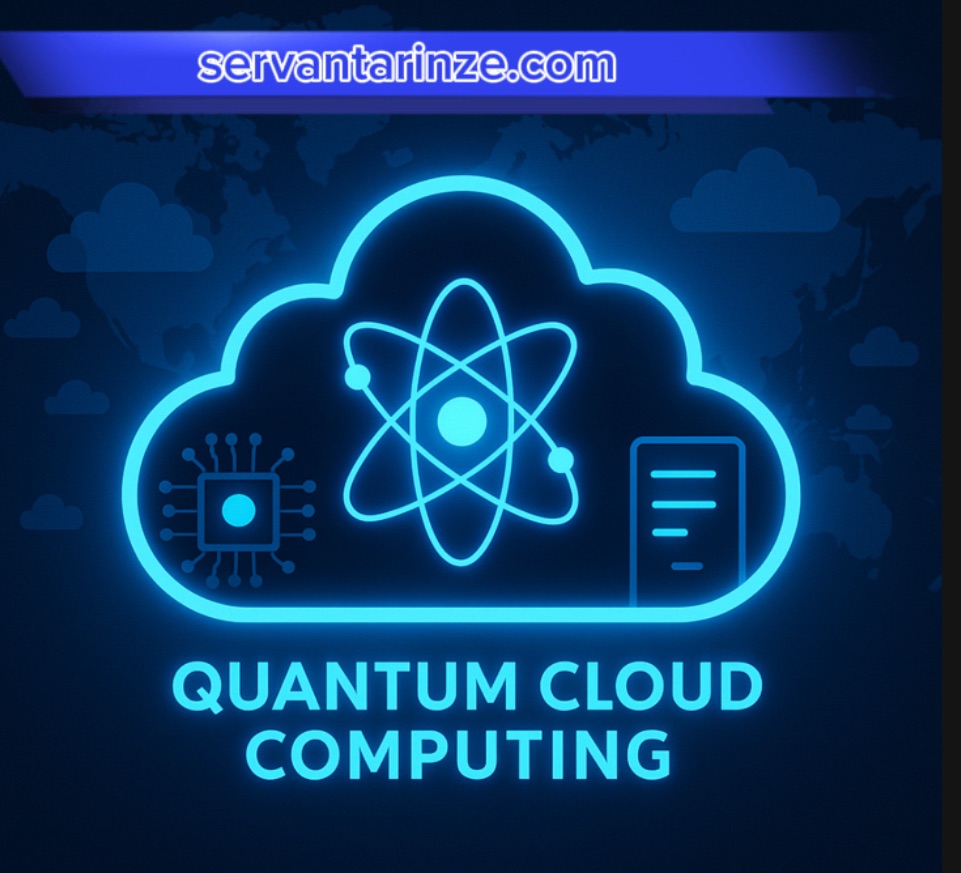
The world is entering a new technological era where Quantum Cloud Computing is becoming the bridge between theory and real-world innovation. For decades, quantum processors lived only inside elite research labs—tightly controlled, expensive, and impossible for ordinary engineers or businesses to access. But the rise of cloud infrastructure has changed everything. Today, anyone with an internet connection can run quantum experiments on real hardware, test quantum algorithms, and explore new computational frontiers without owning a single physical device.
This transformation mirrors what happened when traditional cloud computing emerged. Instead of buying massive servers, companies rented processing power on demand. Now we are witnessing the same shift at a higher level: the cloud is turning quantum processing into a global service. Through platforms like IBM Quantum, Amazon Braket, Microsoft Azure Quantum, and Google Quantum AI, developers can log in, write circuits, and execute programs on machines cooled near absolute zero—machines capable of solving certain problems far beyond classical limits.
This guide explores the future of Quantum Cloud Computing and why it is accelerating the quantum era faster than anyone expected. You will learn how it works, the companies building it, the breakthroughs it enables, and the challenges it must overcome. Most importantly, you will understand how quantum processing delivered through the cloud will shape industries such as AI, cybersecurity, healthcare, logistics, and finance.
Welcome to a future where the universe’s most advanced computing power no longer lives behind laboratory doors—it lives online, available to innovators everywhere.
Understanding Quantum Cloud Computing
To appreciate the impact of Quantum Cloud Computing, you must first understand what it truly represents. At its core, it is a model that allows anyone—developers, researchers, enterprises, or students—to access powerful quantum processors remotely through the internet. Instead of owning a delicate quantum machine maintained at near-absolute-zero temperatures, you simply log into a cloud platform and run your quantum program as easily as running code on a classical server.
This means the heavy lifting—cooling systems, error calibration, qubit stabilization, and maintenance—is handled by the cloud provider. You operate from a normal laptop, while the actual quantum calculations happen inside a specialized facility built to host superconducting or trapped-ion qubits. The cloud abstracts all the complexity, giving you a clean interface to execute quantum circuits on demand.
Quantum Cloud Computing brings together two worlds: the scalability and global reach of traditional cloud services, and the revolutionary computational model of quantum mechanics. Through this fusion, developers can test quantum algorithms for optimization, machine learning, cryptography, chemistry, and simulation without any physical infrastructure of their own.
This democratization is one of the most important aspects of the quantum revolution. In the past, quantum computing progress was limited to a few institutions. Today, thousands of engineers use quantum cloud platforms to build applications, publish research, and develop expertise that will define future industries. The cloud has transformed quantum computing from an exclusive scientific field into an accessible, global innovation environment.
How Quantum Cloud Computing Works
To understand why Quantum Cloud Computing is transforming the tech landscape, it’s important to see how this system operates behind the scenes. Even though users experience it through a simple interface, the execution pipeline is a sophisticated combination of classical servers, advanced middleware, and quantum hardware running in highly controlled environments.
When you write a quantum program using tools like Qiskit, Cirq, or the Braket SDK, your code does not run on your device. Instead, it is packaged and sent over the internet to a cloud data center where the provider hosts various Quantum Processing Units (QPUs). These QPUs may be superconducting qubits, trapped-ion qubits, neutral atoms, photonic qubits, or annealing systems—depending on the company offering the service.
Before the quantum chip even receives your circuit, a powerful layer of middleware translates and optimizes your instructions. This layer restructures the quantum circuit to fit the architecture of the target device, adjusts gate layouts, reduces noise-sensitive operations, and ensures that your program runs effectively on hardware that has limited qubit coherence times.
Once optimized, your quantum circuit is executed on the physical QPU. These devices sit inside deep cryogenic refrigerators, isolated from vibrations, electromagnetic interference, and temperature fluctuations. Qubits are extremely fragile, and even a tiny disturbance can ruin a calculation, which is why the environment is so tightly controlled. After execution, measurement results are sent back to classical servers, processed, and delivered to your local device within seconds.
The true power of Quantum Cloud Computing arises from hybrid execution. In this workflow, classical CPUs and GPUs handle tasks like preprocessing, optimization loops, and machine learning components, while the quantum device performs operations that rely on superposition and entanglement. This hybrid structure forms a continuous feedback loop where classical and quantum systems work together to solve problems more efficiently than either could alone.
This entire pipeline—frontend tools, middleware optimization, and backend hardware—creates a frictionless user experience where anyone can run quantum experiments without specialized knowledge of quantum physics. It is this simplicity and accessibility that make Quantum Cloud Computing an engine of innovation for AI, cybersecurity, chemistry, logistics, climate science, and more.
Recommended for you:
Quantum Hardware Explained for Everyone
Key Industry Players Driving Quantum Cloud Computing
The rise of Quantum Cloud Computing is powered by a small group of global technology leaders who are building the hardware, cloud platforms, and developer tools that make quantum access possible for everyday users. These companies are shaping the future of research, artificial intelligence, cybersecurity, finance, chemistry, and enterprise computing. Understanding who they are—and what each one offers—helps engineers and organizations choose the right platform for their needs.
Below are the industry pioneers leading the charge and defining how quantum services are deployed, scaled, and integrated into real-world systems.
1. IBM Quantum Cloud
IBM remains the most influential force in Quantum Cloud Computing. Through the IBM Quantum Platform, the company offers both free and premium access to real superconducting qubit systems, along with an advanced simulator environment. IBM’s cloud integrates directly with Qiskit, its open-source SDK that has become the foundation for global quantum education and research.
The platform supports hybrid workflows, allowing classical machine learning models to interact with quantum circuits on the cloud. IBM also publishes frequent hardware roadmaps, regularly improving qubit quality, coherence, and error-correction capabilities. With enterprise-level access, IBM continues to set the standard for scalable quantum services.
2. Microsoft Azure Quantum
Microsoft has taken a unique approach by offering a multi-vendor ecosystem within Azure. Instead of relying on a single hardware architecture, Azure Quantum integrates trapped-ion systems from IonQ, topological qubit research from its own labs, neutral atom systems from Quantinuum, and superconducting platforms from Rigetti.
This diversity makes Azure one of the most flexible Quantum Cloud Computing platforms, especially for developers who want to compare performance across different qubit technologies. Azure also provides hybrid orchestration tools that allow classical and quantum code to run seamlessly within the same workflow.
3. Amazon Braket
Amazon Braket focuses heavily on developer accessibility and API-driven design. Built inside AWS, Braket enables users to assemble, optimize, and run quantum circuits on devices from IonQ, Rigetti, and Oxford Quantum Circuits. It includes a high-performance simulator and a managed hybrid execution environment for quantum-enhanced algorithms.
Because Braket is deeply integrated with AWS services like EC2, S3, and SageMaker, it is a natural choice for organizations already building AI or data-heavy applications on Amazon infrastructure. This integration allows teams to embed Quantum Cloud Computing directly into their cloud-native pipelines.
4. Google Quantum AI
Google has contributed groundbreaking research in quantum advantage and fault-tolerant architectures. While its public cloud access is more limited than IBM or Braket, Google’s long-term goal is to deliver error-corrected quantum clusters with millions of stable qubits. The company’s research platform focuses on performance breakthroughs, high-fidelity gates, and qubit stability.
Google’s work is essential because the future of Quantum Cloud Computing depends on scaling beyond noisy intermediate-scale devices. Their progress in error correction serves as a blueprint for the next generation of quantum cloud data centers.
5. Rigetti Quantum Cloud Services
Rigetti is one of the few startups building end-to-end quantum systems, from chip fabrication to cloud platform deployment. Through its quantum cloud services, users can run hybrid quantum–classical programs using Rigetti’s superconducting processors. The company also supports on-premise quantum integration for enterprise clients who need deeper customization and private access.
Rigetti’s modular architecture and strong focus on interoperability make it an important contender in the future of Quantum Cloud Computing, especially as multi-cloud quantum networks become more common.
Each of these players contributes a different strength—whether it’s hardware innovation, cloud scalability, interoperability, or developer tooling. Together, they are accelerating global adoption and building the backbone of the quantum-powered internet of the future.
You may also like:
Top Quantum Algorithms Explained Fast
Benefits and Challenges of Quantum Cloud Computing
As global industries race toward next-generation computing, Quantum Cloud Computing is emerging as one of the most transformative technologies of our time. It brings together the limitless scalability of modern cloud platforms with the revolutionary physics of quantum processors. But like every breakthrough, it comes with both powerful advantages and critical challenges. Understanding these two sides is essential for engineers, researchers, startups, and enterprise leaders preparing for the next decade of innovation.
Major Benefits of Quantum Cloud Computing
1. Global Accessibility & Democratization of Quantum Power
Before cloud access, quantum computers were locked inside elite labs. Today, anyone with a laptop and internet connection can run experiments on real quantum chips. Quantum Cloud Computing removes geographic, financial, and institutional barriers—empowering students, independents, startups, and emerging economies to participate in the quantum revolution.
This shift mirrors the early days of cloud AI: the moment powerful tools become open to everyone, innovation accelerates exponentially.
2. Zero Hardware Ownership Costs
Quantum hardware requires complex cryogenic systems, vibration isolation, electromagnetic shielding, and constant calibration. Such machines cost tens of millions of dollars to build and maintain. Through cloud platforms, users access the same machines without owning them. This eliminates:
- hardware expenses
- maintenance costs
- engineering overhead
- facility and cooling requirements
Cloud providers take care of all infrastructure, allowing developers to focus on algorithms instead of physics.
3. Hybrid Classical–Quantum Workflows
One of the biggest advantages of Quantum Cloud Computing is hybrid integration. Classical CPUs/GPUs handle preprocessing and logic, while QPUs handle probabilistic calculations. This combination is accelerating breakthroughs in:
- drug discovery
- financial modeling
- climate simulation
- logistics optimization
- artificial intelligence
Hybrid workflows allow engineers to build practical quantum-enhanced applications long before large-scale, fault-tolerant devices arrive.
4. Scalable and Constantly Improving Infrastructure
Cloud providers regularly upgrade quantum processors, error rates, gate fidelities, and coherence times. This means users automatically get access to newer and more powerful quantum chips without changing their code. Such “invisible upgrades” allow researchers to push boundaries without worrying about hardware evolution.
5. Rapid Experimentation With Simulators
Cloud platforms offer high-performance simulators for testing algorithms before running them on real quantum processors. This workflow reduces costs, speeds up debugging, and ensures circuits are optimized before consuming expensive QPU time.
Main Challenges of Quantum Cloud Computing
1. Network Latency & Performance Bottlenecks
Quantum workloads often require precise timing. When users interact with remote QPUs, network delays can affect execution time, especially for pulse-level programming. While simulators run locally or in nearby data centers, real QPU access may experience latency that affects experiment sensitivity.
2. Error Rates, Decoherence & Noise
Today’s quantum processors are “noisy intermediate-scale quantum” devices (NISQ). Qubits lose their state within microseconds, operations may misfire, and multi-qubit gates introduce noise. These limitations mean results may vary run-to-run. Cloud platforms work around this with error-mitigation techniques, but the challenge remains central to the technology.
3. Security & Encryption Concerns
Although data transmitted to quantum clouds is encrypted, the future arrival of advanced quantum computers raises concerns about long-term confidentiality. Sensitive workloads—pharmaceuticals, government, health, or financial models—require new layers of protection such as:
- post-quantum cryptography (PQC)
- quantum key distribution (QKD)
- encrypted classical channels
As Quantum Cloud Computing evolves, so must the security frameworks that support it.
4. Lack of Standardization Across Platforms
Every major provider—IBM, Google, Microsoft, Amazon—offers unique SDKs, qubit types, error models, and circuit structures. This fragmentation makes cross-platform development difficult. A circuit optimized for a superconducting QPU may not behave well on a trapped-ion system. Multi-cloud quantum environments will eventually solve this, but today developers must manually adapt workflows.
5. Limited Qubit Counts & Early-Stage Hardware
While cloud access is revolutionary, full-scale fault-tolerant quantum computing is still years away. Today’s processors have limited qubit counts and high error rates. Developers must design algorithms within these constraints. The future will bring larger, more stable quantum clusters—but the current stage requires strategic thinking and creative circuit optimization.
Balancing Opportunity and Reality
Despite its challenges, Quantum Cloud Computing is one of the most promising technological shifts of this century. It allows global access to quantum power, accelerates research, reduces costs, and enables hybrid workflows that were impossible a decade ago. At the same time, users must understand the limitations—noise, security risks, and lack of standardization—so they can design realistic and effective strategies.
The organizations that learn to balance these strengths and weaknesses today will lead the quantum economy tomorrow.
What IBM Research Reveals About Quantum Cloud Progress
According to engineering reports from
IBM Research
, quantum cloud adoption is accelerating globally thanks to improved qubit stability, multi-cloud integration, and new hybrid classical–quantum architectures. Their findings help validate how fast the Quantum Cloud Computing is evolving and why enterprises are investing earlier than expected.
Future Trends in Quantum Cloud Computing
The next decade will define the true potential of Quantum Cloud Computing. As hardware improves and cloud ecosystems mature, quantum services will transition from experimental access to a mainstream technological backbone. What seems futuristic today—error-corrected qubits, quantum clusters, unified hybrid programming—will become part of everyday research, enterprise strategy, and global innovation. Below are the key trends shaping the future of this field, each revealing how quantum power will expand far beyond isolated labs.
1. Rise of Quantum-as-a-Service (QaaS)
Just as cloud computing evolved into Software-as-a-Service and AI-as-a-Service, the next evolution is Quantum-as-a-Service (QaaS). Organizations will pay only for the qubit time they use. This model removes capital costs and allows universities, fintech startups, pharmaceutical labs, and governments to scale quantum experiments instantly without owning hardware. QaaS will make quantum access as normal as renting storage or GPU cycles today.
2. Emergence of Error-Corrected Quantum Clusters
The jump from noisy intermediate-scale quantum devices (NISQ) to fully error-corrected systems will redefine what Quantum Cloud Computing can achieve. Companies like Google, IBM, and Quantinuum are developing architectures that will link thousands—or millions—of stable logical qubits. These error-corrected clusters will allow:
- precise chemical simulation
- breakthrough AI acceleration
- complex optimization at massive scale
- new cryptographic standards
Once these clusters become accessible through the cloud, they will outperform every classical supercomputer in existence.
3. Hybrid Orchestration Across CPU, GPU, and QPU
Future systems will not treat quantum computing as a separate tool—they will integrate CPUs, GPUs, and QPUs inside one seamless workflow. Developers will write a single program where classical machines handle logic, and quantum chips handle probabilistic or combinatorial tasks. This unified model will make Quantum Cloud Computing practical for:
- AI training and optimization
- financial modeling and risk simulation
- drug discovery pipelines
- pathfinding and logistics
Hybrid orchestration will allow teams to solve real-world problems without worrying about which device handles each computation—it will all be automated by the cloud.
4. Growth of Multi-Cloud Quantum Platforms
The future will not belong to one provider. Instead, multi-cloud environments will allow users to access IBM Quantum, Azure Quantum, Amazon Braket, and Google Quantum AI from one unified interface. This multi-cloud model will:
- remove vendor lock-in
- enable cross-platform benchmarking
- improve reliability by offering backup processors
- increase performance flexibility
Just as developers today deploy workloads across AWS, Azure, and Google Cloud, the next generation will orchestrate quantum circuits across global QPU networks.
5. New Security Frameworks Built for Quantum Workloads
Security is becoming central to the evolution of Quantum Cloud Computing. As quantum power grows, both classical and quantum systems require stronger protection. Three critical technologies will dominate this era:
- Post-Quantum Cryptography (PQC) for classical channels
- Quantum Key Distribution (QKD) for high-assurance links
- Encrypted hybrid pipelines for multi-cloud data flows
Governments and enterprises are developing new standards that ensure quantum tasks can run securely even in distributed cloud environments.
6. AI-Enhanced Quantum Development Pipelines
AI models are increasingly being used to design, debug, and optimize quantum circuits. This trend will accelerate. Future quantum development will include:
- AI-generated error mitigation layers
- AI-optimized circuit compilation
- AI-driven qubit layout decisions
- predictive modeling for QPU performance
This combination of AI intelligence and quantum power will create a self-improving ecosystem where circuits become faster, more stable, and more efficient over time.
7. Expansion of Quantum Education and Workforce Development
As Quantum Cloud Computing becomes mainstream, universities and online platforms will expand quantum curricula. This will produce a new generation of developers comfortable with classical-quantum hybrid skills. Expect growth in:
- quantum software engineering
- quantum hardware simulation
- quantum-enhanced AI development
- quantum cybersecurity research
The global demand for quantum-skilled workers will surge dramatically over the next decade.
8. Enterprise Adoption Across High-Value Sectors
Industries that rely on complex modeling will be the earliest large-scale adopters of Quantum Cloud Computing. These include:
- pharmaceuticals
- aerospace
- climate forecasting
- energy optimization
- crypto-asset security
- fintech and risk modeling
Cloud access will enable enterprises to run millions of hybrid simulations without investing in specialized facilities.
9. Toward a Global Quantum Network
The ultimate long-term vision is a worldwide network of interconnected quantum processors—similar to the internet, but built for qubits. This network would enable:
- cross-border quantum collaboration
- global sharing of QPU clusters
- federated quantum AI training
- instant deployment of quantum containers
When this quantum network becomes reality, computing will evolve from a tool into a universal quantum utility available to everyone on Earth.
Real-World Applications of Quantum Cloud Computing
The real value of Quantum Cloud Computing is not in theory—it is in the problems it is already solving across science, industry, national security, and everyday technology. The cloud removes the barriers that once limited quantum research to a handful of elite laboratories. Today, governments, universities, startups, and enterprises can run quantum workloads directly from a browser. Below are the strongest and most transformative real-world applications reshaping entire sectors.
1. Drug Discovery and Molecular Simulation
Drug development often takes 10–15 years because accurately simulating molecules on classical computers is extremely difficult. Proteins, chemical compounds, and biological reactions involve quantum-level interactions that classical hardware cannot fully emulate. With Quantum Cloud Computing, researchers can simulate:
- protein folding structures
- reaction energy levels
- binding affinity between drug molecules and target cells
- molecular stability under different environmental conditions
Pharmaceutical companies using IBM and Azure Quantum have already demonstrated faster molecular modeling, reducing multi-month experiments into hours. This breakthrough speeds up antiviral, antimicrobial, and cancer drug research.
2. Financial Modeling, Risk Analysis, and Portfolio Optimization
Finance is one of the earliest real-world adopters of Quantum Cloud Computing. Banks and investment firms use quantum resources to run:
- Monte-Carlo simulations for pricing derivatives
- fraud detection and anomaly detection in large datasets
- portfolio optimization under uncertainty
- liquidity forecasting and market stress testing
Quantum algorithms accelerate computations that traditionally required supercomputers, allowing traders and analysts to make more accurate decisions with real-time data.
3. Supply Chain Optimization and Logistics Planning
Modern logistics involves thousands of moving parts—trucks, ships, flights, routes, fuel costs, and demand patterns. Classical systems struggle with these “combinatorial explosion” problems. Quantum Cloud Computing allows companies to compute:
- shortest global shipping routes
- optimal warehouse placement
- delivery scheduling under uncertain conditions
- inventory management for high-volume operations
Automotive firms and global logistics companies already use quantum-enhanced solvers to save millions in fuel and time worldwide.
4. Artificial Intelligence and Machine Learning Acceleration
Quantum systems excel at exploring large solution spaces, giving them a natural advantage for certain AI tasks. Through Quantum Cloud Computing, developers now experiment with:
- quantum neural networks (QNNs)
- quantum-enhanced feature selection
- faster optimization of model weights
- quantum-accelerated training for deep learning models
Hybrid AI-quantum pipelines reduce training time and improve accuracy for complex models—especially in reinforcement learning, generative AI, and materials discovery.
5. Climate Modeling and Environmental Forecasting
Climate science requires massive simulation power. Weather patterns, atmospheric chemistry, and ocean behavior involve billions of variables. Quantum Cloud Computing enables faster modeling of:
- long-term temperature changes
- CO₂ absorption patterns
- extreme weather probability analysis
- renewable energy optimization
Governments and research labs use quantum cloud tools to generate more precise forecasts that guide environmental policy and sustainability planning.
6. Cybersecurity and Cryptanalysis
Quantum computing is both a threat and a defense tool. Through the quantum cloud, researchers test:
- post-quantum cryptographic algorithms
- quantum-resistant authentication protocols
- quantum-enhanced threat detection
- secure communication models using QKD
This experimentation is critical as organizations transition to quantum-safe infrastructure in preparation for future quantum attacks.
7. Battery Research and Clean-Energy Innovation
Automotive and energy companies use Quantum Cloud Computing to run precise simulations on:
- lithium-ion stability
- solid-state materials
- fuel-cell chemistry
- next-generation battery performance
Quantum-powered modeling accelerates the creation of safer, longer-lasting, and more sustainable energy solutions.
8. Materials Science and Industrial Engineering
Quantum systems can test material properties at the atomic level—something classical computing cannot do efficiently. Through the cloud, engineers explore:
- high-strength alloys
- carbon-nanotube behaviors
- semiconductor properties
- low-temperature superconductors
These insights lead to stronger structures, faster chips, and more efficient manufacturing processes.
9. National Security, Defense Systems, and Intelligence Analysis
Governments use Quantum Cloud Computing for secure simulation and advanced modeling in:
- satellite optimization
- secure communication networks
- real-time threat detection
- post-quantum defense infrastructure
The quantum cloud reduces the time required to analyze complex security data and supports next-generation national cybersecurity strategies.
Start practicing:
Build Your First Quantum Circuit Online
Final Thoughts
The evolution of Quantum Cloud Computing marks one of the biggest technological turning points of our time. What began as an experimental curiosity locked inside physics laboratories is now becoming a global, on-demand resource accessible through the cloud. This shift is far more than a convenience—it represents the beginning of a new computational era where quantum power is no longer limited by geography, cost, or specialized expertise.
Just as classical cloud computing transformed data storage and software delivery, Quantum Cloud Computing is transforming how humanity solves some of its hardest problems. Researchers can simulate molecules that were previously impossible to model, financial analysts can optimize portfolios at unprecedented scale, AI engineers can explore complex learning landscapes, and industries can accelerate innovation cycles by tapping into quantum processing units from anywhere in the world.
The most powerful aspect of this transformation is accessibility. You no longer need a billion-dollar lab to harness quantum capabilities. Students, developers, startups, and enterprises can run sophisticated algorithms from a laptop. This democratization ensures that groundbreaking discoveries will no longer be limited to elite research hubs—innovation can now emerge from any classroom, any institution, and any country.
As the hardware improves, the cloud will serve as the universal bridge between classical and quantum systems. The next generation of applications—climate simulation, drug discovery, optimization, and advanced AI—will rely on hybrid architecture that blends traditional CPUs with QPUs in seamless workflows. This is where the true potential of Quantum Cloud Computing lies: in unlocking solutions that classical computing alone will never be able to reach.
Looking ahead, we will see:
- multi-cloud quantum networks that allow models to run across IBM, Google, and Amazon simultaneously,
- error-corrected quantum clusters accessible as easily as today’s virtual machines,
- stronger quantum-safe security systems protecting global communication,
- AI-quantum symbiosis shaping the future of intelligent systems.
The organizations and individuals who prepare early—those who learn the tools, experiment with small circuits, and build hybrid workflows—will lead the next wave of scientific and industrial breakthroughs. The quantum revolution will not happen suddenly; it will grow through the people who embrace it now.
In simple terms: Quantum Cloud Computing is not the future of computing—it is the beginning of a new era that has already started. The smartest move you can make is to step into this world now, explore its possibilities, and position yourself at the front of a technological transformation that will redefine innovation for decades to come.
If this guide inspired you, bookmark it, revisit it often, and share it with others who are ready to learn. The quantum era is accelerating—and the cloud is the gateway for everyone.