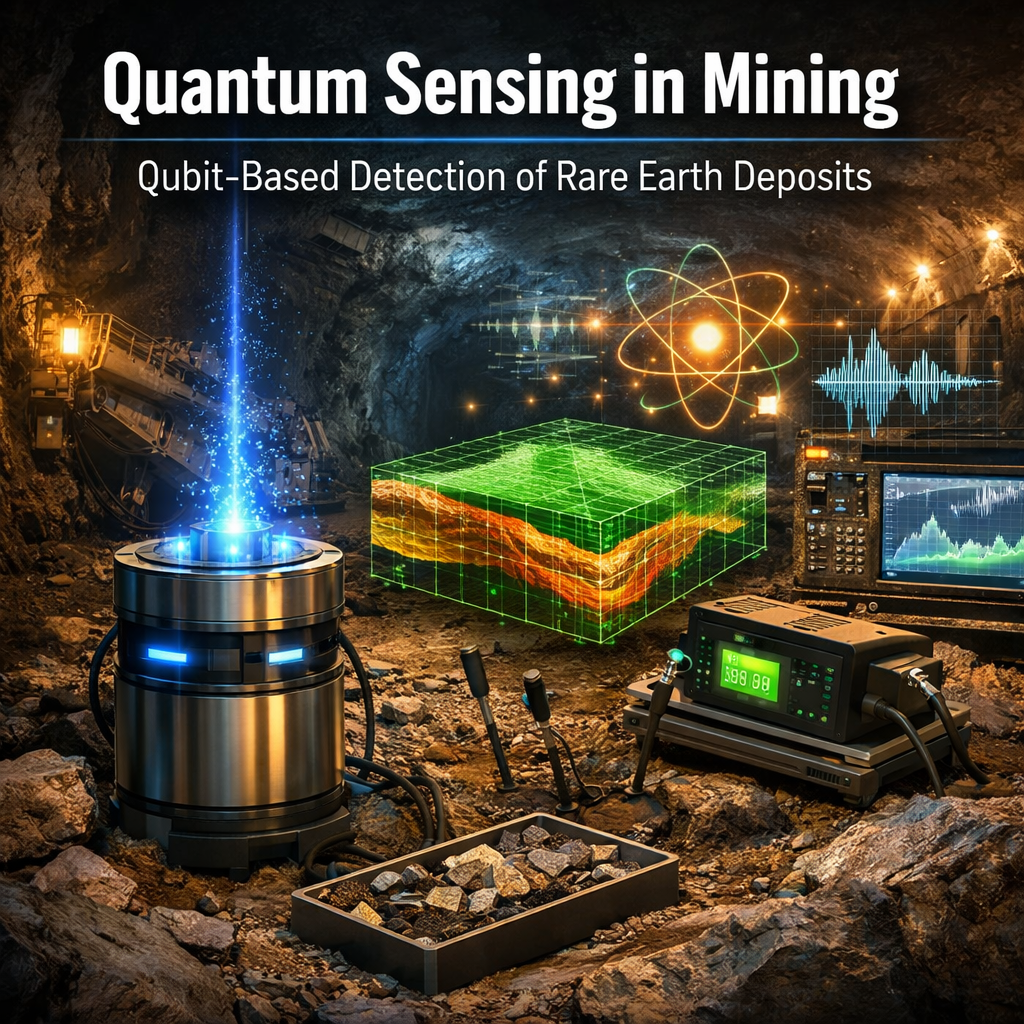

Rare earth mining is strategic, capital-intensive, and often more uncertain than most operators would prefer. The uncertainty starts long before a processing plant is built. It begins in the ground, in the gap between what geologists suspect is there and what a company can prove without spending years drilling, sampling, and discarding targets that never justify the cost. That gap has become more expensive in the past few years because rare earth elements now sit inside several overlapping industrial stories at once: electric vehicles, offshore wind, high-performance magnets, defense systems, advanced electronics, and the broader contest over resilient supply chains.[1] Even the quantum sector depends on materials whose supply is under pressure. The urgency in the market is clear. The exploration problem has not been solved with the same speed.
Conventional exploration still depends heavily on inference. Gravity surveys, magnetics, geochemistry, drilling, metallurgical testing, and ore-body modeling remain indispensable, but each comes with blind spots. A density anomaly can point to something economically irrelevant. A magnetic signal may be muted, noisy, or geologically ambiguous. A promising clay-hosted system may still disappoint once operators discover that the recoverable fraction is lower than laboratory assumptions suggested. In critical minerals, the cost of being wrong is not just financial. It can mean disturbed land, unnecessary water use, repeated mobilization of equipment, and years lost in jurisdictions trying to reduce dependence on concentrated sources of supply.
Editor’s note for accuracy: commercially available quantum gravimeters already exist, and they have moved beyond theory into field deployment. Rare-earth-specific sensing based on qubit platforms, especially at the level of direct in-field selectivity for recoverable fractions, is further behind. The strongest evidence today comes from a combination of mature quantum gravimetry, rapidly advancing quantum magnetometry, and a newer class of mine-site sensing programs that are now being funded and tested in real mineral workflows rather than discussed only in the lab.
That is the context in which quantum sensing has started to attract attention in mining. I do not mean “quantum” in the loose marketing sense that now appears in too many investor decks. I mean sensors that exploit controlled quantum states to measure physical changes at sensitivities that classical instruments struggle to match. In mining, two families matter most. The first uses atomic defects in diamond, especially nitrogen-vacancy centers, as exquisitely sensitive probes of magnetic and chemical environments. The second uses cold atoms in interferometric systems to measure gravity and gravity gradients with extraordinary precision. The practical attraction is not mystique. It is better signal quality, lower drift, stronger calibration behavior, and, in the right settings, a credible path toward fewer blind drilling decisions.
The timing is not accidental. A 2025 review published through the U.S. Department of Energy’s National Energy Technology Laboratory placed quantum gravimeters and quantum magnetometers squarely inside the conversation around resource discovery, while also stressing the unresolved problems that still matter to operators: ruggedization, field deployment, cost, and packaging.[2] Over roughly the same period, governments and industry groups have started backing more targeted mineral-use cases. In Australia, TeraGlo’s funded work on real-time mine-site rare-earth sensing in clay deposits showed how quickly the conversation has shifted from broad technical promise to application-specific instrumentation.[3] In Canada, the National Research Council’s collaboration on quantum-enabled mineral processing made a similar point from another angle: faster identification and sorting of critical minerals is no longer an abstract research theme.[4]
What follows stays tightly on that industrial application. The question is not whether quantum sensing is scientifically elegant. It is whether qubit-based sensing can materially improve the way rare earth deposits are found, interpreted, and processed. There is already enough evidence to take the question seriously, without overstating what the technology can currently deliver. The strongest case today is not that qubits have replaced conventional exploration. It is that they are beginning to change the decision quality around rare earth prospecting and process control in places where classical tools alone leave too much ambiguity.
Why qubits matter once the problem moves underground
Mining decisions are not driven by whether a sensor is quantum. The decision to adopt it is driven by the fact that subsurface information is expensive, incomplete, and often late. The reason qubits enter this discussion at all is that some quantum systems are unusually good at acting as measurement devices. A qubit can be prepared in a controlled state, allowed to interact with an external field, and then read out in a way that converts an otherwise tiny perturbation into usable information. In practice, that means a defect in diamond can register minute magnetic changes, or a cloud of cold atoms can record gravitational differences linked to variations in mass below the surface. The language is quantum, but the commercial logic is geological.
For rare earth exploration, that matters because deposits rarely announce themselves cleanly. Hard-rock systems can carry magnetic signatures tied to associated minerals, alteration halos, or structural settings. Clay-hosted ionic deposits present a different challenge: the economically recoverable fraction may not correspond neatly to bulk chemistry, which is one reason mine-site sensing has become such a live issue in Australia. A sensor that improves the quality of magnetic mapping, density interpretation, or near-real-time process feedback changes the economics before any dramatic discovery headline appears. That is often where value begins to emerge.
The cold-atom side of the field is currently the more mature branch for subsurface work. Quantum gravimeters and gradiometers can reach sub-10-9 m/s2 sensitivity by using atomic interferometry with cold atom qubits, and they highlight the ability to self-calibrate without the drift-estimation burden that complicates many classical systems.[2]
The diamond side of the story is different, and in some ways more subtle. Nitrogen-vacancy centers are atomic-scale defects in diamond lattice structures whose electron spins can be initialized and read optically. Their appeal in mining comes from sensitivity. The same NETL review points to magnetic-field sensitivity down to femtotesla per root hertz levels [2] across quantum magnetometer platforms that include NV centers. That level of sensitivity does not translate directly into rare-earth identification, and the distinction needs to be stated clearly or the article loses credibility. NV-based sensing can be highly useful for detecting magnetic changes and, in chemical settings, for trace metal-ion measurements, but selectivity depends on how the surface is engineered and what exactly is being measured.
That caveat is not a weakness in the technology so much as a reminder that subsurface mining problems come in layers. A gravity anomaly is not a deposit. A magnetic anomaly is not grade. A chemical signal is not recoverable value unless it aligns with mineralogy and processing behavior. The interesting thing about qubit-based sensing is that it narrows uncertainty in those layers rather than pretending to collapse them into one perfect answer. That is why the most convincing industrial strategies are hybrid strategies, not replacement fantasies.
There is another reason the mining industry is paying attention now rather than five years ago. The conversation around quantum sensing has become more industrial and less ceremonial. Recent industry analysis has emphasized a point many people in mining already sensed intuitively: quantum sensing is likely to reach practical commercial relevance before full-scale fault-tolerant quantum computing does.[5] In other words, the mine site may see useful quantum instrumentation before most executives ever encounter a meaningful business use case for a universal quantum computer. That ordering matters because it makes the subject less speculative and more operational.
One technical point deserves emphasis before the article moves deeper into applications. When researchers discuss nanomolar detection of economically relevant metal ions using NV-based methods, they are usually describing controlled sensing environments in which spin relaxometry, photoluminescence, or optically detected magnetic resonance are paired with careful surface functionalization. That is not the same thing as waving a handheld qubit device over a rock face and getting perfect elemental readout. The implication for mining is still important. It means quantum sensing has a plausible role not only in exploration geophysics but also in ore characterization and process monitoring, especially where real-time information about low-concentration species could alter recovery decisions.
That is the real opening in rare earth mining. The sector does not need science fiction. It needs better ways to distinguish signal from noise, recoverable material from background material, and economically meaningful anomalies from expensive distractions. Qubit-based sensing is starting to earn attention because it speaks directly to that problem.
From laboratory qubits to field instruments: what actually gets measured
Once the discussion moves past headlines, the technical differences between sensing approaches start to matter in a very practical way. Mining teams are not choosing between abstract “quantum” options; they are deciding which physical quantity is worth measuring more precisely and how that precision translates into fewer mistakes in the field. In the current landscape, two measurement pathways carry most of the weight: magnetic response and gravitational response. Each traces a different aspect of the subsurface, and each interacts with rare earth systems in ways that are useful but not always straightforward.
Diamond-based sensors built on nitrogen-vacancy centers approach the problem from the magnetic and chemical side. An NV center behaves like a tiny quantum system embedded in a crystal lattice. When illuminated and manipulated with microwaves, its spin state shifts in response to local magnetic fields or, in certain configurations, nearby paramagnetic species. Those shifts can be read optically, translating minute environmental changes into measurable signals. The attraction for mining lies in the sensitivity. Laboratory demonstrations and consolidated reviews report performance in the femtotesla-per-root-hertz range for quantum magnetometers, which places them well beyond the threshold needed to resolve subtle variations associated with mineralized systems under the right conditions.
That does not mean a direct readout of rare earth content from a rock surface. The relationship is mediated. Rare earth elements often occur alongside minerals that influence magnetic properties, and in some cases the ions themselves contribute paramagnetic behavior that can be probed with carefully engineered sensing surfaces. The practical work happens in how the sensor is tuned and how the measurement is interpreted. Researchers have explored functionalization strategies that allow NV centers to interact selectively with specific ions in solution, achieving trace-level detection that can reach nanomolar regimes in controlled environments. The implication for mining is clearest at the process stage, where slurry streams, leach solutions, or tailings could be monitored in near real time for changes that would otherwise require laboratory assays.
The gravitational pathway looks very different because it does not rely on electromagnetic interactions at all. Cold-atom gravimeters and gradiometers operate by splitting and recombining matter waves, using the interference pattern to infer how gravity has affected the atomic trajectories. The underlying physics is delicate, but the field implication is simple enough to state: density contrasts below the surface can be mapped with higher precision and greater stability than many classical systems can deliver. The NETL assessment points to sub-10-9 m/s2 sensitivity, a level that begins to matter when trying to distinguish between geological features that would otherwise blur together in standard surveys.
Rare earth deposits do not always present as clean, high-contrast targets. Carbonatites, ion-adsorption clays, and complex alteration zones can all host economically relevant material, but their density signatures can be modest and easily masked by surrounding geology. A gravimeter that holds calibration over long surveys and reduces drift-related uncertainty has a different value profile from one that merely increases nominal sensitivity. That is part of the reason cold-atom systems have attracted early attention from companies working on subsurface mapping in challenging terrains. The benefit is not only resolution; it is the reliability of the measurement over time.
There is a tendency to treat these sensing modes as competing technologies, but the more credible industrial strategies treat them as complementary layers. Gravity highlights where mass is distributed in a way that warrants attention. Magnetometry refines the interpretation by adding information about mineralogical context. Chemical sensing, whether quantum-enabled or not, helps determine whether the material of interest is actually present in recoverable form. When qubit-based systems enter that chain, they tend to strengthen specific links rather than replace the chain itself.
Rare earth systems are difficult targets for a reason
It is worth pausing on why rare earth exploration remains difficult even with decades of geophysical experience behind it. The challenge is not simply that deposits are hidden. It is that economically meaningful concentrations are often subtle, spatially variable, and dependent on factors that do not map cleanly onto bulk measurements. In clay-hosted deposits, for example, the fraction of ions that can be recovered through ion-exchange processes may vary across short distances, even when bulk concentrations appear similar. In hard-rock systems, the presence of accessory minerals and alteration patterns complicates the magnetic and density signatures that geophysicists rely on.
This is where incremental improvements in sensing can have outsized effects. A survey that reduces ambiguity in a marginal target may prevent a drilling campaign that would otherwise consume months and significant capital. A process sensor that identifies changes in leach chemistry in real time may improve recovery rates in material that would have been treated as uniform. These are not headline-grabbing breakthroughs, but they accumulate into meaningful operational differences. It is also why many of the most serious efforts in quantum sensing are framed around integration with existing workflows rather than wholesale replacement.
The funding decisions made in 2026 reflect that pragmatic approach. In Australia, support for TeraGlo’s development of a real-time sensing system for rare earth elements in clay deposits has been tied directly to mine-site use, not abstract demonstration. The system itself relies on advanced photonic techniques, including up-conversion fluorescence, rather than pure spin-qubit sensing. That distinction matters, but it does not weaken the broader point. The industry is willing to invest in quantum-adjacent technologies when they promise to reduce uncertainty in specific stages of the mining process. The language around that program has been careful, describing an advanced development effort with direct application to REE morphology and speciation at mine sites, rather than a finished commercial product ready for global deployment.
A similar pattern appears in Canada, where work supported by the National Research Council has focused on accelerating the identification and processing of critical minerals using quantum light sources. The emphasis there is not on replacing geological interpretation but on improving the speed and selectivity of downstream analysis, which can influence how ore is sorted and processed. The published account of that work highlights the role of photonic techniques in differentiating materials that are otherwise difficult to separate efficiently. Again, the practical value sits in reducing uncertainty at a stage where small improvements translate into measurable gains.
Field trials in gravimetry reinforce the same pattern from a different angle. Companies working with cold-atom systems have reported improved detection of buried features in comparison with classical surveys, with some analyses suggesting gains in the range of one and a half to two times for certain targets. Those figures should be read carefully. They are context-dependent, tied to specific geological settings and survey designs. What they indicate, however, is that the technology is moving beyond theoretical benchmarks and into comparative field performance, which is the threshold that matters for adoption decisions [5].
One point often overlooked in early discussions is the role of data interpretation. Higher sensitivity does not eliminate ambiguity if the underlying geological model is incomplete. In practice, quantum sensing tends to shift the burden toward better data integration rather than removing it. The signals are cleaner, but they still require context. That is why several partnerships in the sector combine sensing hardware with advanced data analytics, including machine learning approaches that help reconcile gravity, magnetic, and geochemical data into coherent models. The sensor alone does not close the loop. The interpretation framework matters just as much.
That interplay between measurement and interpretation is likely to define how quickly qubit-based sensing becomes routine in mining. The hardware is advancing, but its value depends on how effectively it is embedded in decision-making processes that already exist. In rare earth exploration and processing, where uncertainty carries both financial and environmental consequences, even incremental improvements in that loop are attracting attention.
Where the instruments meet the ground: exploration, sorting, and process control
In practice, the value of any sensing technology in mining is measured less by its theoretical ceiling and more by how it behaves across an entire project cycle. Exploration, delineation, extraction, and processing each impose different constraints. What has become clear over the past two years is that qubit-based sensing does not enter the industry as a single-use tool. It appears at multiple points, sometimes quietly, often in combination with existing systems that crews already trust.
During early-stage exploration, the gravitational pathway has taken the lead. Cold-atom gravimeters are now being deployed in field campaigns where density contrasts are subtle and conventional instruments struggle with drift or recalibration intervals. The appeal is not simply improved sensitivity. It is the stability of the measurement across long surveys. In terrains where logistics are difficult and repeat passes are costly, the ability to hold a reliable baseline reduces uncertainty in a way that directly affects decision-making. Teams working in prospective rare earth regions have started using these systems alongside classical surveys, not as replacements but as a second lens that either confirms or questions what initial data suggests.
Several field programs have reported improved detection of buried features when cold-atom instruments are used in combination with standard gravity surveys. The magnitude of improvement varies with geology and survey design, but internal comparisons have indicated that certain targets become easier to resolve when drift and noise are reduced. Those observations align with broader industry reporting, including analyses discussed by industry-focused publications tracking quantum sensing deployments, which have pointed to measurable gains in subsurface mapping when quantum gravimetry is integrated into survey workflows.
Magnetometry follows a different trajectory because it interacts more directly with mineralogical context. In rare earth systems, magnetic signatures can be influenced by associated minerals, alteration zones, and structural features that are not always obvious in bulk surveys. NV-based magnetometers, when properly configured, can pick up subtle variations that refine those interpretations. The challenge is not sensitivity; it is interpretation. The signal must be tied to geological meaning. In that sense, quantum magnetometry behaves less like a standalone discovery tool and more like an instrument that sharpens the resolution of existing models.
The most immediate impact of quantum-enabled sensing may not come from exploration at all. It is increasingly visible in process environments where information arrives too late to influence decisions. Rare earth extraction, particularly from clay-hosted systems, depends on understanding how ions behave during leaching and separation. Traditional assays introduce delays. By the time results are available, material has already moved through the system. That is the gap that newer sensing approaches are trying to close.
In Australia, the funded work around TeraGlo’s mine-site sensing program illustrates how that shift is taking shape. The system being developed does not rely purely on spin qubits, but it draws on quantum photonics principles to detect rare earth elements in real time within operational environments. The public description of the project points to capabilities in morphology and speciation analysis, both of which are central to understanding how material behaves during processing. The significance is not that it replaces laboratory testing. It is that it introduces a layer of feedback that can alter decisions while the process is still running.
Canada’s approach offers a parallel example from a different angle. Work supported by the National Research Council has focused on quantum-enabled methods for accelerating mineral identification and sorting. The emphasis is on differentiating materials that are otherwise difficult to separate efficiently, a problem that directly affects recovery rates. The reported outcomes of that work suggest that photonic techniques can improve selectivity in ways that reduce processing inefficiencies. Again, the benefit appears not as a dramatic replacement of existing systems but as an improvement in the precision and timing of information.
What ties these efforts together is the movement toward real-time or near-real-time sensing. In exploration, that translates into better-informed decisions about where to drill or where to stop drilling. In processing, it translates into adjustments that can be made before material is lost to tailings or diluted in bulk streams. The economic implications follow directly from that shift. A sensor that reduces uncertainty early in the chain has a different value profile from one that confirms what is already known at the end.
There is also a quieter development underway in how sensing data is combined. Partnerships between sensing companies and data analytics firms have started to produce integrated models where gravity, magnetic, and chemical signals are processed together rather than in isolation. The logic is straightforward. Each dataset carries partial information. When combined, the overlap can reduce ambiguity. In rare earth exploration, where deposits rarely present as clean signals, that integration can make the difference between a marginal target and a viable one.
Projects involving companies such as Atomionics, Nomad Atomics, and exploration platforms working with distributed sensor networks reflect that direction. Their work often pairs quantum sensing hardware with advanced interpretation frameworks, sometimes incorporating machine learning to reconcile multiple data streams. The hardware alone does not deliver a decision. It contributes to a system that does. That distinction has become clearer as field deployments have expanded beyond controlled demonstrations into operational settings where data must support real choices under time and cost pressure.
The pattern that emerges from these applications is not one of sudden transformation. It is a gradual tightening of uncertainty at points where uncertainty has always been expensive. Quantum sensing, in its current form, fits into mining as a set of instruments that make certain measurements better and certain decisions more informed. That may not sound dramatic, but in an industry where margins are shaped by cumulative small gains, it is often enough to change how projects are evaluated.
Why rare earth exploration is becoming a data problem, not just a geology problem
Over the past few years, there has been a shift in how exploration teams think about rare earth deposits. It is no longer enough to identify where minerals might exist. The harder question is how to interpret incomplete, overlapping, and sometimes contradictory signals in a way that leads to reliable decisions. In that sense, rare earth exploration is starting to resemble a data problem as much as a geological one.
This is not a theoretical observation. Teams working on complex deposits have been dealing with it for years. Gravity surveys suggest one structure, magnetic data points to another, and geochemical samples introduce a third layer of uncertainty. None of these datasets are wrong. They are simply partial. The difficulty lies in combining them into a model that is coherent enough to justify drilling or investment. That is where the limits of conventional workflows begin to show.
Quantum sensing enters this picture not as a replacement for geology but as an additional source of high-quality data that can tighten those models. A gravimeter that reduces drift changes how density variations are interpreted across a survey grid. A magnetometer with higher sensitivity can reveal features that were previously masked by noise. In isolation, these improvements may seem incremental. In combination, they shift how confident a team can be about what lies below the surface.
The more interesting change is what happens after the data is collected. Exploration is increasingly tied to how well information can be integrated rather than how much of it exists. This is why several recent projects have paired sensing systems with advanced interpretation frameworks, including machine learning models designed to reconcile multiple geophysical and geochemical inputs. The sensor becomes part of a broader system rather than a standalone instrument.
Rare earth deposits amplify this challenge because economically meaningful signals are often subtle. A small variation in ion distribution or mineral association can determine whether material is recoverable at scale. That level of detail is difficult to capture with any single method. It requires layering information until uncertainty narrows to a point where decisions can be made with reasonable confidence.
Seen from that perspective, the value of qubit-based sensing is not limited to sensitivity. It lies in how it contributes to a more complete dataset, one that can be integrated with other measurements to produce a clearer picture of the subsurface and the material being processed. The shift is gradual, but it changes how exploration risk is managed. The focus moves from collecting more data to collecting better data and using it more effectively.
How the numbers compare when decisions depend on them
The discussion ultimately comes down to performance. Mining decisions are not made on the elegance of a sensing method but on how it compares with what is already available. Classical gravity meters, SQUID magnetometers, and geochemical assays have decades of operational history behind them. They are not easily displaced. What qubit-based systems introduce is a shift in certain performance boundaries, particularly around sensitivity, stability, and how measurements behave over time in the field.
The most meaningful comparisons are not absolute. They depend on terrain, deposit type, survey design, and how data is interpreted alongside other datasets. Even so, a pattern has begun to emerge across field trials and technical reviews. Cold-atom gravimeters tend to offer improved stability and reduced drift relative to many classical instruments, while quantum magnetometry platforms can extend sensitivity into regimes that were previously difficult to access outside controlled environments. Those improvements do not eliminate the need for conventional methods, but they can change how results are weighted when multiple datasets point in different directions.
To make that comparison more concrete, it helps to look at how key parameters line up across sensing approaches as they are currently deployed or tested in mining-related contexts.
| Parameter | Classical Sensing (Gravity, Magnetic, Assay) | Qubit-Based / Quantum Sensing |
|---|---|---|
| Sensitivity | High, but often limited by noise and instrument drift | Extremely high (e.g., femtotesla magnetic sensitivity, sub-10-9 m/s2 gravity) |
| Drift / Stability | Requires periodic recalibration; drift can affect long surveys | Intrinsic self-calibration properties in cold-atom systems reduce drift impact |
| Depth Penetration | Effective, but resolution decreases with depth | Comparable penetration; improved resolution for subtle density contrasts |
| Trace Detection (REE) | Requires lab assays; delays in results | Potential for near real-time detection (nanomolar regimes in controlled setups) |
| Operational Speed | Dependent on survey cycles and lab turnaround | Faster feedback loops in both exploration and processing contexts |
| Environmental Footprint | Higher when repeated drilling or extended surveys are required | Potential reduction due to fewer unnecessary drilling campaigns |
| Cost per Survey | Lower upfront but can escalate with repeated campaigns | Higher initial cost; potential savings through improved targeting |
The numbers in isolation do not tell the full story, but they highlight where the differences begin to matter. Improved sensitivity without stability is of limited use in field conditions. Reduced drift without interpretability does not help decision-making. The advantage of qubit-based systems is that they tend to address both at once, although not perfectly and not in every context.
One comparison that often comes up is with superconducting quantum interference devices, or SQUIDs, which have long been considered among the most sensitive magnetic sensors available. SQUIDs remain powerful tools, and in many cases they are still the benchmark for magnetic measurements. The distinction is not that NV-based systems universally outperform them. It is that diamond-based sensors can operate in environments and configurations where cryogenic requirements or operational constraints make SQUID deployment less practical. Portability and operational flexibility begin to shift the balance in certain field scenarios.
The same nuance applies to gravimetry. Classical instruments have improved significantly over time, and in many settings they provide reliable data at acceptable cost. Cold-atom systems introduce a different calibration profile and, in some cases, improved resolution for subtle features. The advantage is situational. In high-noise environments or long-duration surveys, the reduced drift can be more valuable than incremental gains in nominal sensitivity.
Field reports suggesting improved detection of buried features, sometimes described as increases on the order of one and a half to two times in specific scenarios, should be read in that context. They do not imply a universal doubling of performance. They reflect conditions where reduced noise and better stability allow weaker signals to be interpreted with greater confidence. That distinction is important because it aligns expectations with what operators actually experience when deploying new instruments.
Interpretation note: improvements reported in field trials are highly dependent on geology, survey design, and data integration. Quantum sensing enhances measurement quality, but it does not remove the need for geological interpretation or complementary datasets.
Cost is the other dimension that shapes adoption. Quantum sensing systems are still relatively expensive compared to established tools, particularly when viewed as standalone purchases. The calculation changes when they are evaluated as part of a broader exploration or processing strategy. If improved sensing reduces the number of unsuccessful drill targets or increases recovery rates in marginal material, the return on investment can emerge indirectly rather than through immediate cost comparisons. That dynamic is familiar in mining, where technologies often justify themselves through avoided losses rather than direct savings.
There is also a strategic layer that does not always appear in performance tables. Governments and companies concerned with securing access to critical minerals are beginning to treat sensing capability as part of a larger competitive landscape. Better information about subsurface resources and processing behavior can influence not only project economics but also national supply strategies. In that sense, the adoption of qubit-based sensing technologies is tied to broader shifts in how rare earth resources are valued and managed.
The comparison, then, is not a simple contest between old and new instruments. It is a gradual rebalancing of how different tools contribute to understanding the subsurface and the materials extracted from it. Quantum sensing earns its place when it reduces uncertainty in ways that existing methods cannot, or when it delivers information at a time when that information can still influence decisions. Those are the conditions under which it is starting to move from experimental deployments into operational consideration.
Where the economics start to shift
The financial argument for better sensing in mining rarely appears as a single line item. It shows up in what does not happen. A drilling program that stops earlier than planned because targets have been ruled out with higher confidence. A deposit that moves forward because uncertainty has been reduced enough for investors to commit. A processing line that recovers a few percentage points more material from ore that would otherwise have been treated as marginal. These are small differences in isolation, but they accumulate across a project lifecycle in ways that change the underlying economics.
Rare earth projects are particularly sensitive to that accumulation because margins depend on a chain of decisions rather than a single discovery moment. Exploration risk, metallurgical complexity, and market volatility all intersect. In that environment, a sensing method that improves decision quality early in the chain has disproportionate value. Cold-atom gravimetry, when it reduces ambiguity in subsurface mapping, can narrow the range of plausible geological models. That does not guarantee success, but it shifts probability in a way that matters for capital allocation. Investors respond to uncertainty as much as to resource size, and any tool that reduces the former can influence how projects are financed.
Process-stage sensing follows a similar logic but operates on shorter timescales. In clay-hosted rare earth systems, recovery depends on how ions behave during extraction. Variability in that behavior can translate directly into lost material if it is not detected in time. Real-time or near-real-time sensing introduces the possibility of adjusting parameters while the process is still active. The economic impact is not always visible as a headline figure. It appears in incremental recovery improvements, reduced reagent use, and more stable output quality. Over the life of a project, those increments can be significant.
The funding decisions seen in 2026 reflect an awareness of that dynamic. Programs supporting mine-site sensing are not framed as experimental curiosities. They are tied to operational outcomes. The Australian backing of TeraGlo’s work, for example, is explicitly connected to improving how rare earth elements are identified and characterized during extraction, with the expectation that better information leads to better recovery and lower waste. The public details of that funding make it clear that the objective is practical: to bring sensing closer to the point where decisions are made, rather than leaving it confined to laboratory analysis.
There is also a cost dimension that runs in the opposite direction. Quantum sensing systems are not inexpensive, particularly in their current form. Early deployments often require specialized support, and integration with existing workflows can introduce additional expense. The economic case therefore depends on scale and context. In large projects where exploration budgets run into tens or hundreds of millions of dollars, even modest reductions in uncertainty can justify the investment. In smaller operations, the threshold for adoption may be higher until costs decrease or service-based models become more common.
Environmental pressure is changing the value of information
The environmental argument for improved sensing is less abstract than it once was. Exploration and extraction leave physical traces, and in many jurisdictions those traces are subject to increasing scrutiny. Land disturbance, water use, and energy consumption are not externalities that can be ignored indefinitely. They are part of the project equation from the beginning. Better information about where to focus activity and how to manage material once it is extracted has direct environmental implications.
One of the simplest ways to understand that impact is to look at drilling. Each unnecessary drill hole represents energy, equipment mobilization, and ground disturbance that did not need to occur. If improved sensing reduces the number of targets that proceed to drilling without sufficient justification, the environmental footprint of exploration decreases. The effect may be incremental on a per-project basis, but across multiple projects it becomes meaningful. The same logic applies to repeated survey campaigns that are conducted because initial data was inconclusive.
Processing introduces another layer. Rare earth extraction can involve chemical treatments that generate waste streams requiring careful management. If sensing technologies provide earlier or more precise information about material composition, operators can adjust processes to minimize waste or improve recovery efficiency. That does not eliminate environmental impact, but it can reduce its intensity. In regions where water use and waste disposal are tightly regulated, such improvements carry regulatory as well as operational significance.
There is a tendency to frame environmental benefits in broad terms, but the more convincing case is built from specific mechanisms. Reduced drilling, fewer repeat surveys, improved recovery rates, and more efficient processing all contribute in measurable ways. Quantum sensing does not solve environmental challenges on its own. It changes the information available to those making decisions that have environmental consequences.
Strategic implications go beyond individual projects
Rare earth elements occupy a position in global supply chains that extends beyond mining economics. They are inputs into technologies that governments consider critical, from energy systems to defense applications. Concentration of supply in a limited number of regions has been a recurring concern, particularly for countries seeking to reduce exposure to geopolitical risk. In that context, exploration and processing capabilities are not purely commercial assets. They are part of a broader strategic landscape.
Improved sensing contributes to that landscape by altering how resources are identified and developed. If countries can locate and evaluate deposits with greater confidence, the barrier to developing domestic or allied sources of supply decreases. That does not guarantee that projects will proceed, but it changes the feasibility calculation. The same applies to processing, where better information can make lower-grade or more complex deposits economically viable under conditions where they might otherwise be overlooked.
The Canadian initiatives around quantum-enabled mineral identification and processing illustrate how sensing technologies are being considered within this broader framework. The emphasis on accelerating critical mineral workflows, as described in official accounts of the program, aligns with a strategic interest in securing supply chains rather than relying solely on external sources. Similar considerations appear in other jurisdictions, where investment in sensing and processing technologies is linked to long-term resource strategy.
It would be an overstatement to suggest that quantum sensing alone will reshape global supply dynamics. The development of new mines, the expansion of processing capacity, and the evolution of market demand all play larger roles. What sensing technologies can do is reduce uncertainty at critical points in that system. When uncertainty decreases, decisions can be made with greater confidence, and projects that might have stalled can move forward under clearer assumptions.
The strategic value of that shift is not always visible in short-term metrics. It appears over longer horizons, where the cumulative effect of better information influences how resources are developed and how supply chains evolve. In that sense, the adoption of qubit-based sensing technologies in mining is tied not only to immediate operational gains but also to broader questions about how critical materials are sourced and managed in a changing global landscape.
Where the limits still hold—and what needs to change
For all the attention quantum sensing has attracted, the constraints are not difficult to find once the conversation moves out of controlled environments and into working mines. The first is physical robustness. Instruments that rely on carefully prepared quantum states are, by definition, sensitive. Translating that sensitivity into a device that can operate reliably in variable temperatures, vibration-heavy environments, and remote locations remains an ongoing engineering effort. Progress has been steady, but it is not complete. Field-ready systems exist, particularly in gravimetry, yet they still require a level of handling and operational awareness that differs from many legacy tools.
Cost follows closely behind. Early-stage quantum sensing systems carry development costs that have not yet been fully amortized across large production volumes. That affects both purchase price and the support required to deploy and maintain them. In large-scale exploration programs, the economics can still work because the cost of uncertainty is high. In smaller operations, adoption is likely to lag until systems become more standardized or are offered through service models that distribute cost across multiple users.
There is also a question of integration. Mining workflows are built around established data streams and decision frameworks. Introducing a new sensing modality requires more than inserting a device into the field. It involves aligning outputs with existing interpretation models, training personnel, and in some cases rethinking how decisions are made. The value of improved sensitivity is limited if the resulting data cannot be incorporated into a coherent geological or process model. That is one reason partnerships between sensing developers and data analytics groups have become more common. The hardware and the interpretation layer have to evolve together.
On the technical side, limitations specific to each sensing approach remain relevant. Cold-atom gravimeters, while advanced, are not immune to environmental influences and still require careful deployment to achieve their full potential. NV-based sensing, particularly for chemical detection, depends on surface engineering and measurement protocols that are still being refined for field conditions. The distinction between detecting a signal in a controlled laboratory environment and doing so in a complex, noisy industrial setting should not be understated. It is being addressed, but it has not disappeared.
Another constraint sits at the level of standards and regulation. As quantum sensing data begins to influence decisions with financial and environmental implications, questions about validation, reproducibility, and reporting will become more prominent. Mining already operates within frameworks that govern how resources are estimated and reported. Integrating new types of data into those frameworks will require both technical validation and regulatory acceptance. That process tends to move more slowly than technological development, which can create a gap between what is possible and what is formally recognized.
How the next few years are likely to unfold
The trajectory from here is unlikely to follow a single path. Different sensing approaches will mature at different rates, and their adoption will depend on how well they align with specific mining challenges. Cold-atom gravimetry is already closer to routine deployment, and its use in subsurface mapping is likely to expand as systems become more portable and easier to integrate into standard survey workflows. NV-based sensing, particularly for chemical and trace detection, is moving from laboratory demonstrations toward field trials, with the expectation that hybrid systems combining quantum sensitivity with robust engineering will emerge over the next several years.
One development that is already taking shape is the combination of sensing hardware with advanced data interpretation methods. Machine learning and data fusion techniques are being applied to reconcile information from gravity, magnetic, and chemical measurements into unified models. The goal is not to replace geological expertise but to support it with tools that can handle the complexity of multi-dimensional datasets. In rare earth exploration, where signals are often subtle and overlapping, that integration can be as important as the sensitivity of the sensors themselves.
Another direction involves deployment models. Rather than relying solely on ground-based surveys, there is growing interest in distributing sensing capability across mobile platforms, including drones and autonomous vehicles. The idea is to collect higher-resolution data over larger areas with less manual intervention. Quantum sensing systems are not yet universally suited to such deployments, but ongoing work suggests that miniaturization and improved robustness could make them viable in more flexible configurations. If that happens, the scale at which data can be collected and updated may change significantly.
Timelines are often treated cautiously in this field, and with good reason. The difference between a successful trial and a widely adopted technology can span several years. Even so, the period from the late 2020s into the early 2030s is frequently cited as a window in which quantum sensing could move from selective deployment into broader operational use in mining. That expectation is based not on a single breakthrough but on the convergence of incremental improvements in hardware, integration, and cost.
Closing perspective
It is easy to describe quantum sensing as a transformation and leave the argument there. The more convincing interpretation is quieter. The technology is beginning to adjust how information is gathered and used in parts of the mining process where uncertainty has always been expensive. In rare earth exploration and extraction, that adjustment is already visible in field trials, funded programs, and early deployments that aim to improve both discovery and recovery.
The underlying physics is sophisticated, but the industrial logic is straightforward. Better measurements lead to better decisions, provided those measurements are integrated into workflows that can act on them. Qubit-based sensing contributes to that improvement by extending sensitivity and stability in ways that classical instruments do not always match, while still relying on the same geological and operational frameworks that have guided mining for decades.
For companies evaluating where to invest attention, the signal is not that quantum sensing will replace existing methods in the near term. It is that certain applications—particularly in subsurface mapping and process monitoring—are reaching a point where ignoring the technology carries its own risk. Programs such as those underway in Australia and Canada, along with ongoing field deployments of cold-atom gravimetry, suggest that the transition from experimental capability to operational consideration is already in progress.
The next phase will be defined less by new announcements and more by accumulated experience. As more projects incorporate quantum-enabled measurements into their workflows, the industry will gain a clearer understanding of where the technology delivers consistent value and where it remains better suited to specialized use. That process will determine how widely qubit-based sensing becomes embedded in mining over the coming decade.
For readers following developments in critical minerals and advanced sensing, the most practical step is to watch the pilots that connect directly to mine-site decisions. The details of those deployments—how data is collected, how it is interpreted, and how it changes outcomes—will provide a more reliable indicator of progress than any single headline. The trajectory is becoming clearer, but the pace will depend on how quickly the technology proves itself under the conditions that matter most.
References
-
International Energy Agency. The Role of Critical Minerals in Clean Energy Transitions. Paris: IEA, 2021.
https://www.iea.org/reports/the-role-of-critical-minerals-in-clean-energy-transitions
↩ Back -
U.S. Department of Energy, National Energy Technology Laboratory. Quantum Sensing for Emerging Energy Technologies, 2025.
https://www.osti.gov/servlets/purl/3017390
↩ Back -
Quantum Australia. “Australian Mining Sensor: Real-Time Rare Earth Detection Project (TeraGlo),” 2026.
https://www.quantum-australia.com/news/australian-mining-sensor
↩ Back -
National Research Council Canada. “Mine Your Battery: Quantum Technology Speeds Critical Mineral Extraction.”
https://nrc.canada.ca/en/stories/mine-your-battery-quantum-technology-speeds-critical-mineral-extraction
↩ Back -
The Quantum Insider. “Understanding Quantum Sensing Industrial Potential,” 2026.
https://thequantuminsider.com/2026/03/02/understanding-quantum-sensing-industrial-potential/
↩ Back
Frequently Asked Questions About Quantum Sensing in Mining
Is quantum sensing already used in real mining operations?
Yes, but selectively. Cold-atom quantum gravimeters are already deployed in field surveys for subsurface mapping, particularly where high stability is required. Other applications, such as NV-based sensing for rare earth detection, are still moving from controlled trials into early-stage field use. Most current deployments combine quantum sensing with conventional tools rather than replacing them entirely.
Can quantum sensors directly identify rare earth elements underground?
Not in a straightforward way. Quantum gravimeters detect density variations, while quantum magnetometers measure magnetic responses. These signals can indicate geological conditions associated with rare earth deposits, but they do not directly confirm elemental composition. Chemical detection using quantum methods is possible in controlled environments, especially in processing stages, but still requires careful calibration and interpretation.
How does quantum sensing reduce mining costs?
The main impact comes from reducing uncertainty. More precise subsurface data can lower the number of unsuccessful drill targets, while real-time sensing during processing can improve recovery rates. These effects do not always appear as direct cost savings but reduce wasted effort, materials, and time across the project lifecycle.
Is quantum sensing better than existing geophysical methods?
It is more accurate in certain conditions, but not universally better. Classical methods remain essential and widely used. Quantum sensing adds value where higher sensitivity, reduced drift, or improved stability can refine interpretation. In most cases, it works alongside existing tools rather than replacing them.
When will quantum sensing become standard in mining?
Broader adoption is expected gradually between the late 2020s and early 2030s, depending on cost reductions, field validation, and integration with existing workflows. Some applications, particularly in gravimetry, are already close to routine use, while others remain in advanced development and pilot stages.