

Quantum computing has a scaling problem that hasn’t gone away, regardless of how much progress the field reports. There has been real progress, but the main obstacle is still physical, not conceptual. Superconducting qubits drift. Trapped-ion systems demand extraordinary control. Noise, crosstalk, and decoherence keep turning elegant algorithms into fragile laboratory performances. Fault tolerance still separates demonstrations from systems that can actually run sustained computation. That is why the conversation keeps returning to overhead. However fast a platform improves, the question is always the same: how many physical qubits will be consumed just to protect one logical qubit from error?[1]
This is where topological qubits start to matter, and why Microsoft has been willing to spend more than two decades pursuing an approach that many people in the field considered too speculative, too slow, or simply too difficult to prove. The appeal is not only stability. It is that they promise a different way of thinking about protection itself. In conventional architectures, information is protected by active correction layered on top of fragile hardware. In a topological architecture, the hope is that the hardware begins with a degree of protection already built into how the quantum information is stored. The emphasis shifts away from the local state of a device toward the global structure of the system and the braiding history of exotic quasiparticles associated with it.
For a long time, the idea sounded unrealistic even within the field. It ties quantum computation to some of the strangest parts of condensed-matter physics: non-Abelian anyons, topological phases, and Majorana zero modes. For years, topological quantum computing lived in that uncomfortable space between deep theory and incomplete experimental evidence. That changed with Microsoft’s 2025 announcement. In February 2025, the company announced Majorana 1, described as the first quantum processor built around a topological core, and paired the announcement with a Nature paper on interferometric single-shot parity measurements in InAs–Al hybrid devices[2]. Microsoft also said the architecture was designed with a path toward a million qubits on a single chip, a claim large enough that it immediately drew both attention and scrutiny from across the community[3].
The response from the community followed a familiar pattern. Microsoft’s topological program has a long history, and so does the skepticism around it. The company’s claim did not land in an empty room. Physicists quickly asked the hard question that has followed this line of work for years: is this finally the moment where the evidence for Majorana-based topological qubits becomes decisive, or is it another step that is technically important but still short of what the boldest headlines imply? Even Scott Aaronson, while taking the announcement seriously, treated it as something that deserved careful distinction between what had been shown experimentally and what was still being inferred or projected.
That tension is exactly why the subject needs to be examined carefully. Microsoft is not betting on braiding because it is exotic. It is betting on braiding because, if non-Abelian quasiparticles can be created, controlled, and measured reliably, topology offers a route to quantum information that is protected at a deeper level than ordinary circuit engineering can provide. The promise is not a small performance gain. The promise is a different error model, a different hardware roadmap, and possibly a different timetable for fault-tolerant quantum computing.
To understand why that bet is so consequential, it helps to begin with the basic problem topological qubits are trying to solve.
From Fragile Qubits to Topological Protection
Anyone working around quantum hardware quickly learns that the central challenge is not how to perform quantum operations but how to keep them reliable long enough to matter. A qubit is an extraordinarily delicate physical object. In superconducting systems the information is encoded in microwave resonators operating at temperatures only a fraction of a degree above absolute zero. In trapped-ion systems it resides in electronic states of atoms suspended by electromagnetic fields. The physics is elegant, but the reality is unforgiving. Slight environmental disturbances, microscopic fluctuations in electromagnetic fields, or subtle interactions between neighboring qubits can introduce errors that accumulate faster than algorithms can tolerate.
The result is that modern quantum processors devote enormous effort to error correction. Logical qubits are constructed from many physical qubits, with continuous measurements used to detect and repair mistakes as they occur. The mathematics of quantum error correction is impressive, but the engineering overhead is staggering. In some proposed architectures thousands of physical qubits may be required just to maintain a single reliable logical qubit. When researchers discuss the need for machines with millions of qubits, much of that scale is not about solving the problem itself but about defending the computation against noise.
Topological quantum computing starts from a different premise. Instead of trying to correct errors after they occur, the idea is to store quantum information in structures that are inherently resistant to small disturbances. The underlying idea comes from topology, a branch of mathematics that studies properties of objects that remain unchanged under continuous deformation. A classic example used in physics discussions compares a coffee mug to a donut. Topologically they are equivalent because each object has a single hole. Stretching or bending the surface does not change that property. Only cutting the object or sealing the hole would alter its topology.
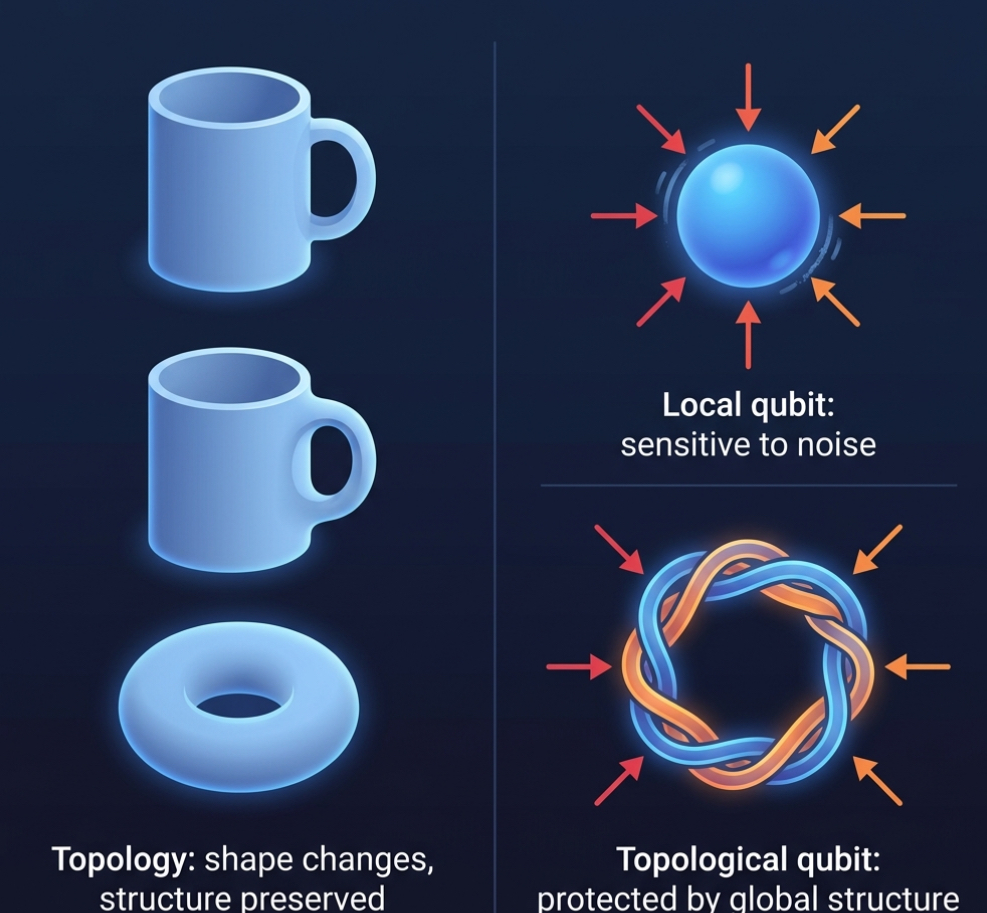
In certain exotic states of matter, similar topological properties can appear in the collective behavior of electrons. These states are known as topological phases. Instead of being defined by local features such as magnetic alignment or crystal symmetry, they are defined by global characteristics of the system. The remarkable consequence is that information encoded in these global structures becomes insensitive to small local disturbances. If noise perturbs a tiny region of the system, it does not immediately change the overall topology.
This is precisely the protection researchers hope to exploit. In a topological quantum computer, the quantum information would not be stored in the local state of a single particle or circuit element. Instead it would be encoded in the collective configuration of quasiparticles known as anyons. These quasiparticles emerge in certain two-dimensional systems where the statistics of particle exchange behave differently from the familiar categories of bosons and fermions. When anyons are moved around one another in space, the quantum state of the system changes in a way that depends on the path taken rather than just the final positions.
This process is referred to as braiding. If the paths of two quasiparticles are traced as they circle each other over time, the resulting trajectories form intertwined strands, similar to braided cords. In topological quantum computing, those braids are not merely visual metaphors; they correspond to mathematical operations acting on the encoded quantum state. The critical feature is that the operation depends only on the topology of the braid itself. Small disturbances in the path do not change the overall braid pattern, which means the quantum gate remains stable even if the motion is imperfect.
If such particles can be created and controlled reliably, quantum gates would be performed by braiding them rather than by applying precisely timed electromagnetic pulses. Errors caused by small fluctuations would become far less damaging because they would not change the global topology of the braid. In principle this could dramatically reduce the burden placed on conventional error-correction techniques.
The theoretical framework for this idea has existed for more than two decades, largely developed through work associated with Microsoft’s Station Q research group and collaborators in condensed-matter physics. What remained uncertain for many years was whether nature would actually provide the kind of quasiparticles required for the scheme. The search for those particles led physicists to one of the most unusual candidates in modern condensed-matter theory: Majorana zero modes.
Majorana Zero Modes, Anyons, and the Physics of Braiding
The idea that quantum computation could be protected by topology depends on a very specific kind of quasiparticle. These objects are not ordinary electrons or photons, and they do not exist as isolated particles in free space. They emerge instead from the collective behavior of electrons inside carefully engineered materials. The particular quasiparticle at the center of Microsoft’s approach is the Majorana zero mode, a concept rooted in a proposal made by Ettore Majorana in 1937[4].
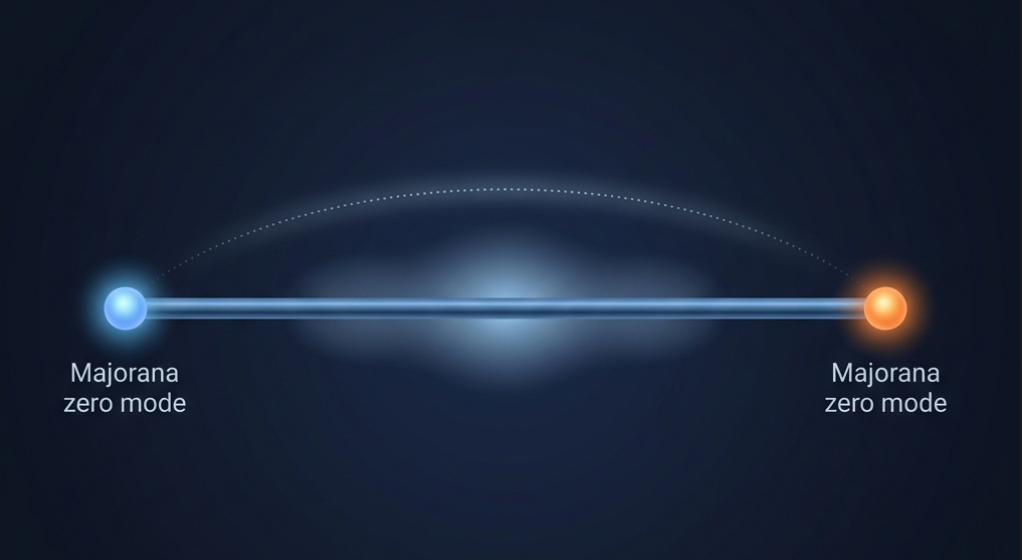
In modern experiments, Majorana zero modes are not fundamental particles but quasiparticle excitations that appear at the boundaries of certain superconducting systems. The most widely studied platform involves semiconductor nanowires, often made from materials such as indium arsenide or indium antimonide, placed in close contact with a superconductor like aluminum. When these hybrid structures are cooled to very low temperatures and exposed to a carefully tuned magnetic field, they can enter a topological superconducting phase. In that phase, Majorana modes are expected to appear at the ends of the nanowire.
What makes these modes unusual is not just where they appear but how they encode information. A single Majorana mode does not represent a complete qubit on its own. Instead, quantum information is stored nonlocally across pairs of Majorana modes. The combined state of two spatially separated modes defines a fermionic parity that can represent quantum information. Because the information is distributed across multiple locations, local disturbances affecting one end of the system are less likely to destroy the encoded state. This nonlocal encoding is one of the core reasons topological qubits are expected to be more resilient than conventional qubits.
The key difference appears in how these modes behave when they are exchanged. In ordinary quantum systems, swapping two identical particles either leaves the wavefunction unchanged or introduces a simple phase factor. For Majorana modes in a two-dimensional topological system, the exchange operation can do something more complex. It can transform the quantum state within a multi-dimensional space of possibilities. This is the defining feature of non-Abelian statistics[5].
To visualize this, it helps to think in terms of worldlines. Imagine tracking the position of each quasiparticle over time. If two particles are exchanged, their paths trace out strands that wrap around each other in spacetime. These strands form a braid. In systems with non-Abelian anyons, the mathematical operation applied to the quantum state depends on the topology of that braid rather than the precise trajectory of each particle. Stretching or distorting the path without changing how the strands cross does not alter the resulting transformation.
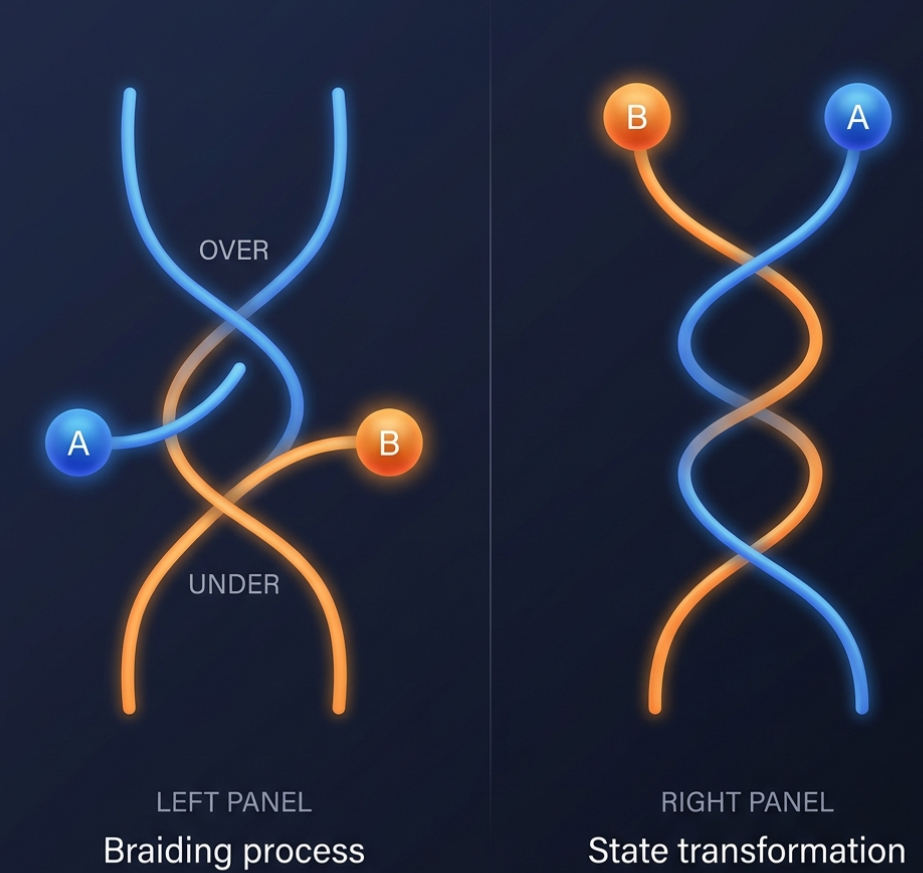
This property has profound implications for quantum computation. In a conventional quantum processor, gates are implemented through precisely timed control pulses applied to qubits. Any small error in amplitude, timing, or environmental interaction can degrade the fidelity of the operation. In a topological system, the gate is defined by the braid itself. As long as the braid is executed correctly at the topological level, small imperfections in the physical implementation do not change the logical operation.
The mathematics behind this behavior connects to structures such as braid groups and the Yang–Baxter equation. The details are highly technical, but the key point is straightforward. Different sequences of exchanges must remain consistent with one another, meaning that distinct paths leading to the same braid produce identical outcomes. This constraint is what gives the system its unusual form of robustness, one that is built into the structure of the operations themselves rather than imposed through external correction.
In practice, physically moving quasiparticles around one another is not always necessary. Many experimental approaches rely on measurement-based braiding, where sequences of parity measurements effectively simulate the exchange of Majorana modes without requiring literal motion. This approach is particularly relevant to Microsoft’s architecture. Instead of dragging quasiparticles through space, the system performs controlled measurements that change how the modes are paired and correlated, achieving the same topological transformation as a braid.
A simple analogy is braiding strands of rope. The exact shape of each strand between crossings does not matter. What matters is the order and structure of the crossings themselves. Similarly, in a topological quantum system, the detailed path taken by a quasiparticle is less important than the overall pattern of exchanges. Noise may distort the path, but as long as it does not alter the topology of the braid, the computation remains intact.
Of course, not all anyons are suitable for universal quantum computation. Some systems, such as those associated with Ising anyons, support a restricted set of operations that must be supplemented by additional techniques to achieve universality. Other theoretical anyon models, such as Fibonacci anyons, would provide a fully universal set of gates through braiding alone, but realizing such systems experimentally remains an open challenge. Microsoft’s approach focuses on Majorana-based systems, which fall into the Ising category and therefore require careful architectural design to achieve a complete computational toolkit.
This is where engineering meets physics. Creating Majorana modes is already a demanding task. Controlling them, measuring them reliably, and arranging them into structures that can perform meaningful computation adds another layer of complexity. Microsoft’s work has focused on building device geometries in which multiple Majorana modes can be combined into a single qubit and manipulated through sequences of measurements that effectively implement braiding operations.
The result is a system where quantum information is encoded nonlocally, operations are performed through topological transformations, and error sensitivity is reduced at the physical level rather than compensated for entirely through software and redundancy. It is an approach that trades immediate scalability for a potentially more stable long-term architecture.
Understanding how Microsoft translates these ideas into an actual hardware platform requires looking at the specific device structures and design choices behind its topological qubits.
What Topological Protection Actually Protects—and What It Doesn’t
It is easy to hear the phrase “topological protection” and assume that it implies a kind of near-immunity to error. That interpretation is part of the appeal, but it overstates what topology actually guarantees. Topology does not remove noise from a quantum system. It changes which kinds of noise matter.
In a conventional qubit, information is stored in a local degree of freedom, such as the energy state of a superconducting circuit or the internal state of an ion. Any small disturbance that perturbs that local state can introduce an error. In a topological system, the information is encoded nonlocally, often across multiple Majorana modes separated in space. Because of this, small local perturbations are less likely to corrupt the logical state. The system becomes insensitive to a wide class of errors that would otherwise be dominant.
However, this protection is not absolute. It depends on maintaining the system within the correct topological phase and preserving the conditions under which the quasiparticles behave as expected. Large perturbations, uncontrolled coupling between modes, or errors in measurement can still disrupt the computation. Even in a topological architecture, readout errors, fabrication defects, and environmental instability remain part of the engineering challenge.
There is also a more subtle limitation. The protection offered by topology applies primarily to operations defined by braiding or its measurement-based equivalents. Additional components required for universal computation, such as certain non-Clifford operations, may not inherit the same level of intrinsic robustness. This means that some form of error correction or supplementary control techniques is still necessary, even in a topological system.
In practice, topological quantum computing is not an escape from the realities of noise, but a redefinition of how that noise interacts with information. It narrows the set of errors that must be actively corrected and shifts part of the burden from software to physics. Whether that shift is sufficient to change the scaling behavior of quantum hardware remains one of the central questions driving current research.
Why Microsoft Is Betting on Braiding
From a physics standpoint, the appeal of topological qubits is clear, but Microsoft’s long-term investment cannot be understood purely as a scientific curiosity. It is a strategic decision shaped by how the company views the scaling limits of existing quantum architectures. While competitors have focused on increasing qubit counts and improving gate fidelity within established platforms, Microsoft has taken a slower and more uncertain path in exchange for a potentially different scaling curve.
The strategy is based on the assumption that fault tolerance should not be treated as a separate layer added on top of fragile hardware. Instead, it should be built into the physical system itself. If quantum information can be encoded in topological states that are inherently resistant to local noise, then the number of physical qubits required to achieve a reliable logical qubit could be dramatically reduced. In practical terms, this is the difference between needing millions of qubits primarily for error correction and needing millions of qubits that are already closer to usable computation.
Microsoft’s work toward this goal has been carried out largely through its Station Q research program, which has focused on both theoretical models of topological quantum computation and the experimental realization of Majorana-based systems. Over the years, the company has invested heavily in materials science, nanofabrication, and device engineering, recognizing that the success of topological qubits depends as much on creating the right physical environment as it does on designing the right algorithms.
The Majorana 1 Processor
The announcement of Majorana 1 in early 2025 marked a turning point in how the broader community engaged with Microsoft’s approach. The processor was described as the first device built around a topological core, incorporating eight qubits constructed from networks of Majorana modes. While eight qubits may appear modest compared to the hundreds reported by other platforms, the significance lies in the underlying architecture rather than the raw count.
According to Microsoft’s description, each topological qubit is formed using a set of Majorana modes arranged within a nanowire network. The device geometry often resembles an H-shaped structure, where segments of semiconductor nanowires are connected and proximitized by superconducting materials. At specific points within this structure, Majorana modes can be created, manipulated, and measured. Four such modes can define a single qubit, with their combined fermionic parity encoding the quantum information.
The use of multiple spatially separated Majorana modes within a single qubit is essential. Because the information is distributed nonlocally, disturbances affecting one region of the device do not immediately destroy the encoded state. This arrangement reflects the core principle of topological protection: the qubit is defined by a global property of the system rather than a local variable.
Measurement-Based Braiding
One of the most distinctive aspects of Microsoft’s architecture is that it does not rely on physically moving quasiparticles through space to perform braiding operations. Instead, it uses sequences of measurements to achieve the same effect. By measuring the parity of different combinations of Majorana modes, the system can effectively change how those modes are paired, which corresponds mathematically to a braiding operation.
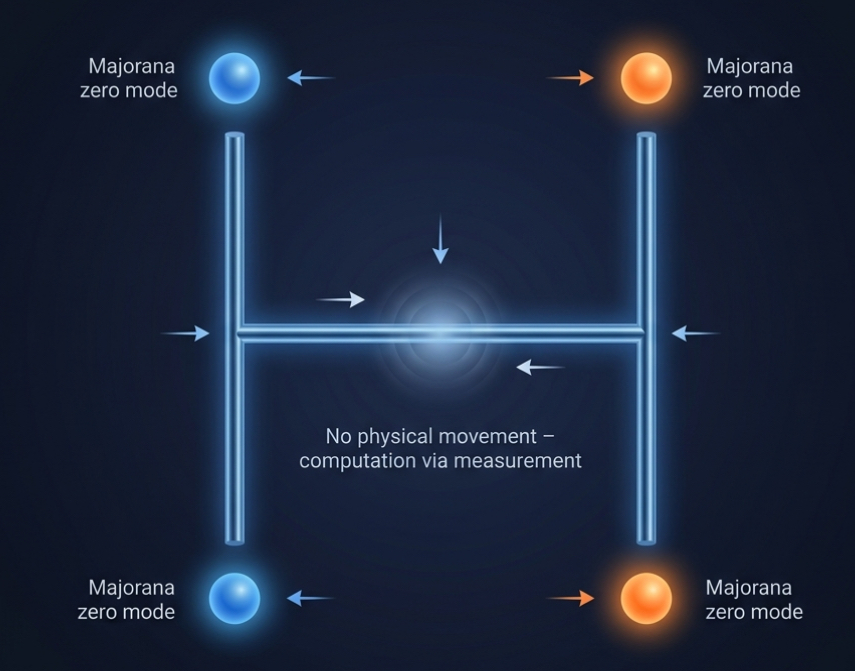
This measurement-based approach offers practical advantages. Physically transporting quasiparticles across a device introduces additional engineering complexity and potential sources of error. By contrast, performing controlled measurements allows the system to remain relatively static while still implementing the necessary topological transformations. In effect, the braiding is realized in the structure of the measurement sequence rather than in literal motion.
The Nature paper associated with the Majorana 1 announcement focused on interferometric measurements that allow the parity of Majorana pairs to be determined in a single shot. Achieving reliable, high-fidelity parity measurements is a crucial step, because these measurements form the foundation of both qubit readout and braiding operations in this architecture.
Topoconductors and Materials Engineering
A less visible but equally important aspect of Microsoft’s approach lies in the materials themselves. The company introduced the term “topoconductor” to describe a class of engineered materials designed to host and control Majorana modes. These materials combine semiconducting nanowires with superconducting layers in a way that allows the system to transition into a topological phase under specific conditions.
Creating such materials is not a straightforward extension of conventional semiconductor fabrication. It requires precise control over interfaces, disorder, and electronic properties at the nanoscale. Small imperfections can obscure or mimic the signatures of Majorana modes, which is one of the reasons experimental verification has been so challenging. Microsoft’s long investment in materials research reflects the understanding that topological quantum computing cannot succeed without a reliable physical platform.
Scaling Toward a Million Qubits
Perhaps the most ambitious aspect of Microsoft’s roadmap is the claim that its architecture could scale to a million qubits on a single chip. This projection is based on the assumption that topological protection will significantly reduce the overhead required for error correction. If each qubit is intrinsically more stable, fewer additional qubits are needed to maintain logical coherence, and the overall system can scale more efficiently.
This contrasts sharply with other approaches, where scaling often implies building larger and more complex cryogenic systems to support increasing numbers of fragile qubits. Microsoft’s vision suggests a more compact and integrated design, although achieving this in practice will depend on continued advances in materials, fabrication, and device control.
Position Within the Broader Quantum Landscape
The differences between Microsoft’s approach and those of other major players can be summarized in terms of trade-offs. Superconducting qubits, used by IBM and Google, offer fast gate operations and relatively mature fabrication techniques but require extensive error correction to achieve fault tolerance. Trapped-ion systems provide high-fidelity operations and long coherence times but face challenges in scaling and control complexity. Photonic approaches avoid some noise sources but introduce their own engineering constraints.
Topological qubits, if realized as intended, could offer a different balance. By embedding error resilience into the physical system, they aim to reduce the need for large-scale error correction. The cost of this potential advantage is the difficulty of creating and verifying the underlying physics. In that sense, Microsoft’s strategy can be seen as a high-risk, high-reward bet on a fundamentally different route to scalable quantum computing.
Whether that bet pays off depends not only on engineering progress but also on the ongoing effort to demonstrate that Majorana-based systems truly exhibit the topological properties required for fault-tolerant computation.
Challenges, Criticism, and the Current State of Evidence
The potential of topological qubits is widely acknowledged, but it has never been a settled story. From the beginning, the central difficulty has not been the theory but the evidence. Majorana zero modes are predicted to emerge under very specific conditions, yet proving that they exist unambiguously in a real device has been one of the most challenging problems in condensed-matter physics over the past decade. Experimental signatures that initially appeared convincing have, in some cases, later been attributed to more conventional effects such as disorder, Andreev bound states, or other non-topological phenomena.
This history has shaped how the community responds to new claims. Each reported observation of Majorana behavior is examined carefully, often with a level of scrutiny that reflects both the importance of the result and the number of previous false positives. The distinction between observing signatures consistent with Majorana modes and demonstrating fully controllable, topologically protected qubits remains significant. Many experiments have reached the former stage without conclusively achieving the latter.
The 2025 announcement of Majorana 1 and the accompanying Nature publication introduced new data based on interferometric measurements of fermion parity in hybrid nanowire devices. These experiments represented an important technical step forward, particularly in demonstrating single-shot measurement capabilities that are essential for any measurement-based braiding scheme. At the same time, the Nature editorial context emphasized that the results did not yet constitute definitive proof of topological qubits in the strongest sense. The measurements were consistent with the expected behavior of Majorana modes, but alternative interpretations had not been entirely ruled out.
This distinction is important because topological quantum computing depends not only on the presence of Majorana modes but on their non-Abelian properties and their ability to support stable braiding operations. Demonstrating non-Abelian statistics experimentally is far more demanding than observing energy signatures or zero-bias conductance peaks. It requires showing that exchanging quasiparticles leads to the predicted transformations of the quantum state, a task that remains at the frontier of current research.
Skepticism within the field is therefore not a rejection of the idea but a reflection of the standards required to validate it. Researchers such as Scott Aaronson have pointed out that even if the underlying physics is correct, competing platforms have accumulated a substantial head start in terms of qubit counts, operational fidelity, and software ecosystems. From this perspective, topological quantum computing must not only work; it must advance quickly enough to offset years of progress made by more conventional approaches.
There is also a practical challenge related to complexity. The materials systems required to host Majorana modes are highly sensitive to fabrication quality and environmental conditions. Achieving reproducible behavior across many devices is essential for scaling, yet even small variations in nanowire composition or interface properties can affect experimental outcomes. This makes large-scale manufacturing a nontrivial problem, even if the underlying physics is validated.
At the same time, recent progress suggests that the field is moving forward in measurable ways. Improvements in device fabrication, measurement techniques, and theoretical modeling have brought experiments closer to regimes where topological behavior can be tested more rigorously. The ability to perform controlled parity measurements, as demonstrated in recent work, provides a foundation for more complex operations that could eventually include full braiding sequences.
The current state of topological quantum computing can therefore be described as cautiously advancing. The fundamental ideas remain strong, and the experimental evidence continues to improve, but the decisive demonstrations required to confirm fully operational topological qubits have not yet been universally accepted. This uncertainty is part of what makes Microsoft’s strategy both risky and potentially transformative.
If the approach succeeds, it could alter the trajectory of quantum computing by reducing the reliance on large-scale error correction. If it fails to deliver on its core promises, it will stand as one of the most ambitious detours in the field’s development. For now, it remains a frontier where theory, experiment, and engineering are still converging.
Real-World Implications and What Comes Next
If topological qubits achieve sufficient control and reliability their proponents expect, the impact would extend well beyond incremental improvements in quantum hardware. The immediate effect would be a shift in how fault tolerance is approached. Instead of treating error correction as the dominant cost of computation, a portion of that burden would be absorbed by the physics of the qubit itself. That change alone could alter the scale at which practical quantum advantage becomes feasible.
In fields such as quantum chemistry and materials science, the ability to simulate strongly correlated systems with high precision remains one of the most anticipated applications of quantum computing. Current classical methods struggle with these problems because the computational cost grows exponentially with system size. Quantum algorithms offer a more natural representation of such systems, but only if the hardware can support sufficiently deep and stable circuits. A platform with lower effective error rates would make these simulations more realistic, moving them closer to practical use rather than theoretical demonstrations.
Optimization problems present another area where fault-tolerant quantum systems could have a measurable impact. Many real-world systems, from logistics networks to energy distribution, involve complex optimization landscapes that are difficult to explore efficiently. Hybrid quantum-classical algorithms have shown promise in this domain, but their effectiveness is limited by noise and circuit depth constraints. A more stable qubit architecture could expand the range of problems that can be addressed meaningfully.
The implications for cryptography are often discussed in broader terms. A sufficiently large and reliable quantum computer would be capable of running algorithms that challenge widely used public-key cryptographic systems. While that outcome depends on reaching a level of scale that is still far beyond current devices, progress toward more stable qubits brings that horizon into clearer focus. At the same time, it reinforces the importance of developing quantum-resistant cryptographic standards.
There is also a less frequently discussed connection to machine learning. Quantum systems are not expected to replace classical AI training methods directly, but they may provide new tools for sampling, optimization, and modeling complex probability distributions. These capabilities could complement existing approaches, particularly in areas where classical methods face limitations in representing high-dimensional systems.
Beyond applications, the pursuit of topological qubits is likely to deepen our understanding of condensed-matter physics itself. The ability to engineer and manipulate topological phases in controlled environments would represent a significant achievement independent of quantum computing. It would confirm the existence of new states of matter and open pathways for further exploration in both theoretical and experimental physics.
Looking ahead, several developments will determine how this field evolves. Continued improvements in device fabrication will be necessary to produce reproducible systems capable of hosting Majorana modes reliably. Experimental demonstrations of increasingly complex operations, particularly those approaching full braiding sequences, will provide stronger evidence for the underlying topological behavior. Scaling from small prototype devices to larger arrays will test whether the architecture can move beyond proof-of-concept toward practical implementation.
Microsoft’s integration of its quantum work into Azure Quantum suggests that the company intends to connect its hardware progress with a broader software and cloud ecosystem. This integration reflects a recognition that quantum computing will not develop in isolation. It will be part of a hybrid landscape where classical and quantum resources interact continuously.
For observers of the field, the most important question is not whether topological qubits are interesting but whether they can be realized at scale. The answer will emerge gradually, through a combination of experimental verification, engineering progress, and independent replication of results. Until then, the approach remains one of the most ambitious and closely watched directions in quantum computing.
References
- Preskill, John.
“Quantum Computing in the NISQ Era and Beyond.”
Quantum 2 (2018): 79.
https://arxiv.org/abs/1801.00862
↩ - Albrecht, S. M. et al.
“Interferometric Single-Shot Parity Measurement in InAs–Al Hybrid Devices.”
Nature (2024).
https://www.nature.com/articles/s41586-024-08445-2
↩ - Microsoft Azure Quantum.
“Microsoft Unveils Majorana 1: The World’s First Quantum Processor Powered by Topological Qubits.”
Microsoft unveils Majorana 1, the world’s first quantum processor powered by topological qubits
↩ - Majorana, Ettore.
“Teoria Simmetrica dell’Elettrone e del Positrone.”
Il Nuovo Cimento, 1937.
https://journals.aps.org/rmp/abstract/10.1103/RevModPhys.80.1083
↩ - Nayak, Chetan, Steven H. Simon, Ady Stern, Michael Freedman, and Sankar Das Sarma.
“Non-Abelian Anyons and Topological Quantum Computation.”
https://arxiv.org/abs/0707.1889
↩
Conclusion
Topological qubits remain one of the most ambitious directions in quantum computing, not because they promise incremental improvements, but because they attempt to change the foundation on which quantum information is built. Instead of relying entirely on layers of error correction to stabilize fragile qubits, the approach seeks to encode information in structures that are inherently resistant to disturbance. The idea that computation can be protected by topology itself remains both elegant and difficult to realize.
Microsoft’s long-term commitment to this path reflects a strategic belief that the current trajectory of quantum hardware may not scale efficiently without a deeper shift in how qubits are constructed. By focusing on Majorana zero modes and braiding-based operations, the company is effectively betting that stability at the physical level can reduce the enormous overhead required for fault tolerance. If that assumption proves correct, it could compress timelines that otherwise extend far into the future.
At the same time, the challenges remain significant. Demonstrating clear, reproducible evidence of topological qubits and their non-Abelian behavior is still an open task. The physics is subtle, the experiments are demanding, and the standards of proof are necessarily high. Progress continues, but it is measured and carefully scrutinized.
Within the field, the importance of this approach lies not only in whether it succeeds, but in what it reveals about the nature of quantum systems themselves. The pursuit of topological qubits has already expanded the boundaries of condensed-matter physics and deepened our understanding of how quantum information can be encoded and manipulated.
Whether braiding ultimately becomes the dominant paradigm or remains one of several competing approaches, it has already changed how researchers think about the relationship between physics and computation. That alone makes it one of the most important ideas shaping the future of quantum technology.
Frequently Asked Questions About Topological Qubits and Microsoft’s Braiding Approach
What are topological qubits and why are they considered more stable?
Topological qubits store quantum information in non-local properties of a system rather than in the state of a single particle. Because the information depends on the global configuration of quasiparticles such as Majorana modes, small local disturbances are less likely to corrupt the state. This provides a form of intrinsic protection against noise that differs from conventional error correction approaches.
How does braiding anyons perform quantum computation?
In systems hosting non-Abelian anyons, exchanging two quasiparticles changes the quantum state in a predictable way. The sequence of exchanges forms a braid, and the resulting transformation depends on the topology of that braid rather than the exact path taken. These braid operations act as quantum gates, allowing computation to be performed through controlled exchanges of quasiparticles.
Why is Microsoft investing in topological qubits instead of scaling conventional qubits?
Microsoft’s strategy is based on the idea that current qubit technologies may require extremely large overhead for error correction. By developing topological qubits that are inherently more resistant to noise, the company aims to reduce that overhead and enable more efficient scaling toward fault-tolerant quantum computing, even if progress at the early stages is slower.
Have topological qubits been fully proven experimentally?
Evidence for Majorana-based systems has improved significantly, but the existence of fully controllable, non-Abelian topological qubits has not yet been universally accepted. Experimental results, including recent interferometric measurements, are consistent with theoretical predictions, but further validation is required to confirm topological behavior beyond alternative explanations.
What is the significance of Microsoft’s Majorana 1 processor?
The Majorana 1 processor represents an early attempt to build a quantum device around topological principles using Majorana modes. While it operates at a small scale, its importance lies in demonstrating key components such as parity measurement and device architecture that could support larger, more stable quantum systems if the approach continues to develop successfully.